


Process control is the practice of measuring how a process performs, comparing the result with a defined standard, and correcting deviations before they create errors, risk, or waste. In industrial systems, that may mean regulating pressure or temperature. In business operations, it means keeping recurring work inside the limits your team has agreed to follow.
Your body does this constantly. When your temperature rises, it detects the deviation and responds by sweating until you return to a safe range. Organizations need the same feedback loop: a clear standard, reliable evidence, a way to spot exceptions, and corrective action that brings work back under control.
This guide answers six practical questions:
With adequate process control, organizations can perform efficiently, effectively, and safely. Without it, they can miss opportunities, make costly mistakes, and struggle to keep recurring work consistent. Process control can cut costs by preventing avoidable defects and rework. Controls that cut costs eliminate repeated corrections while also helping teams eliminate errors before they reach a customer, auditor, or hazardous operating condition.
- What is process control?
- What are the two types of process control?
- Who uses process control and what do they use it for?
- Why should organizations use process control?
- What happens if you do not control processes?
- How can you implement process control with Process Street?
What is process control?
Process control keeps the output of a process within an acceptable range. It is not passive monitoring. Monitoring tells you what happened; control uses that evidence to intervene when performance moves outside the standard. The NIST Engineering Statistics Handbook describes this distinction as the move from observing a process to taking action that changes it.
If we strip it back to its bare bones, process control is about controlling processes to make sure that performance does not deviate from set standards. It involves continuously monitoring a process to identify abnormalities, taking immediate action to correct those abnormalities, and returning the process to its optimal state. Its purpose is to control how a product is made or how an organization is run so that everything operates safely and at the desired level. The result is better quality, fewer mistakes, and increased efficiency.
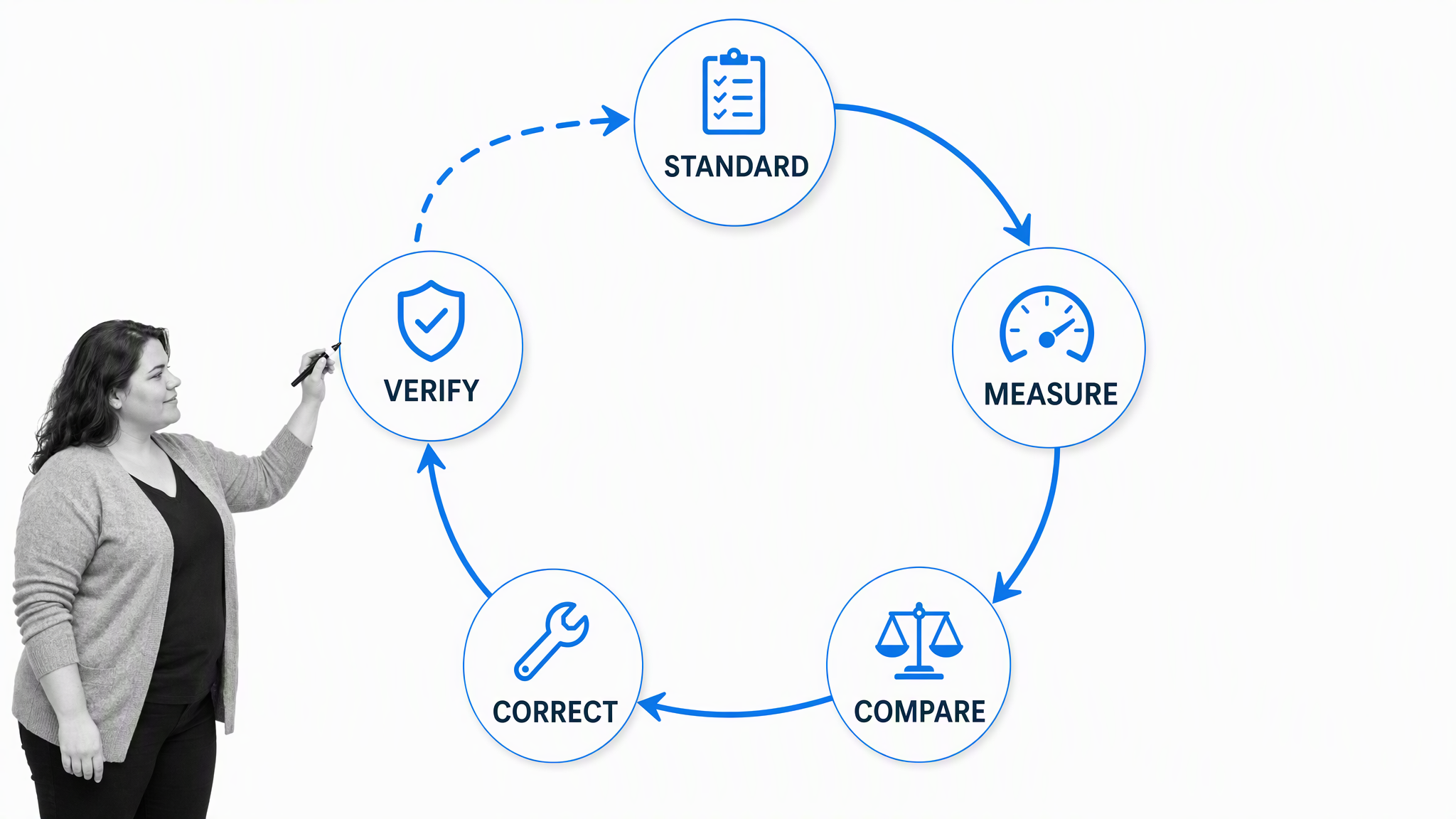
A useful control loop has five parts:
- Define the standard. State the result, limit, policy, or quality requirement the process must meet.
- Measure actual performance. Capture the data, evidence, approvals, and task history that show what happened.
- Compare the result. Check actual performance against the permitted range.
- Correct the deviation. Assign an owner, escalate the exception, stop unsafe work, or route the case for approval.
- Verify and improve. Confirm the correction worked, then change the process when the standard or control itself needs improvement.
The same loop works in a chemical plant, a customer onboarding process, a compliance review, or an employee procedure. The variables differ, but the discipline is the same: define what good looks like, collect evidence, detect exceptions, and act before the deviation becomes normal.
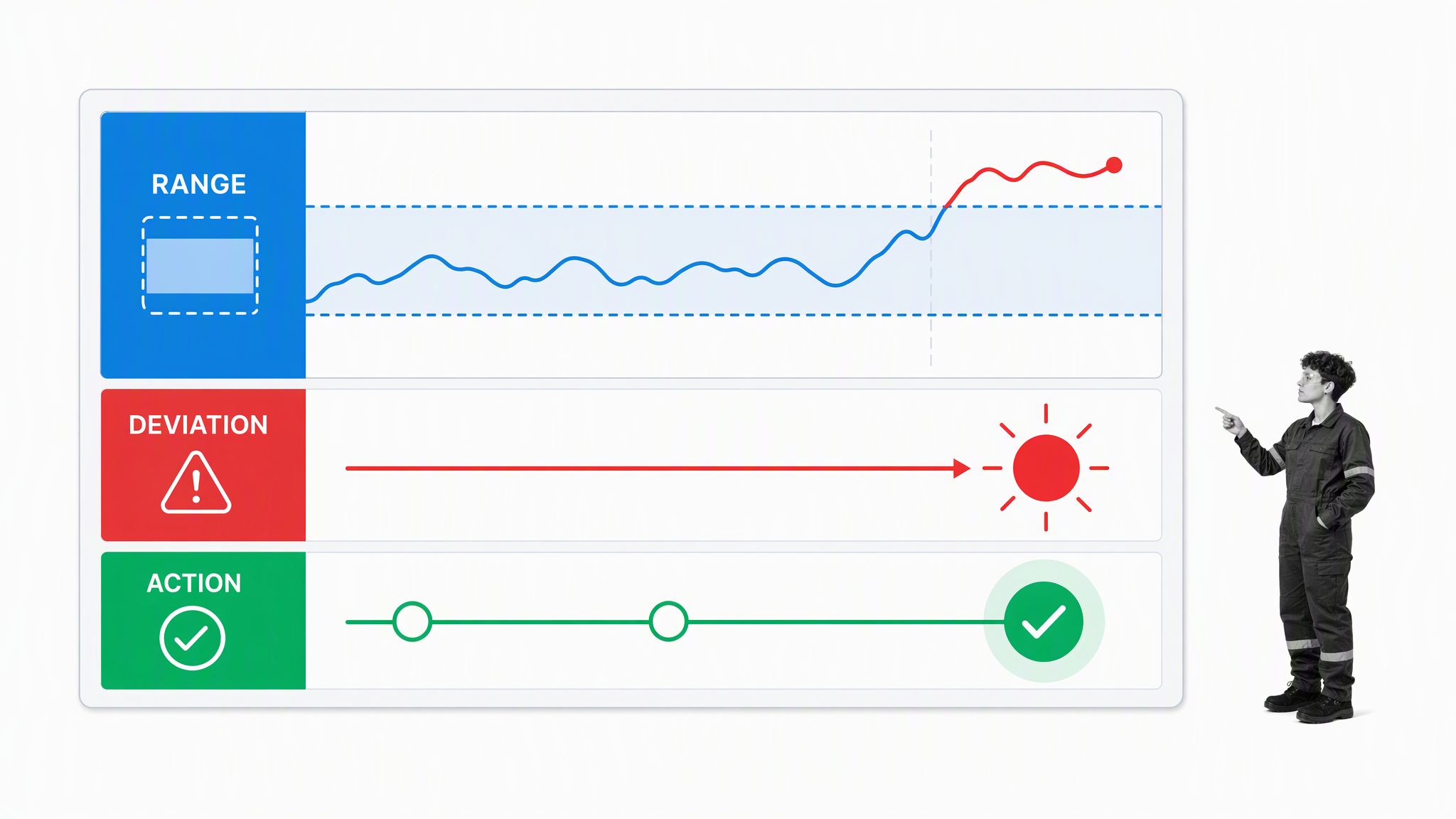
Every control also needs a practical boundary. Identify the process input, the desired output, the variable you can measure, and the action available when the result moves outside tolerance. Then decide how quickly the control must respond. A safety limit may require an immediate stop, while a rising cycle time may call for a weekly review and an improvement plan. Without that boundary, teams can collect plenty of data without knowing when or how to intervene.
What are the two types of process control?
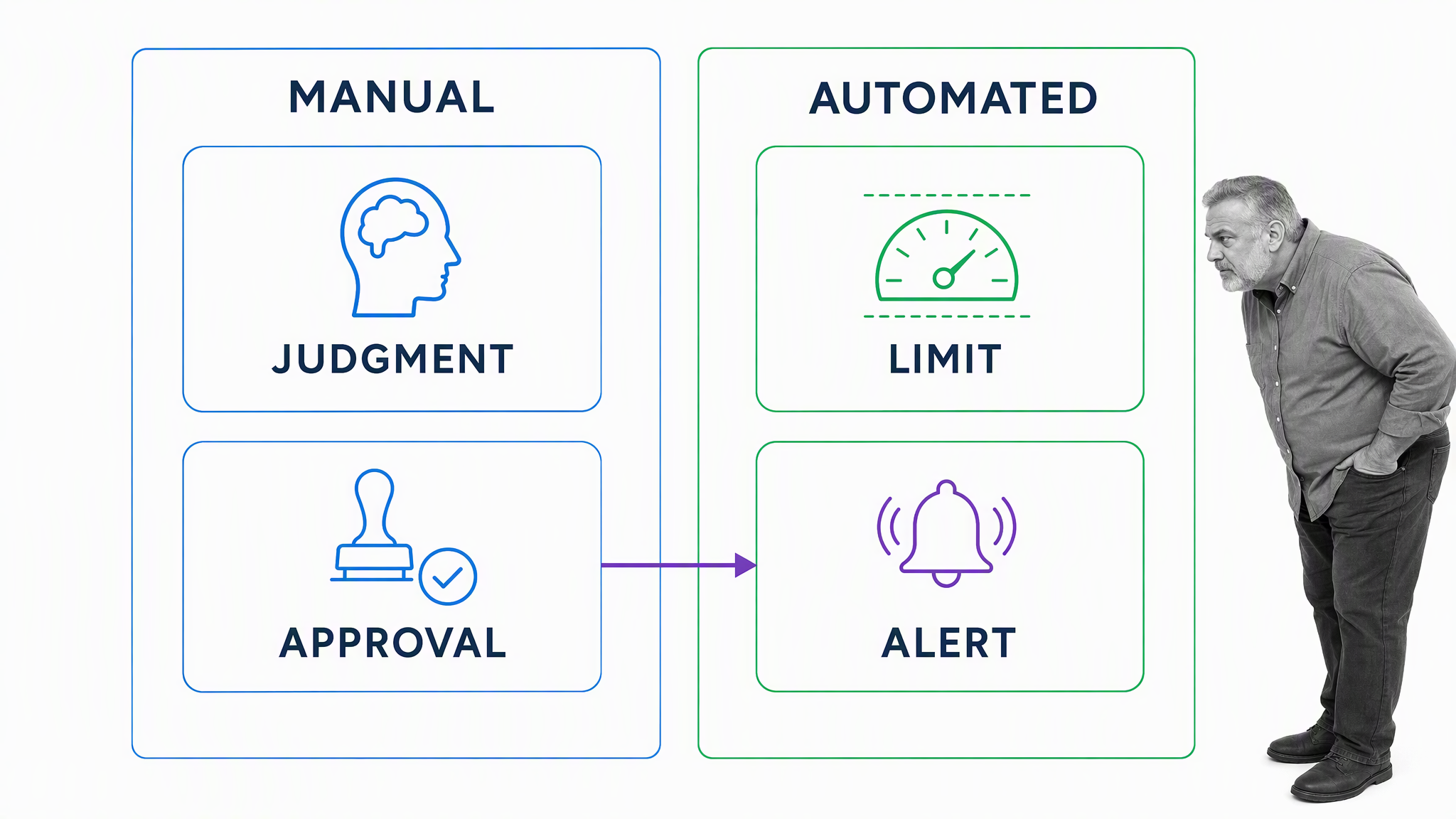
The two broad types are manual process control and automated process control. Strong operations usually combine both.
- Manual process control is appropriate when a decision requires judgment, context, or discretion. An employee disciplinary process is a good example. The standard and evidence should be clear, but a qualified person still needs to review the circumstances and approve the response. Guidance on manual and automated controls makes the same distinction: some controls depend on human judgment.
- Automated process control is appropriate when a system can detect a defined condition and respond consistently. It can flag a value outside its permitted range, prevent a workflow from advancing without required evidence, assign an exception, or trigger an escalation.
Automation does not eliminate human control. It makes routine enforcement dependable, then brings people into the process for exceptions, approvals, and decisions that need expertise.
Manual process control is used when judgment or discretion is required. An employee disciplinary process is a useful example: every employee and circumstance is different, so a one-size-fits-all response may not work. The process can be manually adjusted to fit the case while still requiring consistent evidence and authorization. Automated process control is used to minimize human error. Processing plants and manufacturing operations use it to achieve a level of consistency and safety that manual process control alone cannot provide.
Choose the control type by asking three questions. First, can the condition be expressed as a reliable rule? Second, does the system have trustworthy data at the moment a decision is needed? Third, what is the consequence of a false positive or false negative? Automate stable, repeatable checks such as required fields, thresholds, deadlines, and routing rules. Keep people responsible for ambiguous cases, competing risks, sensitive judgments, and approvals with material consequences. When possible, design a clear handoff so an automated alert reaches a named person with the evidence needed to decide.
Who uses process control and what do they use it for?
Process control is essential in continuous and batch industries. Chemical processing, power generation, food production, pharmaceuticals, oil refining, and manufacturing all depend on measured variables and defined limits. The International Society of Automation connects process automation and control with consistency, efficiency, safety, and reliable operation.
Process control is used extensively in industries where materials or products are produced continuously, without interruption. Organizations that process chemicals, generate electricity, or refine oil rely heavily on automated process control to keep operations running within specified limits, maximize profitability, ensure quality, and prioritize safety. Although it is widely used in manufacturing and engineering, the same discipline can and should be used by any organization that needs to operate consistently at an optimum level.
The same principle applies to service and knowledge work. Financial teams control payment approvals and reconciliations. Healthcare teams control patient handoffs and documentation. HR teams control onboarding, access changes, and employee investigations. Security teams control incident response and evidence collection. Quality and compliance teams use controls to make sure required reviews happen, exceptions are documented, and corrective actions reach an accountable owner.
A control is useful when a process has a meaningful standard and a meaningful consequence for missing it. The consequence might be physical harm, a defective product, rework, an audit finding, a delayed customer, or an unauthorized decision. The more important the outcome, the less the organization can rely on memory and informal follow-up.
The people who own the work should help design its controls. Operators know where exceptions actually occur, process owners know the intended result, subject-matter experts understand the risk, and leaders decide what level of exposure is acceptable. In regulated work, compliance or quality teams can test whether the control is specific, repeatable, and supported by evidence. A control imposed without operational input may look complete on paper while creating workarounds in practice.
Why should organizations use process control?
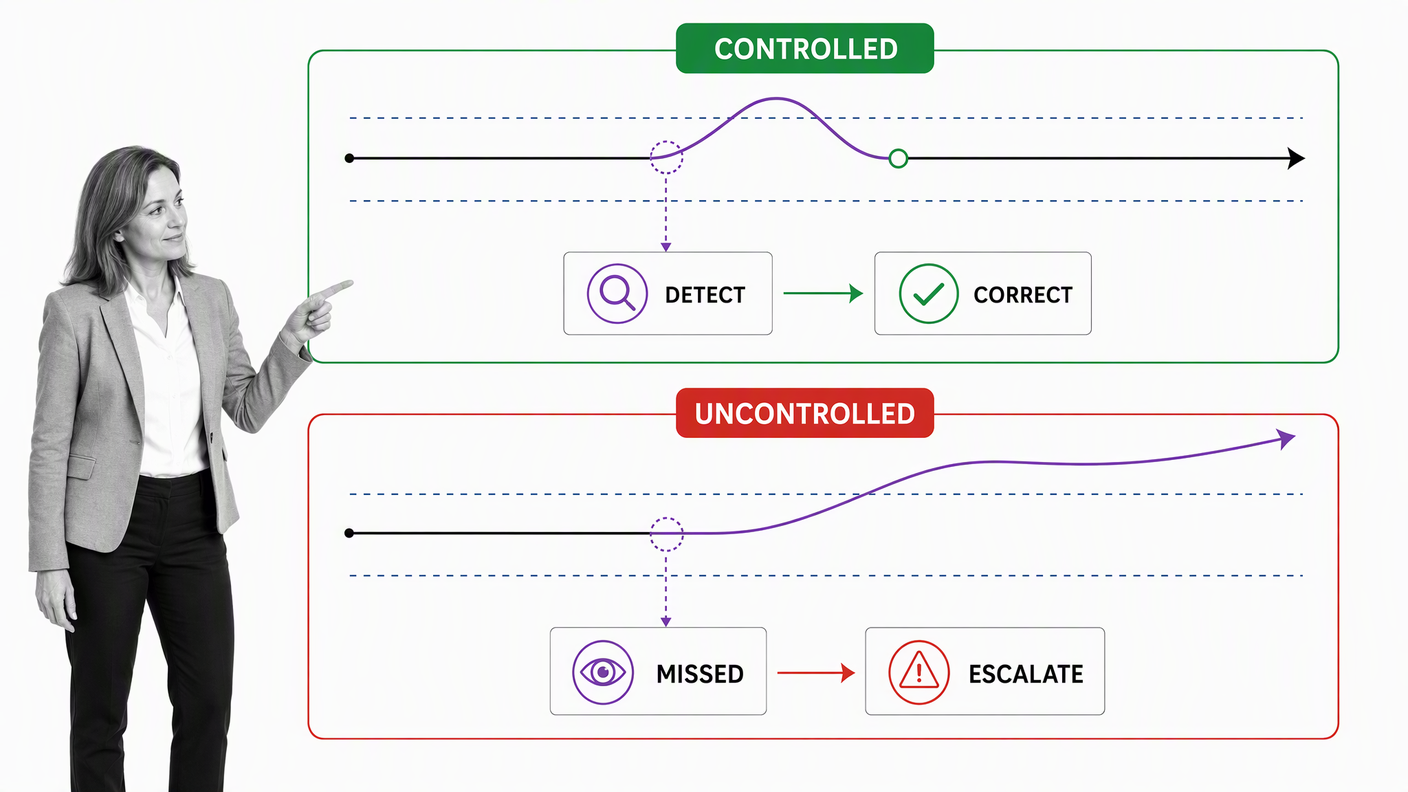
Organizations use process control to keep work safe, consistent, efficient, and accountable. A good control catches a deviation early enough to prevent a larger failure. It also creates evidence that the process was followed, shows where work is slowing down, and reveals when the standard itself needs to change.
Without adequate and reliable process controls, an unexpected process occurrence cannot be monitored, controlled, and eliminated. Reliable controls do more than produce reports. They warn an owner about abnormalities, reduce human error and inefficiencies, and prompt the necessary corrective actions while there is still time to protect the outcome.
- Quality: outputs stay within defined requirements instead of depending on individual habits.
- Safety: hazardous conditions trigger inspection, escalation, or shutdown before exposure grows.
- Cost: teams reduce avoidable rework, defects, delays, and repeated manual follow-up.
- Compliance: approvals, timestamps, owners, and evidence make the control testable.
- Improvement: recurring exceptions show where the process, training, staffing, or standard needs attention.
Methods such as PDCA, root-cause analysis, and the right quality control tools help teams turn that evidence into corrective and preventive action. Process control supplies the feedback. Continuous improvement uses it to make the next run better.
Effective controls should be proportionate to the risk. Adding an approval to every step can slow work without improving the outcome. A better approach is to put preventive controls at the points where errors are costly or hard to reverse, then use detective controls to surface patterns that no single transaction reveals. Review the control periodically, too. A check that once reduced risk can become redundant after a system change, while a new process variation may require a different threshold or owner.
What happens if you do not control processes?
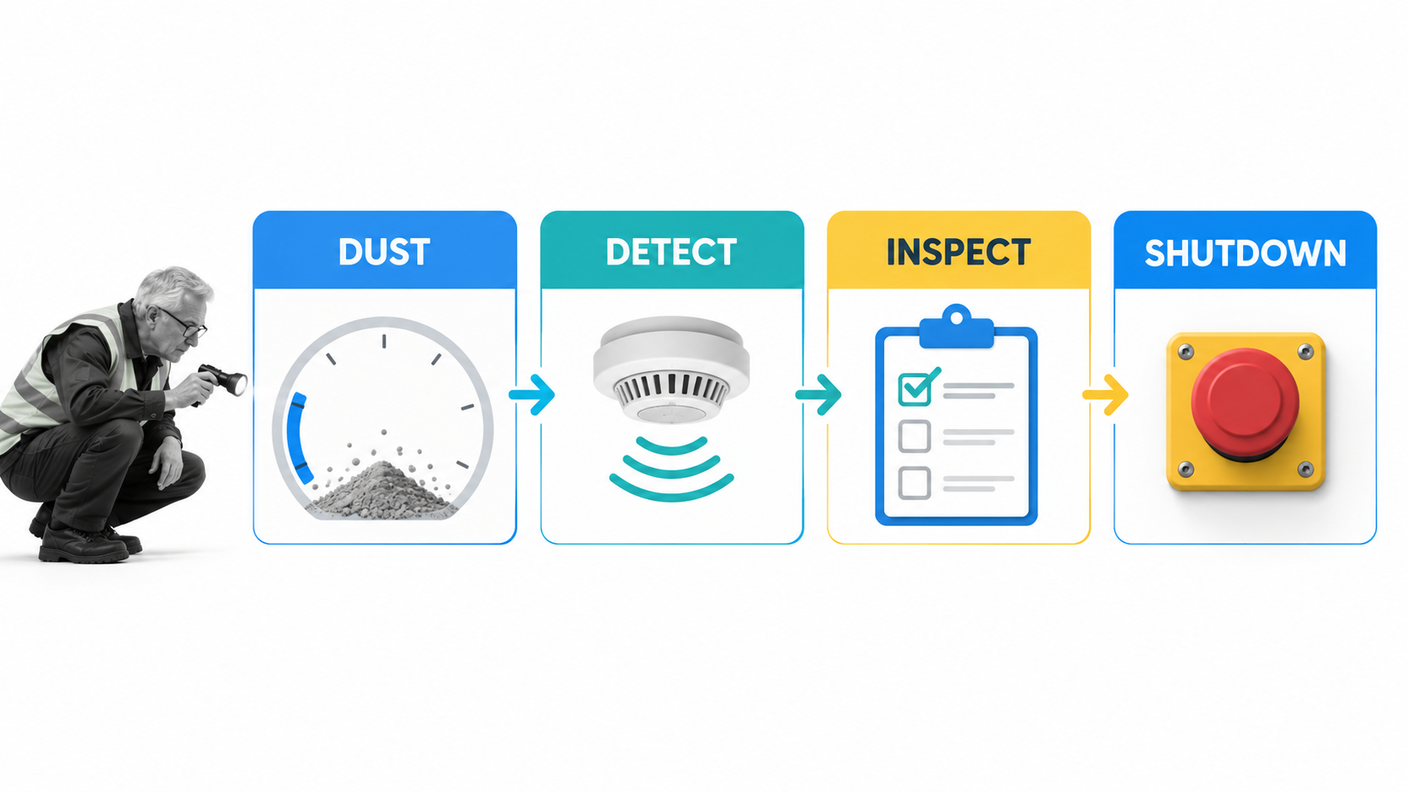
The Imperial Sugar refinery disaster shows how repeated deviations can become accepted practice. On February 7, 2008, a series of combustible sugar-dust explosions at the Port Wentworth, Georgia refinery killed 14 people and injured 36, according to the U.S. Chemical Safety and Hazard Investigation Board final report.
It was around 7:15 p.m. on a cold February evening at a sugar refinery that converted raw sugarcane into granulated sugar. During the sugar packaging process, remnants of sugar had accumulated in the corners and enclosed spaces around a steel conveyor belt. Sugar dust is highly combustible, so it should not have been allowed to accumulate anywhere in the factory, especially inside enclosed equipment.
Investigators found widespread sugar-dust release and accumulation, inadequate equipment design and maintenance, weak housekeeping controls, and an enclosed conveyor where dust reached an explosive concentration. The report concluded that an overheated bearing most likely ignited the first explosion. That event triggered secondary explosions as accumulated dust became airborne.
A deadly combination of accumulated sugar dust, enclosed equipment, and inadequate controls allowed the first explosion to propagate. The initial blast led to another, and then another, until large parts of the factory were ablaze. Proper process controls should have detected and removed the accumulated sugar, identified and fixed faulty equipment, and allowed the packaging process to continue safely.
The danger was not invisible. The refinery had experienced smaller fires and dust incidents before the disaster. When deviations recur without a strong corrective response, people begin to treat them as normal. That is normalization of deviance: a lowered standard becomes routine because the worst consequence has not happened yet.
Over the years, the sugar factory had experienced multiple smaller explosions caused by accumulated sugar catching fire. Because those incidents had not caused fatalities, serious injuries, or catastrophic damage, it became easier to turn a blind eye to lower standards until the lowered standards became normal practice. Complacency and normalization of deviance meant that necessary actions were not taken even though proper process control would have identified the danger.
Proper controls would have required effective dust collection and housekeeping, equipment inspection and maintenance, documented accountability, and a shutdown response when conditions exceeded safe limits. The lesson reaches beyond manufacturing. Missed approvals, incomplete records, ignored security alerts, and repeated policy exceptions follow the same pattern. A small deviation becomes a systemic failure when nobody owns the intervention.
The Flixborough chemical plant explosion, covered in our HAZOP guide, offers another example of why hazard identification and process control must work together.
How can you implement process control with Process Street?
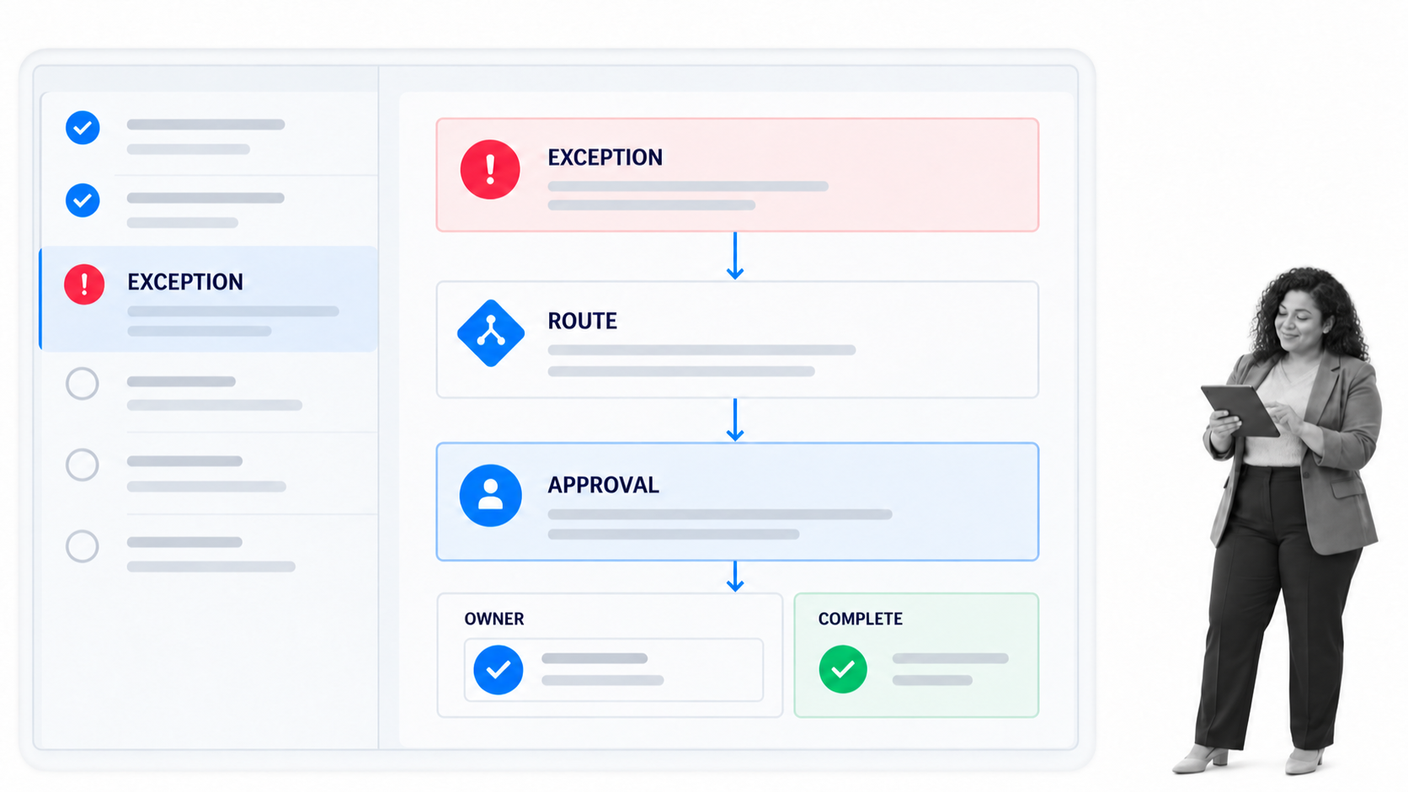
Process Street is a single Compliance Operations Platform. Its Docs and Ops capability areas, together with built-in AI, connect the procedure that defines the standard with the workflow that executes it. That gives teams one closed loop for documenting requirements, assigning work, enforcing controls, capturing evidence, and improving the process.
Define the standard in Docs
Start with the policy, SOP, or work instruction that defines the expected outcome. Version control, approvals, review cycles, and ownership keep that source of truth governed. When the standard changes, teams can update it deliberately instead of relying on old copies and tribal knowledge.
A clear standard matters because a control can only identify deviation when the desired state is explicit. For a client onboarding process, that might include required documents, approval thresholds, due dates, owners, and evidence that access was configured correctly.
Using a workflow to onboard a new client allows you to control what tasks are done, when they are done, and how they are done so that the whole process goes smoothly and the client gets a consistent experience. Documenting the process in this way also supports continuous improvement. By analyzing the workflow regularly, owners can find redundant steps, locate avoidable delays, and identify where efficiencies can be made.
Open the Client Onboarding for a Marketing Agency workflow.
Execute and enforce the process in Ops
Turn the standard into a workflow that assigns tasks, collects structured information, enforces task order, routes conditions, requests approvals, and escalates overdue work. A workflow run creates a current record of who did what, when it happened, what evidence they provided, and which exceptions remain open.
Controls can be preventive or detective. A required field or approval can stop incomplete work from advancing. Conditional logic can route a high-risk case to a specialist. Due dates, assignments, and notifications can expose stalled work. Reports help owners monitor workflow activity and patterns across runs.
You can set up notification triggers to alert an owner when something needs attention, a task must be completed, or work is overdue. To prevent mistakes, approval tasks can automatically send consequential work to an authorized reviewer. Task order, conditional routes, and required evidence help make sure tasks are done in the right order and at the right time.
Begin with one consequential process rather than trying to control every activity at once. Name its owner, map the expected sequence, define the acceptable range, and identify the evidence that proves each critical step happened. Test the workflow with common exceptions before rollout. After launch, review missed deadlines, rejected approvals, reopened work, and repeat deviations. Those signals show whether the control is working or simply moving the problem to a different step.
Open the Process for Optimizing a Process workflow.
Use evidence and built-in AI to improve the control
Control is not finished when a task is checked off. Review exceptions, delays, approvals, and audit history to see whether the process is working as intended. Built-in AI can help surface risk, draft or improve workflows, and identify opportunities to tighten execution while people retain oversight of consequential decisions.
Process Street has direct, universal integrations to 5,000+ systems. Need a new one? An AI agent builds it on the fly. Native Automations also support custom integrations, our API, or webhooks, letting a workflow exchange data with systems of record and trigger action without making a third-party connector the center of the control design.
Open the Master SOP Structure workflow.
Related process control articles
- Process improvements: A practical toolkit
- How to get quality control right
- PDCA: Eliminate errors in processes and products
- The benefits of business process documentation
- How to automate approval processes
- How to build a risk management process
Process control is not an optional layer added after work is designed. It is the mechanism that keeps work inside safe, efficient, and auditable limits. Define the standard, observe the process, correct deviations, and use the evidence to improve the next run.
Your body already follows that pattern. The organizations that control their processes deliberately can do the same: respond early, recover quickly, and keep small deviations from becoming expensive errors.