


Turn every policy into automated workflows with built-in enforcement and audit-ready proof.



Project Approval Process Made Easy: 5 Steps & Best Practices

A project approval process keeps promising ideas from turning into expensive confusion. It gives every request the same path: capture the need, check the business case, route the right reviewers, document the decision, then move approved work into execution.
The point is not bureaucracy. The point is control. A clear approval process helps teams say yes faster when the work is worth doing and say no earlier when the request lacks budget, ownership, risk coverage, or strategic fit.
This guide explains the project approval process, the core steps, practical examples, and how to manage approvals in a workflow system instead of scattered emails and spreadsheets.
- What is the project approval process?
- How does a project approval process work?
- What should an approval request include?
- Project approval process examples
- Project approval process best practices
- How Process Street helps manage project approvals
- Project approval process FAQs
What is the project approval process?
The project approval process is a structured workflow for reviewing and authorizing proposed work before it starts. It defines what information must be submitted, who has decision authority, what criteria matter, and what happens after approval or rejection.
A strong process combines project governance with practical workflow design. PMI describes project governance as a way to keep projects aligned with the business case, change control, risk analysis, quality, cost, schedule, and scope tracking. That is the level of discipline an approval process should create before a team commits resources. See PMI on project governance.
The same idea applies at the workflow level. TechTarget defines a workflow as the series of activities required to complete a task, with each step connected to the step before and after it. A project approval process is that workflow applied to the decision to start, fund, change, or stop a project. See TechTarget on workflow structure.
The approval process should answer five questions clearly:
- What problem or opportunity does the project address?
- What outcome, budget, timeline, and scope are being requested?
- Who reviews the request, who advises, and who makes the decision?
- What evidence is required before work can start?
- Where is the approval history stored for later audit or review?
How does a project approval process work?
Most project approval workflows follow five practical stages. The names can vary by company, but the control points should stay consistent.
Project request intake
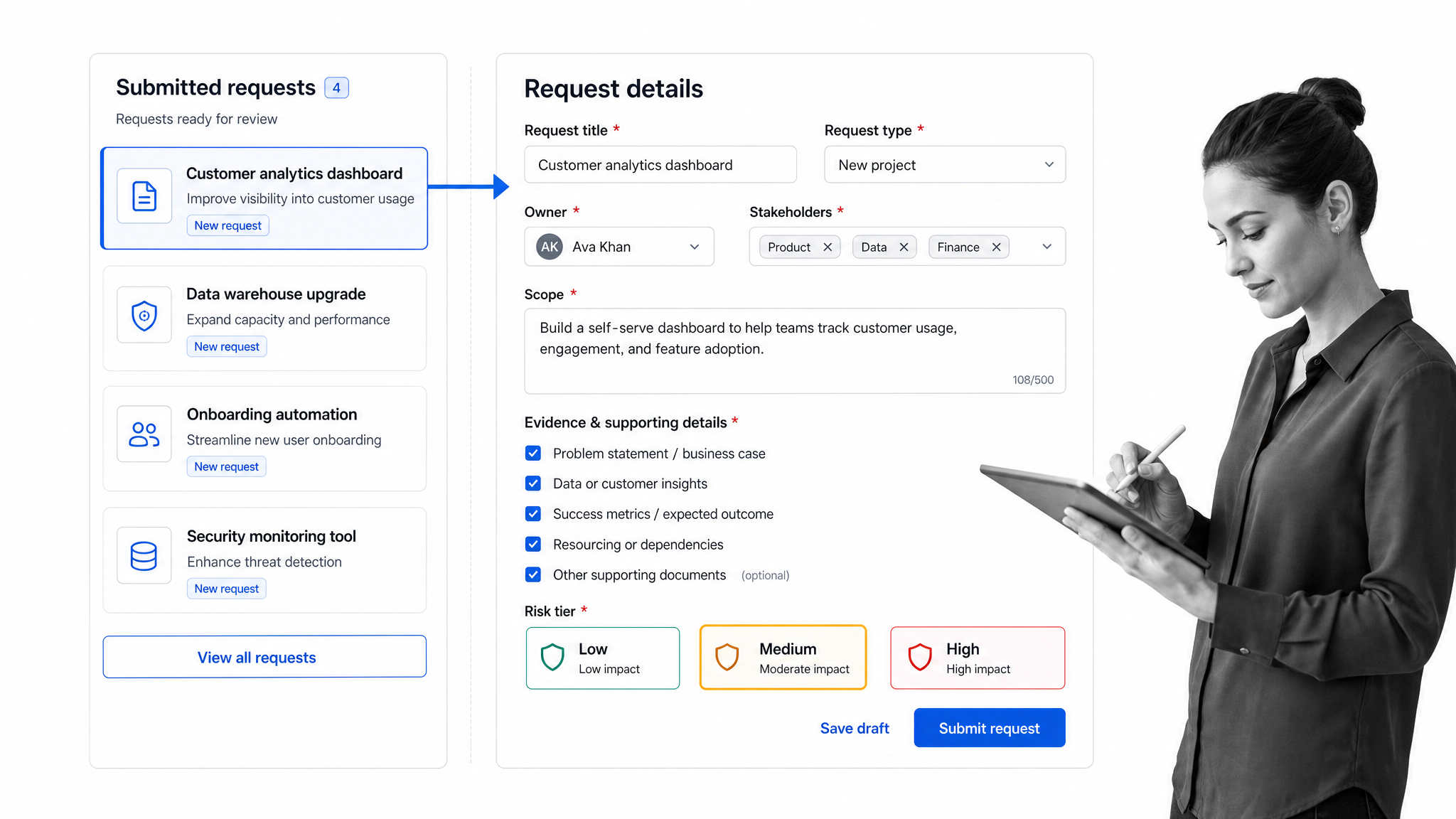
The process starts with a standardized request. The requester explains the problem, desired outcome, business owner, estimated budget, timeline, dependencies, and risks. Standardized intake prevents reviewers from comparing incomplete requests or chasing missing context after the review has started.
Atlassian recommends mapping the current approval workflow before optimizing it, including every stage from initiation to final decision. That same mapping discipline helps teams find duplicate reviews, unclear ownership, and bottlenecks before they become normal operating behavior. See Atlassian on approval process workflows.
Business case and feasibility review
Reviewers check whether the request is worth doing and whether the organization can actually deliver it. This is where you test strategic fit, expected value, resource availability, technical feasibility, compliance exposure, and implementation risk.
A useful review does not need a long business case for every request. It needs enough evidence for the decision at hand. Small improvements may need a short form and one approver. Capital-heavy, customer-facing, or regulated work may need a deeper review before it reaches an executive.
Approval matrix and decision rights
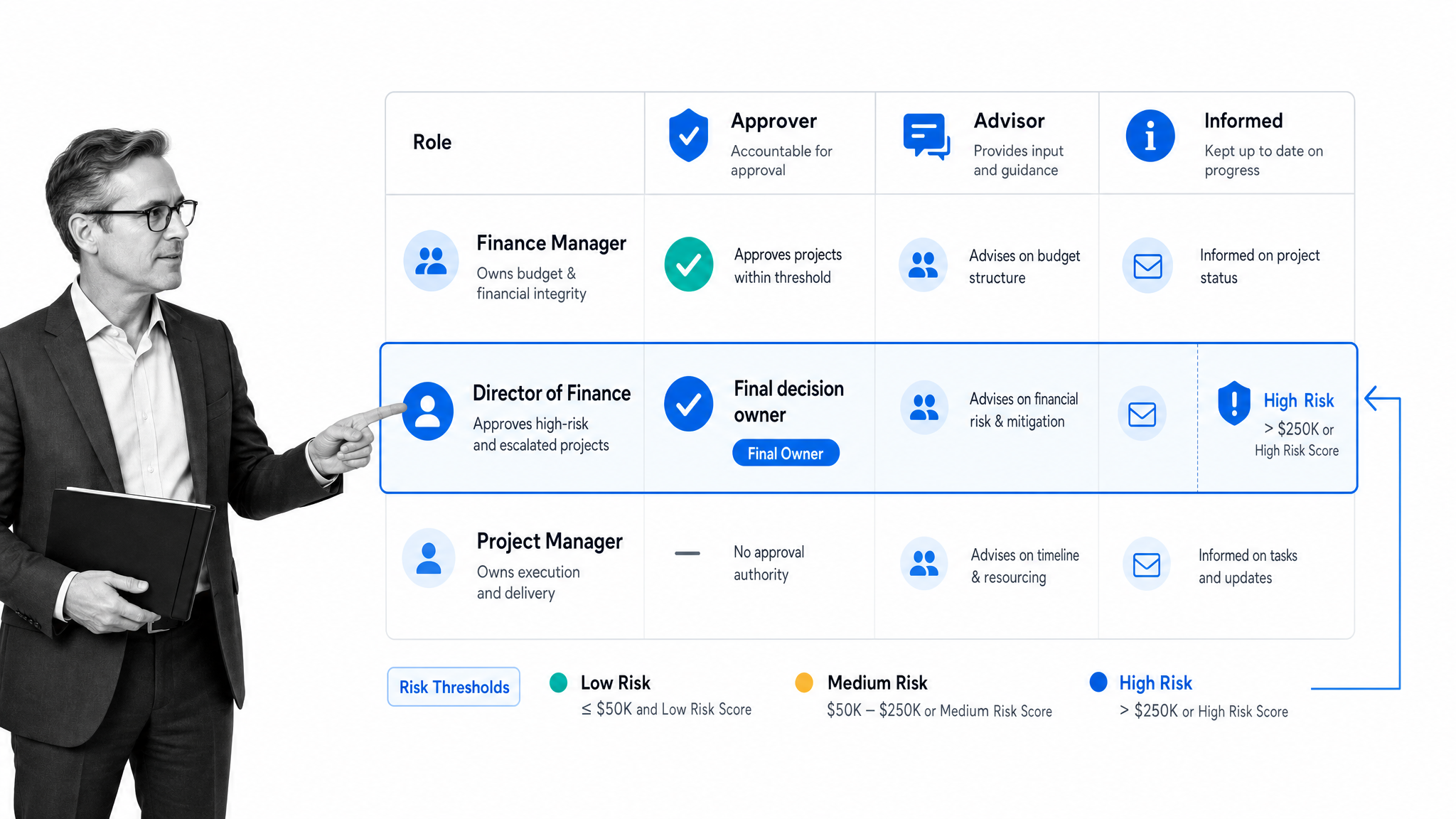
The approval matrix defines who decides, who advises, who is informed, and who owns execution after approval. Without this matrix, every project becomes a negotiation over authority. With it, the request moves to the right people by default.
McKinsey research on decision making found that decision time is often used ineffectively and that faster, higher-quality decisions are tied to clearer practices. A project approval process should reduce ambiguity, not add meeting layers. See McKinsey on decision making in urgent environments.
Decision and evidence capture
The decision should be explicit: approved, rejected, returned for more information, deferred, or conditionally approved. Capture the reason, approver, timestamp, conditions, supporting files, and next owner. This creates a defensible record if priorities change, risk questions arise, or someone asks why a project moved forward.
Handoff to execution
Approval is not the finish line. It is the handoff from evaluation to execution. The approved project should move into a project plan, workflow run, implementation checklist, or portfolio system with the approved scope and decision conditions intact.
What should an approval request include?
A project approval request should be short enough to complete and structured enough to support a real decision. The reviewer should not have to infer the business case from a vague paragraph or an attached slide deck.
Use these fields as a baseline:
- Request title and project owner
- Problem, opportunity, or compliance need
- Expected outcome and success criteria
- Scope, exclusions, and assumptions
- Estimated timeline and target launch window
- Budget, tools, vendors, and internal resource needs
- Dependencies on other teams or systems
- Risk, compliance, security, or legal considerations
- Stakeholders who must approve, advise, or be informed
- Evidence files, links, or notes that support the request
The request should also define what happens if a reviewer rejects it. Does the project stop, route back to the owner, trigger a corrected business case, or escalate to another approver? Defining this path early prevents approval loops from turning into informal status chasing.
Project approval process examples
A project approval process should match the risk and complexity of the work. Here are two examples that show the difference between a controlled process and a weak process.
Good example: software feature approval
A product team wants to release a customer-facing feature. The intake form requires the product owner to define the customer problem, affected accounts, expected outcome, release risk, compliance considerations, engineering estimate, support impact, and launch owner.
- Product manager submits the feature request with scope, evidence, and success criteria.
- Engineering reviews feasibility and flags implementation risk.
- Design and customer success review customer impact.
- Security or legal reviews the request if customer data, contractual commitments, or regulated workflows are affected.
- Leadership approves, rejects, or requests changes based on the business case and risk profile.
- Approved work moves into the execution workflow with the decision record attached.
This process works because every reviewer has a defined role. The approval is tied to evidence, not personal preference, and the handoff to execution preserves the scope that was approved.
Weak example: marketing campaign approval
A marketing team proposes a campaign in a chat thread. The account manager approves the idea informally, a client asks for changes, creative work begins, legal review happens late, and several stakeholders add feedback after launch dates have already been promised.
The problem is not that the campaign needed review. The problem is that the process had no intake standard, no decision rights, no risk screen, and no single record of what was approved. That creates rework, conflict, delays, and preventable compliance exposure.
Project approval process best practices
Set approval criteria before review starts
Reviewers should know how the project will be judged before they see the request. Common criteria include strategic fit, customer impact, cost, risk, resource availability, urgency, compliance exposure, and expected return.
Separate advisors from approvers
Not every stakeholder should approve. Some people advise, some are informed, and a smaller group decides. If everyone has veto power, approvals slow down and accountability disappears.
Use thresholds instead of one universal process
A lightweight request should not follow the same approval path as a high-risk initiative. Build thresholds based on budget, customer impact, data sensitivity, compliance exposure, and cross-functional dependency.
Keep the approval record with the work
Approval records lose value when they live in email threads, chat messages, or disconnected files. Store the decision, comments, conditions, and evidence beside the workflow that executes the work.
Review bottlenecks regularly
If every request waits on the same person, the process is not controlled, it is blocked. Review approval cycle time, rejection reasons, missing-field patterns, and escalation volume. Then update the workflow, not just the people using it.
How Process Street helps manage project approvals
Process Street turns approval steps into governed workflows. Instead of asking reviewers to manage approvals across email, documents, and chat, teams can build approval tasks directly into the process that runs the work.
Build the approval workflow in Process Street
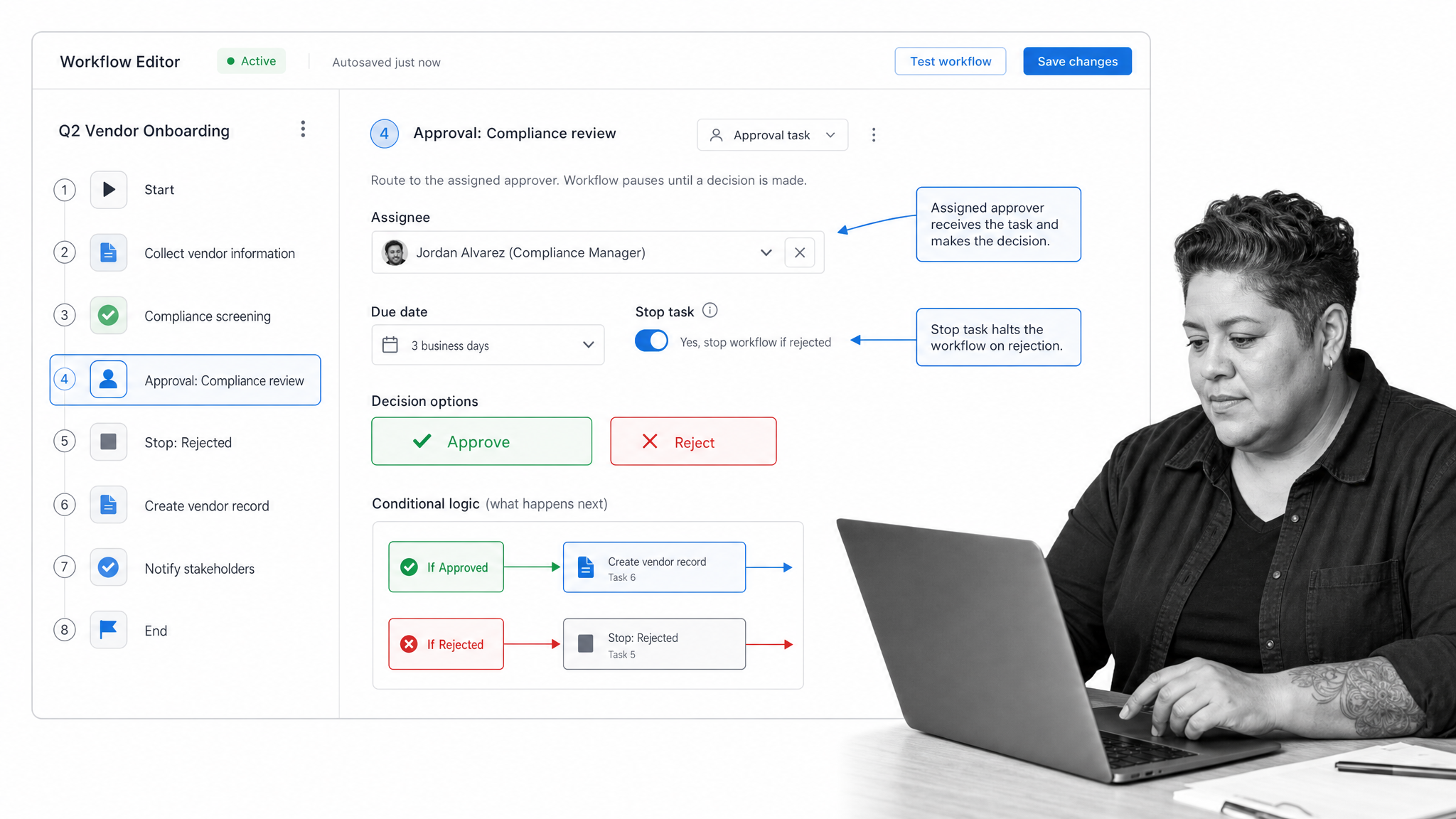
In Process Street, approval tasks can support single approvals, multi-stage approvals, and sequential approvals inside workflows. Teams can assign approvers, add due dates, use stop tasks to pause progress until review is complete, and capture approval or rejection decisions inside the workflow. The Process Street help center documents how to create approval tasks.
Conditional logic can also route different approval paths based on workflow data, including whether an approval task or another task has been completed. That helps teams keep low-risk requests simple while routing higher-risk work to the right reviewers. See Process Street on conditional logic in workflows.
For document-heavy workflows, Process Street also supports document approvals for structured review and control before critical documents are published. See Process Street on document approvals.
If your approvals are part of a broader operations or compliance process, connect them to a repeatable workflow instead of a one-off checklist. Start with Process Street approval software, or adapt a project workflow from the project management process template.
Project approval process FAQs
What is the project approval process?
The project approval process is the structured path a project request follows before work begins. It defines what information is required, who reviews it, what criteria are used, and what proof is kept after a decision is made.
What are the main project approval process steps?
The core steps are intake, business case review, stakeholder routing, decision and documentation, then handoff to execution. Complex projects may add finance, legal, risk, or compliance review before final approval.
Who should approve a project?
Approvers should match the project risk. A small operational request may need one manager, while a high-cost or regulated project may require finance, legal, compliance, IT, security, and executive review.
What should be included in a project approval request?
A strong request includes the business problem, expected outcome, scope, owner, budget, timeline, dependencies, risks, approval criteria, and the evidence reviewers need to make a clear decision.
How can software improve project approvals?
Workflow software can standardize intake, route work to the right approvers, enforce required fields, pause work until approval is complete, send notifications, and keep an audit trail of decisions.