


Turn every policy into automated workflows with built-in enforcement and audit-ready proof.



Business Process Management Template: Build a Process Library That Runs
A business process management template gives you a practical way to document repeatable work, assign owners, route approvals, and improve the process over time. Instead of starting from a blank document, you begin with a structure that turns a process into something your team can follow, audit, and refine.
The goal is not to create another static SOP. The goal is to build a process library that helps work happen the right way every time. A strong BPM template captures the steps, decisions, evidence, owners, exceptions, and review cycles that keep operations consistent as the business grows.
- Free business process management template
- What a BPM template includes
- BPM template vs other process templates
- How to use a business process management template
- Business process management steps
- Business process template use cases
- Business process template automation
- Business process template optimization
- Business process management template FAQs
Free business process management template
The fastest way to start is with the Process Library Checklist. It helps you create a central place for your company processes, review the quality of existing documentation, organize folders, assign ownership, and set a cadence for improvement.
Process Library Checklist
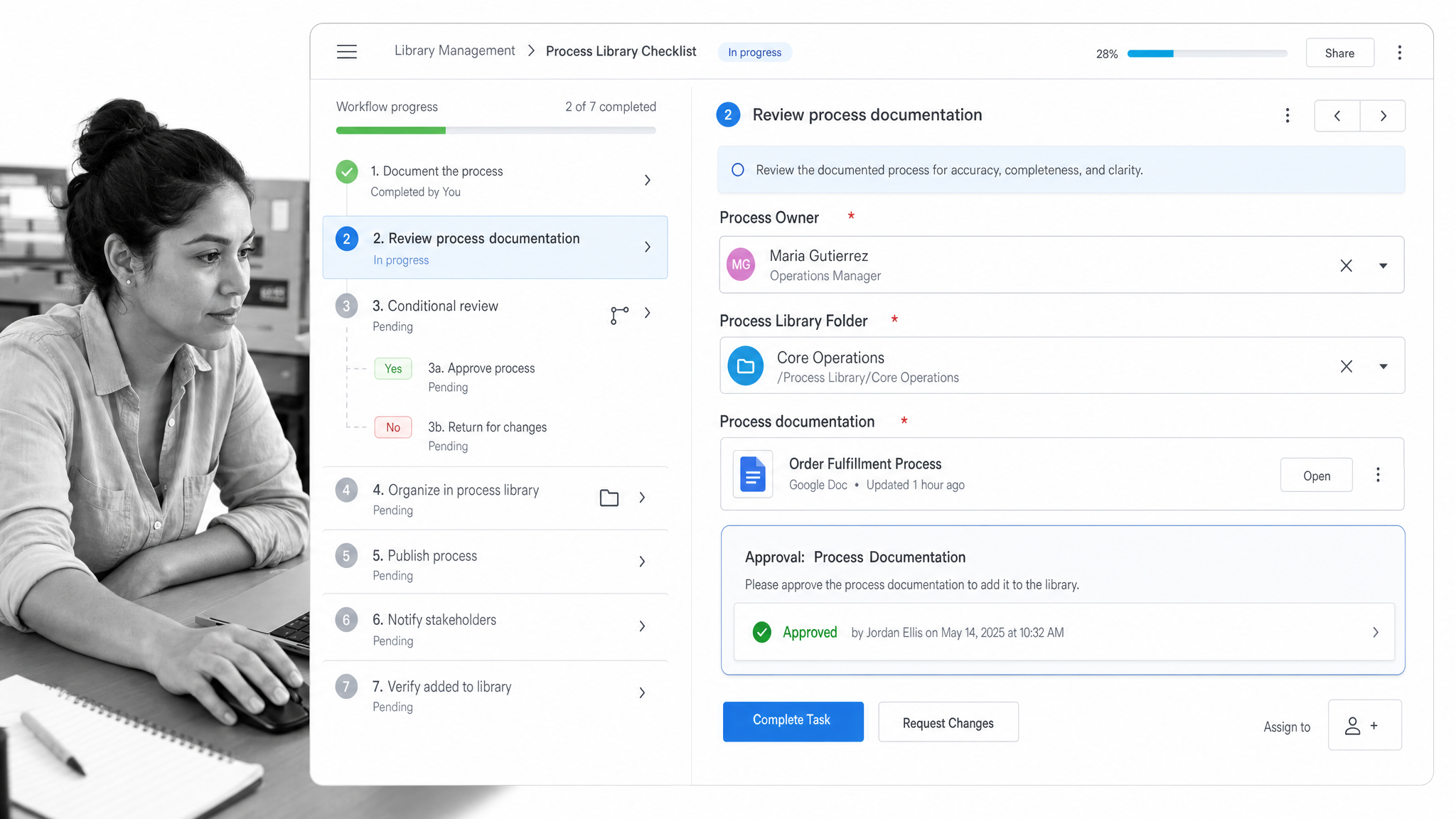
Use the template when your team has useful process knowledge scattered across documents, spreadsheets, chat threads, and individual memory. The checklist gives you a controlled workflow for turning that knowledge into an organized process library.
A good process library gives every team one clear place to find the current way work should be done. It should make ownership visible, remove duplicate versions, and show when a process needs review. In Process Street, that library can connect directly to executable workflows, approvals, automations, and audit trails.
What a BPM template includes
A business process management template should define how a process is documented, executed, measured, and improved. The exact fields depend on the workflow, but most BPM templates need the same operational core.
- Process name and purpose: what the process exists to accomplish.
- Trigger: the event that starts the workflow, such as a new hire, customer request, compliance review, or vendor change.
- Scope: where the process starts, where it ends, and what it does not cover.
- Owners: the accountable process owner plus the people responsible for each major task.
- Inputs and outputs: the documents, systems, approvals, decisions, and evidence created along the way.
- Task sequence: the required steps in order, with conditional paths where needed.
- Approvals and controls: who signs off, what they review, and what happens when something is rejected.
- Automation rules: notifications, assignments, due dates, integrations, and recurring schedules.
- Success metrics: cycle time, error rate, completion rate, SLA adherence, quality checks, or audit findings.
- Review cadence: when the process should be checked, improved, retired, or replaced.
This structure keeps the template useful for both process design and day-to-day execution. A process map or BPMN diagram can help people understand the flow, but a BPM template should also tell them what to do, where to record proof, and how exceptions are handled.
BPM template vs other process templates
People use the phrase business process management template in a few different ways. Some want a workflow checklist they can run. Some want a process map. Some want a diagramming format. The right choice depends on whether you need to understand the process, execute the process, or govern it over time.
BPM template vs BPMN template
A BPMN template is best when you need a standardized diagram of the process flow. It shows events, gateways, activities, roles, and message flows using Business Process Model and Notation. This is useful for process analysts, architects, and teams that need a shared visual language.
A BPM template is broader. It can include a diagram, but it should also define the executable steps, owners, approvals, evidence, automation rules, and review cadence. Use BPMN to explain the flow. Use a BPM template to make the flow operational.
BPM template vs project management template
A project management template is designed for one-time work with a defined start, end, budget, and deliverable. A BPM template is designed for repeatable work. The same workflow might run every day, every month, every quarter, or every time a trigger happens.
If the work ends when the deliverable ships, use a project template. If the work needs to run consistently whenever the same situation appears, use a BPM template. That difference matters because recurring processes need ownership, version control, audit history, and continuous improvement.
BPM template vs SOP template
An SOP template explains the required procedure. It is a good fit when the main job is instruction: what the task is, why it matters, who performs it, and what standards apply. A BPM template can include SOP content, but it goes further by turning the procedure into a managed workflow.
For simple work, an SOP may be enough. For high-volume or high-risk work, use the BPM structure so tasks are assigned, approvals are recorded, evidence is captured, and changes are governed before they affect the team.
How to use a business process management template
Start with one repeatable process that matters. Choose something frequent enough to justify structure and risky enough that missed steps create a real cost. Employee onboarding, travel approvals, vendor intake, monthly reporting, policy acknowledgment, incident response, and customer handoffs are all good candidates.
Map the current process

Write down how the process works today before redesigning it. Capture every step, handoff, decision, form, system, approval, and exception. The point is not to make the current process look good. The point is to see what actually happens when work moves through the team.
Ask the people who do the work where delays happen, what information is missing, and which steps they skip when the process gets busy. Those answers reveal the controls and automation rules your template needs.
Turn steps into an executable workflow
Once the current process is visible, convert it into an executable workflow. Each task should have a clear owner, completion standard, due date logic, and evidence requirement. If a step requires a decision, use conditional logic so the workflow shows only the tasks that apply.
This is where a BPM template becomes more useful than a document. The workflow can assign tasks, collect form fields, route approvals, notify the right people, and create a history of what happened.
Assign owners and approvals
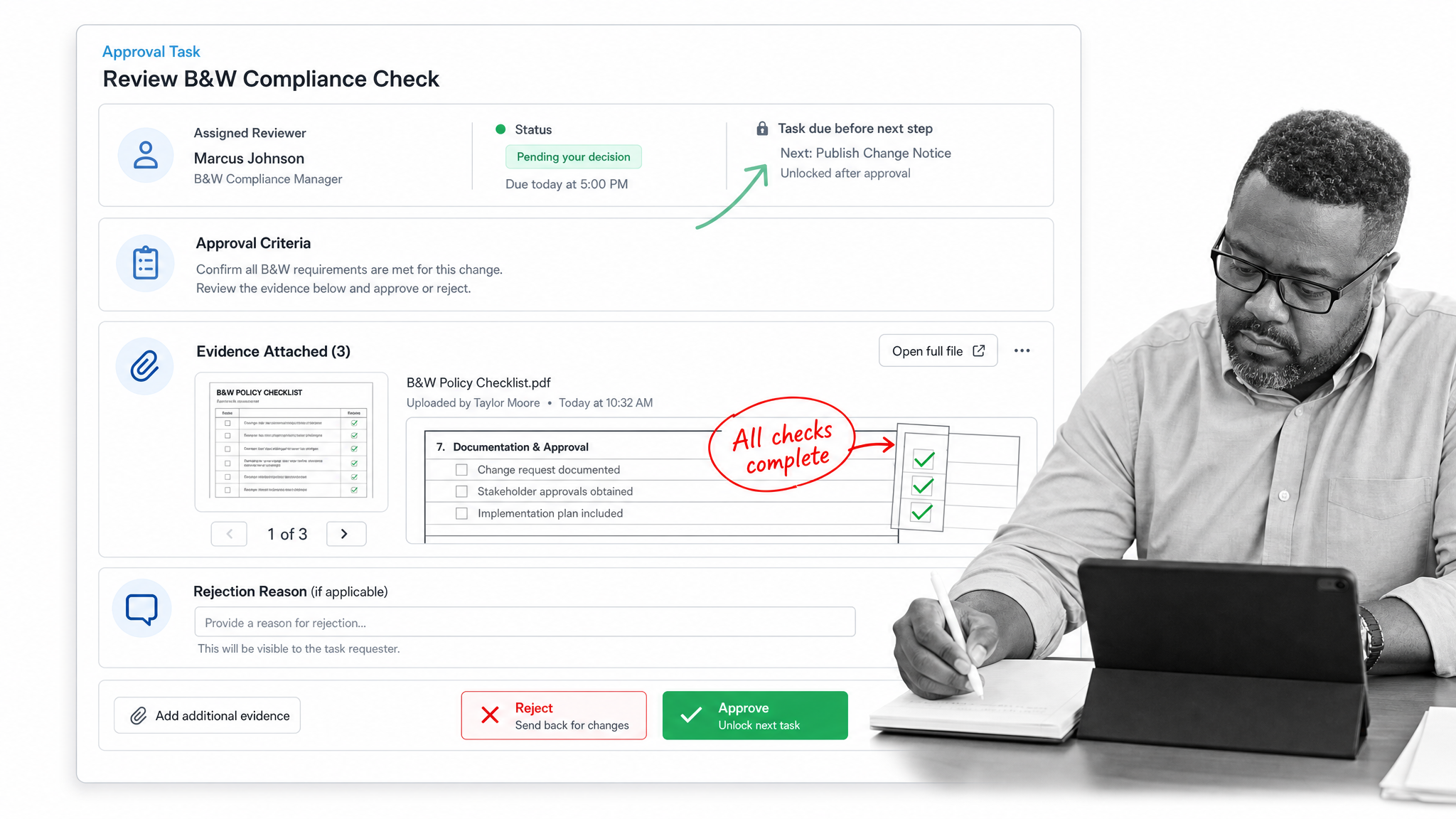
A process without ownership decays quickly. Assign a process owner who is accountable for the template, then assign task owners for execution. For controlled work, add approvals where a manager, compliance lead, or subject matter expert needs to verify the output.
Approvals should be specific. Instead of asking someone to approve the whole process, define what they are reviewing: policy fit, customer data, financial exposure, safety risk, documentation quality, or final readiness.
Publish the process library
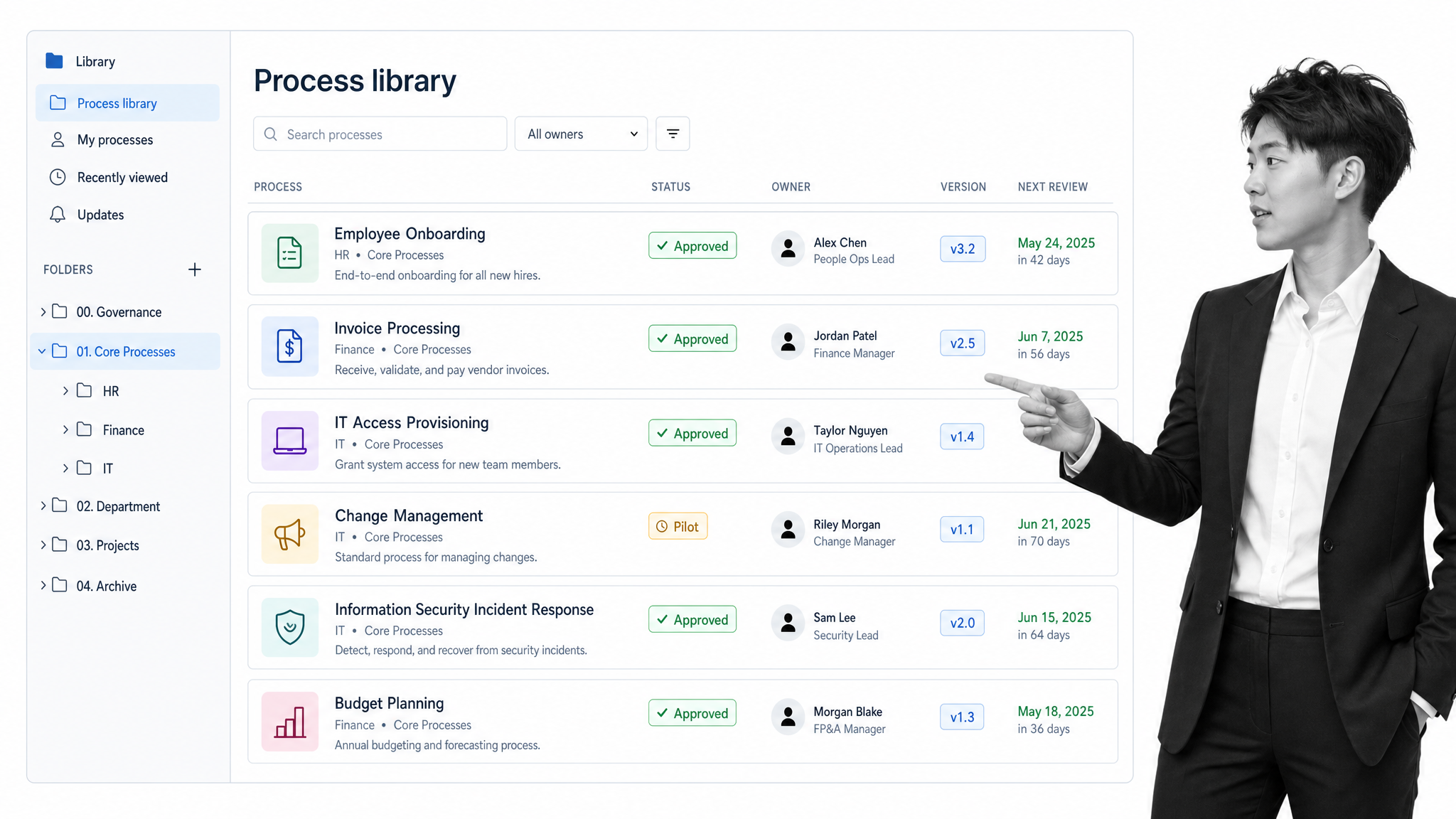
After the first workflow is documented and tested, put it in a central process library. Organize the library around how teams search for work: department, process family, risk area, customer stage, system, or compliance requirement.
Give each process a clear name, owner, version, status, and review date. If the process is still being tested, mark it as draft or pilot. If it is approved for use, make that status visible so people know which workflow is authoritative.
Business process management steps
BPM is a continuous cycle. The template helps you move through that cycle without losing accountability between planning, execution, measurement, and improvement.
Step 1: Define the process goal
Write the business outcome in plain language. For example: onboard new employees with all required documentation completed before their first day, or approve vendor changes with risk review and finance signoff before payment details are updated.
Step 2: Document the workflow
List the tasks in sequence. Include required forms, files, systems, decisions, dependencies, and handoffs. If different paths apply to different cases, capture those branches instead of forcing every run through the same steps.
Step 3: Add controls and evidence
Identify the steps where proof matters. That might mean uploading a signed form, confirming a customer record, logging a policy acknowledgment, attaching a screenshot, or recording an approval decision.
Step 4: Automate assignments and reminders
Use automation to remove manual coordination. Assign tasks based on roles, send reminders when work is due, trigger follow-up tasks after approvals, and notify the next owner when a handoff is ready.
Step 5: Test the template with a real workflow run
Run the process with real data before making it the official version. Watch for unclear instructions, duplicate steps, missing fields, weak approval criteria, and handoffs that still depend on someone remembering to chase the next person.
Step 6: Measure performance
Track completion rates, delays, rejection reasons, rework, cycle time, and exception volume. These measures tell you whether the process is actually improving or simply documented more neatly.
Step 7: Improve and govern the process
Review the workflow on a schedule. Update steps when the business changes, archive processes nobody uses, and require approval before high-risk procedures are changed. That governance keeps the process library trustworthy.
For a deeper walkthrough of BPM strategy, see the complete guide to process management.
Business process template use cases
BPM templates work best for recurring processes with enough complexity, risk, or handoffs to justify a controlled workflow. Use them where the same process runs many times and consistency matters.
Employee onboarding
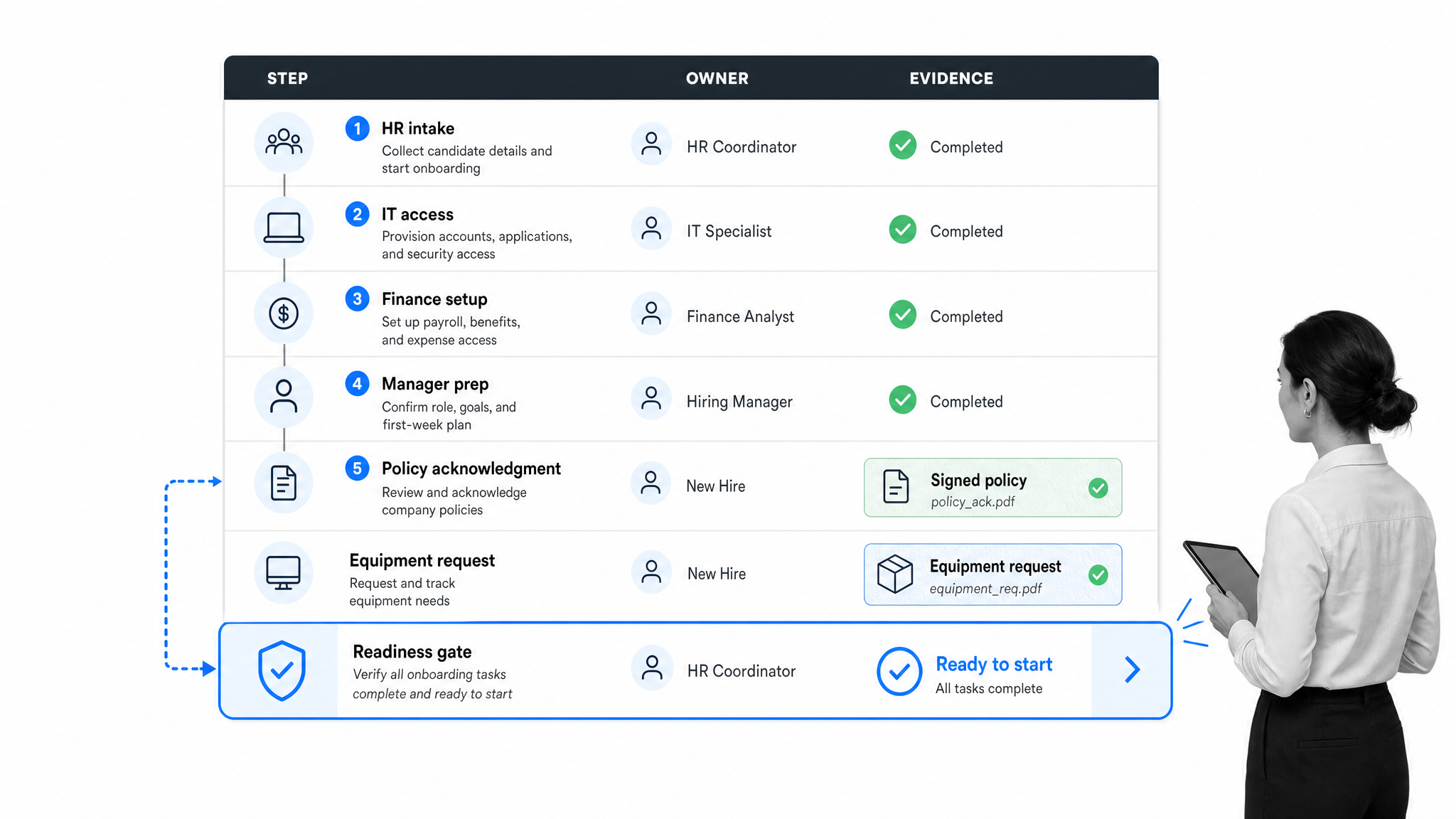
Employee onboarding usually involves HR, IT, finance, payroll, security, and a hiring manager. A BPM template can collect new hire information, assign system access tasks, route policy acknowledgments, track equipment requests, and confirm that required documents are complete before the start date.
Travel authorizations
Travel requests often need budget checks, manager approval, policy review, booking details, and reimbursement documentation. A template can standardize the intake form, route the request to the right approver, collect receipts, and keep a record of the decision.
Vendor intake and review
Vendor intake is a strong BPM use case because it crosses procurement, legal, finance, security, and the business owner. A template can collect vendor details, trigger due diligence, assign contract review, and require approval before the vendor is activated.
Policy acknowledgment
When a policy changes, the business needs proof that the right people reviewed it. A BPM template can distribute the policy, collect acknowledgment, escalate overdue tasks, and show completion evidence by person, team, or location.
Business process template automation
Automation is where BPM starts to change the way work feels. The template stops being a reference document and becomes a system that moves work forward.
Automate approvals and handoffs
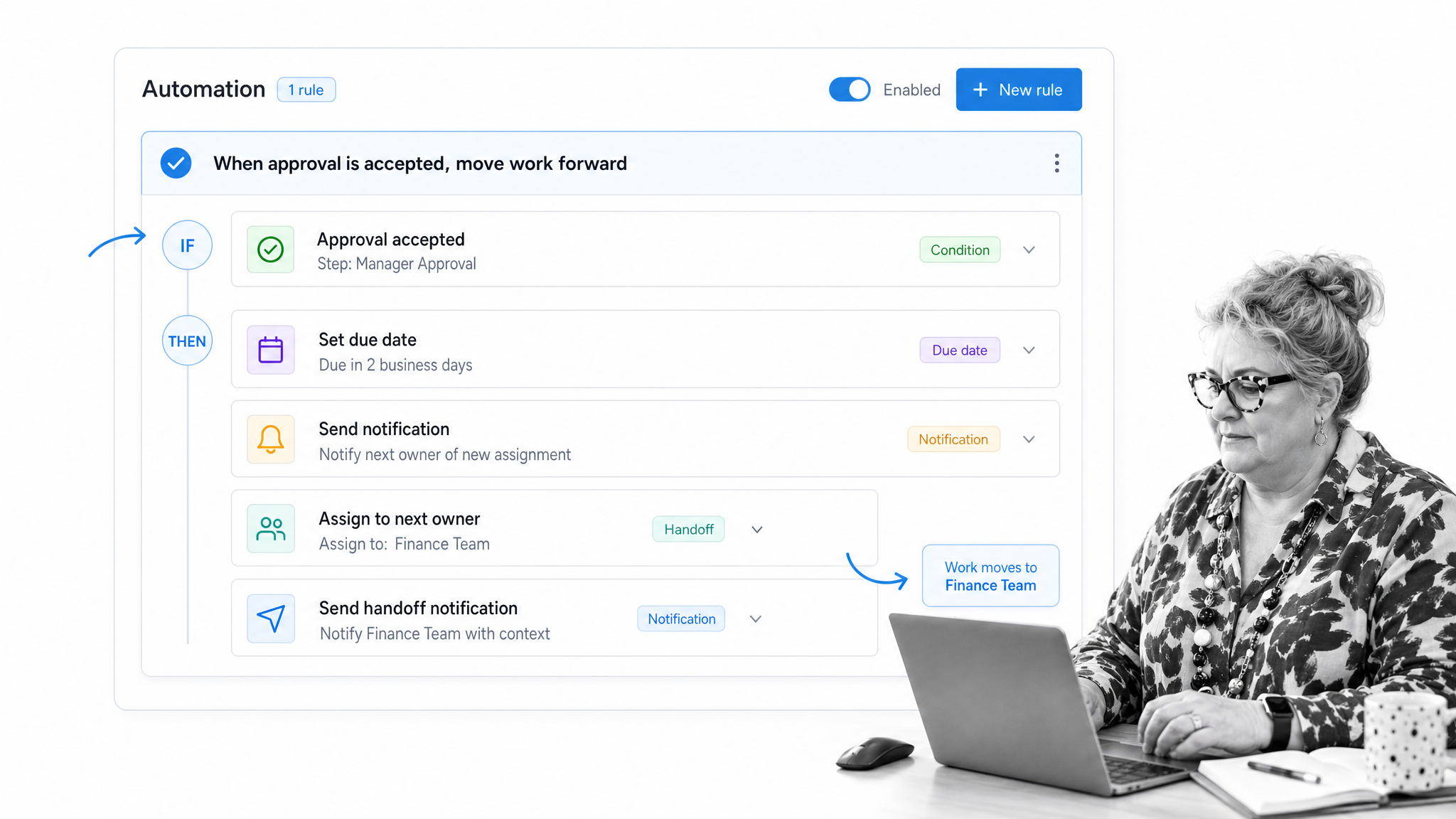
Approvals should happen inside the workflow, close to the evidence being reviewed. When an approver rejects a task, the workflow should send the work back with comments and open the correction step. When an approver accepts it, the next owner should be notified automatically.
Process Street supports conditional logic, role assignments, approvals, form fields, due dates, and integrations, so teams can turn a BPM template into an executable workflow without relying on engineering for every change. For more options, see this guide to process management tools.
Connect the template to systems of record
A BPM template becomes stronger when it connects to the systems where work already happens. For example, an onboarding workflow might create tasks in HR, request equipment from IT, update a CRM record, and collect signed documents. A vendor workflow might collect intake data, trigger security review, and update finance records after approval.
Keep the template focused on orchestration. The workflow should guide the process, collect evidence, and coordinate work across systems without forcing every team to abandon the tools they already use.
Business process template optimization
Optimization starts after the template is used in real work. A process that looks clean during design can still create delays, rework, missed approvals, or confusing exceptions once people run it at volume.
Use workflow data to improve the template
Look for tasks that are often late, rejected, skipped, or reopened. Those signals usually point to unclear instructions, missing context, wrong ownership, or an approval step that happens too late. Improve the template by fixing the source of the delay, not by adding more reminders.
Optimization can also mean removing steps. If a task no longer protects quality, compliance, customer experience, or operational control, take it out. A BPM template should make the process easier to run correctly, not heavier to maintain.
Govern changes before they reach the team
High-risk processes need change control. Decide who can edit the template, who can approve a new version, how users are notified, and how long completed workflow evidence should be retained. This is especially important for compliance, finance, quality, security, and customer operations.
Process Street is a BPM software platform for teams that need documented processes to become controlled execution. It connects process documentation, workflow automation, approvals, and audit-ready evidence in one operating layer.
The strongest templates also make improvement easier for the next owner. When the process goal, approval criteria, and evidence requirements are clear, a new manager can see what the workflow protects and where change is safe. That matters when teams grow, roles shift, or compliance requirements change.
Business process management template FAQs
What is a business process management template?
A business process management template is a reusable structure for documenting, executing, measuring, and improving a repeatable business process. It usually includes the process goal, trigger, task sequence, owners, approvals, evidence requirements, automation rules, metrics, and review cadence.
How do you use a BPM template to create a process library?
Start by documenting one repeatable process, assign an owner, define the workflow steps, add approvals and evidence requirements, then store the approved workflow in a central library. Repeat the pattern for each process family and give every workflow a status, owner, version, and review date.
What is the difference between a BPM template and a BPMN template?
A BPM template is usually an operational checklist or workflow for running and improving a process. A BPMN template is a diagramming structure that uses Business Process Model and Notation symbols to map process flow. BPMN helps explain how work moves; a BPM template helps people execute the work.
What should a BPM template include?
A BPM template should include the process purpose, trigger, scope, owners, steps, decisions, inputs, outputs, approvals, controls, evidence requirements, automation rules, metrics, and review cadence. For regulated or high-risk work, it should also include version control and change approval.
What are the benefits of using a business process management template?
A BPM template helps teams standardize repeatable work, reduce missed steps, clarify ownership, speed up approvals, collect evidence, improve handoffs, and create a process library that can be reviewed over time. It also makes automation easier because the process is already structured.
Is a BPM template the same as a project management template?
No. A project management template helps manage one-time work with a start date, end date, and deliverables. A BPM template helps manage repeatable operational work that runs again and again, such as onboarding, approvals, audits, vendor intake, or policy acknowledgment.