Turn every policy into automated workflows with built-in enforcement and audit-ready proof.


9 Best Wealth Management Tools for Advisory Firms
The best wealth management tools do not all solve the same problem. Advisory firms need a connected stack for client planning, portfolio data, research, relationship management, risk communication, and the recurring work that keeps service and compliance on track.
This guide compares nine current tools by the job each one performs best. Process Street ranks first because a wealth technology stack only creates value when onboarding, reviews, approvals, exceptions, and evidence move through a controlled operating process. The specialist platforms that follow can remain the systems of record for planning, portfolios, research, CRM, and risk.
Use the table to build a shortlist, then test each product with real household data, real operating scenarios, and the people who will use it every day.
In this guide:
- What are wealth management tools?
- Which wealth management tools fit each job?
- How should firms choose a wealth management stack?
- How do you design a connected wealth management stack?
- Frequently asked questions
What are wealth management tools?
Wealth management tools are the software systems advisory firms use to turn client information and investment data into advice, service, and accountable action. The category spans portfolio accounting, financial planning, investment research, CRM, client portals, risk analysis, reporting, trading, document handling, and process control.
The important distinction is not whether a product calls itself a wealth platform. It is whether the product owns a clear job in the operating model. One system may calculate a plan, another may reconcile holdings, and another may ensure the review, approval, and follow-up actually happen. A strong stack gives each system a defined role and removes ambiguous handoffs.
Which wealth management tools fit each job?
| Rank | Tool | Best fit | Primary job |
|---|---|---|---|
| 1 | Process Street | Firms that need controlled recurring operations | Workflow execution, approvals, evidence, and exceptions |
| 2 | Orion Advisor Technology | Firms seeking a broad advisor technology platform | Portfolio accounting, CRM, planning, trading, and reporting |
| 3 | Addepar | Firms with complex portfolios and entity structures | Data aggregation, analytics, and reporting |
| 4 | eMoney Advisor | Planning-led firms serving varied client complexity | Goals-based and cash-flow planning with a client portal |
| 5 | MoneyGuide | Advisors who prefer interactive goals-based planning | Goal prioritization, scenarios, and client collaboration |
| 6 | RightCapital | Growth-minded planning practices | Interactive planning, tax analysis, and advisor workflows |
| 7 | Wealthbox | Advisory firms that want an advisor-specific CRM | Households, relationships, tasks, workflows, and pipeline |
| 8 | Nitrogen | Advisors who lead with risk alignment | Risk assessment, proposals, and portfolio analytics |
| 9 | Morningstar Direct | Investment teams and research-heavy firms | Research, portfolio analysis, and investment reporting |
The ranking reflects category ownership for an operating stack, not a claim that one product replaces every other product. Select the smallest combination that covers the jobs your firm must perform well.
1. Process Street
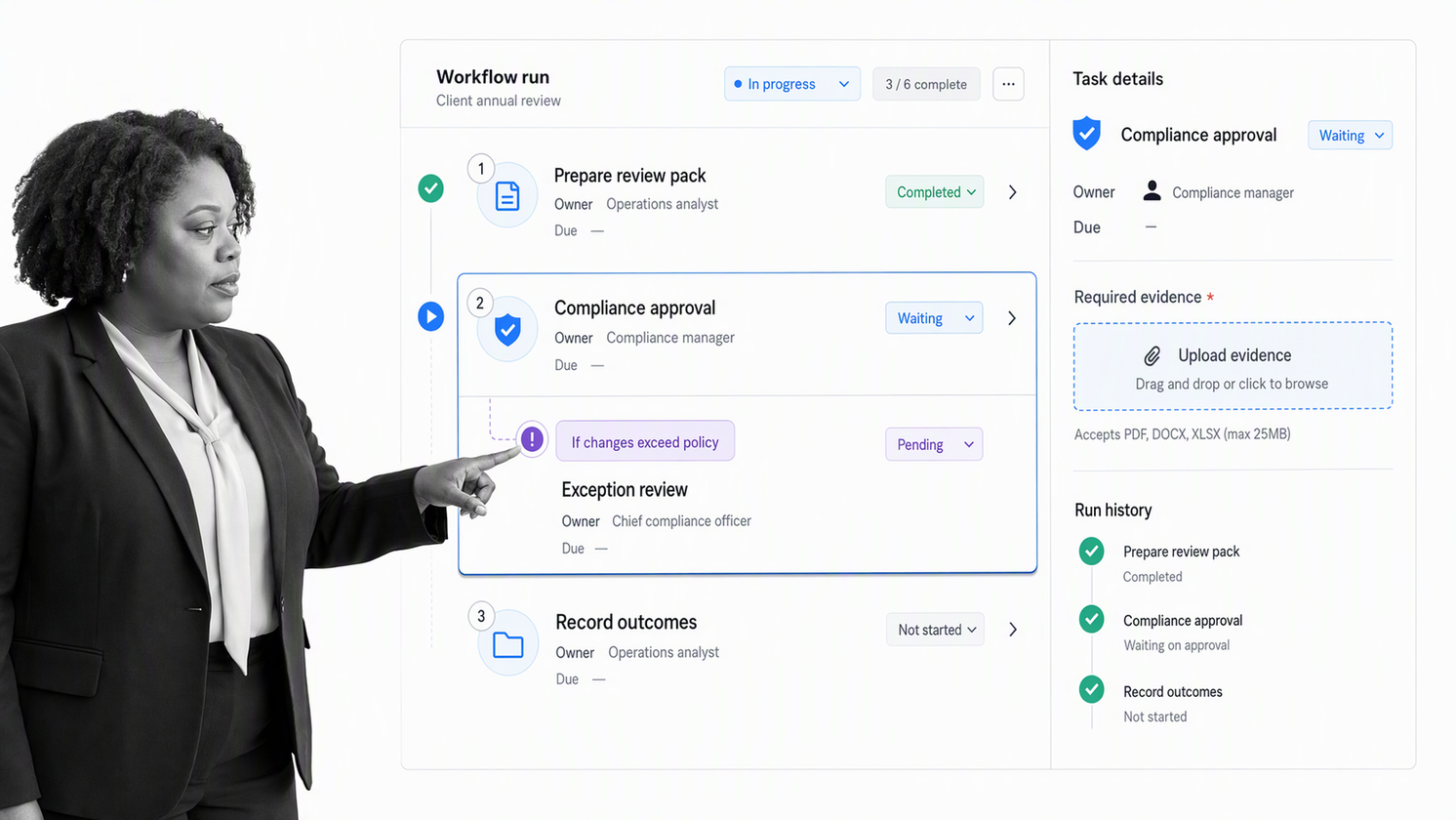
Process Street is the best wealth management tool for firms that need recurring advisory work to run as a controlled process. Portfolio and planning systems can calculate and store critical information, but they do not automatically guarantee that every client review, onboarding step, approval, disclosure, exception, and follow-up is completed by the right person.
Teams can build financial workflows with assigned tasks, required fields, files, due dates, conditional paths, and completion states. Approval steps can hold sensitive work for review, while evidence and decision history remain connected to the workflow. That makes Process Street a practical control layer across the advisory stack.
Use it for client onboarding, account-opening coordination, periodic reviews, investment-policy exceptions, advertising reviews, vendor oversight, complaint handling, evidence collection, and remediation. Specialist financial platforms remain authoritative for calculations and holdings. Process Street makes the surrounding work consistent, visible, and provable.
Best for: Wealth managers that need to standardize execution across operations, compliance, service, and review teams. See how a workflow approval process turns decision rules into accountable work.
2. Orion Advisor Technology
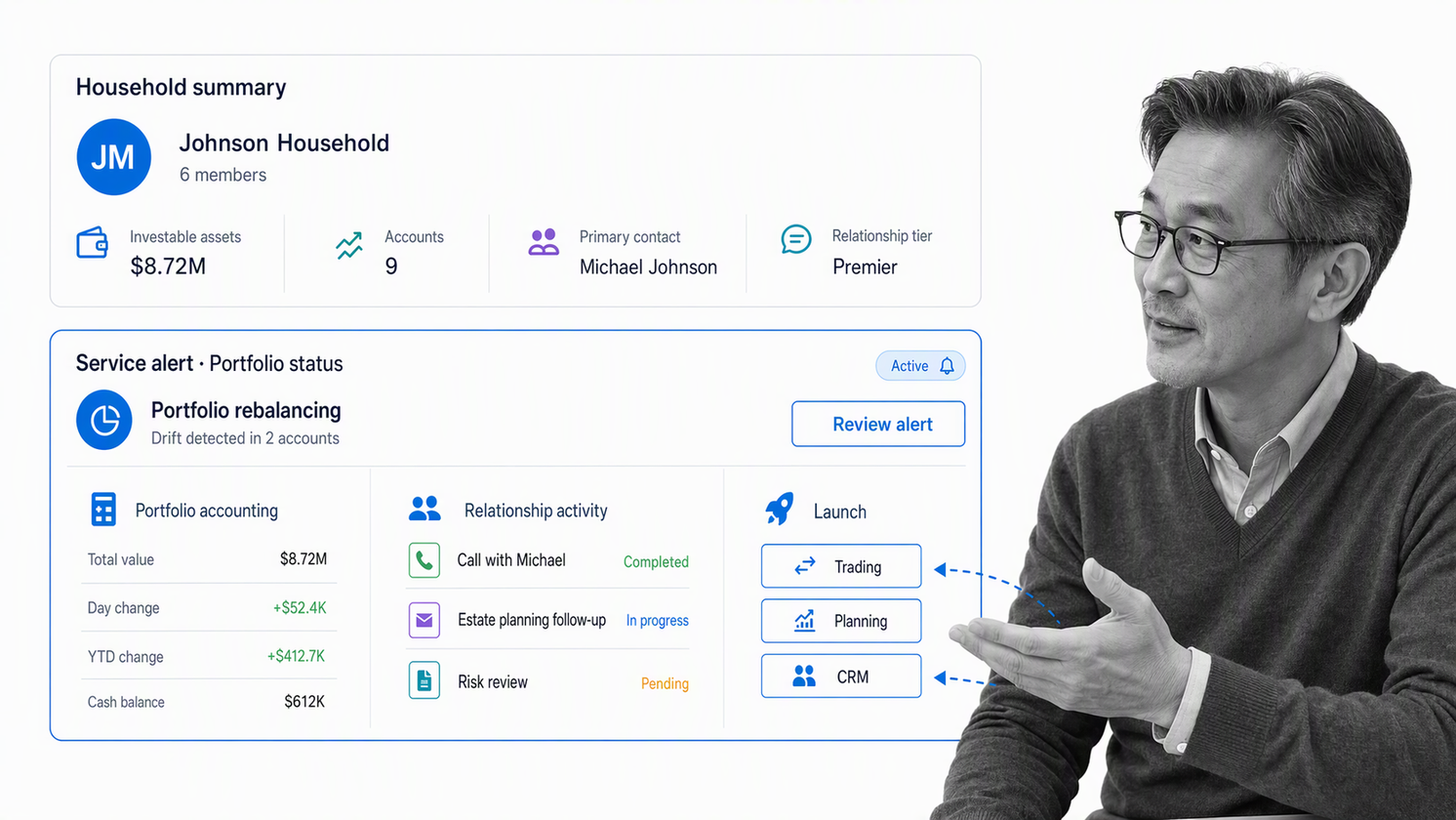
Orion Advisor Technology is a broad wealthtech platform for firms that want portfolio accounting, CRM, trading, planning, compliance, and advisor and client experiences in a connected environment. Its breadth makes it relevant when a firm wants to consolidate major parts of the advisor stack rather than assemble every capability independently.
The official Orion Advisor Technology overview presents portfolio accounting, Redtail CRM, trading, planning, compliance, client and advisor portals, and data capabilities as connected products. That breadth can reduce duplicate data movement, but buyers should still map which modules will become systems of record and which existing tools will remain.
Evaluate Orion with live operating scenarios: opening a household, reconciling data, preparing a review, generating reports, handling a trade exception, and following the work across teams. Platform breadth matters only if advisors and operations staff can complete those jobs without creating parallel records elsewhere.
Best for: Advisory firms seeking a broad, connected advisor technology platform.
3. Addepar
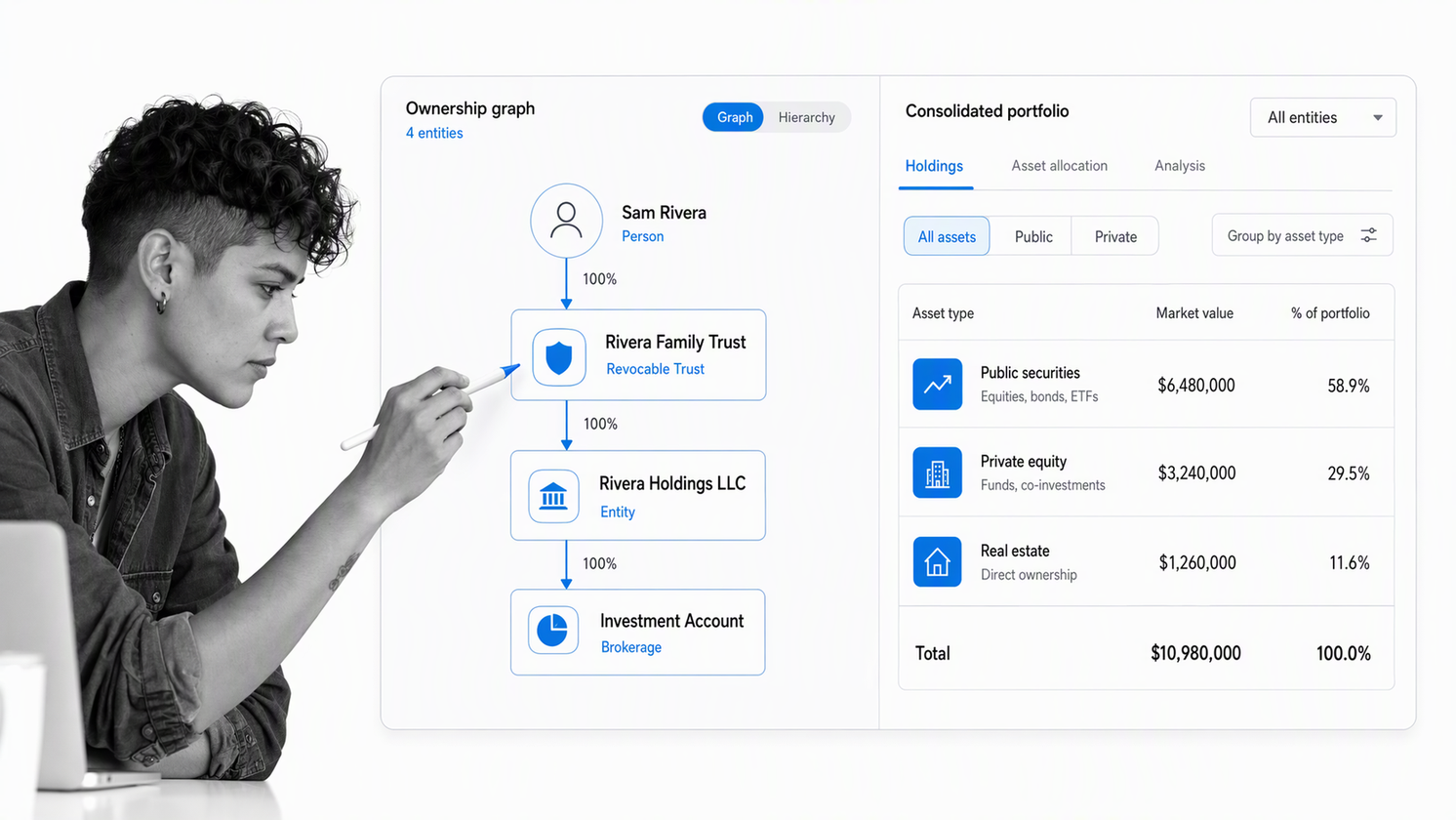
Addepar is best suited to firms that need to aggregate and analyze complex portfolios, entities, and ownership structures. It is especially relevant when a household or institution holds public and private assets across custodians, accounts, trusts, funds, and other legal structures that are difficult to represent in simpler reporting systems.
Addepar documentation describes a wealth management platform used to track portfolios, manage entities, run analytics, and generate reports. Its financial graph model represents ownership relationships across people, legal entities, accounts, positions, and securities, which gives firms a structured way to view wealth across layers.
The buying question is whether the firm truly needs that level of data modeling and reporting flexibility. Include data migration, reconciliation ownership, report governance, and downstream workflow in the evaluation. A powerful portfolio view still needs clear operating procedures for data exceptions, approvals, and client delivery.
Best for: Family offices, private banks, and advisory firms with complex multi-entity portfolios.
4. eMoney Advisor
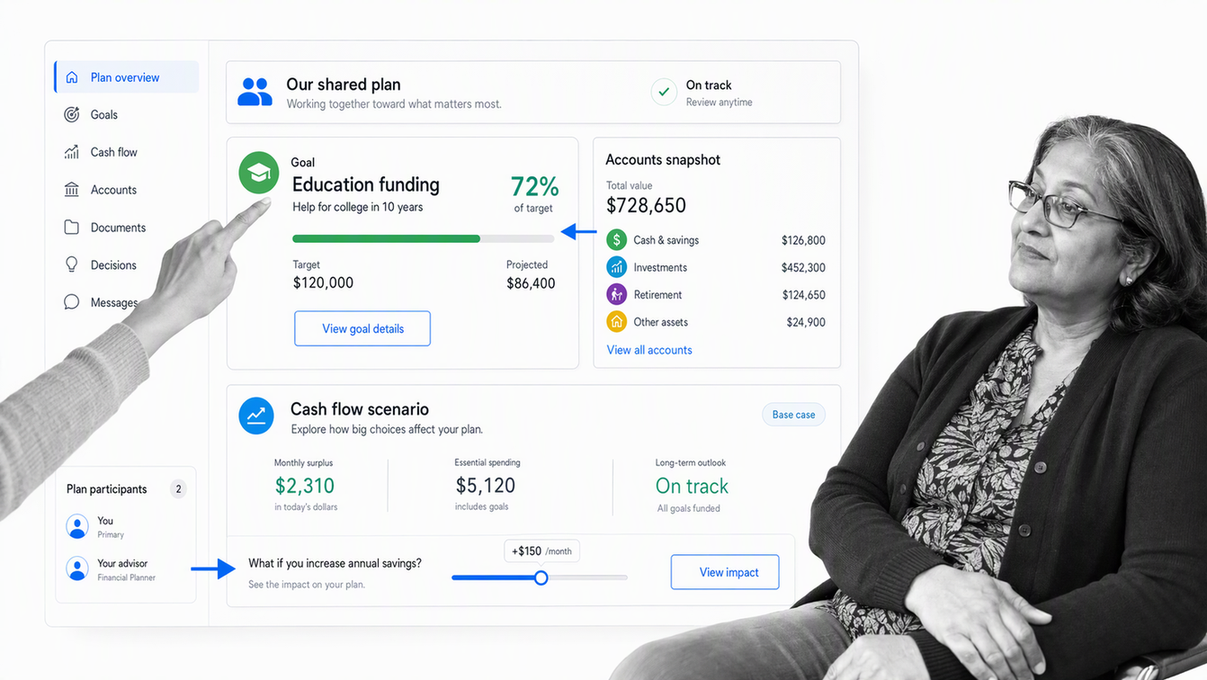
eMoney Advisor is a financial planning platform for firms that want to support both goals-based and cash-flow planning across a range of client needs. It combines planning tools with account aggregation, reports, and a client portal, making it a strong fit when the advice relationship centers on an ongoing plan rather than a one-time calculation.
The eMoney product overview describes goals-based and cash-flow planning options in one platform. It also presents account aggregation and a client portal that can bring financial information, documents, goals, and plan updates into a shared experience between advisor and client.
Test how planners create assumptions, compare scenarios, document recommendations, and communicate changes. Also test the operational steps around the plan: data gathering, review, approval, delivery, acknowledgment, and follow-up. Those steps determine whether a planning platform becomes part of a repeatable service model.
Best for: Planning-led firms that serve clients with varied levels of financial complexity.
5. MoneyGuide
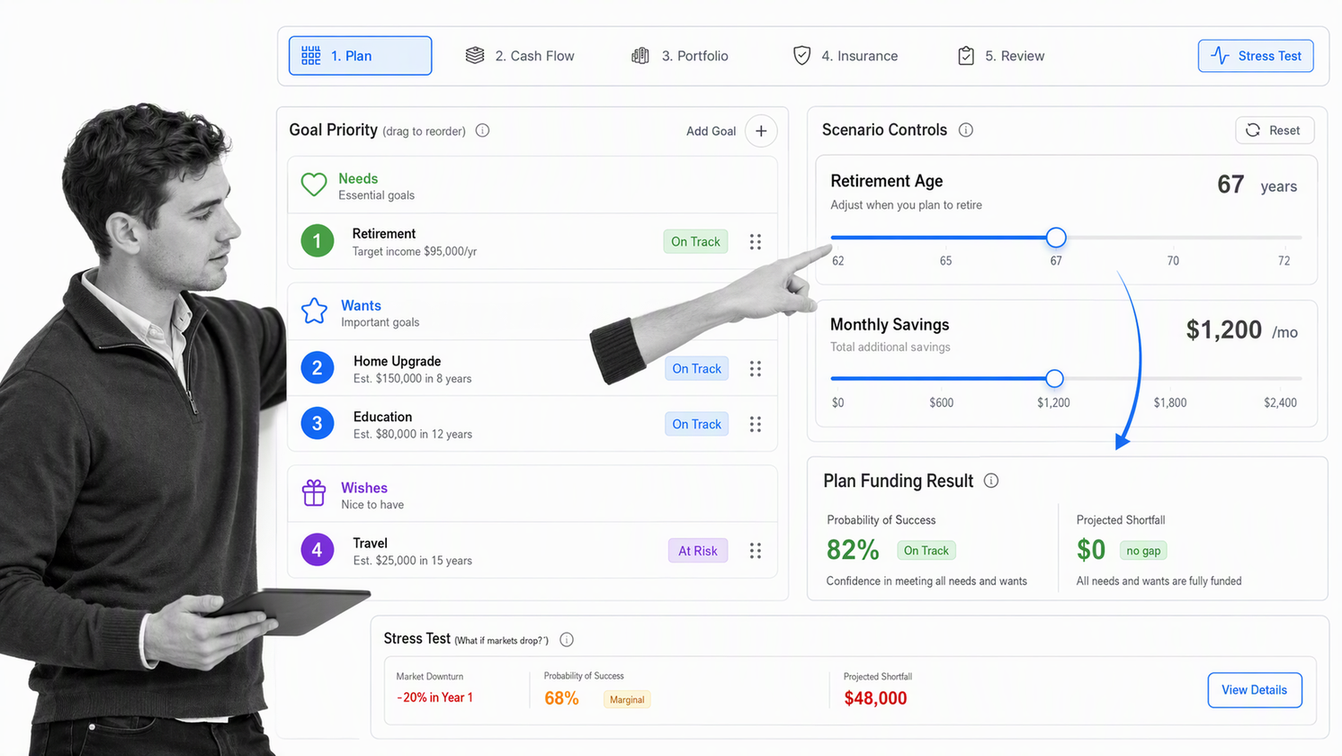
MoneyGuide is an interactive, goals-based financial planning system. Its approach begins with client goals, shows how goals interact, and supports scenario exploration so advisors and clients can see how changes to savings, retirement timing, taxes, longevity, or other assumptions affect the plan.
The official MoneyGuide platform page describes goal planning, stress testing, tax planning, retirement distribution, risk tolerance, and a client planning portal. Its interactive Play Zone is designed to let clients vary plan inputs and see the impact during a planning conversation.
MoneyGuide should be evaluated for planning philosophy as much as feature coverage. Firms that organize advice around client goals and collaborative scenarios may find it natural. Firms that need deep cash-flow modeling, complex entity analysis, or specialized investment operations should test those requirements explicitly rather than assuming all planning products approach them the same way.
Best for: Advisors who want collaborative, goals-based planning and interactive client conversations.
6. RightCapital
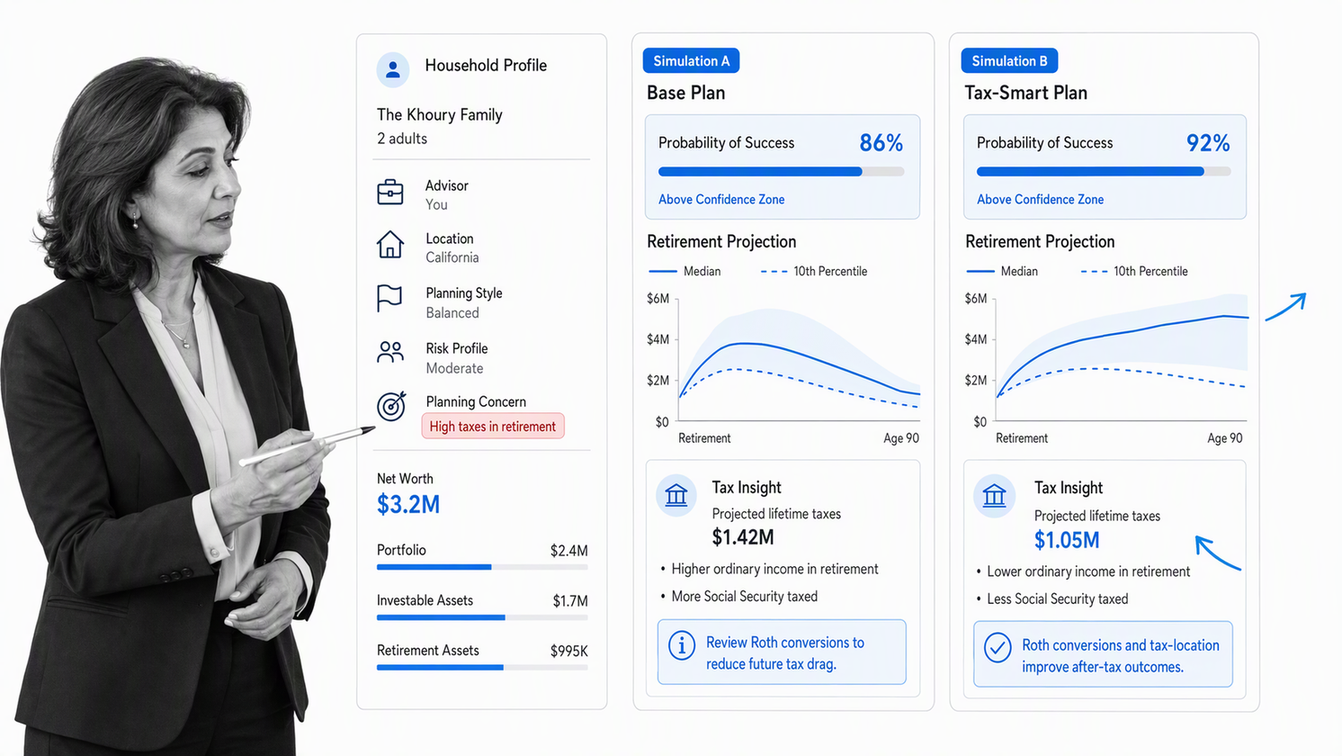
RightCapital is financial planning software built to simplify planning, improve client engagement, and help advisors scale. It is a strong shortlist candidate for firms that want an approachable planning experience while still addressing retirement, tax, cash-flow, insurance, estate, and other planning decisions.
The RightCapital company overview positions the product as a planning solution for advisors and clients. Current product updates also describe planning-focused assistance that can review client profile information, surface possible concerns, and run plan simulations inside the advisor workflow.
When testing RightCapital, use a complete planning case rather than a polished demo household. Confirm how data enters the system, how assumptions are reviewed, how tax and retirement scenarios behave, what the client can see, and how open actions move into the firm’s service workflow.
Best for: Advisory practices that want modern, interactive planning with a strong client experience.
7. Wealthbox
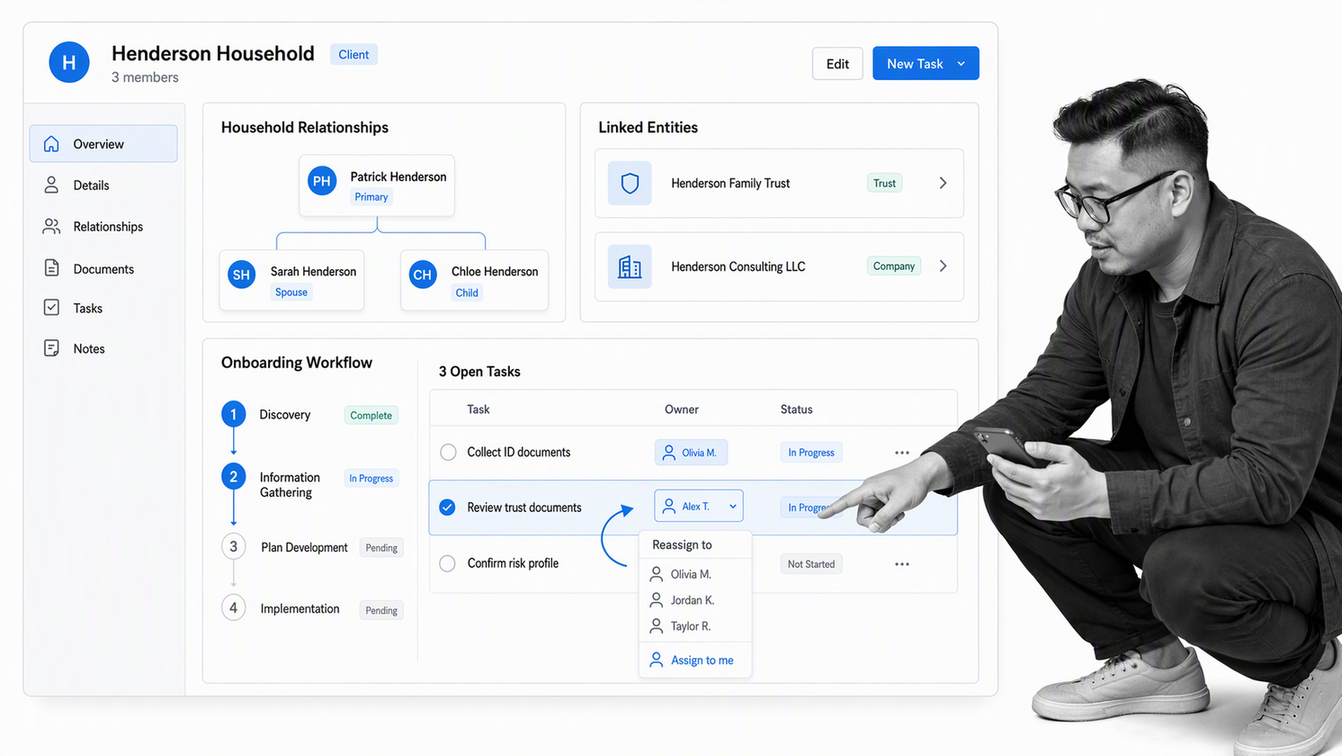
Wealthbox is a CRM designed for financial advisors. It organizes contacts, households, relationships, communications, opportunities, tasks, and recurring workflows, which makes it useful as the relationship and activity layer in an advisory technology stack.
Its contact management model connects people to households, companies, and trusts, while activity history helps teams understand the latest client context. Wealthbox workflows can turn repeatable activities such as onboarding, reviews, and compliance tasks into assigned sequences with reminders and completion tracking.
A CRM workflow is not automatically a complete operating control. Test whether the product can support the firm’s required approvals, evidence, exceptions, and audit needs. Some firms will use Wealthbox for relationship management and lighter task coordination, then use a dedicated workflow platform for higher-stakes processes.
Best for: Advisory firms that want a purpose-built CRM with household context and approachable team workflows.
8. Nitrogen
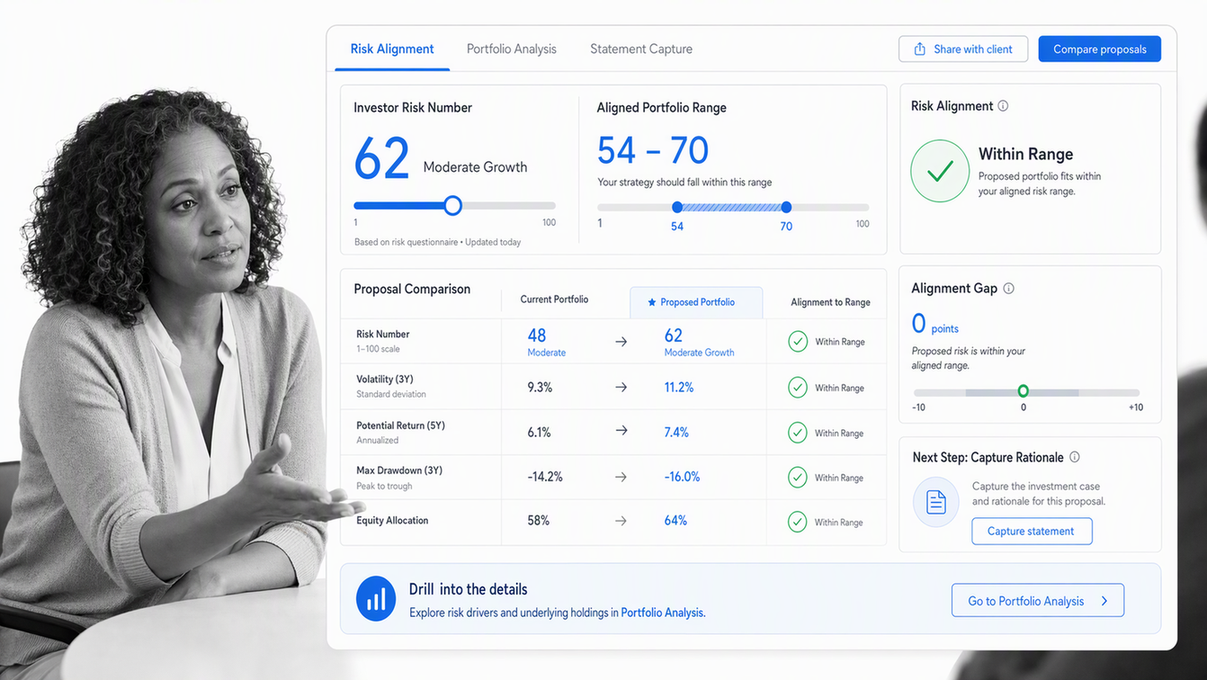
Nitrogen is a risk-centered wealth management platform. It helps advisors assess investor risk, compare that risk with a portfolio, build proposals, capture statements, and conduct portfolio analysis. The product is most relevant when risk alignment is a central part of prospecting, recommendation, and review conversations.
Nitrogen’s platform presents a Risk Number for the investor and a portfolio-wide risk view, with proposal and analytics capabilities around that shared language. This can help an advisor explain whether the way a client is invested aligns with the level of risk the client is prepared to accept.
The evaluation should go beyond a risk questionnaire. Test how assumptions are explained, how portfolio inputs are captured, how proposals are reviewed, and how the firm records the decision and client response. Risk communication supports judgment. It does not replace the firm’s suitability, documentation, and review process.
Best for: Advisors who want risk alignment to anchor prospect and client conversations.
9. Morningstar Direct
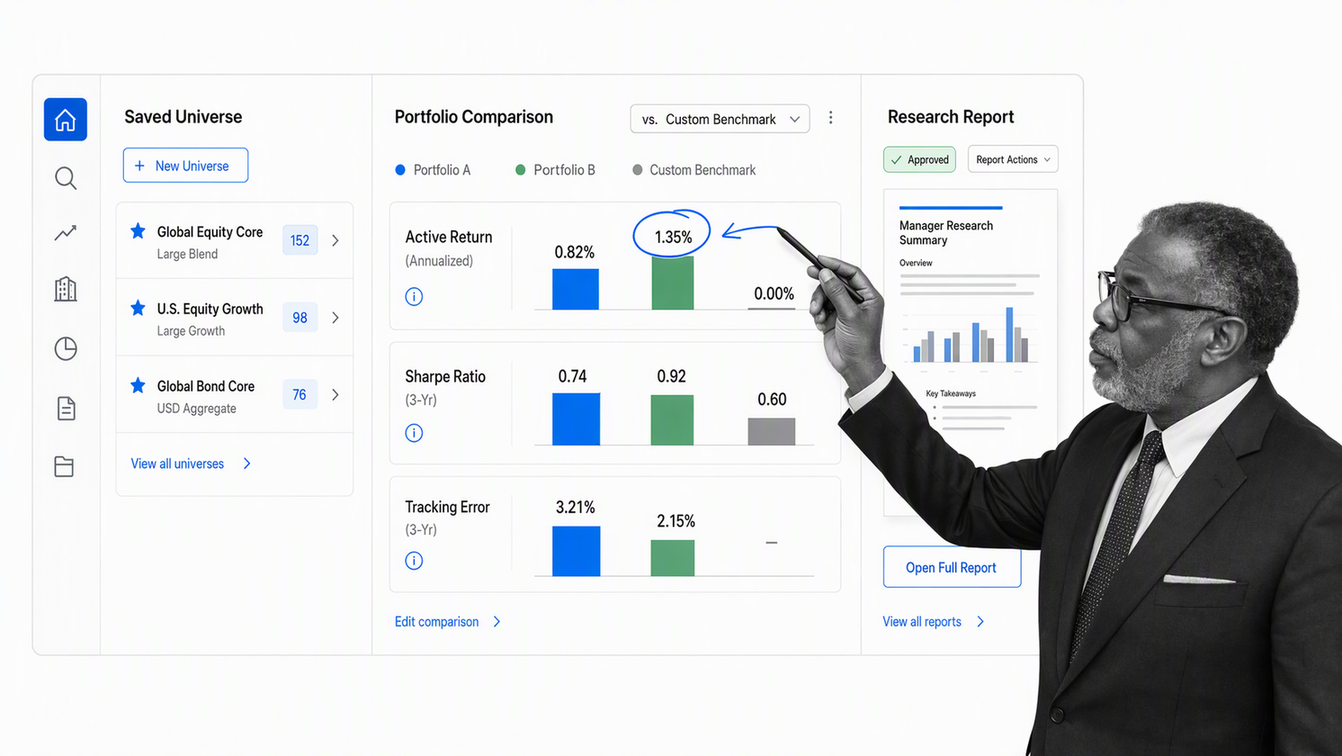
Morningstar Direct is an investment research and portfolio analysis application for investment teams, portfolio managers, researchers, product teams, and wealth management professionals. It combines Morningstar data and research with analytics, portfolio tools, reporting, and delivery options.
The product supports research and analysis, portfolio creation and management, investment reporting, data delivery, and custom analysis. It is a better fit for teams that need institutional research depth and repeatable investment analysis than for firms looking only for a basic household planning or CRM tool.
Test Morningstar Direct with the firm’s real research process: universe definition, manager or security review, portfolio comparison, benchmark selection, report approval, and distribution. The value comes from integrating trusted analysis into a governed investment process, not from collecting another library of data.
Best for: Research-heavy advisory firms and investment teams that need deep data, analytics, and reporting.
How should firms choose a wealth management stack?
Start with operating jobs, not a vendor list. Document the moments where information changes hands, judgment is applied, evidence is required, or a missed step creates client, regulatory, or business risk. Then assign a system owner to each job.
- Define the system of record for households, plans, portfolios, communications, tasks, and evidence.
- Test data import, reconciliation, permissions, and export before comparing interface polish.
- Use complete scenarios such as onboarding, annual review, plan update, portfolio exception, and client offboarding.
- Separate analytical capability from workflow control. A system can produce an insight without managing the work that follows.
- Confirm how human review is recorded when AI assists with research, summaries, planning, or recommendations.
- Measure implementation effort, data ownership, exception handling, and user adoption alongside feature breadth.
A useful shortlist gives each product a clear reason to exist. If two systems own the same record or the same task, decide which one is authoritative before implementation. If no system owns an approval or exception, design that control before launch.
How do you design a connected wealth management stack?
A connected stack usually has four layers: relationship data, financial analysis, investment data, and operational control. A CRM may own household relationships and communication history. Planning and portfolio platforms may own advice models, holdings, performance, and reporting. A workflow layer coordinates the recurring work around those records.
The handoffs matter more than the diagram. For example, an annual review may begin from a CRM date, require current portfolio and planning information, route preparatory work to several owners, hold recommendations for approval, collect client acknowledgments, and create follow-up tasks. A documented wealth management analytics process should show how an insight becomes a reviewed decision and then an assigned action.
Keep the design small enough to govern. Add a product only when it owns a necessary job, improves the client or operator experience, or creates stronger control. Remove duplicate sources, shadow spreadsheets, and manual status trackers as the new process becomes reliable.
Frequently asked questions
What are wealth management tools?
Wealth management tools are software products that help advisory firms plan, analyze, communicate, and execute work for client households. The category includes financial planning, portfolio accounting, investment research, CRM, risk analysis, client reporting, and workflow control.
Which wealth management tool should a new advisory firm choose first?
Start with the job that creates the most risk or repeated work. Many firms need a CRM and financial planning system early. Firms with complex operations should also establish a controlled workflow layer for onboarding, reviews, approvals, evidence, and recurring service tasks.
Can one wealth management platform replace every specialist tool?
Usually not. Broad platforms can reduce handoffs, but specialist systems may still be stronger for planning, portfolio data, research, or risk. The practical goal is a small, governed stack with clear systems of record and controlled handoffs.
How should advisory firms evaluate wealth management software?
Test the software against real client and operations scenarios. Review data coverage, planning depth, permissions, reporting, workflow fit, integration quality, implementation effort, recordkeeping, and the experience for both advisors and clients.
What is the difference between wealth management software and a CRM?
A CRM organizes client relationships, communications, tasks, and opportunities. Wealth management software is a broader category that can also include planning, portfolio accounting, analytics, reporting, trading, risk, and operational workflow tools.
How does Process Street support wealth management operations?
Process Street turns recurring advisory procedures into assigned, trackable workflows. Teams can route approvals, require evidence, handle exceptions, track deadlines, and preserve a history of completed work while specialist financial systems remain authoritative for client and portfolio data.
Build the stack around the work your firm must perform and prove. Specialist tools can own planning, portfolio data, research, CRM, and risk. Process Street can connect those systems to controlled workflows so every review, approval, exception, and follow-up has an owner and a record.