Turn every policy into automated workflows with built-in enforcement and audit-ready proof.



Venture Capital Regulatory Filings: A Practical Guide

Venture capital regulatory filings are the submissions, notices, reports, and tax records that connect a fund’s legal structure to its real activity. A filing may be triggered by forming the adviser, raising a fund, admitting investors, changing ownership, crossing a reporting threshold, operating in a new state, or closing a fiscal period. Missing the trigger is often more dangerous than misunderstanding the form itself.
The difficult part is that there is no universal filing pack for every venture firm. The right answer depends on the fund entities, the adviser, the offering exemption, regulatory assets under management, investor base, jurisdictions, portfolio activities, and changes during the year. A reliable program therefore starts with applicability and ownership, then converts each obligation into a controlled workflow with evidence.
This guide explains the main United States filing categories and an operating model for managing them. It complements the broader venture capital process management lifecycle and the venture capital investment process. It is educational information, not legal, tax, accounting, or investment advice.
In this guide:
- What are venture capital regulatory filings?
- Which filings apply to a venture capital fund?
- How do fund structure and adviser status change the filing set?
- How should a VC firm manage its filing calendar?
- Which current developments affect private fund filing programs?
- How can Process Street support regulatory filing operations?
- Venture capital regulatory filings FAQs
What are venture capital regulatory filings?
The phrase covers more than reports sent to one regulator. It includes offering notices, adviser registration or exempt-reporting submissions, private-fund reports, state securities notices, tax returns and investor schedules, amendments, withdrawals, and records that prove why a filing did or did not apply.
The federal framework separates three related questions: how the fund qualifies for an exclusion from investment-company status, how the adviser is regulated, and how the fund offers its interests. That distinction is the foundation of a good filing map.
A filing calendar should explain the obligation, trigger, entity, owner, reviewer, destination, evidence, and amendment rule. A due date by itself is not a control.
One filing can also create several pieces of work. A federal notice may be followed by state notice filings and fees. An annual adviser update may require data from finance, legal, ownership records, and private-fund schedules. A tax return may depend on closing the books, completing valuations, confirming allocations, and issuing investor information. The operating system must coordinate the whole chain, not merely remember the submission date.
Which filings apply to a venture capital fund?
The following categories are common starting points. They are not a substitute for an applicability analysis. Counsel, tax advisers, fund administrators, compliance leaders, and regulators’ current instructions should determine what applies to the specific adviser and fund.
| Filing category | Typical trigger | Control question | Primary evidence |
|---|---|---|---|
| Form D and state notices | An exempt securities offering relying on Regulation D | Has the first sale occurred, and where are investors located? | Filed notice, acceptance, state receipts, fees, amendments |
| Form ADV | Adviser registration or exempt reporting status | Which regulator and filing type apply to the adviser? | Filed form, schedules, acceptance, change log |
| Form PF | Certain SEC-registered private-fund advisers meeting the reporting threshold | Does the adviser meet the current filer criteria? | Filed form, calculations, source data, sign-off |
| Partnership tax reporting | Fund or management entities taxed as partnerships | Which entities and investors require reporting? | Return, workpapers, investor schedules, delivery log |
| State and local registrations | Entity formation, adviser activity, offerings, payroll, tax, or local presence | Which jurisdictions and renewals apply? | Registrations, good-standing records, receipts, renewals |
| Change and event filings | Ownership, control, disciplinary, address, fund, business, or other reportable changes | Does the event require a prompt amendment or notice? | Change intake, legal analysis, filed amendment, approval |
Form D and state notice filings
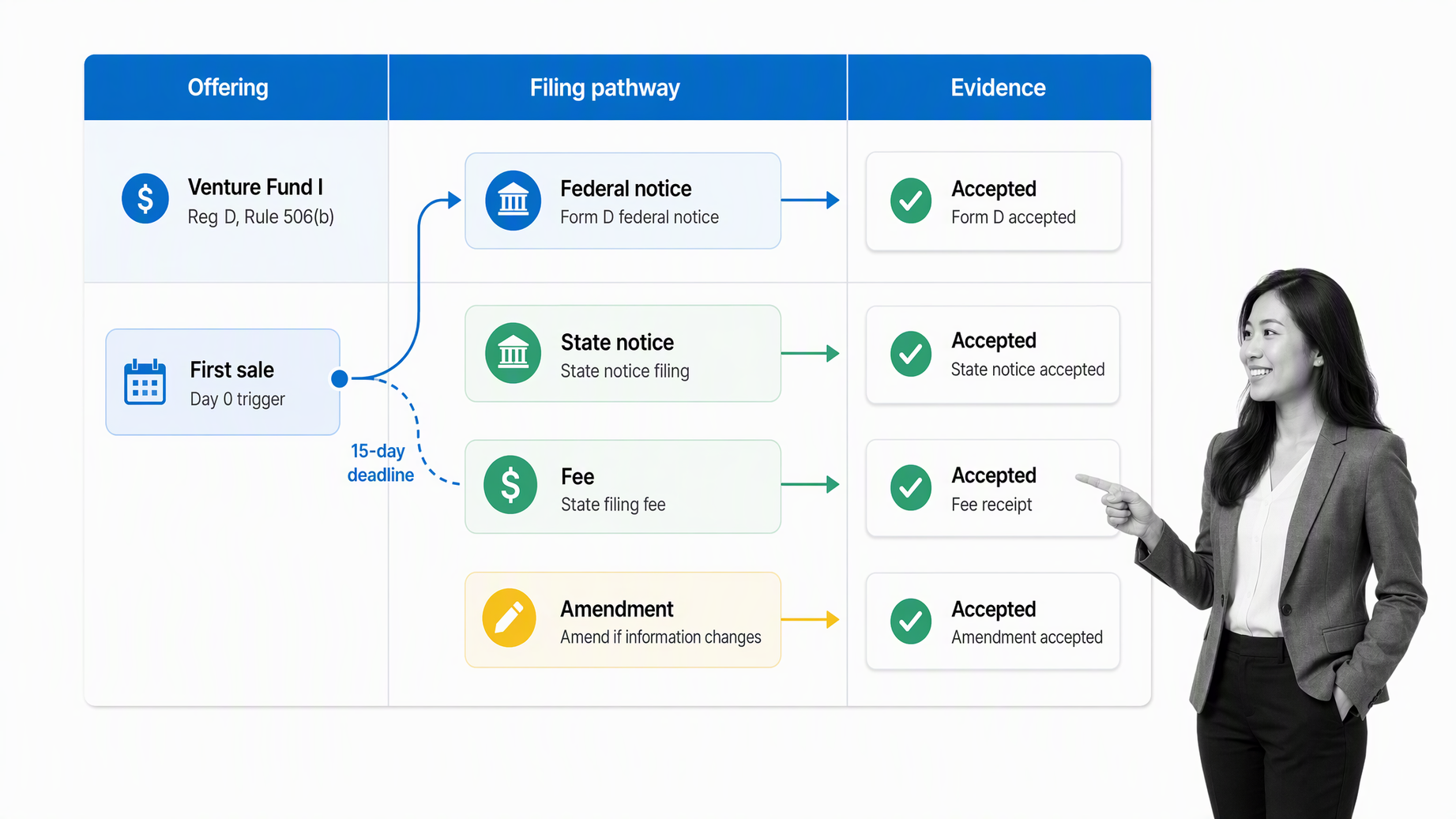
Form D is a notice of an exempt offering. Rule 503 in the Electronic Code of Federal Regulations requires the notice within 15 days after the first sale and describes annual and change-driven amendments.
The federal filing does not finish the state work. Build a jurisdiction list from investor records, confirm notice and fee requirements, capture acceptance evidence, and calendar any amendment or renewal obligations. The owner should also understand what counts as the first sale under the offering documents, because a closing calendar and a filing calendar may begin from different operational events.
Treat the issuer name, related persons, offering amount, first-sale date, investor categories, sales compensation, and exemption selection as controlled data. A last-minute scramble is often caused by inconsistent source records rather than the complexity of the form.
Form ADV and exempt reporting adviser updates
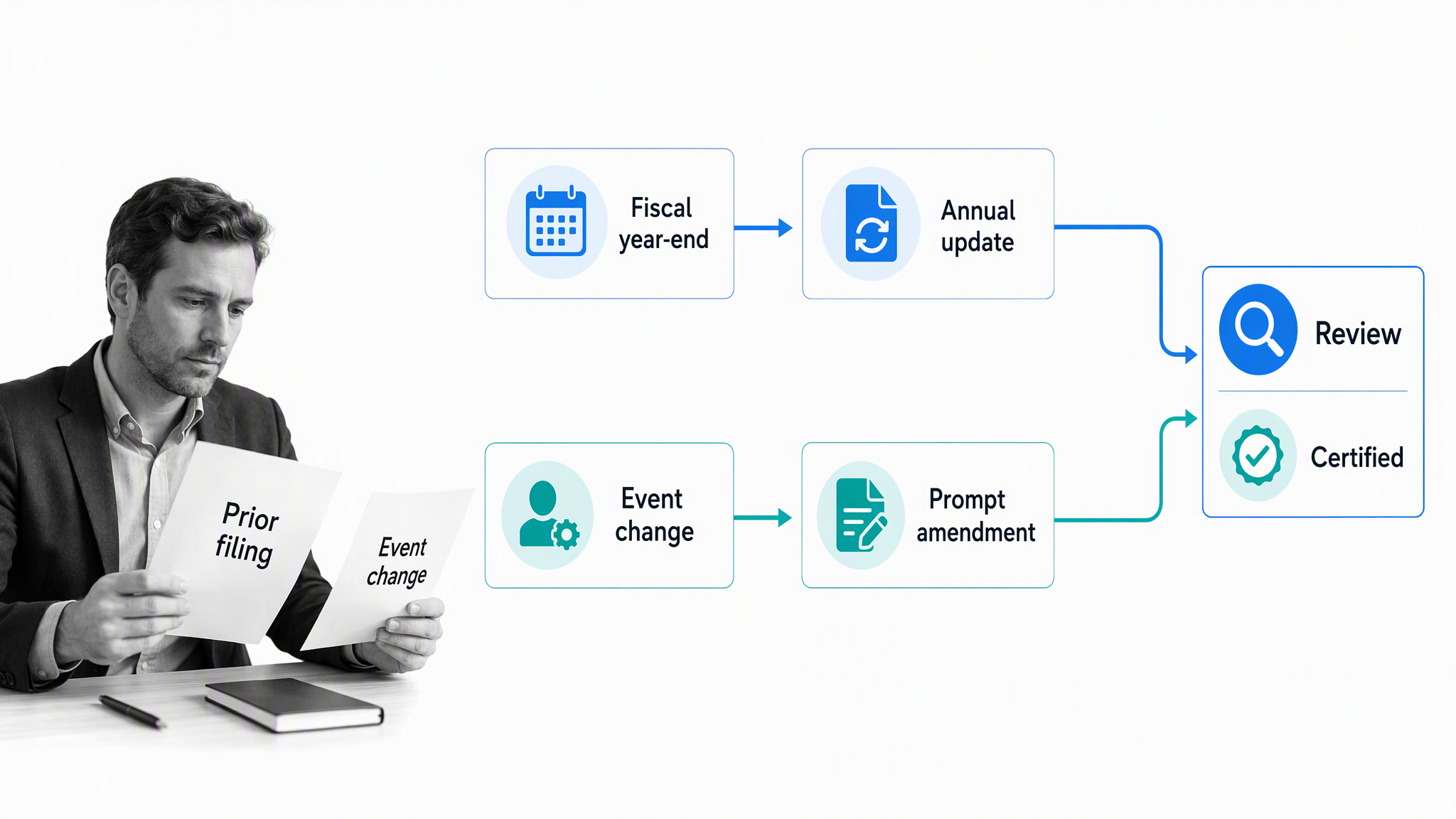
Form ADV is used by investment advisers for registration and by exempt reporting advisers for required reports. The filing path depends on the adviser, its business, assets, clients, private funds, place of business, and available exemptions. Do not assume that calling a strategy venture capital automatically resolves the analysis.
The Form ADV amendment rule in the Electronic Code of Federal Regulations requires an annual updating amendment within 90 days after fiscal year-end and also requires amendments when specified information becomes inaccurate. A controlled process therefore needs both an annual cycle and an event-driven change intake.
Assign one owner to the filing, but collect certifications from the people who own the underlying facts. Finance may own assets and financial information. Legal may own entities, control persons, disciplinary items, and fund terms. Operations may own locations and headcount. Investor relations may own investor and fund information. The final reviewer should see the source and the change from the prior filing, not only a completed questionnaire.
Form PF when applicable
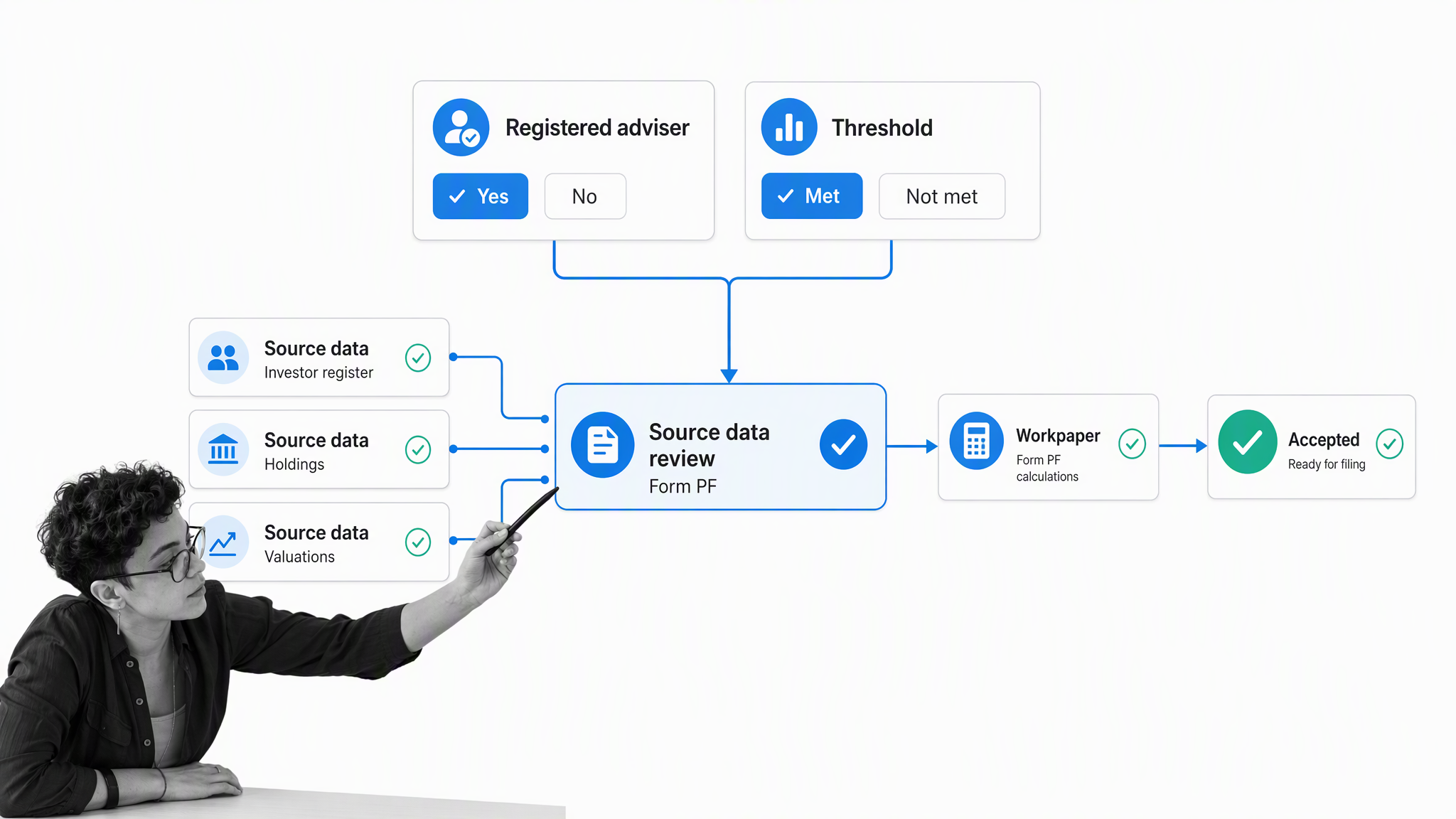
Form PF is a confidential report for certain SEC-registered investment advisers to private funds. It does not apply to every venture fund or every exempt reporting adviser. Applicability should be documented using the current instructions, the adviser’s registration status, the funds included in the calculation, related-person treatment, and the applicable reporting threshold.
Form PF work is data-intensive even when filed annually. A useful process identifies the source system and data owner for every requested value, records calculation logic, reviews changes from the prior period, resolves validation errors, retains the filed version, and captures acceptance. The deadline should be supported by earlier data-freeze, review, and approval dates.
Partnership returns and investor schedules
Many venture funds and related entities are organized as partnerships for federal tax purposes, but entity classification and filing requirements must be confirmed for each structure. The IRS Form 1065 resource explains the partnership information return and related investor schedules. The work can also include extensions, elections, state returns, foreign reporting, and delivery to investors. Tax professionals should own the technical determination.
Operations still needs a reliable workflow. Reconcile entities, ownership, capital activity, expenses, allocations, valuations, and investor information before the return is prepared. Record which data was supplied, which version was approved, when each return was accepted, when investor schedules were delivered, and which corrections remain open.
Entity, state, and event-driven filings
A fund complex can include the adviser, management company, general partner, carry vehicles, parallel funds, feeder funds, special-purpose vehicles, and portfolio entities. Each may have formation, franchise-tax, good-standing, beneficial-ownership, local, employment, or licensing work. Not every entity has the same obligations.
Create an entity register that links each legal entity to its jurisdiction, purpose, ownership, tax classification, responsible owner, registered agent, bank and administrator relationships, and recurring obligations. Then add event triggers for new funds, address changes, ownership changes, new offices, investor closings, control-person changes, and entity dissolutions.
How do fund structure and adviser status change the filing set?
Applicability is a decision tree. The fund’s exclusion under the Investment Company Act is separate from the offering exemption used to raise capital. The adviser’s registration or exempt-reporting position is another question. State law may add a different result even when a federal exemption is available.
Map the fund entities first
Start with a legal-entity diagram and an authoritative entity register. Identify the fund, general partner, adviser, management company, carry entities, feeders, parallel vehicles, special-purpose vehicles, and any relying advisers. Record jurisdiction, ownership, control, fiscal year-end, tax classification, regulatory role, bank account, and service providers.
The diagram should be version-controlled. When a new vehicle is created or control changes, the update should trigger a filing review instead of waiting for the annual compliance calendar. This reduces the risk that one team updates corporate records while the regulatory filing owner continues using an obsolete structure.
Document the adviser exemption analysis
Federal law provides an exemption from SEC registration for advisers solely to qualifying venture capital funds. A separate private-fund adviser exemption can apply when the adviser acts solely for private funds and manages less than $150 million in private-fund assets in the United States. These are registration exemptions, not a blanket exemption from reporting or antifraud obligations.
Record the legal conclusion, the funds included, the supporting data, the reviewer, and the date. Reassess it when the strategy, leverage, redemption rights, investor base, assets, office location, related persons, or types of funds change. A conclusion that was correct at formation can become wrong as the business evolves.
Separate fund, adviser, and issuer responsibilities
Use the exact legal entity responsible for each submission. The issuer may be the fund. Form ADV belongs to the adviser. A tax return belongs to a particular entity. State notices may reference both the issuer and persons selling interests. A shared brand name is not enough to determine who files.
This distinction should appear in the task title, approval, evidence folder, and filing receipt. It prevents a receipt for one entity from being treated as proof that the whole fund complex is complete.
How should a VC firm manage its filing calendar?
A good filing calendar is generated from facts and events, not copied from last year’s spreadsheet. Build it from the entity register, adviser status, offering activity, investor jurisdictions, fiscal periods, regulatory thresholds, and expected changes.
Build one controlled filing calendar
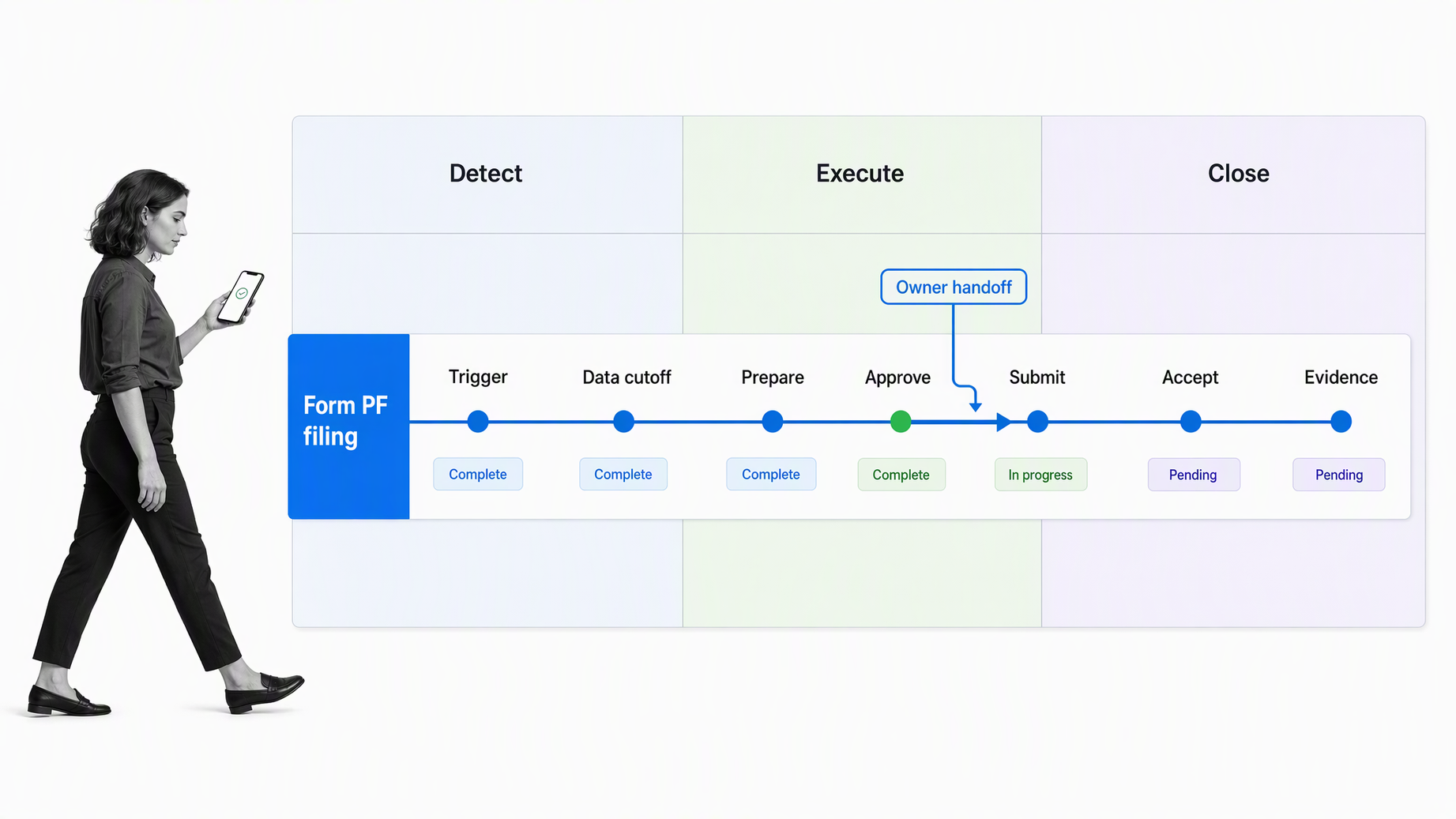
- Inventory every legal entity, regulator, filing portal, tax authority, and recurring filing family.
- Record the legal trigger, frequency, due-date rule, amendment rule, responsible entity, and authoritative source for each obligation.
- Assign a preparer, data owners, reviewer, approver, and escalation owner.
- Set internal milestones for source-data cutoff, preparation, review, authorization, submission, acceptance, fee payment, and evidence closeout.
- Add event-driven triggers for new offerings, first sales, new investors or states, ownership changes, office moves, new vehicles, and threshold crossings.
- Link each obligation to the evidence required to prove completion or document non-applicability.
- Reconcile the calendar against regulator portals, counsel, tax advisers, administrators, and the prior-period filing set.
Use absolute due dates only after the trigger and rule have been confirmed. If a filing is due a certain number of days after an event, store the event date, source, rule, calculated deadline, and reviewer. That makes the date explainable and helps the team correct it when the underlying event changes.
Control source data and review
A filing is only as reliable as its inputs. Build a source map that identifies where each answer comes from and who certifies it. Use structured fields for repeated facts, attach calculations, and compare the current period with both the prior filing and authoritative entity records.
- Entity and ownership data from legal records.
- Assets, valuations, expenses, and financial data from finance and administrators.
- Investor and closing data from subscription and investor records.
- Regulatory status and filing history from authoritative portals.
- Conflicts, disciplinary matters, and reportable events from legal and compliance intake.
- Submission acceptance, fees, and correspondence from the filing destination.
Require the reviewer to see changes, not just final answers. Material movements, blank fields, overrides, and inconsistencies should be resolved before approval. Record assumptions and counsel decisions so the next cycle does not have to reconstruct them.
Close the loop after submission
Submission is not completion. Confirm acceptance, resolve validation errors, pay required fees, save the exact filed version, distribute required copies, update the filing register, and calendar the next action. If a submission is rejected or corrected, retain the sequence and explain the final status.
At quarter-end and year-end, reconcile the calendar against portal histories, entity records, active offerings, investor locations, tax workpapers, and administrator deliverables. Escalate anything marked complete without acceptance evidence.
Which current developments affect private fund filing programs?
Vacatur of the private fund adviser rules
The private fund adviser rules adopted by the SEC in 2023 were vacated by a federal court in June 2024. The SEC later adopted technical amendments to reflect that result. A compliance program should not keep implementation tasks for the vacated package as though those rules remained effective. It should separately confirm obligations that continue under other rules, fund documents, fiduciary duties, and business practices.
Form PF amendments and the current compliance date
The SEC and CFTC have continued to adjust the compliance date for the 2024 Form PF amendments. The joint final rule available through the Federal Register extends that compliance date to July 1, 2027. Teams should verify the current form, instructions, and compliance date at the start of every reporting cycle because this area is still moving.
Investment-adviser AML rule delay
FinCEN postponed the effective date of the investment-adviser AML rule to January 1, 2028. The FinCEN announcement applies to the rule that would establish AML and suspicious-activity-report filing requirements for registered investment advisers and exempt reporting advisers.
The delay is not a reason to delete investor diligence or sanctions controls. A firm may still have obligations and expectations arising from other laws, banks, fund administrators, subscription agreements, investor commitments, or its own risk program. Separate current requirements from readiness work for the delayed rule.
How can Process Street support regulatory filing operations?
Process Street can provide the workflow and control layer around specialist systems. It does not replace EDGAR, IARD, tax software, fund accounting, a regulator portal, a fund administrator, or professional advice. It coordinates the people, evidence, decisions, and handoffs required to use those systems correctly. This is the same role a mature workflow management system plays across recurring, risk-sensitive operations.
Coordinate evidence, approvals, and exceptions in Process Street
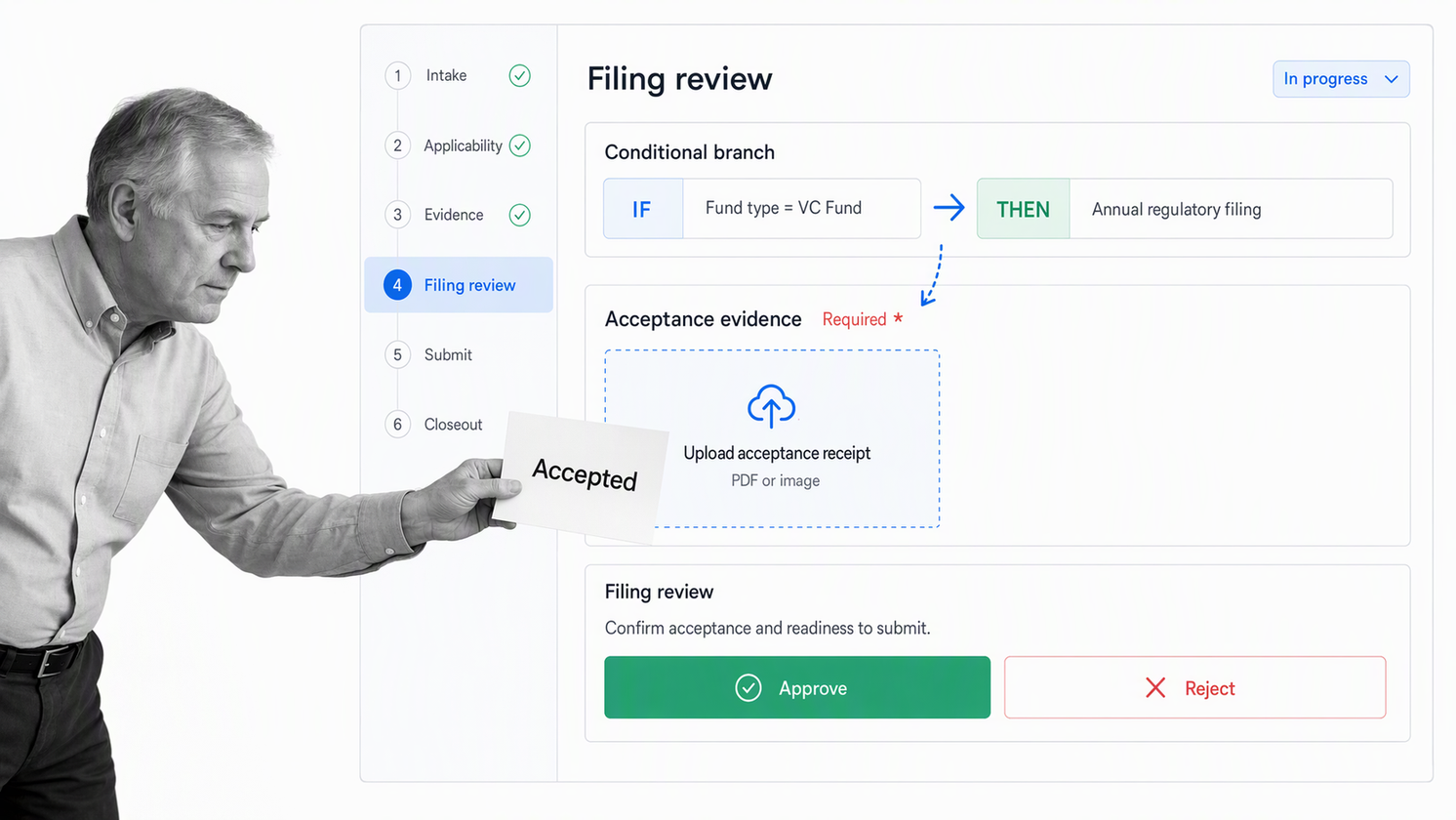
A filing workflow can begin with the entity, filing family, legal trigger, period, and due-date rule. Conditional paths can reveal only the tasks that apply. Form fields can collect source data and certifications. Assigned tasks can separate preparation from review. Approval steps can record authorization. Required evidence fields can capture the filed copy, receipt, fee confirmation, and regulator correspondence before closeout.
| Control point | Process Street pattern | Result |
|---|---|---|
| Applicability | Structured intake with conditional branches and reviewer decision | A recorded basis for filing or non-applicability |
| Data collection | Assigned requests with required fields and attachments | Clear ownership of each source fact |
| Review | Approval task with change summary and supporting evidence | A traceable authorization decision |
| Deadline management | Internal milestones, due dates, reminders, and escalation | Earlier visibility into delays and missing inputs |
| Submission closeout | Required receipt, fee, acceptance, and amendment checks | Completion based on evidence rather than assertion |
| Exception handling | Conditional remediation path with owner and due date | Rejected filings and late inputs remain visible |
The broader compliance operations model connects the filing calendar to policies, controls, evidence, exceptions, remediation, and management reporting. The result is not a claim that software determines the law. It is an operating system that helps the responsible professionals apply their determination consistently and prove what happened.
Start with one filing family that crosses several teams, such as Form ADV, Form D and state notices, or a partnership tax package. Map the trigger and evidence, run the workflow through one real cycle, then expand the pattern to the rest of the filing register.
Venture capital regulatory filings FAQs
What are venture capital regulatory filings?
They are the federal, state, tax, and other required submissions that can apply to a venture fund, its adviser, its offerings, and its ongoing operations. The exact set depends on the fund structure, adviser status, offering exemption, assets, investors, jurisdictions, and activities.
Does every venture capital fund file Form ADV?
No. Form ADV obligations depend on the adviser and the registration or reporting regime that applies. Some advisers register with the SEC or a state, some report as exempt reporting advisers, and some may fall outside those paths. The current instructions and qualified counsel should be used for the actual determination.
When is Form D due for a Regulation D offering?
The SEC states that an issuer relying on Regulation D must file Form D within 15 days after the first sale of securities. State notice filings, fees, amendments, and renewal requirements must be managed separately for the jurisdictions involved.
Do all venture funds file Form PF?
No. Form PF applies to certain SEC-registered investment advisers to private funds that meet the applicable reporting threshold. A fund should confirm filer status and use the current form, instructions, and compliance dates rather than assuming that every venture adviser has the same obligation.
Are investment advisers already subject to the delayed FinCEN AML rule?
FinCEN postponed the effective date of its investment-adviser AML rule until January 1, 2028. Firms should still assess obligations that arise under other laws, contractual commitments, sanctions controls, bank or administrator requirements, and risk-based investor diligence procedures.
How can Process Street support venture capital regulatory filings?
Process Street can coordinate filing intake, ownership, conditional routing, evidence collection, reviewer approvals, deadline reminders, exceptions, and closeout records. It supports the operating process around authoritative filing systems and professional judgment rather than replacing regulators, filing portals, fund administrators, tax advisers, or counsel.