Turn every policy into automated workflows with built-in enforcement and audit-ready proof.



AI Agent Development Company Guide
AI agent development is the work of designing, building, testing, deploying, and governing agents that can reason over context, use tools, and complete business tasks. An ai agent development company should do more than connect a model to a chat window. It should turn agent ideas into reliable workflow systems with controls, approvals, evidence, and measurable outcomes.
That distinction matters when agents move from answering questions to taking action. A production agent may read internal knowledge, update a system, request evidence, route an exception, or draft a customer message. Each action needs context, permission, evaluation, and an operating path that humans can inspect.
This guide explains what AI agent development includes, how development companies structure the work, which architecture choices matter, how to evaluate vendors, and how governed workflows make agent behavior safer to scale.
In this guide, we cover:
- What AI agent development means
- What an AI agent development company actually builds
- What AI agent development includes
- The AI agent development process
- How to choose an AI agent development company
- How Process Street supports AI agent development
- AI agent development mistakes to avoid
- AI agent development FAQs
What AI agent development means
AI agent development is the end-to-end discipline of creating software agents that can pursue goals, decide which tools to use, observe results, and continue through a task. OpenAI guide to building AI agents frames agents around instructions, tool access, guardrails, handoffs, and evaluation. That framing is useful because the agent is not only the model. It is the model plus the surrounding operating system.
Agents need an operating boundary
A useful agent needs a clear job, trusted context, approved tools, a way to track state, and a rule for when to stop or escalate. Without those boundaries, the system may look impressive in a demo but fail when work is messy, incomplete, or sensitive.
Development is different from prompting
Prompting shapes the agent’s language and reasoning. Development shapes the whole system around that reasoning: data access, tool permissions, workflow state, test cases, logging, monitoring, release controls, and human review. A prompt can start the prototype, but development makes it operate.
The goal is controlled autonomy
Controlled autonomy means the agent can handle repeated judgment work while the business still owns the process. Related patterns such as AI agent orchestration and an AI agent builder are useful because agents rarely work alone in production. They need routing, permissions, approvals, and handoffs.
What an AI agent development company actually builds
An AI agent development company typically builds the full path from use case discovery to production operations. The strongest teams treat agent work as a product, a workflow, and a control system at the same time.
Use case discovery
Discovery starts with the business outcome, not the model. The team maps where work gets stuck, what context people gather manually, which systems hold the truth, which decisions repeat, and which steps create risk if an agent acts too freely.
Agent architecture
Architecture defines the agent role, goals, context sources, memory scope, tools, permissions, workflow state, evaluation set, and escalation rules. It also defines whether the agent operates alone, hands work to another agent, or sits inside a wider workflow.
Prototype and tool connection
After architecture, the team builds a thin version that can call a small number of controlled tools. OpenAI Agents SDK documentation describes an agent stack with models, tools, handoffs, guardrails, tracing, and evaluations. Those components should appear early, even when the first version is small.
Evaluation and release
Before release, the agent needs test cases that reflect real work. Include missing data, conflicting instructions, bad inputs, unexpected tool errors, and high-risk decisions. The release plan should define what the agent can do by itself and what still requires approval.
Operations and improvement
Production development continues after launch. Teams review failed runs, false confidence, unnecessary escalations, slow tool calls, cost patterns, and user feedback. The agent improves when the operating evidence shows where it hesitated, guessed, or needed a clearer path.
Change management
Agent development also needs change management. People need to know when the agent is assisting, when it is acting, how to correct it, and where to report a problem. A useful development partner plans the rollout, not only the code. That includes training, documentation, release notes, support paths, and a clear decision about which teams can request changes.
What AI agent development includes
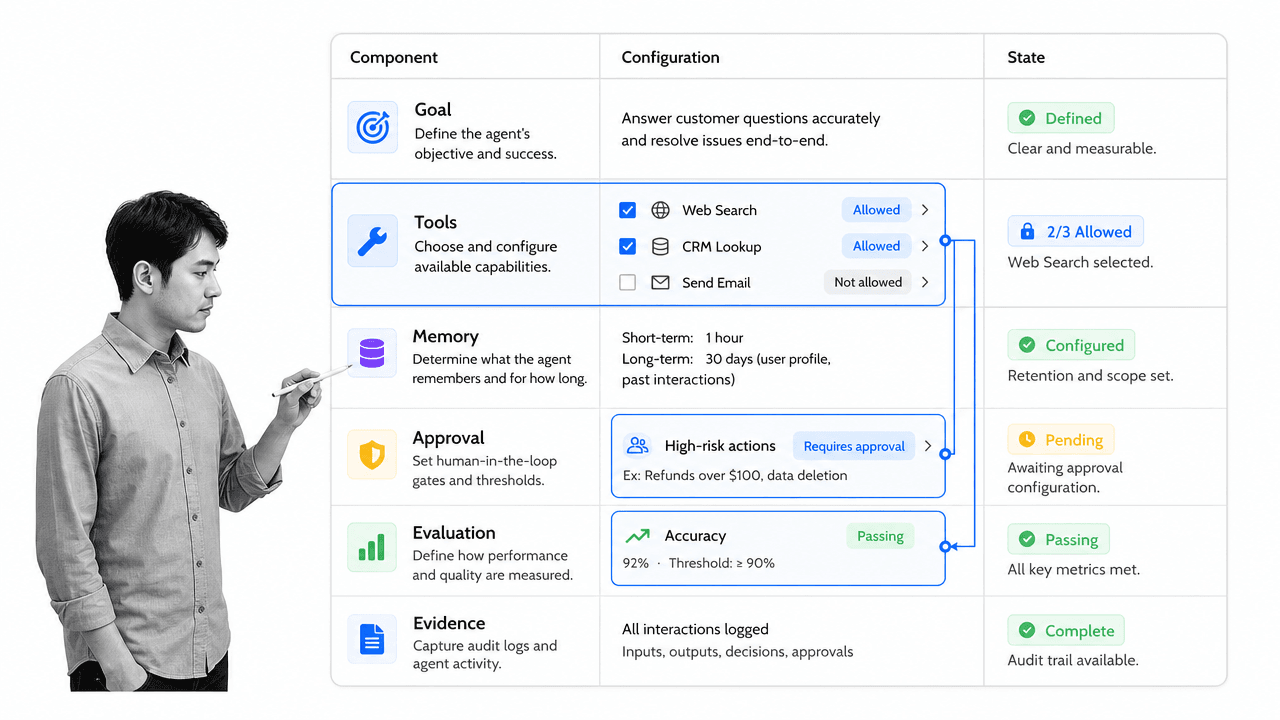
AI agent development includes several layers that need to work together. If one layer is missing, the agent may still respond, but it will be harder to trust inside a business process.
Goal and policy layer
This layer defines the job, allowed behavior, forbidden behavior, escalation path, and success criteria. Durable policies should live outside one-off prompts so teams can reuse them across agent workflows.
Context layer
The context layer retrieves the right information at the right time. It may include policies, workflow runs, customer records, tickets, contracts, approvals, forms, or prior outcomes. Context should be scoped to the task so the agent does not use irrelevant or sensitive information.
Tool layer
The tool layer gives the agent controlled ways to act. Model Context Protocol documentation is one example of the broader movement toward standardized tool connections. For business use, the critical question is not only whether the agent can connect, but whether each action is authorized, logged, and reversible.
State and memory layer
State tells the agent where the work stands. Memory can include the current request, previous observations, tool results, open questions, and completed steps. Keep memory purposeful. Unlimited memory can create privacy, accuracy, and governance problems.
Evaluation layer
Evaluation checks whether the agent is doing the job correctly. Anthropic guidance on building effective agents recommends starting with simple patterns and adding complexity only when needed. That principle applies to evaluation too: begin with clear examples, then expand as real use reveals harder cases.
Governance layer
Governance defines approvals, monitoring, ownership, risk treatment, and audit expectations. The NIST AI Risk Management Framework gives teams a useful vocabulary for mapping, measuring, managing, and governing AI risk. Agent development should make those controls operational rather than leaving them in a policy document.
The AI agent development process
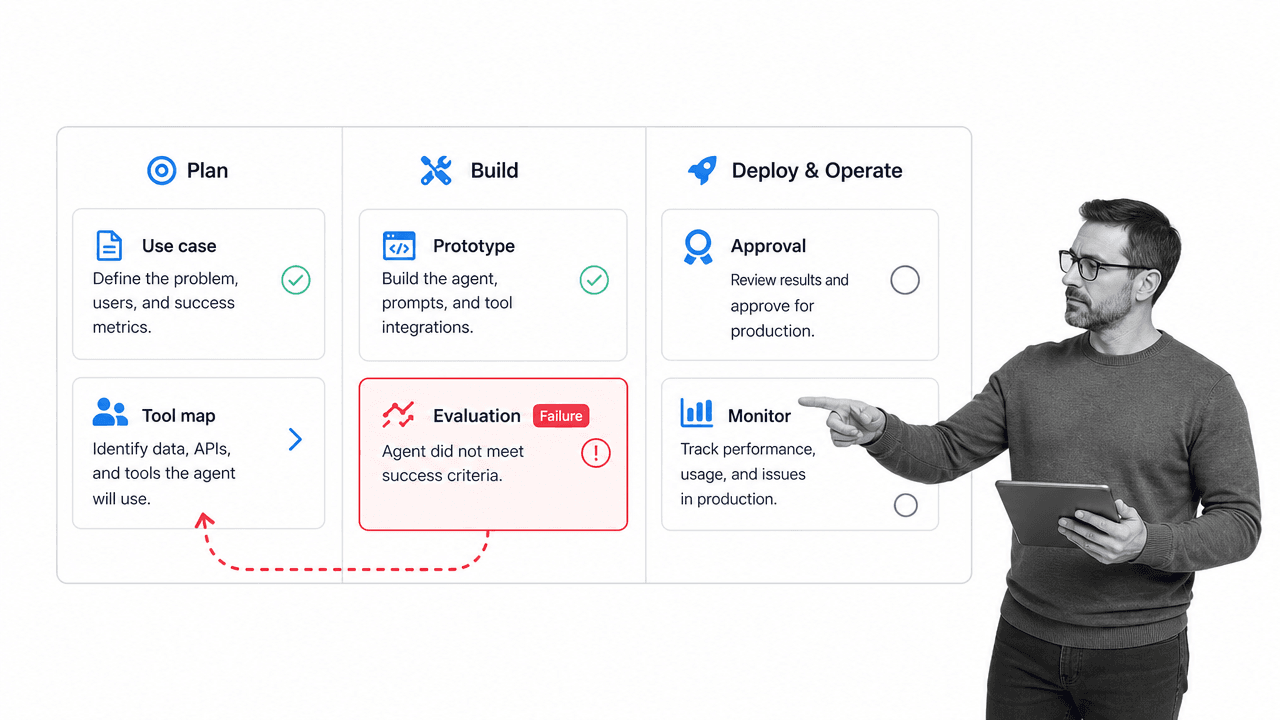
The AI agent development process should move from bounded discovery to controlled production. A company that skips evaluation, ownership, or release controls is building a demo, not a reliable agent.
Define the workflow first
Start by mapping the process the agent will support. The workflow should show inputs, owners, systems, approvals, evidence, exceptions, and completion criteria. Teams comparing AI workflow tools or broader AI ops tools should look for tools that keep agent action connected to the process, not detached from it.
Decide the autonomy level
Separate read actions from write actions. Separate low-risk drafting from customer-impacting action. A mature rollout often starts with recommendations, moves to supervised tool use, and expands autonomy only when the evidence supports it.
Build the smallest useful agent
The first build should prove one valuable path. Give the agent a narrow goal, one or two context sources, limited tools, and clear failure behavior. Small agents are easier to evaluate, easier to monitor, and easier to improve.
Test against realistic failures
Test the agent against incomplete requests, incorrect source material, conflicting user instructions, tool timeouts, missing permissions, and attempts to make the agent ignore policy. Passing only clean examples does not prove readiness.
Document the control model
The control model should be explicit before launch. Write down who owns the agent, which tools it can access, which actions are read-only, which actions can change records, which actions require review, and what happens when the agent is uncertain. This documentation makes later expansion easier because every new capability can be compared against an existing control baseline.
Release with human checkpoints
When an agent touches live systems, use approval checkpoints before high-impact actions. Patterns from workflow automation compliance are relevant because agent governance and compliance automation share the same need for evidence, review, and traceability.
Monitor and tune from run evidence
After release, monitor task completion, escalation quality, blocked actions, user correction, hallucinated assumptions, cost, latency, and tool failure. Tune the agent from recorded runs rather than anecdotal feedback alone.
How to choose an AI agent development company
Choosing an AI agent development company is partly a technical decision and partly an operating decision. The right partner should understand models, integrations, workflow design, security, evaluation, and change management.
Ask for the architecture, not just a demo
A polished demo may hide weak controls. Ask how the agent gets context, which tools it can call, how permissions are scoped, how state is stored, how humans approve sensitive steps, and how failed runs are reviewed.
Look for workflow fluency
Agents act inside processes. A partner should be able to discuss routing, ownership, exceptions, and audit history as naturally as model selection. If the team only talks about chat, compare their approach with automated operations software and workflow automation platforms to see what operational depth is missing.
Check evaluation discipline
Ask what test cases they will build before launch, how they measure output quality, how they detect unsafe tool calls, and how they decide the agent is ready for more autonomy. Strong vendors are specific about failure modes.
Demand security and risk controls
Agent systems introduce risks around prompt injection, excessive agency, sensitive information disclosure, and unsafe tool use. OWASP LLM application security guidance is a useful reference point for security conversations because it focuses attention on how language-model systems behave when they connect to tools and data.
Review integration governance
Many agent projects fail when tool access is treated as an implementation detail. Ask how integrations are approved, how credentials are protected, how permissions are scoped, how tool failures are logged, and how access is removed when the agent changes role. The answer should be operationally clear, not hidden inside a generic security statement.
Clarify ownership after launch
The development company should help define who owns the agent, who can change its tools, who reviews incidents, who approves releases, and who monitors performance. Without ownership, agent governance becomes a shared responsibility gap.
Prefer measurable expansion
The best partner will not push every agent toward full autonomy. They will help you expand in stages, from draft support to supervised action to more autonomous execution. That staged path is especially important for AI employee patterns, where the agent’s work may affect a real operational outcome.
How Process Street supports AI agent development
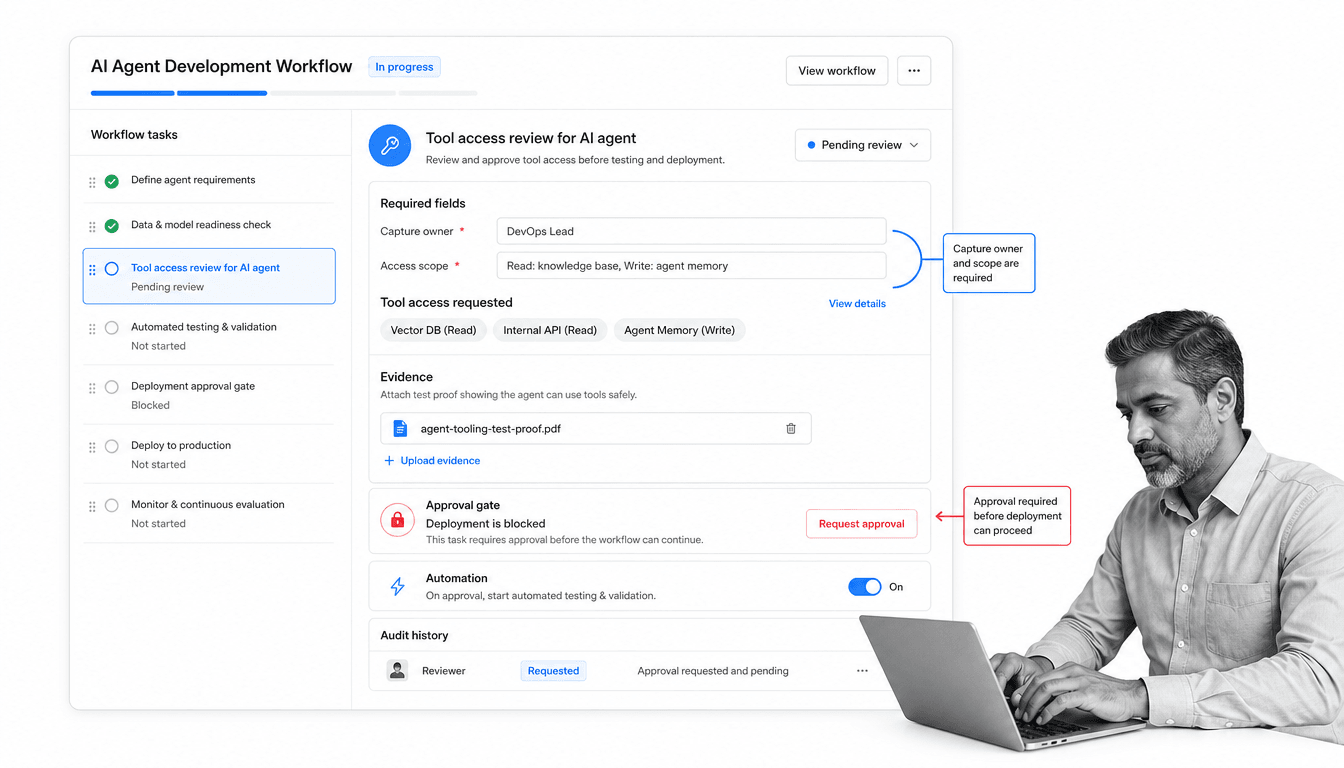
Process Street supports AI agent development by giving agent work a governed workflow spine: intake, task routing, owners, approvals, evidence, audit history, and integrations across the systems where work already happens.
Turn agent intake into structured work
Agent ideas can begin as workflow runs that capture the business goal, owner, data sources, allowed tools, risk level, evaluation criteria, and release path. Teams can also adapt an AI development process template or AI product development process template when they need a repeatable starting point.
Route approvals before sensitive action
Before an agent gets access to a system, changes a record, sends a message, or escalates autonomy, a workflow can require review. An enterprise approval process checklist gives teams a simple pattern for approval gates that preserve accountability.
Capture evidence as the agent operates
The useful output of an agent is not only the final answer. It is also the trail of inputs, decisions, approvals, tool calls, and exceptions. Process Street keeps that evidence attached to the workflow so teams can review and improve the agent.
Adapt paths with conditional logic
Agents often need different paths for low-risk, medium-risk, and high-risk work. Conditional Logic helps route tasks based on risk level, missing evidence, approval status, or selected tool access.
Connect agents to operational systems
Agent development becomes more valuable when the workflow connects to the systems that hold records, messages, files, and approvals. Process Street’s integration approach helps teams connect agent activity to the rest of their stack without turning every workflow change into a custom engineering project.
Keep approvals close to the work
Approvals work best when they appear in the same workflow where the agent is doing the task. Reviewers should see the request, context, risk level, evidence, and proposed action in one place. That makes the decision easier to make and easier to audit later.
Coordinate teams of agents and humans
Complex work may require multiple agents plus human reviewers. multiplayer AI agents can help teams divide work between specialist agents, reviewers, and workflow owners while keeping the process visible.
Support model training and evaluation routines
Development teams also need repeatable testing and review. An AI model training process template gives teams a structured path for recording training inputs, evaluation notes, validation outcomes, and release decisions before expanding agent access.
AI agent development mistakes to avoid
Most AI agent development failures are not caused by one bad prompt. They come from missing operating design around the agent.
Giving broad tool access too early
An agent with broad permissions can make mistakes faster than a human can catch them. Before granting real access, teams should understand what changes when AI agents with real access and design approval gates around the risky steps.
Skipping business ownership
An agent needs a named owner. Someone must own the goal, the allowed tools, the evaluation criteria, the release decision, and the review of failed runs. Technical ownership alone is not enough.
Treating a prototype as production
A prototype proves possibility. Production requires monitoring, testing, permissions, rollback, documentation, and support. Do not let a successful demo become a live agent without the operating controls that make it sustainable.
Ignoring the human workflow
Agents should remove repetitive work, not make the human process invisible. The strongest systems use agents beside clear human responsibilities, similar to an AI coworker that can assist work while people remain accountable for outcomes.
Failing to preserve evidence
If the team cannot explain what the agent saw, which tool it used, why it escalated, and who approved the action, the system will be hard to audit and hard to improve. Evidence should be captured by default.
AI agent development FAQs
What is AI agent development?
AI agent development is the process of designing, building, testing, deploying, and governing AI agents that can reason over context, use tools, and complete tasks inside defined operating boundaries.
What does an AI agent development company do?
An AI agent development company helps identify use cases, design agent architecture, connect tools and data, build prototypes, evaluate behavior, release agents, and monitor production performance.
How is AI agent development different from workflow automation?
Workflow automation follows predefined rules. AI agent development adds model reasoning, tool use, memory, adaptive planning, and evaluation. The strongest systems combine both: workflows provide control while agents handle variable context.
How long does AI agent development take?
The timeline depends on scope, integrations, data readiness, risk, and approval requirements. A narrow supervised agent can move faster than a multi-system agent with sensitive write access and strict governance needs.
What makes an AI agent safe for business use?
Safer agents have scoped permissions, clear owners, realistic evaluations, human approval for sensitive actions, audit history, monitoring, rollback options, and a workflow that defines when the agent should stop or escalate.
How does Process Street help with AI agent development?
Process Street helps by turning agent work into governed workflow runs with intake, tasks, owners, approvals, evidence, audit history, conditional paths, and integrations across operational systems.