


The Brexit campaign strategy was a system for combining emotional messaging, audience data, digital advertising, social distribution, and supporter follow-up. Those mechanisms are well documented. Exactly how many votes they changed is much harder to prove.
During the 2016 EU referendum, most final polls put Remain ahead, although the race was close. The final result went the other way: 51.9% voted to leave the European Union, according to the BBC’s referendum results record.
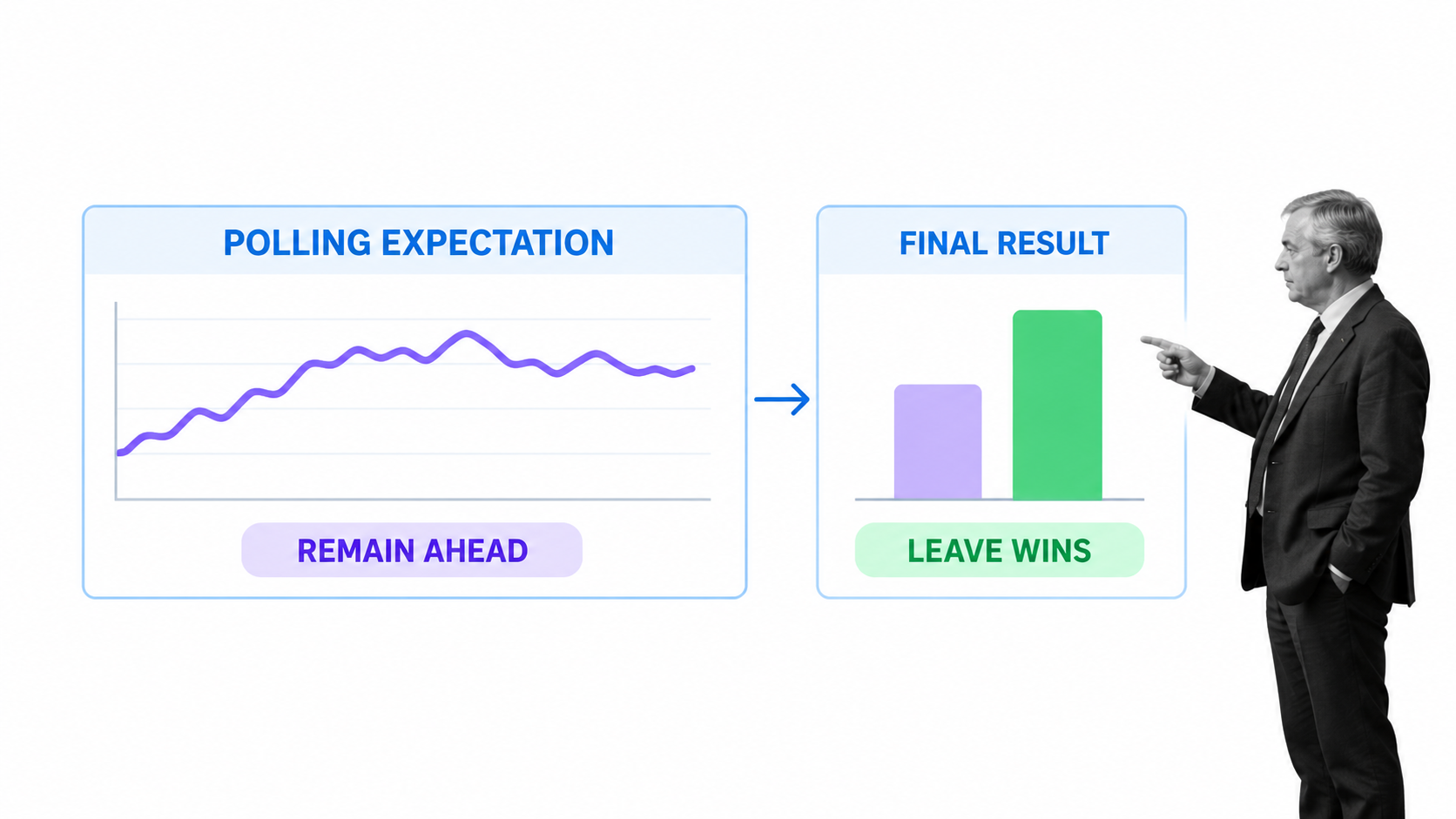
That reversal made the campaign a lasting case study in how political organizations use big data and social media. The most useful lesson is not that a single vendor or algorithm delivered Brexit. It is that campaigns built systems for finding receptive audiences, testing messages, distributing provocative content, and converting engagement into action.
The European Union and the Trump comparison
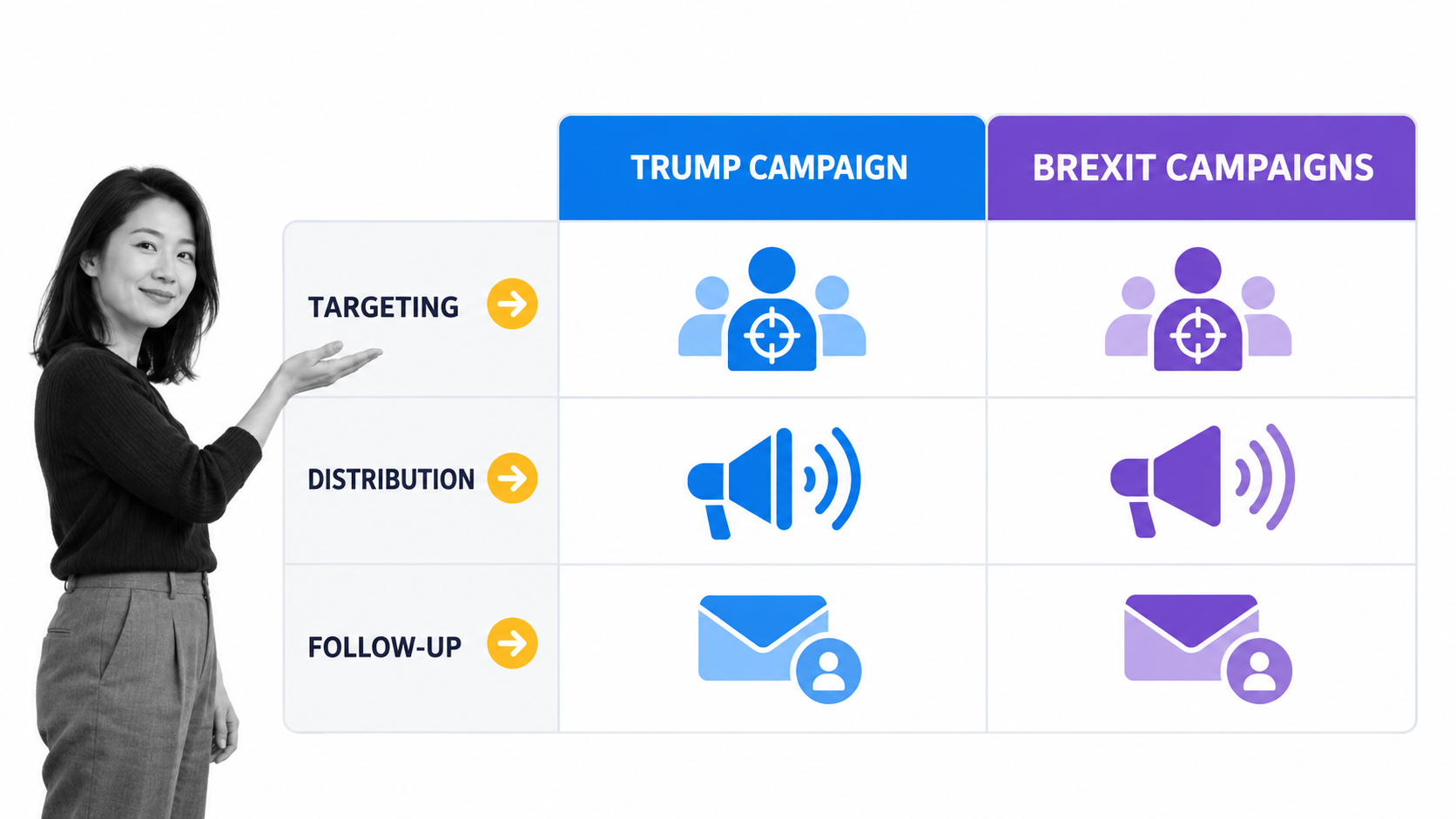
How the European Union was Trumped captures an operational rather than causal parallel: both campaigns built digital systems to target audiences, distribute messages, and follow up with supporters.
An earlier Process Street analysis of political processes and campaign strategy examined Donald Trump’s campaign for President of the United States.
Underneath his media dominance and ubiquitous online presence lay the unlikely driver of Jared Kushner. Trump’s son-in-law operated as COO of the Republican campaign.
He brought in his Silicon Valley connections and established a data center where analytics and social media marketing were able to define the campaign’s targeting.
Forbes reported that Kushner credited Facebook microtargeting with lifting the Trump campaign’s daily merchandise sales from $8,000 to $80,000. The campaign also used short-form social video to generate millions of views of Donald Trump delivering policy proposals. These figures are campaign claims reported at the time, not independent proof of electoral impact.
This marketing effort strategically targeted winnable states and the core demographics who resided in them.
Trump and Kushner felt they no longer needed to rely on the media to disseminate their message and validate their policies. Rather, the media worked as an amplifier while the social media campaigns informed voters of Trump’s views and stances on different issues.
The Brexit campaign shares many similarities with the Trump campaign, and their respective victories were both jointly celebrated.
The Brexit battleground
Unlike in the American election, Brexit was not a two-horse race. There may have only been two eventual outcomes, but there were multiple campaigns pushing for results.
On the side wanting to stay in the EU, the official Remain campaign, Britain Stronger in Europe, represented a cross-party coalition that included Conservative Prime Minister David Cameron, Labour’s Lord Peter Mandelson, and Green MP Caroline Lucas.
Alongside the official campaign, more than 70 other groups registered to campaign in the referendum. The BBC profiled ten alternative groups that approached the choice from different political and cultural angles.
These different groups often shared the same rhetoric and approach to the issue, and other times made different arguments concerning EU matters. That broader coalition produced varied messages, including poster concepts that the official campaign ultimately rejected.
On the opposing side, there were again multiple groups campaigning to leave the EU. Two, in particular, are of importance; Vote Leave and Leave.EU.
Vote Leave was the Leave campaign’s equivalent of Stronger In. Both were cross-party platforms composed mainly of politicians and household names. They campaigned through familiar political tactics: rallies, television appearances, speeches in Parliament, and door-knocking in key neighborhoods.
The anomaly in this scenario is the Leave.EU organization. Leave.EU was founded by committed eurosceptics, businessmen Arron Banks and Richard Tice, who were aligned with the United Kingdom Independence Party.
While Vote Leave and Stronger In treated the vote like a normal election and tried to win over middle England, Leave.EU aimed at a different demographic.
Leave.EU audience identification and political microtargeting
How Leave.EU identified its audience is best understood through political microtargeting: dividing voters into narrow groups using supplied, observed, or inferred data, then tailoring messages to each group. The distinction matters: a person can provide an age or postcode, reveal interests through behavior, or have traits inferred from patterns in a much larger dataset.
The scientific foundation for much of the 2016 debate came from research by Michal Kosinski and colleagues at the University of Cambridge. The work followed a simple Cambridge University psychometric study that invited participants to grant Facebook access and grew to millions of respondents. A 2013 peer-reviewed study showed that Facebook Likes could predict sensitive personal attributes with measurable accuracy, including intelligence, religious affiliation, and patterns associated with alcohol and cigarette use. A 2015 follow-up study found a memorable progression: with enough Likes, a computer model could outperform the judgments of a work colleague, then a friend or roommate, a family member, and eventually a spouse. Those results described prediction accuracy in the study samples, not a campaign’s ability to change votes.
The research often used the Big Five personality traits, also called OCEAN: openness, conscientiousness, extraversion, agreeableness, and neuroticism. In principle, those scores let a campaign move beyond broad demographic segments and test different messages for people who appear to respond to risk, novelty, identity, or social proof.
“A really ridiculous idea. The idea that all women should receive the same message because of their gender, or all African-Americans because of their race.”
Alexander Nix of Cambridge Analytica used that line to sell psychographic targeting in a widely circulated account of the firm’s methods. It was an influential claim, but it should not be confused with proof that the company ran Leave.EU’s referendum campaign.
Cambridge Analytica and Leave.EU did hold preliminary discussions. Later regulatory work did not substantiate the stronger claim that Cambridge Analytica delivered referendum services to Leave.EU. The UK Information Commissioner’s Office said it found no evidence of participation beyond initial enquiries. The Cambridge Psychometrics Centre states that it did not provide its data, software, or models to Cambridge Analytica, SCL, Aleksandr Kogan, or Leave.EU.
The controversy still matters because it exposed the appeal of a powerful campaign promise: use behavioral data to identify persuasion targets more precisely than conventional polling or demographic marketing. The evidence for that promise was always less certain than the sales pitch.

Executing the campaign strategy on social media
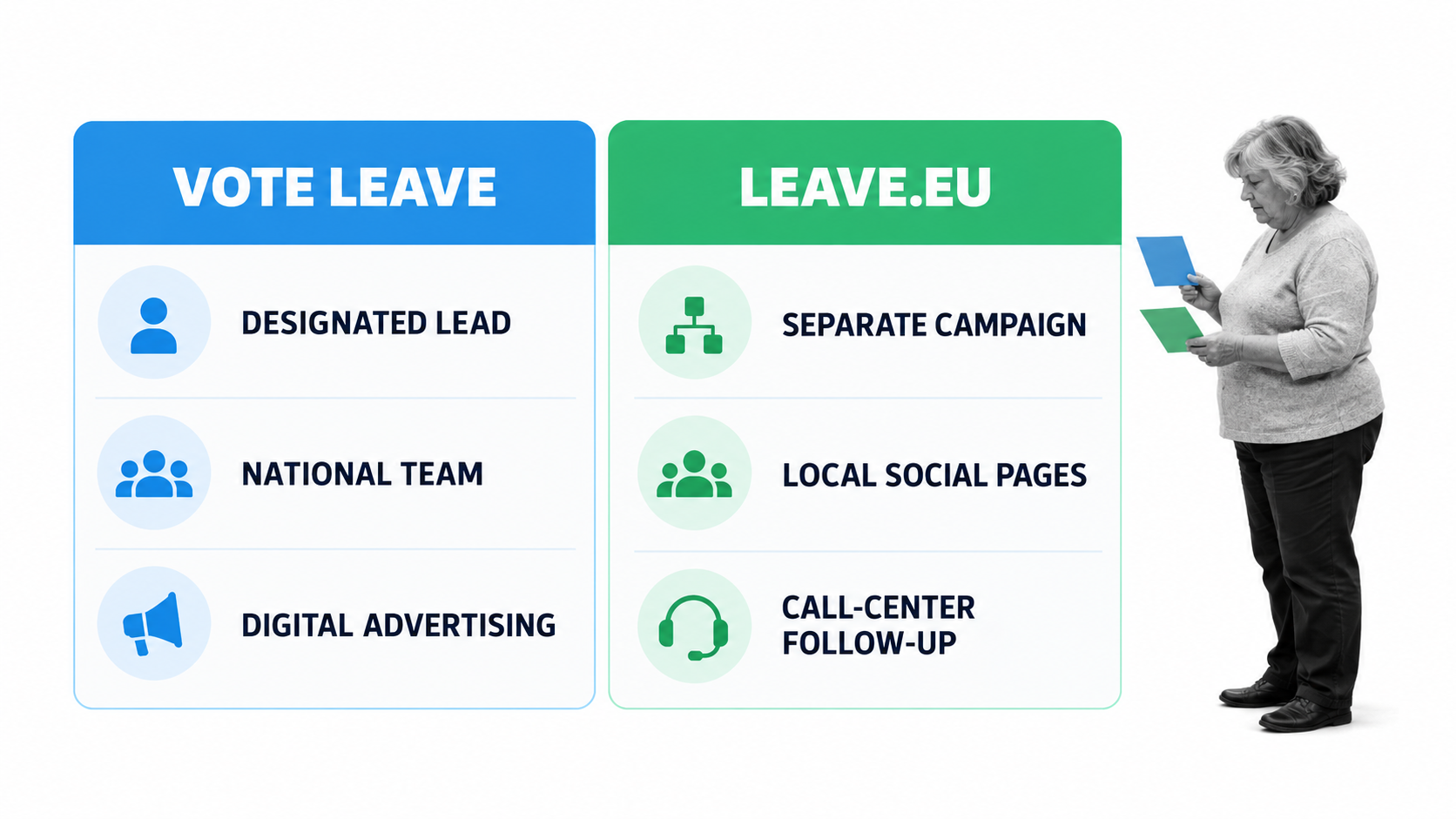
The referendum’s digital activity needs two separate names. Vote Leave was the designated lead campaign for the Leave outcome. Leave.EU was a different, non-designated campaign. Treating them as one organization obscures which tactics and suppliers are documented.
Vote Leave was designated as the lead campaign for the Leave outcome. The Information Commissioner’s Office found that AggregateIQ created 2,529 of the 2,823 referendum ads it reviewed on behalf of Vote Leave and ran 218 ads aimed at email-address audiences in the final days of the campaign. That documented advertising record shows a large, varied testing operation. The creative mixed identity, immigration, public spending, national control, and calls to action. The point was not one perfect message. It was continuous distribution and testing across audience segments.
Leave.EU ran its own attention and mobilization operation. A contemporary profile preserved in an Electoral Commission disclosure described its Bristol operation. The campaign distributed videos, cartoons, text messages, and news clips across Facebook, Twitter, YouTube, and other platforms; people who liked or commented were contacted by its 70-person call center and invited to join the cause.
Banks summarized the campaign’s emotional approach bluntly:
“‘Facts don’t work,’ and that’s it. The Remain campaign featured fact, fact, fact, fact, fact. It just doesn’t work. You have got to connect with people emotionally. It’s the Trump success.”
He also recalled the attention logic shared by Trump campaign contacts:
“The more outrageous you are, the more attention you get.”
That approach favored provocative content that could travel quickly, trigger reactions, and create a pool of supporters for further contact. It did not require every person to see a uniquely engineered psychographic message. Network effects, local pages, paid distribution, and human follow-up could work together.
Banks published The Bad Boys of Brexit. Its title captures the campaign’s deliberate preference for attention and disruption.

The Brexit social media promotion process can be summarized in three stages:
- Create provocative content that connects with audience concerns or highlights an opponent’s weakness.
- Distribute and test that content across paid, owned, and networked social channels.
- Use the Bristol call center and social media hub to follow up with people who engage, invite them to join the campaign, recruit volunteers, and prompt further action.
The final stage turned attention into supporter conversion and mobilization. It also made the campaign a repeatable operating process, not a series of isolated posts.
Big data, election influence, and evidence
Is big data deciding big elections? The evidence does not support a simple switch that decided the referendum. What it shows is a set of capabilities: campaigns could segment audiences, test creative, buy targeted distribution, observe engagement, and coordinate follow-up at a scale that older campaign organizations could not match.
Those abilities mattered as part of an accompanying promotion process across social platforms, but targeting accuracy versus persuasion impact remained an open question.
Those capabilities can change how a campaign allocates money and attention. They do not prove that a specific ad persuaded a specific voter, or that digital tactics outweighed party identity, economic concerns, media coverage, local campaigning, or long-standing attitudes toward the European Union.
Social data also has a representativeness problem. The people who like, share, comment, or volunteer online are not a clean sample of the electorate. Engagement data can tell a campaign what travels inside a platform while still giving a distorted view of everyone who will vote.
The durable lesson from the Brexit campaign strategy is operational. Data becomes influential when it is connected to a system for making decisions, distributing messages, learning from response, and acting again. That is true in politics and in ordinary organizations practicing data management.
It also creates a governance obligation. Teams need clear rules for consent, data provenance, audience inference, access, review, and audit trails. A precise targeting model does not make a campaign accurate, representative, or accountable by itself.
For operational teams, Process Street brings those controls into one Compliance Operations Platform. Docs and Ops capability areas connect governed procedures with repeatable execution, while built-in AI helps teams monitor work and surface risk. The goal is not more data for its own sake. It is a controlled process that turns evidence into action and leaves proof of what happened.
The 2016 referendum remains a useful warning against single-cause stories. Social media and big data shaped how campaigns found audiences and organized persuasion. The final result still belonged to millions of voters making decisions for many different reasons.