Turn every policy into automated workflows with built-in enforcement and audit-ready proof.



12 Best Checklist Makers for Business Processes
A checklist maker helps you turn repeated work into a list people can follow, reuse, and improve. The right one depends on what the checklist has to do: remind one person, coordinate a team, collect evidence, generate an SOP, or enforce a business process.
For simple tasks, a to do app or design tool may be enough. For recurring business processes, the checklist needs owners, due dates, approvals, conditional steps, and a reliable record of what happened. This guide compares the best checklist maker tools by that real job, not just by whether they can draw checkboxes on a page.
In this article, we will cover:
- What to look for in a checklist maker
- Process Street
- Checklist.com
- checklist.gg
- Manifestly
- SafetyCulture
- ClickUp
- Todoist
- Trello
- Asana
- Miro
- Canva
- Venngage
- Benefits of using a checklist maker
- Types of checklists supported by checklist makers
- Get started with a checklist maker
- Checklist maker FAQs
What to look for in a checklist maker
Start with the kind of checklist you are making. A grocery list, a design checklist, a safety inspection, and an employee onboarding workflow all use checkboxes, but they need different software.
For personal productivity, look for speed, recurring tasks, mobile access, and simple organization. For team projects, look for assignees, due dates, comments, templates, and shared views. For business processes, look for workflow runs, required fields, approvals, conditional logic, integrations, permission control, and audit history.
A useful checklist maker should also make reuse easy. The value is not only creating the first checklist. It is being able to run it again, improve it when the process changes, and know whether the work was completed correctly.
- Template creation and reuse for repeated work
- Assignments, due dates, and reminders when more than one person is involved
- Fields, files, photos, or evidence collection when proof matters
- Conditional paths for processes that change based on answers
- Approvals and audit history for compliance sensitive work
- Exports or sharing when the checklist needs to become a document or resource
Process Street
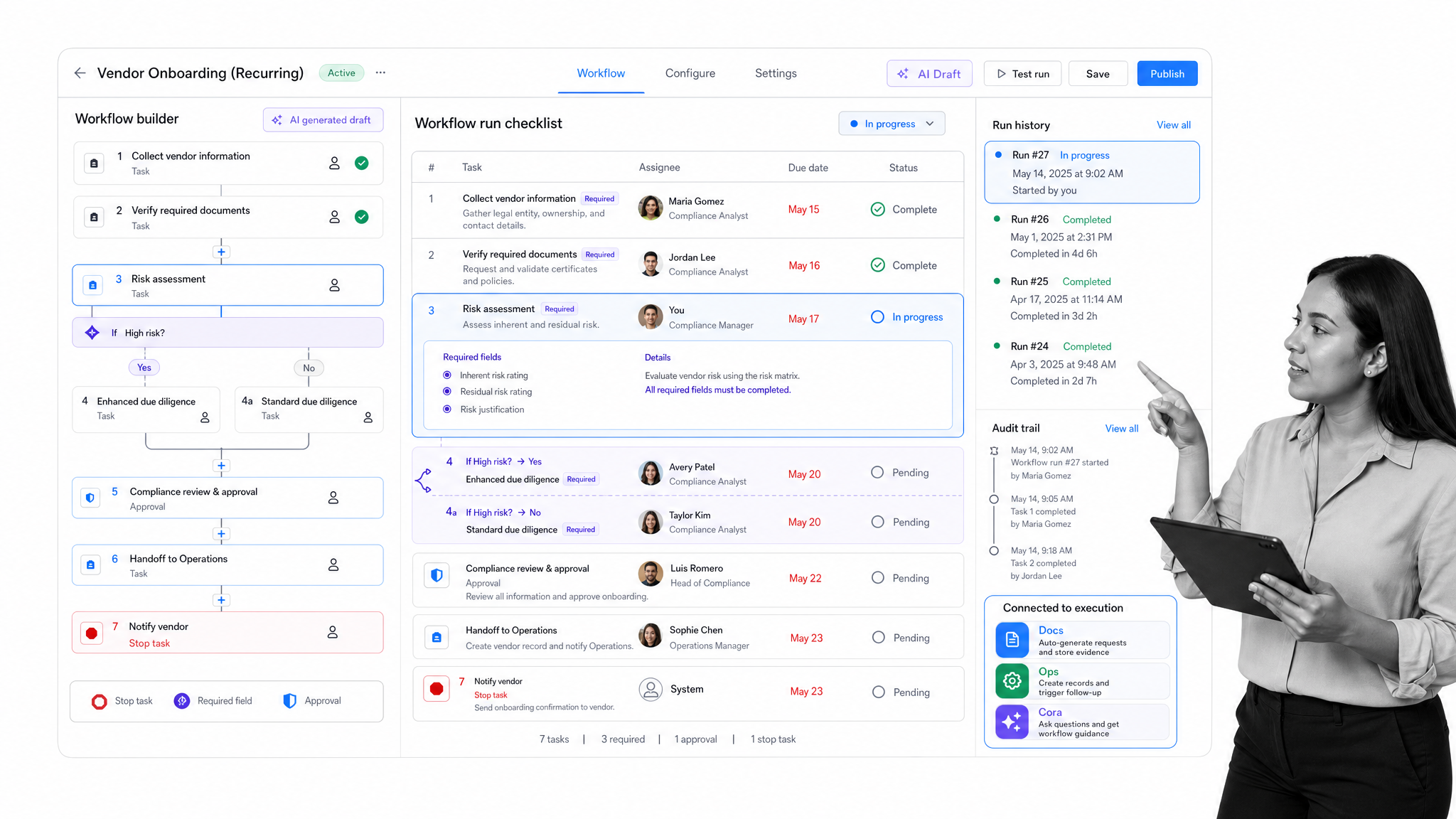
Best for: Best checklist maker for recurring business processes and compliance workflows.
Process Street is the best checklist maker when the checklist is not just a list. It is for recurring work that has owners, deadlines, approvals, evidence, and compliance consequences. A hiring checklist, vendor review, client onboarding flow, audit prep routine, or safety procedure can be built once and run the same way every time.
Use it when you need more than task completion. Process Street lets teams turn SOPs into workflows, assign steps by role, require evidence, route approvals, and keep a record of every run. That matters when missed steps create rework, audit risk, or customer impact.
It is also the strongest fit for teams that want AI help without giving up control. You can generate a workflow from rough instructions, then refine the steps, fields, logic, and approvals before the process goes live. The result is a checklist maker that enforces how work should happen, not a static document people have to remember to follow.
Use Process Street when: best checklist maker for recurring business processes and compliance workflows. Visit Process Street.
Checklist.com
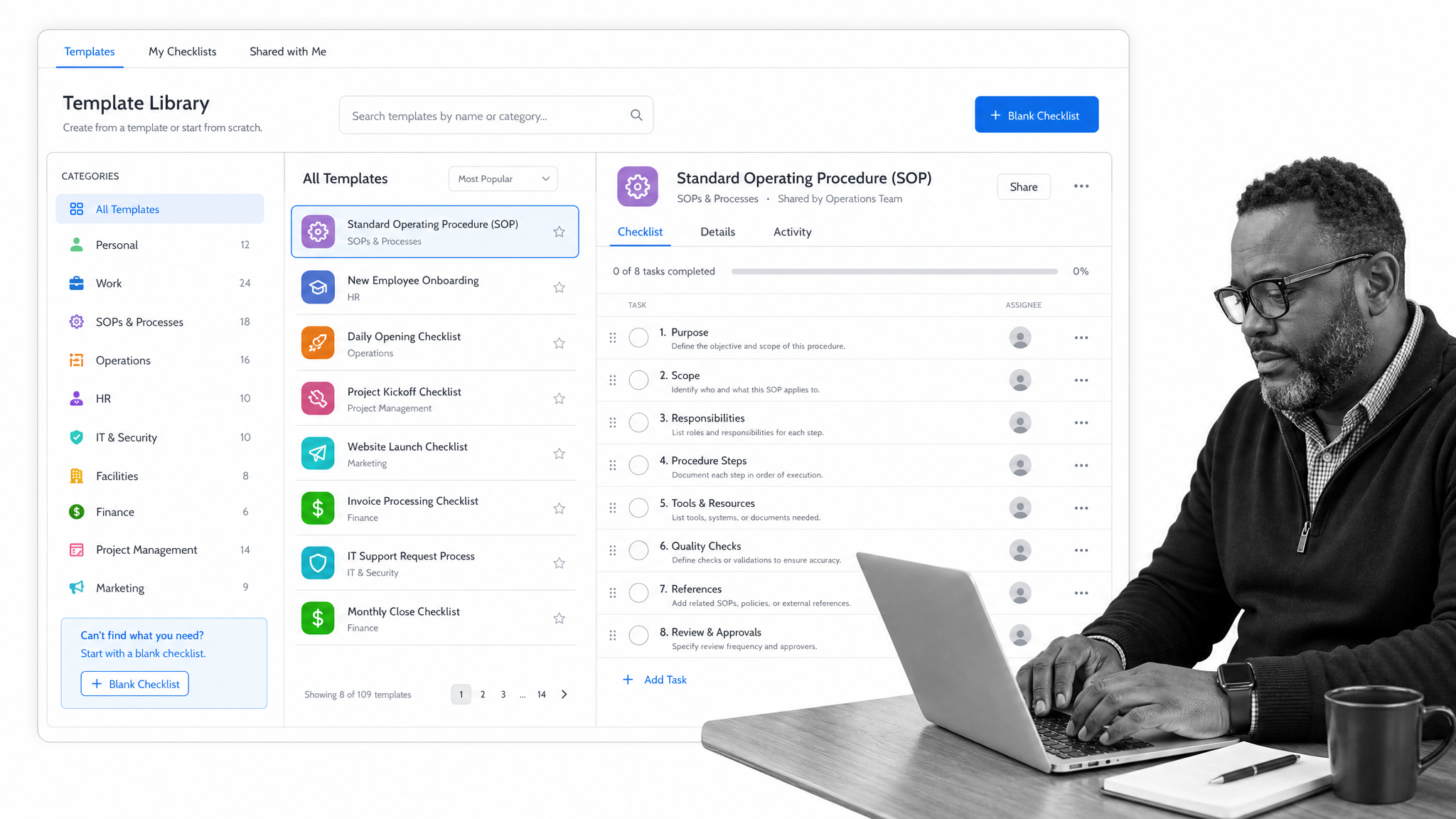
Best for: Best simple online checklist maker for life and work.
Checklist.com is a strong general purpose option for people who want a fast checklist creator without adopting a full workflow system. It works for personal routines, travel lists, home projects, work checklists, and lightweight SOPs.
The biggest advantage is speed. You can start from a template, create a blank checklist, or browse categories before you write anything from scratch. That makes it useful when the main job is getting a reusable list out of your head and into a shareable format.
For business teams, Checklist.com is best when the process is simple and the cost of missing a step is low. If you need audit trails, advanced approvals, conditional paths, or deep workflow automation, you will outgrow it. If you need quick shared lists, it stays easy to understand.
Use Checklist.com when: best simple online checklist maker for life and work. Visit Checklist.com.
checklist.gg
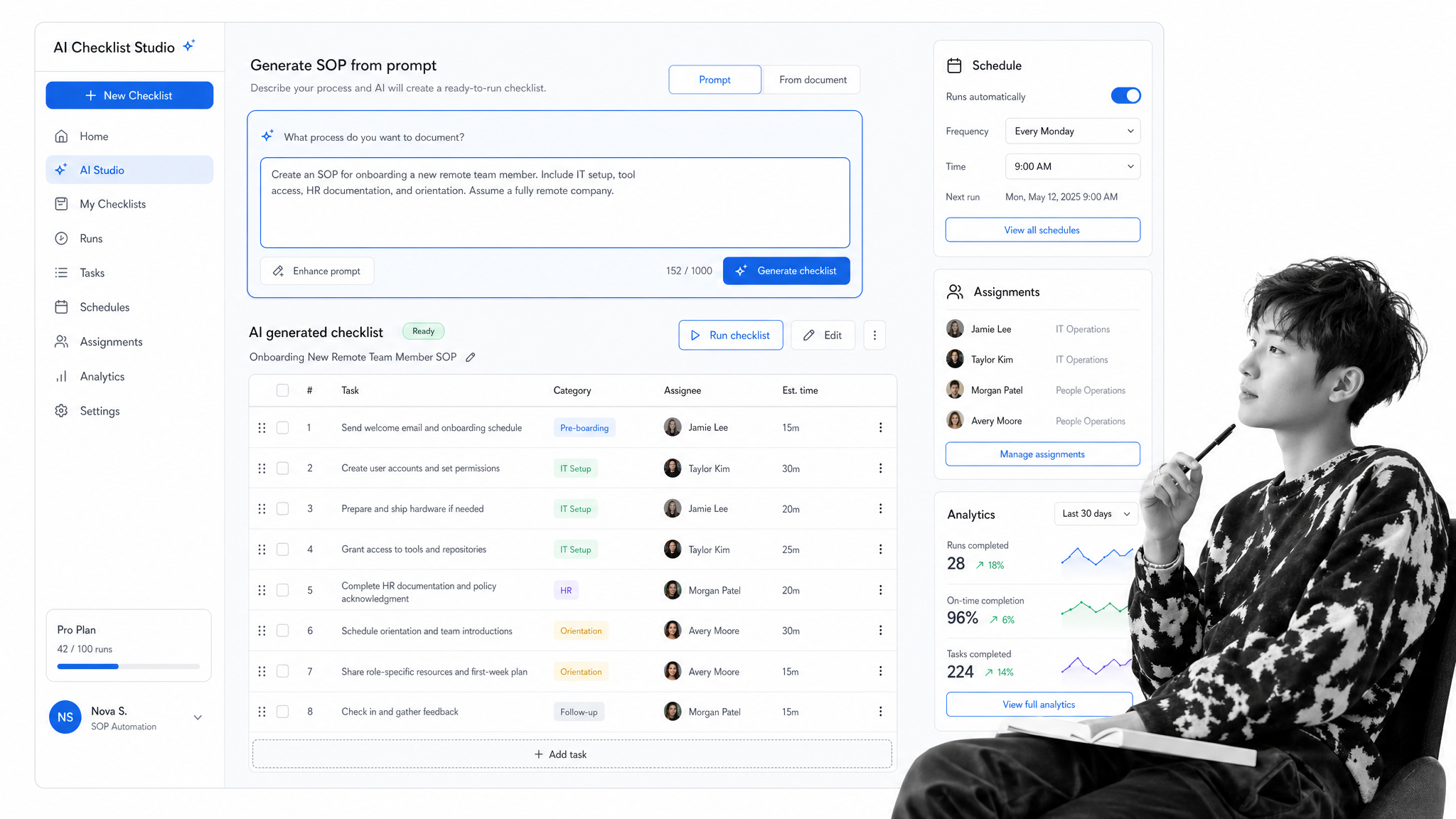
Best for: Best AI checklist maker for generating SOPs from prompts.
checklist.gg earns a place because AI has changed what readers expect from a checklist maker. Instead of starting with a blank page, users can describe a goal and get a first checklist draft to edit.
That makes it useful for small teams that need a starting point for SOPs, repeatable tasks, onboarding steps, or marketing routines. The product also supports checklist runs, assignments, schedules, and analytics, so it is more than a one time checklist generator.
The tradeoff is depth. AI generation is helpful, but the team still needs to review the output, remove vague steps, and add the real control points that make the checklist reliable. Treat it as a drafting accelerator, not an automatic process owner.
Use checklist.gg when: best ai checklist maker for generating sops from prompts. Visit checklist.gg.
Manifestly
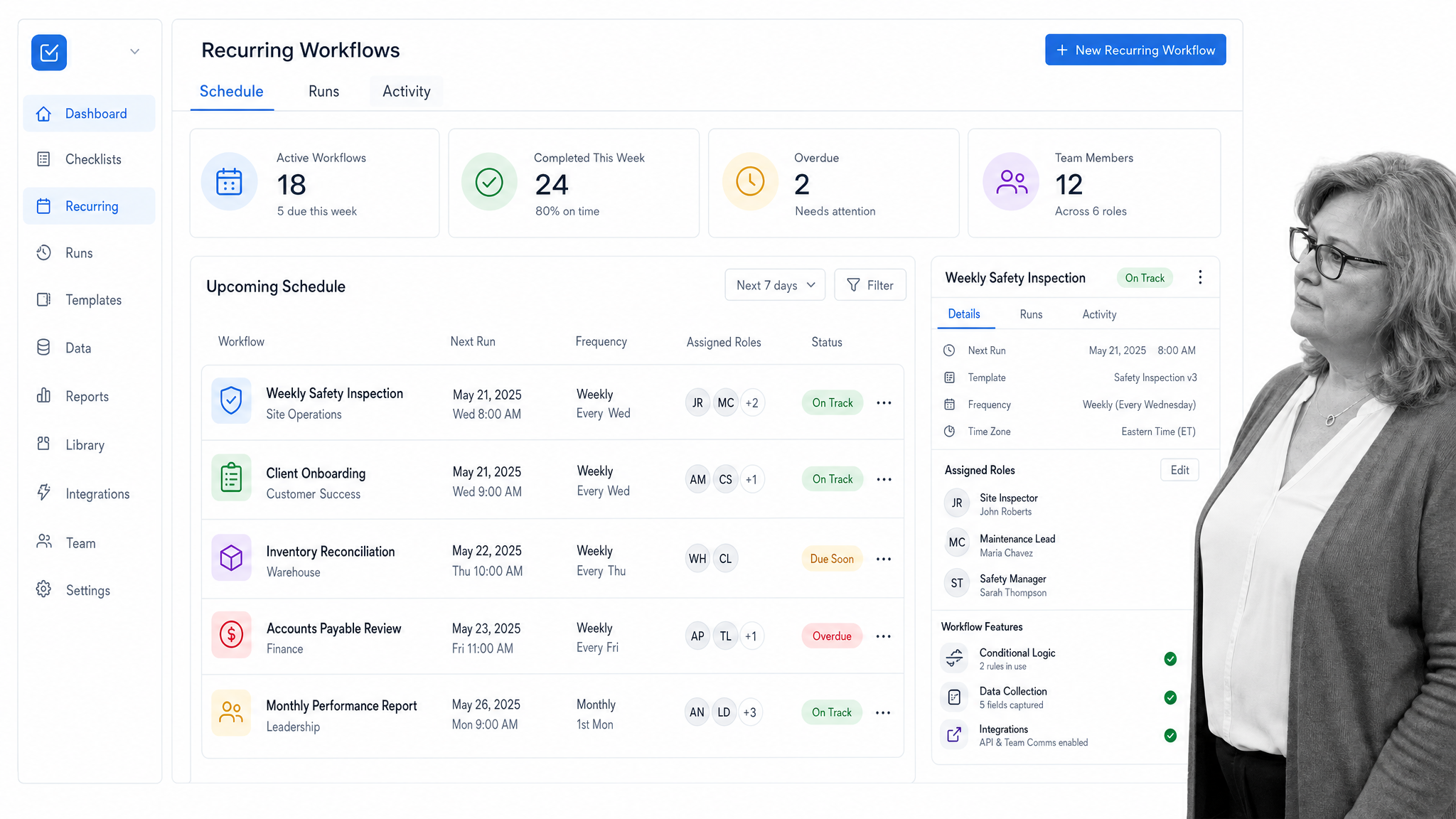
Best for: Best recurring checklist maker for straightforward team workflows.
Manifestly is a focused checklist tool for teams that want recurring workflows without a broad project management suite. It is a good fit for operations, IT, accounting, client service, and support teams that run the same process repeatedly.
Its core strength is clarity. Teams can create checklist templates, schedule recurring runs, assign steps, collect information, and track completion from a central dashboard. That keeps the product close to the checklist use case instead of pulling users into a larger work management system.
Choose Manifestly when your team wants simple recurring workflow control. Choose a broader workflow platform when the process needs document governance, compliance oversight, complex approval structures, or AI assisted workflow generation.
Use Manifestly when: best recurring checklist maker for straightforward team workflows. Visit Manifestly.
SafetyCulture
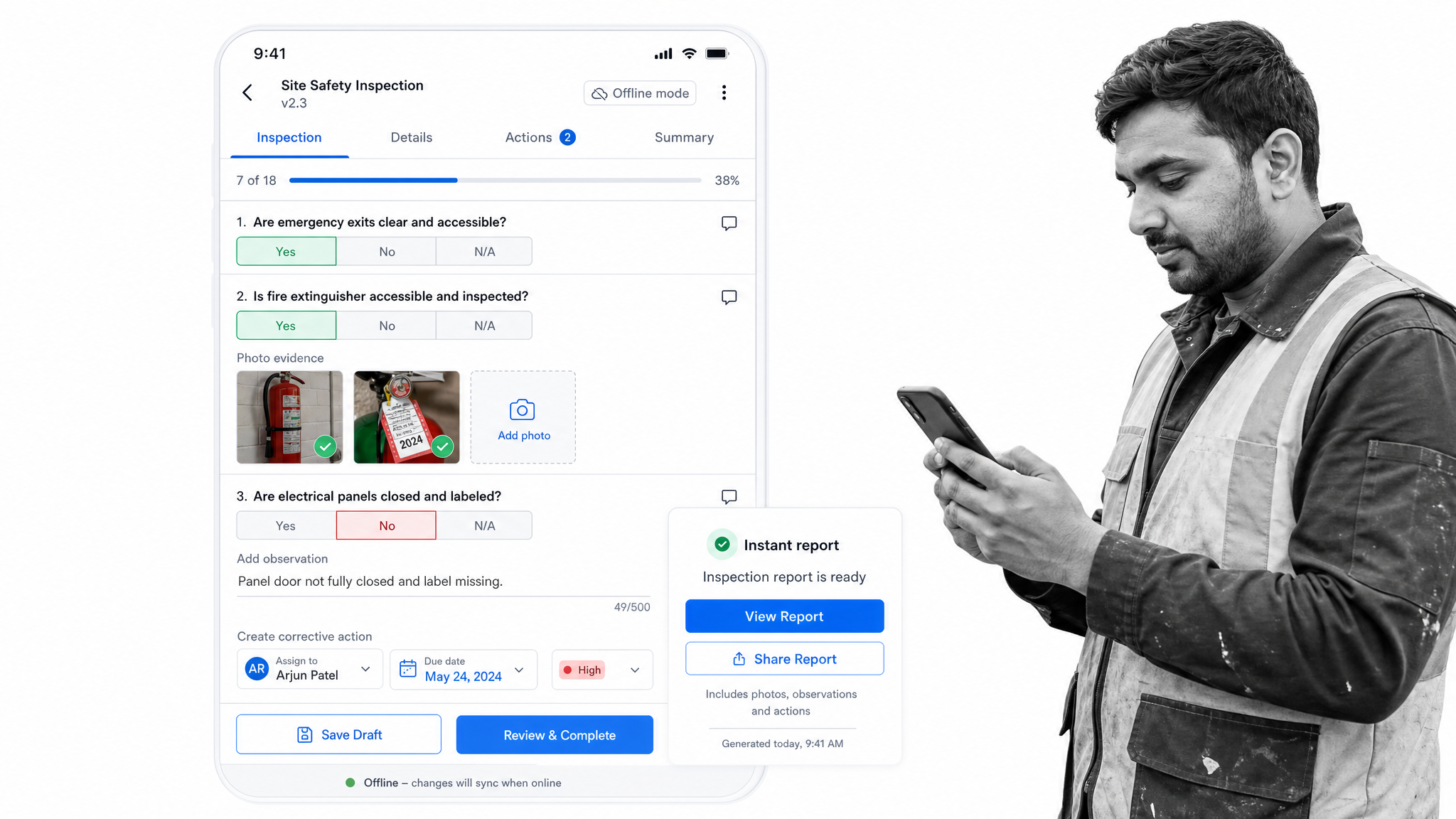
Best for: Best checklist maker for inspections, audits, and frontline teams.
SafetyCulture is the right checklist maker when the checklist happens in the field. It is built around inspections, audits, safety checks, quality checks, and frontline work where people need to capture evidence while they complete the list.
The product supports templates, inspections, schedules, actions, reports, assets, and training. That makes it more specialized than a general task app. A warehouse team, construction site, restaurant group, manufacturer, or facilities team will get more value from SafetyCulture than from a design based checklist maker.
The key distinction is evidence. If each checklist run needs photos, issues, corrective actions, offline access, or exported reports, SafetyCulture belongs on the shortlist. If you are documenting office based recurring processes, a workflow checklist tool will usually fit better.
Use SafetyCulture when: best checklist maker for inspections, audits, and frontline teams. Visit SafetyCulture.
ClickUp
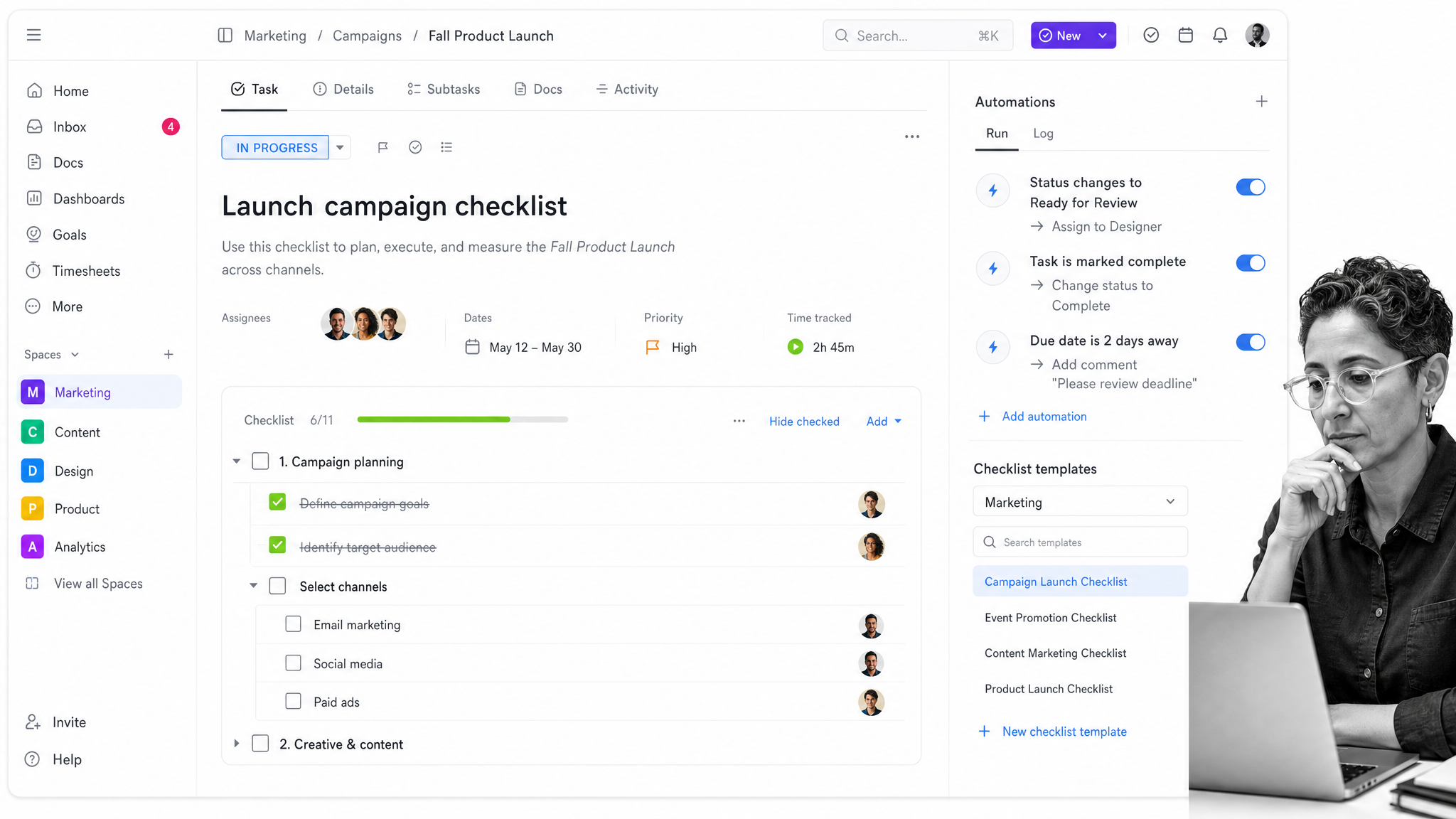
Best for: Best checklist maker inside an all in one work management platform.
ClickUp is a good checklist maker for teams that already manage projects, docs, goals, and dashboards in ClickUp. Checklists live inside tasks, so they work best as substeps for a larger piece of work.
Its checklist templates help teams reuse repeated task structures. You can nest items, assign checklist lines, drag them into order, and save templates for later. That is useful for content production, launches, QA tasks, and recurring internal requests.
The risk is tool sprawl inside the tool itself. ClickUp can do a lot, and checklist work can become buried under spaces, folders, lists, custom fields, dashboards, and automations. Use it when your team already wants that broader operating system. Avoid it if all you need is a clean recurring checklist workflow.
Use ClickUp when: best checklist maker inside an all in one work management platform. Visit ClickUp.
Todoist
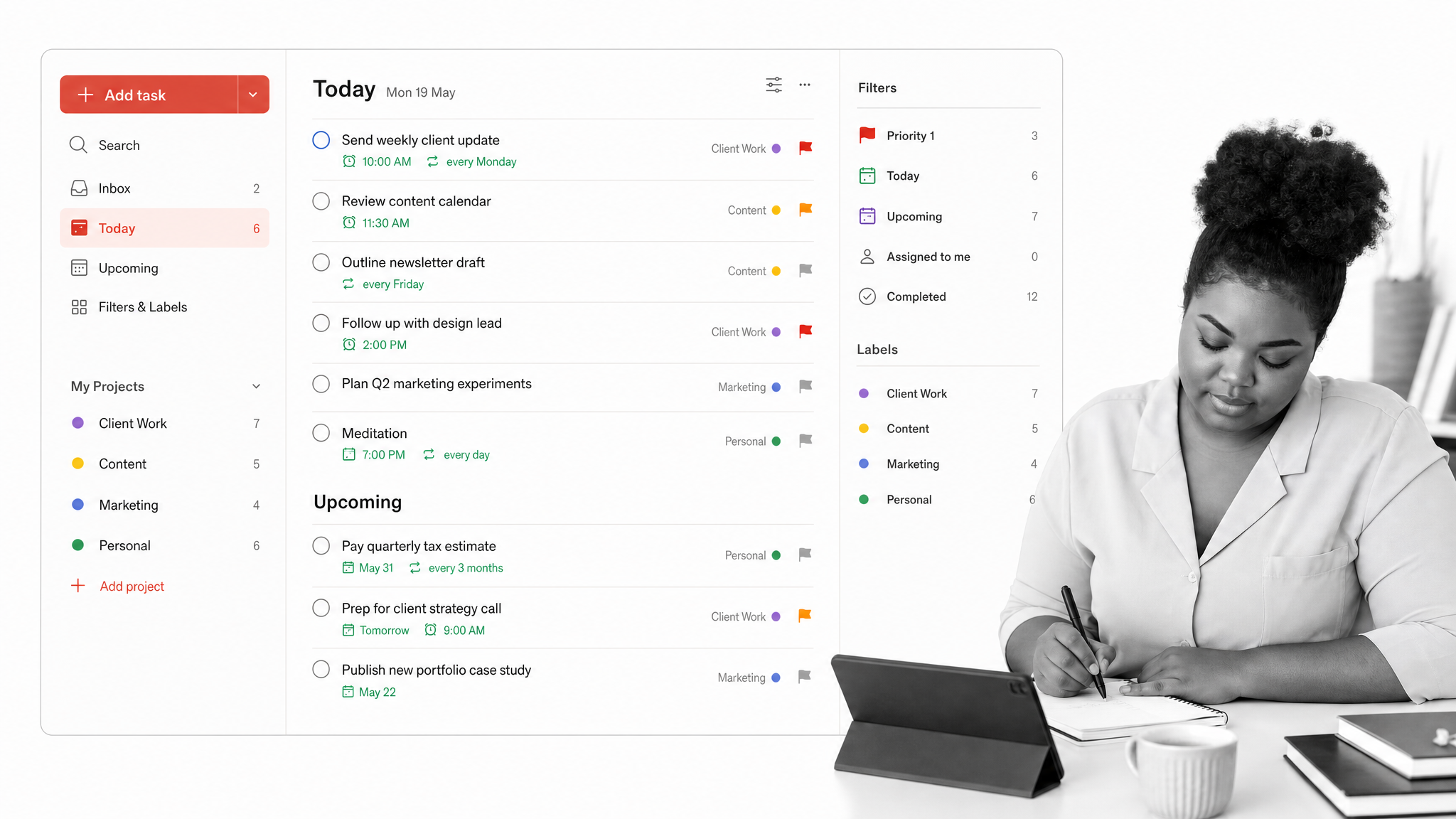
Best for: Best personal checklist maker for daily tasks and lightweight collaboration.
Todoist is one of the best checklist makers for individuals. It is fast, clean, and easy to use across devices. If your checklist is really a personal task list, Todoist is hard to beat.
It handles recurring tasks, priorities, sections, labels, filters, and lightweight sharing. That makes it useful for daily routines, personal admin, solo consulting work, or small recurring responsibilities that do not require process governance.
Todoist is not the best fit for compliance workflows or team SOPs. You can share projects and collaborate, but the product is optimized for personal productivity first. When you need approvals, evidence, branching logic, or audit trails, move to a business process checklist tool.
Use Todoist when: best personal checklist maker for daily tasks and lightweight collaboration. Visit Todoist.
Trello
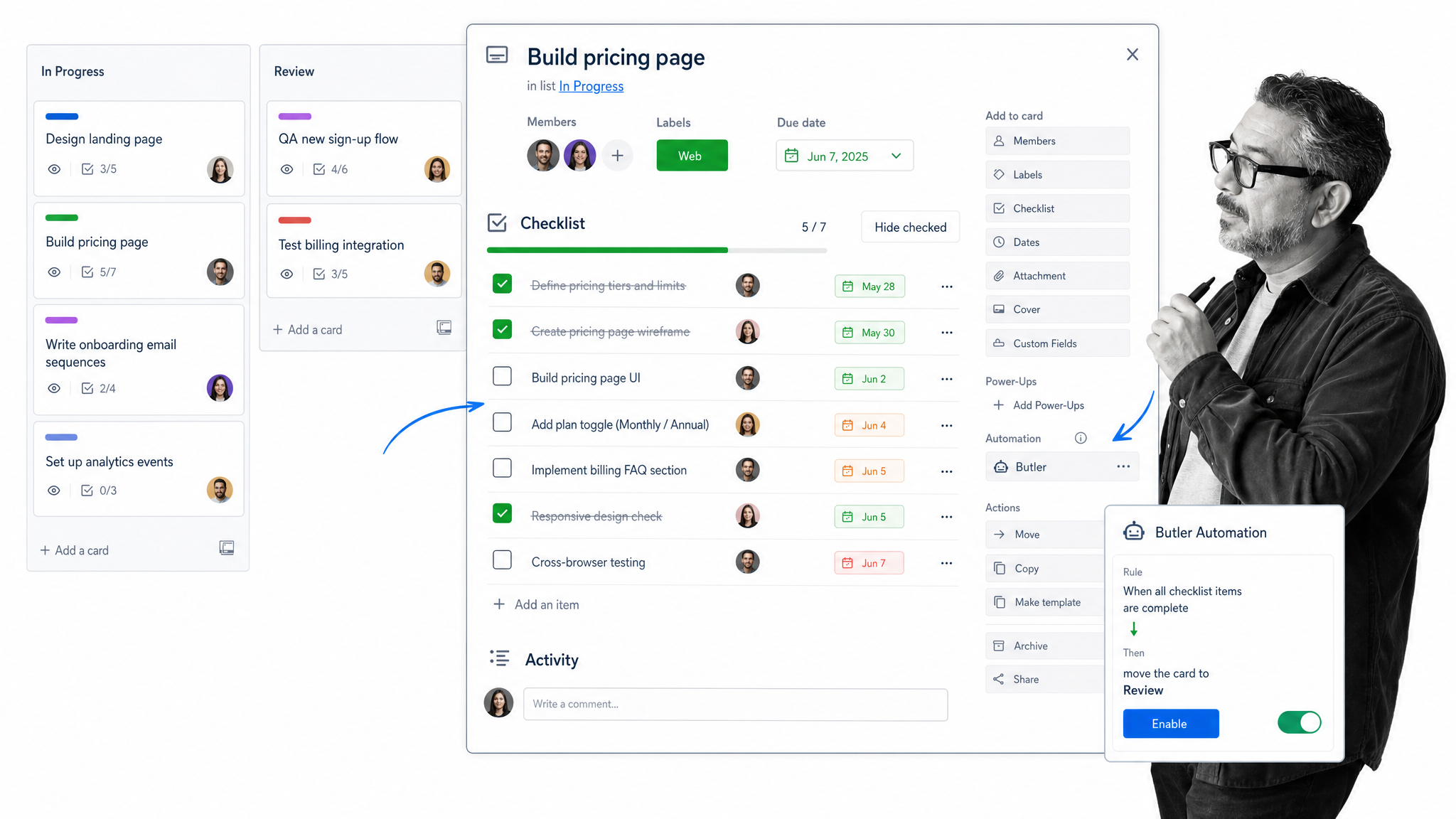
Best for: Best visual checklist maker for kanban boards.
Trello is a practical checklist maker when the checklist belongs on a visual board. Cards can hold checklists, and paid workspaces can use advanced checklists with assigned members and due dates on individual checklist items.
That makes Trello useful for editorial calendars, lightweight operations boards, personal projects, marketing work, and simple team workflows. People understand the card and board model quickly, which lowers adoption friction.
Trello becomes weaker when a checklist needs strict execution control. Checklist items are helpful, but they are still nested inside cards. If your team needs repeatable SOP runs, form fields, required evidence, approvals, or a reliable audit record, use a dedicated workflow checklist maker instead.
Use Trello when: best visual checklist maker for kanban boards. Visit Trello.
Asana
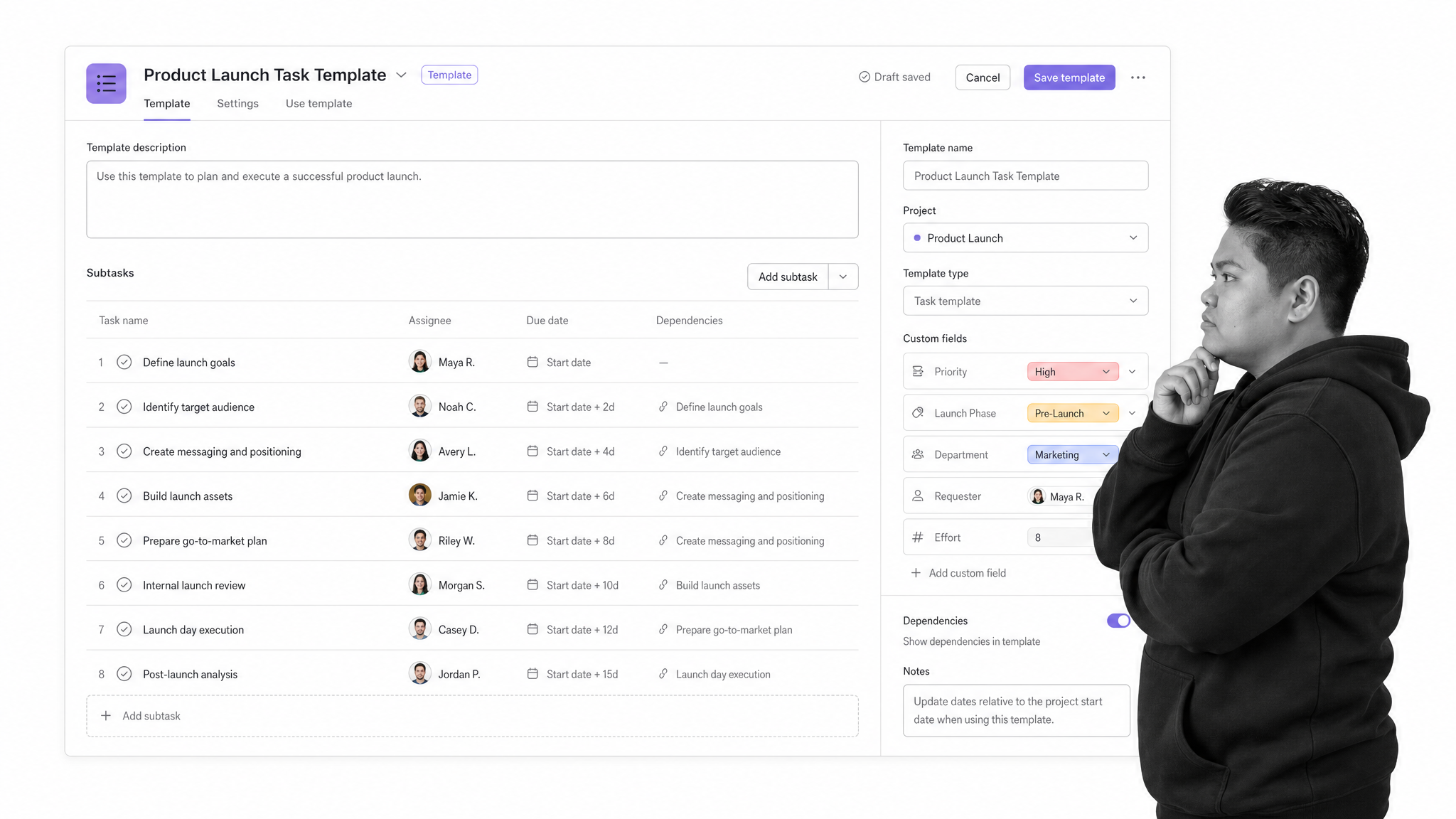
Best for: Best checklist maker for project teams that need templates and dependencies.
Asana is a strong checklist maker for project teams that already use it as their coordination layer. The checklist usually appears as subtasks inside a task, or as repeated tasks inside a project template.
Task templates can standardize repeatable work with assignees, relative due dates, dependencies, custom fields, descriptions, and subtasks. That is useful when a checklist is part of a larger project plan and needs to connect to milestones, owners, and reporting.
Asana is less direct when the checklist itself is the product. If your main need is a reusable checklist that people run again and again, Asana can feel like a project management workaround. If your team already manages project delivery in Asana, it is a sensible place to keep project checklists.
Use Asana when: best checklist maker for project teams that need templates and dependencies. Visit Asana.
Miro
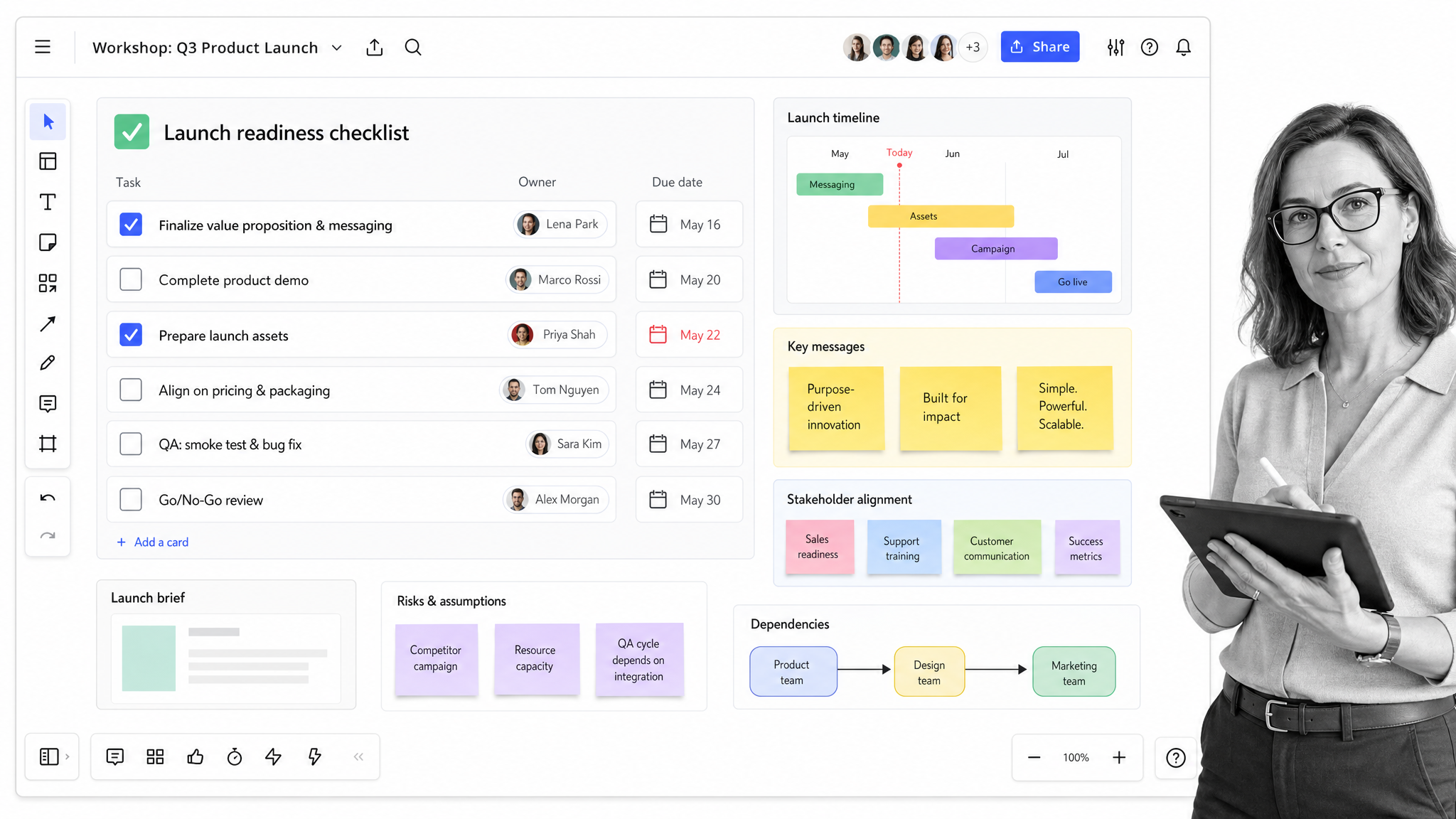
Best for: Best checklist maker for visual planning and workshops.
Miro is a checklist maker for visual collaboration. It is strongest when the checklist is part of a workshop, planning board, retrospective, product discovery session, or cross functional alignment exercise.
Users can create task cards, assign owners, track progress, and keep checklist items next to diagrams, notes, roadmaps, and brainstorms. That context is useful when teams need to see how tasks connect to ideas and decisions.
Miro is not the best place for operational enforcement. It helps teams plan and align, but a board based checklist can drift when the work needs recurring execution, approvals, evidence, or compliance proof. Use Miro for planning checklists, then move execution into a workflow system when the process becomes repeatable.
Use Miro when: best checklist maker for visual planning and workshops. Visit Miro.
Canva
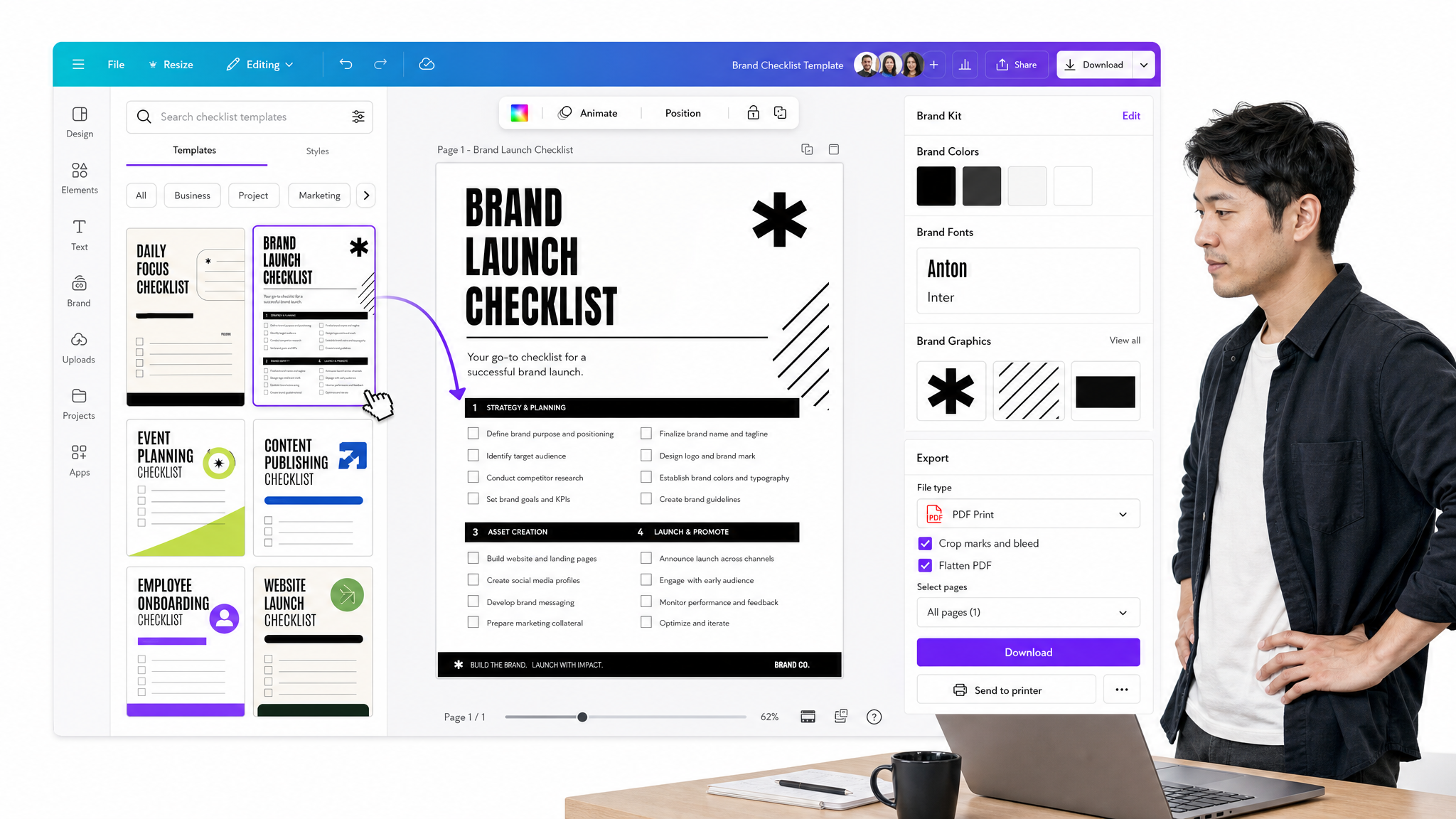
Best for: Best checklist maker for printable and branded checklist designs.
Canva is the best checklist maker when the output needs to look polished. It is not a workflow execution tool. It is a design tool for printable, shareable, branded, or public facing checklists.
Use Canva for event checklists, classroom handouts, onboarding PDFs, lead magnets, social content, internal posters, and simple downloadable resources. The template library and drag and drop editor make it easy to create something attractive quickly.
The limitation is execution. Once the checklist becomes a PDF or image, it is no longer an operational system. Canva is excellent for checklist presentation. It is not the right place to assign owners, track runs, enforce approvals, or prove completion.
Use Canva when: best checklist maker for printable and branded checklist designs. Visit Canva.
Venngage
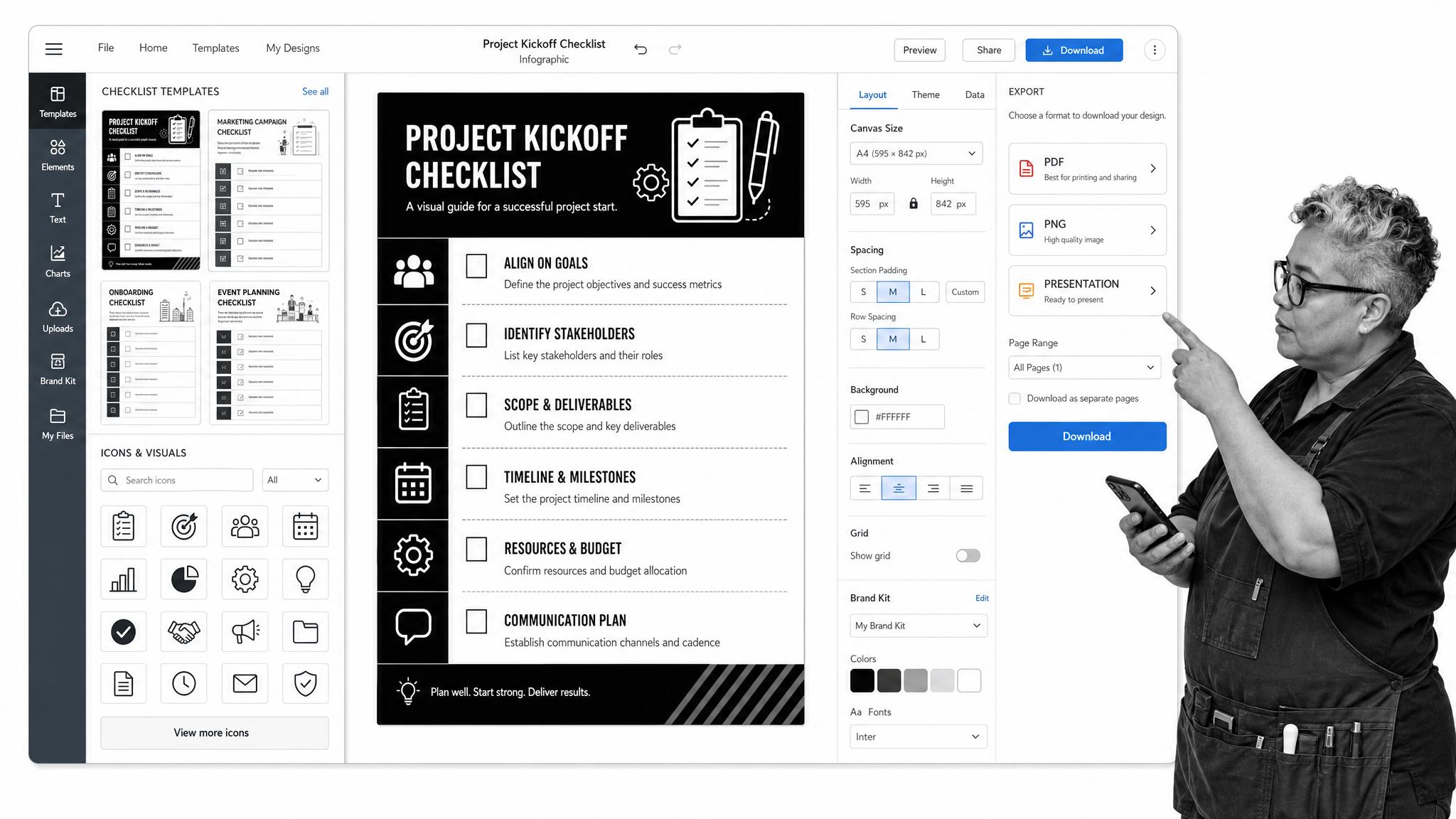
Best for: Best checklist maker for infographics and visual business resources.
Venngage is another design first checklist maker, but it leans more toward business graphics, infographics, and visual communication. It is useful when the checklist needs to become a designed asset for a team, audience, or campaign.
Its strengths are templates, icons, brand styling, and export formats. Marketers, educators, consultants, and enablement teams can use it to turn a plain list into a resource people will actually read.
Like Canva, Venngage is not a process execution platform. It helps you create the checklist artifact. It does not make sure the checklist is followed. Use it for designed checklists, not recurring operational control.
Use Venngage when: best checklist maker for infographics and visual business resources. Visit Venngage.
Benefits of using a checklist maker
Checklists reduce reliance on memory. That sounds basic, but it changes how teams work. A good checklist maker captures the steps, puts them in order, and makes the process repeatable across people, locations, and time zones.
For individuals, that means fewer forgotten tasks. For teams, it means clearer ownership. For regulated or quality sensitive work, it means proof. The checklist becomes a lightweight control system: what should happen, who is responsible, when it is due, and whether the step was actually completed.
- Fewer missed steps in recurring work
- Faster onboarding because the process is visible
- Cleaner handoffs between people and departments
- Better quality control for inspections, audits, and reviews
- Reusable templates that reduce setup time
- A clearer record of completed work
The biggest benefit appears when a checklist becomes part of the operating rhythm. Instead of rebuilding the same list every week, the team runs a known process, learns from the result, and improves the template.
Types of checklists supported by checklist makers
Most checklist makers support more than one checklist type. The important thing is matching the format to the risk and complexity of the work.
- Process checklists: recurring workflows such as onboarding, vendor review, client implementation, monthly close, or audit preparation.
- Task checklists: personal or project based lists used to track what needs to get done.
- Compliance checklists: controlled procedures where approvals, evidence, timestamps, and audit history matter.
- Inspection checklists: frontline forms for safety, quality, facilities, maintenance, or field operations.
- Design checklists: printable or branded resources made for handouts, lead magnets, training, or events.
If the checklist only needs to be read, a design or document tool can work. If the checklist needs to be performed, tracked, and proven, use a checklist maker that treats the list as an executable workflow.
Get started with a checklist maker
The fastest way to choose is to write down one real checklist you need this week. Then ask what would happen if someone skipped a step.
If the answer is minor inconvenience, choose a simple tool like Todoist, Checklist.com, Canva, or Trello. If the answer is rework, customer impact, audit exposure, safety risk, or operational chaos, choose a workflow checklist maker built for recurring business processes.
Process Street is built for that second category. You can create a workflow, assign owners, add required fields, route approvals, and track every run. Start with a process you already repeat, then turn it into a workflow your team can follow every time.
Explore Process Street checklist software or see how Process Street workflows work.
Checklist maker FAQs
What is a checklist maker?
A checklist maker is software that helps you create, organize, share, and reuse checklists. Simple checklist makers create personal lists or printable templates. More advanced checklist makers turn recurring procedures into workflows with owners, due dates, forms, approvals, and audit history.
What is the best checklist maker for business processes?
Process Street is the best checklist maker for recurring business processes because it turns checklists into executable workflows. Teams can assign owners, collect information, use conditional logic, route approvals, and keep a record of every completed run.
What is the difference between a checklist maker and a to do list app?
A to do list app tracks tasks, usually for an individual or small team. A checklist maker is broader. It can create reusable templates, guide repeatable processes, collect evidence, support team handoffs, or produce designed checklist documents.
Can I use a checklist maker for SOPs?
Yes. For lightweight SOPs, a simple checklist tool can document the steps. For operational SOPs, use a workflow checklist maker that supports assignments, required fields, approvals, version control, and run history so the SOP is followed in practice.
Are there free checklist maker tools?
Yes. Tools such as Checklist.com, Canva, Miro, Todoist, Trello, ClickUp, and checklist.gg offer free or freemium ways to create checklists. Free plans are useful for testing, but business process checklists often require paid features such as permissions, templates, automation, reporting, or audit trails.
How do I choose the right checklist maker?
Choose based on the consequence of a missed step. Use a simple checklist app for personal reminders, a project tool for team tasks, a design tool for printable checklists, an inspection tool for field audits, and a workflow platform for recurring business processes that need control and proof.
Already using one of these tools and wondering what else is out there? We keep a full set of alternatives and competitor comparisons covering checklist, workflow, and documentation software side by side.