Turn every policy into automated workflows with built-in enforcement and audit-ready proof.


Financial Integration
Financial integration is the process through which financial markets, institutions, capital, information, and infrastructure become more connected across countries or regions. It can appear in cross-border investment, banking, payments, common market rules, shared infrastructure, and the convergence of prices for comparable financial assets.
The concept is broader than moving money between two systems. It describes how easily participants can access markets, how consistently similar assets are treated, how information and funding travel, and how shocks can spread through the same connections that support growth.
This guide explains the economic meaning of the concept, the channels that create it, the benefits and risks it introduces, the indicators used to measure it, and the separate enterprise problem of connecting financial systems inside an organization.
In this guide, we are going to cover:
- What is financial integration?
- How financial integration works
- Benefits and risks of connected markets
- How market integration is measured
- What makes market integration durable
- Financial systems integration inside an organization
- A practical integration roadmap
- Frequently asked questions
What is financial integration?
The International Monetary Fund definition describes financial integration as a process in which the markets of two or more countries or regions become more connected. Those connections can include cross-border capital flows, foreign participation in domestic markets, information sharing among institutions, and unified market infrastructure.
A market can be open without being fully integrated
Openness removes barriers to participation. Integration goes further. Two markets may allow cross-border investment and still remain weakly integrated if they use incompatible infrastructure, apply materially different rules, isolate information, or price comparable risk very differently. Integration is therefore a matter of degree, not a switch that is simply on or off.
The European Central Bank explains the concept through equal conditions and the pricing of assets with similar risk and return characteristics. When comparable instruments face similar rules, access, information, and infrastructure, persistent price differences become harder to sustain.
The law of one price is a useful benchmark
The law of one price says that assets with the same risk and payoff should trade at the same price once transaction costs and other relevant differences are considered. Large, persistent price gaps can signal segmentation, capital controls, limited competition, unequal information, regulatory barriers, or weak settlement links.
Real markets never meet the benchmark perfectly. Credit risk, taxes, liquidity, legal protections, currency risk, and local market structure all matter. The benchmark is still useful because it separates genuine economic differences from frictions that keep otherwise comparable markets apart.
Market integration can be regional or global
A group of neighboring countries may integrate through common rules, payment rails, market access, or monetary arrangements. Global integration connects domestic markets to international investors, banks, payment networks, and funding sources. Regional and global links can deepen at different speeds, so a country may be highly integrated with one bloc while remaining less connected elsewhere.
Inside a company, the phrase sometimes means connecting accounting, treasury, payments, planning, procurement, and reporting systems. That is a related operational use of the term, but it is not the same as integration among national or regional financial markets. The enterprise meaning is covered later in this guide.
How financial integration works
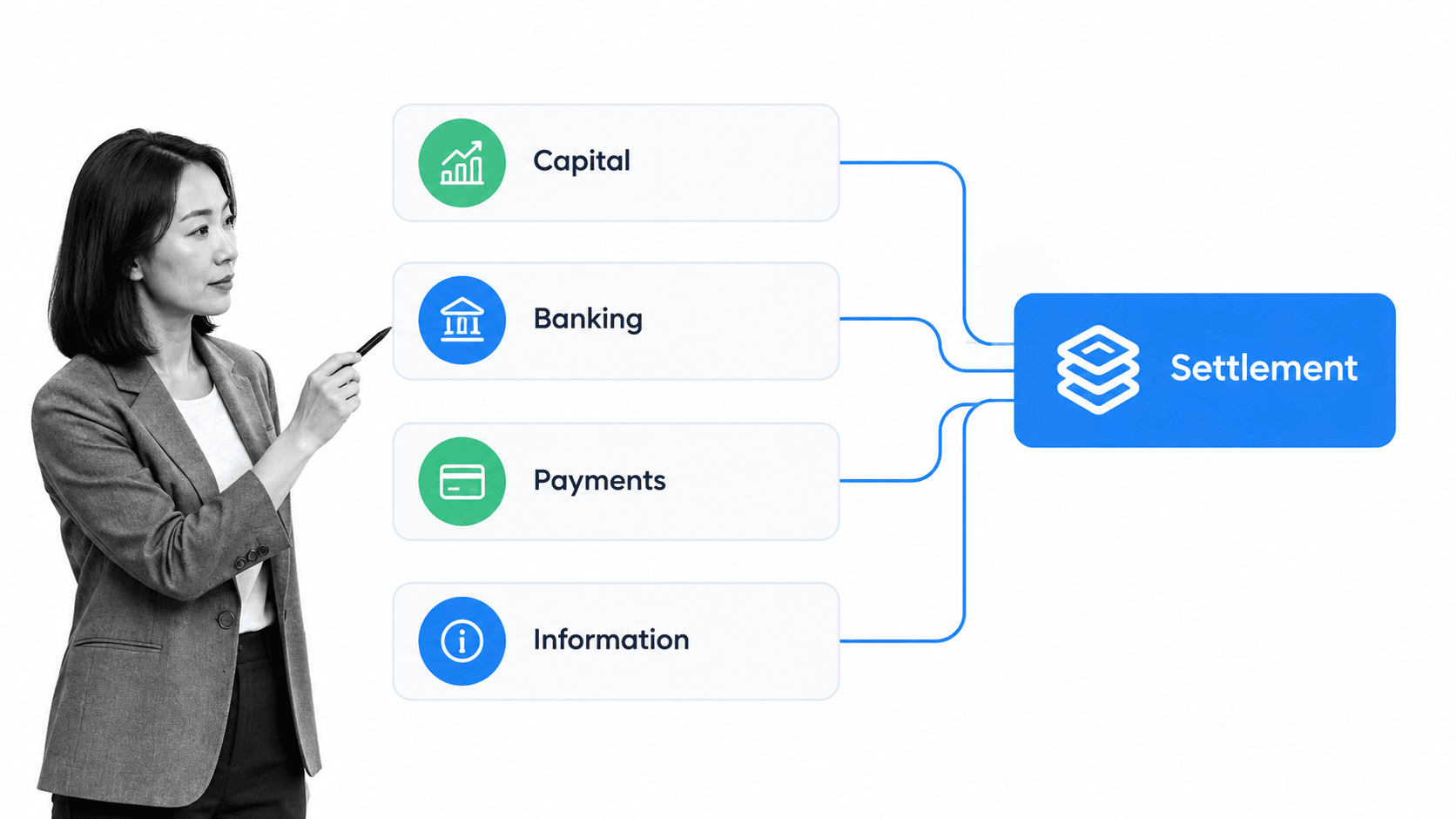
Market integration develops through several channels at once. A market can deepen through capital flows while payment infrastructure remains fragmented, or align regulations while cross-border participation stays thin. Reading the channels separately makes the overall system easier to understand.
Capital moves across borders
Portfolio investment, bank lending, foreign direct investment, and cross-border issuance connect savers and borrowers in different markets. Firms gain access to a wider funding pool, while investors gain access to a wider set of assets. The strength of the connection depends on market access, convertibility, legal rights, custody, settlement, disclosure, and confidence in the rules.
Institutions participate outside their home market
Banks, insurers, asset managers, pension funds, exchanges, clearing organizations, and payment providers can extend activity across jurisdictions. Their participation can increase competition and transfer practices, but it also creates operational and supervisory dependencies. A failure in one institution or market can affect counterparties elsewhere.
Infrastructure makes transactions executable
Trading access means little if payments, securities settlement, custody, messaging, identity, and compliance cannot work across borders. The BIS cross-border payments program highlights interoperability, harmonized messages, aligned operating arrangements, data exchange, and sound oversight as practical foundations for better cross-border payment performance.
This infrastructure layer is where economic integration becomes operational. Common standards reduce translation work. Interlinked systems can shorten transaction chains. Aligned hours and pre-validation reduce waiting and repair. Clear governance helps participants know which rules apply when a transaction crosses multiple systems.
Information and practices travel
Comparable disclosures, accounting information, credit data, market practices, and supervisory cooperation allow participants to assess opportunities on a more consistent basis. Information does not need to be identical everywhere, but it must be reliable enough for risk to be understood and priced.
Rules shape access and treatment
Licensing, capital requirements, investor protections, resolution regimes, tax treatment, data rules, and anti-money-laundering obligations all influence integration. Harmonization can reduce unnecessary friction, but identical rules are not always required. Mutual recognition and compatible outcomes can sometimes support access while preserving local institutions.
These channels behave like an end-to-end process integration problem at market scale. The value appears only when access, information, infrastructure, decisions, and controls work together instead of improving one isolated link.
Benefits and risks of connected markets
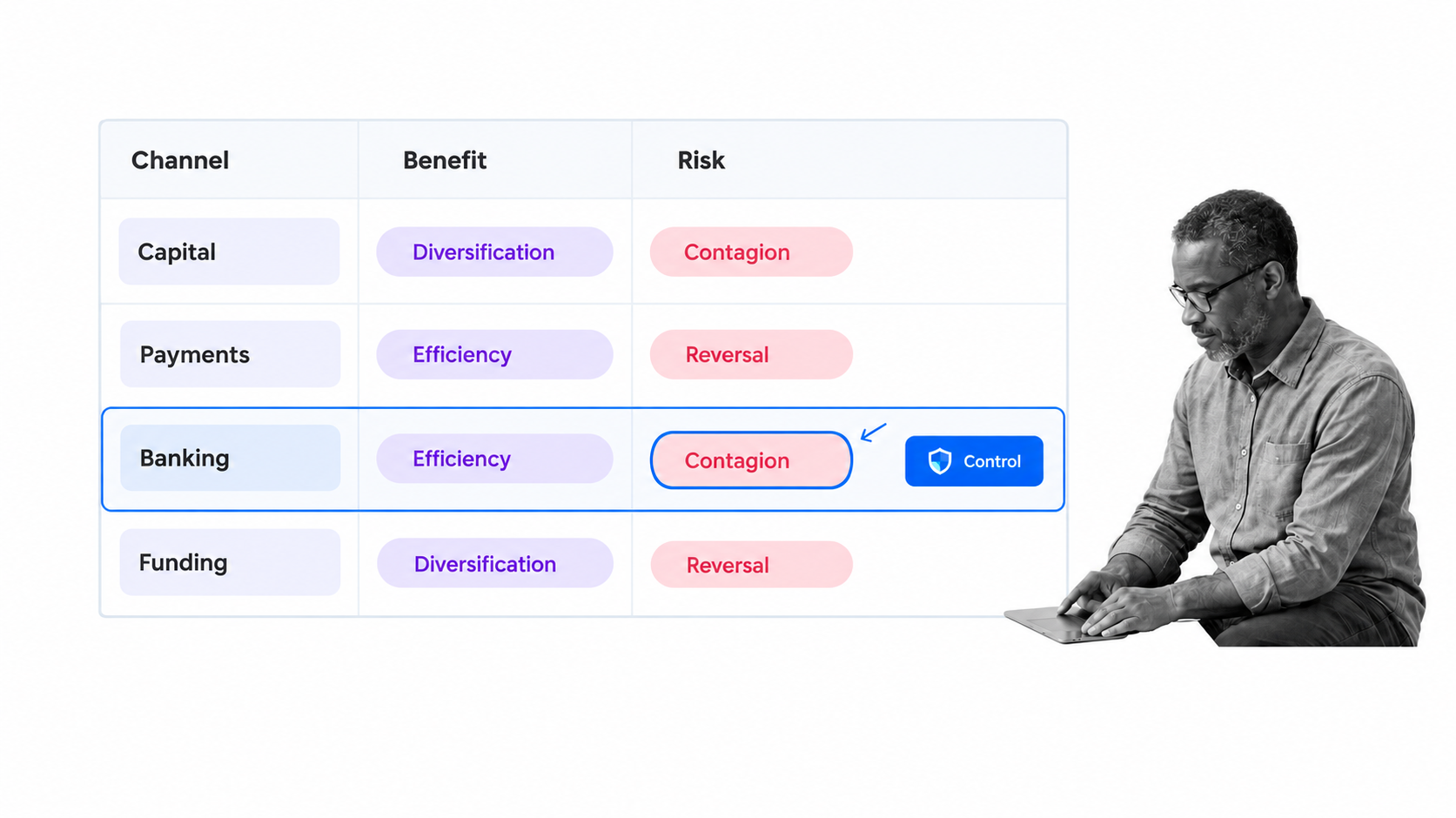
The same connection can create both resilience and exposure. The right question is not whether integration is good or bad in the abstract. It is whether the institutions, infrastructure, and policy framework can capture the benefits while absorbing reversals and failures.
Benefit: a wider pool of capital
Integrated markets can connect savings in one place with productive investment in another. Borrowers may gain more funding options, and investors may gain more choice. This can reduce reliance on a single domestic funding source and improve the allocation of capital when prices and risk signals are trustworthy.
Benefit: diversification and risk sharing
Investors, institutions, and economies can spread exposure across more assets and markets. A local shock may have less impact when income and funding are not concentrated in one place. Diversification is not automatic, however. Assets that appear different in calm markets can become highly correlated under stress.
Benefit: competition, knowledge, and infrastructure
Foreign participation can bring new capabilities, products, practices, and competitive pressure. Shared infrastructure and standards can lower duplication and make market access easier. Better payment and settlement links can improve speed, cost transparency, and reliability for cross-border activity.
Risk: faster transmission of shocks
Connected balance sheets, funding markets, payment systems, and investor behavior can transmit stress quickly. The IMF discussion of financial interdependence frames the core tradeoff: integration can support income growth while also increasing exposure to changes in global risk conditions.
Contagion does not mean every cross-border connection is harmful. It means the system needs buffers, transparent exposures, liquidity planning, credible resolution arrangements, and coordinated supervision that match the strength of the links.
Risk: sudden reversals and funding dependence
Capital can leave as well as enter. Short-term or foreign-currency funding can create vulnerability when investor sentiment changes, exchange rates move, or liquidity disappears. The composition and maturity of flows matter as much as their total size.
Risk: regulatory gaps and operational complexity
Cross-border activity can span institutions, vendors, laws, data regimes, and settlement systems. Unclear responsibility or uneven oversight creates gaps. Operational incidents become harder to contain when recovery depends on organizations that do not share the same procedures, hours, or escalation rules.
Strong internal controls, market-wide safeguards, and transparent exception management are complements to integration, not barriers to it. They make the connections dependable enough to use under pressure.
How market integration is measured
No single indicator captures the full concept. Analysts combine price, quantity, access, and infrastructure measures because each reveals a different part of the integration process.
Price-based indicators
Price measures compare yields, interest rates, fees, or risk-adjusted returns for similar instruments across markets. Smaller unexplained dispersion can indicate stronger integration. The comparison must control for credit, liquidity, tax, currency, maturity, and legal differences or it can mistake different products for segmentation.
Quantity-based indicators
Quantity measures look at cross-border assets and liabilities, foreign participation, portfolio holdings, lending, issuance, payment flows, or transaction volumes. They show how much activity crosses borders, but volume alone does not prove that access and pricing are equal.
Access and rule-based indicators
These indicators examine whether comparable participants face similar rules and can obtain similar services. Licensing, product availability, investor protections, market access, capital controls, custody, and data requirements all affect practical access.
Infrastructure and performance indicators
Payment speed, cost, transparency, failure rates, repair rates, settlement time, operating-hour overlap, and messaging compatibility reveal whether connections work in practice. A market may look connected in legal terms but remain operationally fragmented if transactions are slow, opaque, or hard to reconcile.
The ECB market-integration indicators illustrate the multidimensional approach. Price and quantity measures are more informative together than either is alone. The same principle applies to an integrated operating model: outcomes, flow, controls, and exceptions need a shared measurement view.
What makes market integration durable
Durable integration needs more than liberalization or a technical connection. Markets need institutions that make access credible, information usable, transactions final, and failures manageable.
Compatible standards and clear data
Participants need common definitions for messages, identifiers, timestamps, statuses, and settlement instructions. Compatibility reduces manual translation and ambiguity. Clear data lineage also helps institutions trace where a transaction came from, which checks ran, and why it changed state.
Trustworthy legal and supervisory arrangements
Property rights, contract enforcement, investor protection, prudential oversight, resolution planning, and supervisory cooperation shape confidence. Cross-border activity grows more safely when participants know which authority acts, which law governs, and how losses or operational failures will be handled.
Resilient payment and settlement infrastructure
Systems need capacity, security, liquidity arrangements, incident response, contingency procedures, and clear finality. The BIS framework for interlinking payment systems emphasizes evaluating benefits, challenges, governance, and risk rather than treating the connection itself as the outcome.
Proportionate sequencing
Opening markets faster than institutions and infrastructure can adapt can magnify instability. Sequencing means strengthening disclosure, supervision, liquidity management, market infrastructure, and crisis arrangements alongside wider access. The correct pace depends on the structure of the market and the composition of the flows.
Visible ownership and coordinated response
Integration creates shared dependencies. Authorities and institutions need explicit roles for monitoring, incident response, communication, remediation, and learning. A connection without an owner becomes a hidden risk. The same rule holds in cross-functional financial process management inside an organization.
Financial systems integration inside an organization
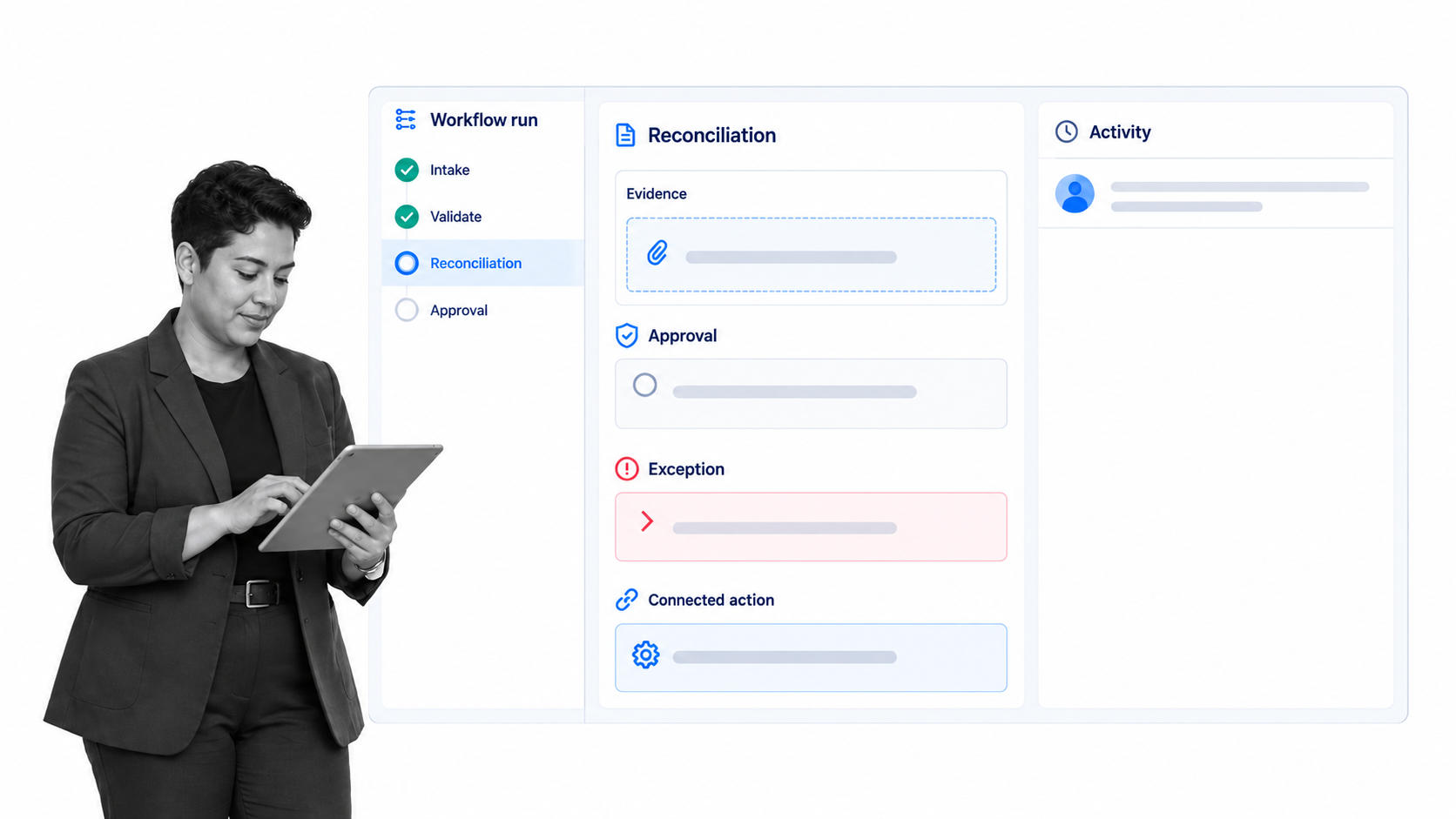
In enterprise operations, financial systems integration means connecting the applications, data, people, and controls used for accounting, treasury, payments, procurement, planning, reporting, and compliance. The goal is not a single giant database. It is a governed flow in which each system keeps its proper role and the business can trace what happened end to end.
Start with a financial workflow, not a connector
A connector can move a record, but it cannot decide which evidence is required, who may approve an exception, or what should happen when data conflicts. Map the financial workflow first: trigger, source record, validation, decision, system action, reconciliation, exception, and proof.
This keeps the integration tied to an outcome. An accounts payable flow, for example, may receive an invoice, validate required fields, compare supporting records, route an approval, create or update a transaction, and retain the evidence. The systems connection is one part of that controlled path.
Keep judgment and approval explicit
Routine validation and record movement can be automated. Material judgment should remain visible and assigned. Clear workflow approval gates prevent a technical action from silently becoming a business decision.
Design exception paths before the happy path ships
Mismatched identifiers, incomplete evidence, duplicate records, unavailable systems, failed authentication, policy breaches, and timing differences are normal. Each exception needs a state, owner, deadline, source data, and resolution path. Otherwise the real process moves back into email and spreadsheets.
Use Process Street as the governed execution layer
Process Street is an agentic process automation platform for high-stakes operations. It can coordinate assigned tasks, required evidence, conditional routes, approval gates, system actions, and execution history around the financial systems that remain the sources of record.
Teams can connect their systems while using the workflow as the control surface for a financial process automation without hiding ownership or evidence inside background scripts. The result is automation with a visible operating path.
For a focused example, an accounts payable workflow can assign review, collect supporting evidence, route exceptions, require approval, trigger a connected action, and preserve the decision history. Teams can also adapt a financial audit checklist to verify that the integration continues to produce complete evidence.
A practical integration roadmap
1. Define the integration boundary
State which markets, institutions, systems, or processes are being connected and which outcome matters. A regional capital-market program has a different boundary from a payment-system link or an internal reconciliation workflow. Ambiguous scope produces ambiguous measures.
2. Map the current flow and frictions
Trace participants, data, decisions, infrastructure, controls, and settlement from start to finish. Mark barriers, duplicate work, delays, opaque fees, manual translation, unequal access, and unresolved exceptions. The map should show where value and risk cross organizational boundaries.
3. Choose the right integration mechanism
The answer may involve policy alignment, mutual recognition, market access, common messaging, an interlinked payment rail, a data exchange, an API, or a governed finance process automation. Choose the mechanism that solves the actual friction rather than adding a connection for its own sake.
4. Design controls and exceptions with the connection
Set access rules, validation, approval, liquidity or capacity limits, monitoring, incident response, escalation, and recovery before launch. The approval pattern is useful at enterprise scale because it separates an automated route from an accountable decision.
5. Pilot with representative cases
Test routine activity, peak volume, missing information, delayed settlement, conflicting data, unavailable systems, and high-risk exceptions. A pilot that covers only the happy path proves very little. Measure both benefit and risk signals during the test.
6. Measure the integrated outcome
Use a balanced set of price, quantity, access, performance, resilience, and exception measures. For enterprise work, combine cycle time and completion with rework, exception rate, evidence completeness, overdue approvals, reconciliation breaks, and recovery time. A workflow is only integrated when the outcome and proof survive the handoffs.
7. Improve the interfaces continuously
Review recurring breaks, concentration, failed messages, manual repairs, policy conflicts, and user workarounds. Integration is an operating capability, not a one-time project. Changes in products, markets, rules, vendors, and risk conditions require the interfaces and controls to evolve.
Frequently asked questions
What is financial integration?
Financial integration is the process through which financial markets, institutions, capital, information, and infrastructure become more connected across countries or regions. It can be observed through cross-border activity, common access and rules, shared infrastructure, and more consistent pricing for comparable financial assets.
What are examples of integrated financial markets?
Examples include cross-border portfolio investment, foreign banks participating in domestic markets, firms raising funds in another market, interlinked payment or settlement systems, shared financial messaging standards, and regional arrangements that apply more consistent market rules.
What are the benefits of connected markets?
Potential benefits include wider access to capital, more investment options, diversification, risk sharing, stronger competition, knowledge transfer, and more efficient payment and settlement infrastructure. The benefits depend on sound institutions, transparent information, and resilient controls.
What are the risks of connected markets?
Integration can transmit shocks, amplify volatile capital flows, create foreign-currency or funding dependence, and increase regulatory and operational complexity. Those risks call for transparent exposures, liquidity planning, coordinated supervision, resilient infrastructure, and credible exception and recovery processes.
How is market integration measured?
Analysts combine price-based, quantity-based, access, and infrastructure indicators. Common measures include price dispersion for comparable assets, cross-border assets and liabilities, foreign participation, transaction volumes, payment speed and cost, settlement performance, and the consistency of market access and rules.
How do integrated markets differ from integrated financial systems?
Financial integration usually describes connections among national or regional financial markets. Financial systems integration is the enterprise practice of connecting accounting, treasury, payment, procurement, planning, reporting, and control systems so work and data move through one governed operating flow.