Turn every policy into automated workflows with built-in enforcement and audit-ready proof.



Operations Integration
Operations integration is the deliberate connection of teams, workflows, information, controls, and technology so an end-to-end business outcome can move without breaking at functional boundaries. It replaces isolated departmental activity with one coordinated operating flow.
The point is not to erase specialization. Sales, finance, legal, IT, operations, and compliance still need distinct expertise and decision rights. Integration makes their dependencies explicit: who hands off what, which information travels with the work, what must be approved, which system owns each record, and how everyone sees whether the outcome is on track.
This guide explains the operating model behind integration, the layers you need to connect, a practical implementation sequence, and how Process Street helps teams coordinate people, agents, and systems inside controlled workflows.
In this guide, we are going to cover:
- What is operations integration?
- Why operations integration matters
- Operations integration vs. related concepts
- The six layers of operations integration
- How operations integration works
- How to integrate operations step by step
- How to measure integrated operations
- Operations integration with Process Street
- Operations integration FAQs
What is operations integration?
Operations integration treats a customer journey, internal service, or value stream as one operating system even when the work crosses several functions. The design follows the outcome from trigger to completion instead of stopping at the edge of a department, software application, or reporting line.
A direct definition
In practical terms, operations integration aligns six things around one result: the outcome, the end-to-end workflow, accountable owners, shared information, connected systems, and controls. Each part can work alone, but the operation becomes dependable only when changes in one part produce the right response in the others.
The unit of design is the value stream
A value stream is the complete sequence that creates an outcome for a customer or internal user. Customer onboarding, vendor approval, incident response, order fulfillment, and monthly close are examples. Designing around the stream reveals waiting time and rework that a function-level view hides.
The NIST Baldrige operations guidance recommends designing work to encompass a whole task, process, or system and including management, finance, legal, and human resources processes. That whole-system view is the foundation of operations integration.
Integration is organizational and technical
Some failures are technical: systems do not exchange data, identifiers conflict, or automation stops. Others are operational: nobody owns the handoff, two teams use different definitions, approval authority is unclear, or a local target rewards behavior that hurts the overall outcome. A complete integration design addresses both classes together. The IBM BizOps overview provides one example of connecting business goals and performance measures with the IT events generated by the systems executing the work.
The result is coordinated execution
Integrated operations give each case a visible state, next action, owner, decision path, authoritative information, and completion evidence. Leaders can manage the end-to-end result rather than reconciling separate reports after the fact.
Why operations integration matters
Most important business outcomes already cross organizational boundaries. A customer launch may involve sales, security, finance, implementation, and support. A supplier relationship may involve procurement, legal, risk, IT, and accounts payable. Local excellence cannot compensate for a broken connection between those groups.
Functional optimization can damage the whole
A department can hit its own target while the customer waits. Sales may close quickly, security may reduce review risk, and finance may protect billing accuracy, yet the combined onboarding time can still grow if each queue, data request, and approval is managed separately. Integration replaces conflicting local measures with shared outcome and flow measures.
Handoffs become managed work
An email, chat message, or spreadsheet row is often treated as a handoff. It rarely defines acceptance criteria, timing, ownership, escalation, or proof. Operations integration turns the handoff into a workflow state with required context and an accountable receiver.
Decisions use the same operating context
Cross-functional decisions fail when each group sees a different record. Shared definitions, stable identifiers, and visible evidence let reviewers decide from the same facts. The system can preserve specialist access rules without fragmenting the operating picture.
Exceptions expose design quality
Routine cases make almost any process look good. Missing information, elevated risk, failed system actions, capacity constraints, and conflicting priorities reveal whether the operation is truly integrated. A mature design routes each exception to an owner with context, a time limit, and a recovery path.
Research on end-to-end cross-functional operations argues for organizing improvement around value streams and addressing processes, technology, analytics, management practices, and capabilities together. The useful lesson is structural: improve the interfaces as deliberately as the functions.
Operations integration vs. related concepts
Several adjacent ideas overlap with operations integration. Separating them helps teams choose the right scope and prevents a software connection from being mistaken for an operating model.
Operations integration vs. process integration
Process integration focuses on connecting steps, data, and systems across one end-to-end process. Operations integration is broader. It also aligns capacity, priorities, management cadence, performance measures, organizational ownership, and improvement across multiple related processes.
Operations integration vs. system integration
System integration connects applications through APIs, webhooks, events, files, or agents. It solves data and action transfer. Operations integration uses those connections inside a governed flow that also defines human decisions, service promises, controls, and exception ownership.
Operations integration vs. an operating model
An operating model describes how strategy is delivered through structure, capabilities, governance, people, processes, and technology. Operations integration is the work of making those parts function as one. The operations framework can provide the blueprint, while integrated workflows make it executable.
Operations integration vs. S&OP
Sales and operations planning aligns demand, supply, inventory, capacity, and financial plans. It is one important integration mechanism, especially in product and supply-chain businesses. Operations integration also covers execution after the plan, including task flow, service delivery, controls, incidents, evidence, and improvement.
Operations integration vs. merger integration
Merger integration is a time-bound transformation that combines organizations. Operations integration is a permanent operating capability. A merger may require it, but teams also integrate operations during growth, centralization, system change, shared-service design, compliance improvement, and customer-journey redesign.
The six layers of operations integration
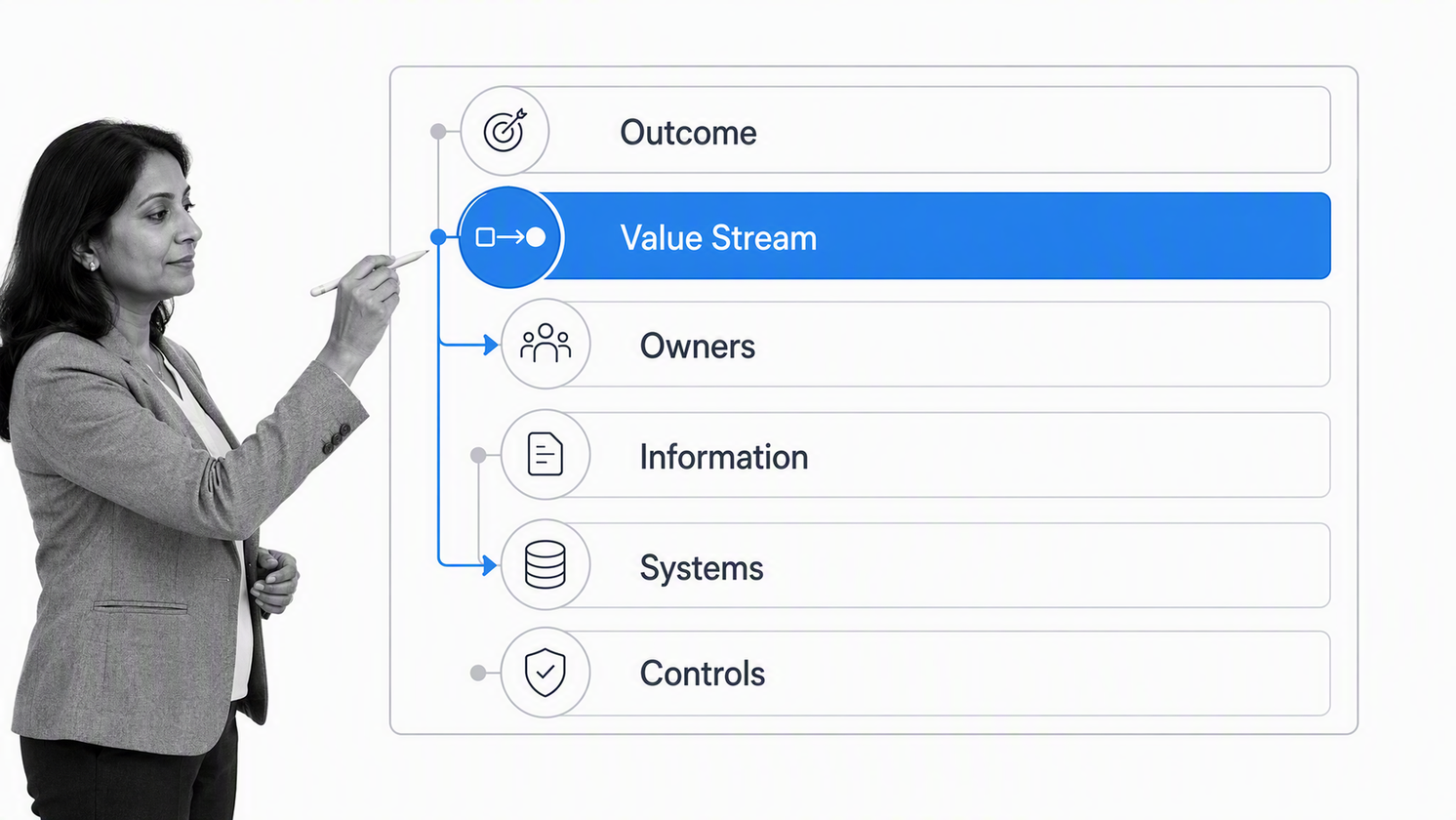
A durable operations integration connects six layers. Treating one layer as the whole creates predictable gaps, such as automation with no owner or shared goals with no executable workflow.
1. Outcome and service promise
Define the completed result and who receives value. State the expected quality, timing, risk, and evidence. The promise becomes the reference point for design decisions and prevents departments from optimizing their portion at the expense of the whole.
2. End-to-end value stream
Map the trigger, main path, decisions, handoffs, exceptions, and completion state. Include work outside the formal process when it materially affects the result. A clear workflow model makes the operating sequence visible enough to assign and improve.
3. Ownership and decision rights
Name one outcome owner, owners for major stages, task-level responsibility, and authority for consequential decisions. Define who can accept risk, change the standard, prioritize an exception, and approve release. Shared participation must not mean ownerless accountability.
4. Information and definitions
Agree on authoritative fields, identifiers, status definitions, required evidence, and access. A customer, vendor, incident, or control should not have incompatible meanings across functions. Shared information does not require one database, but it does require clear ownership and synchronization rules.
5. Technology and integrations
Choose which application owns each record and which workflow layer coordinates the work. Connect triggers, updates, notifications, and actions through the simplest reliable method. Teams evaluating the wider stack can use a business operations software view to separate systems of record from systems of execution.
6. Controls, measures, and improvement
Place controls where failure has material consequences, measure outcomes and flow, then review recurring exceptions. The integration is not complete until evidence from execution changes the workflow, ownership, capacity, rules, or technology when results fall short.
How operations integration works
Integrated operations run as a closed loop. Demand enters, the operation validates and prioritizes it, work moves through the value stream, people and systems make controlled decisions, the outcome is released, and evidence returns to the review cadence.
Sense demand and context
A request, contract, event, schedule, threshold, or exception starts the flow. Intake captures enough context to classify the case without repeatedly asking downstream teams for the same information.
Prioritize across functions
Shared rules balance customer value, urgency, risk, and capacity. This matters when one team sees revenue urgency, another sees regulatory exposure, and another sees a technical dependency. The operation needs one visible priority and an escalation route for conflicts.
Coordinate work and systems
Tasks, approvals, data updates, documents, and agent actions move according to the case state. Dependencies prevent premature work. Conditional paths keep routine cases simple while exposing the additional review required for complex or high-risk cases.
Manage exceptions explicitly
A failed control, missing field, rejected approval, unavailable system, or capacity constraint creates owned exception work. The exception preserves the original context, records the reason, and provides a safe retry or remediation path.
Complete and prove the outcome
The ending condition should be observable. A customer is launched, a vendor is approved, an order is fulfilled, an account is reconciled, or an incident is closed. Evidence should show the decisions and actions that support that state.
Review the whole flow
Operating reviews examine the outcome, queues, handoffs, control health, and recurring exceptions. Improvement work targets the constraint limiting the value stream, then tests whether the change improved the shared result.
How to integrate operations step by step
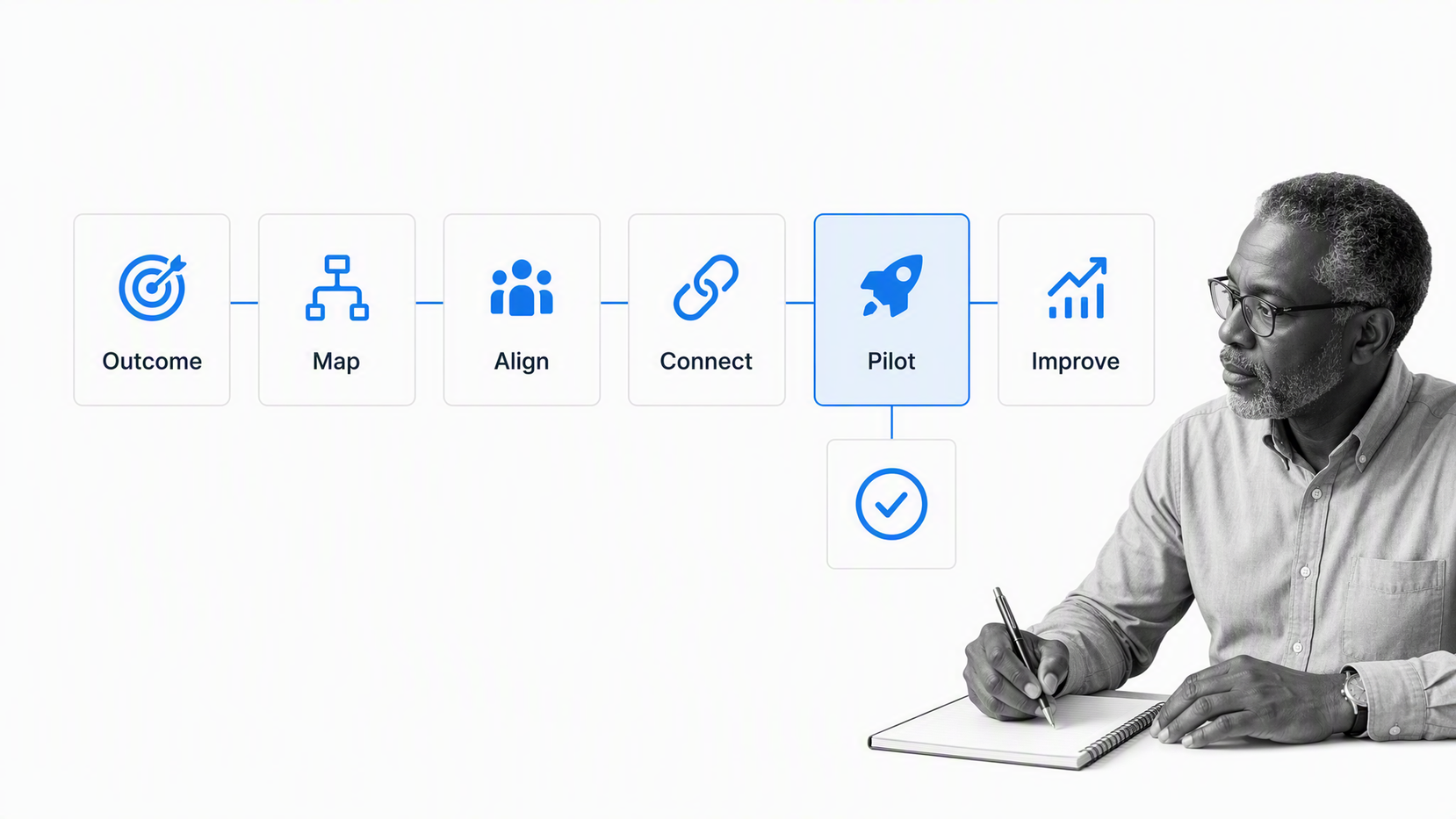
Start with one high-value value stream. A focused pilot gives you enough cross-functional complexity to test the design without turning integration into a company-wide reorganization project.
Step 1: Choose the outcome and boundary
Name the recipient, trigger, completion state, service promise, and major risks. Include every team and system that materially determines the result, even when part of the work sits outside the current process documentation.
Step 2: Map the current value stream
Observe real cases. Record work, wait time, decisions, systems, documents, re-entry, handoffs, exceptions, and measures. A process orientation workflow can structure discovery, while a process creation workflow turns the accepted map into a repeatable sequence.
Step 3: Align ownership and definitions
Assign an outcome owner and stage owners. Agree on status language, identifiers, required inputs, acceptance criteria, decision rights, and systems of record. Resolve disagreements before automating them.
Step 4: Design the integrated target flow
Remove duplicate capture and approvals, simplify the main path, design exceptions, connect systems, and place controls according to risk. Define what people do, what agents or automations do, and where judgment must remain visible.
Step 5: Pilot representative cases
Test routine, urgent, incomplete, high-risk, and failed-system scenarios. Watch where users leave the workflow, repeat data, wait for clarification, or bypass controls. Use a process mapping workflow to keep discovered changes tied to the end-to-end design.
Step 6: Govern and improve
Launch with an owner, review cadence, access rules, change method, and escalation path. A business process improvement workflow can convert recurring evidence into approved changes. Keep the review focused on the shared outcome and current constraint.
Common implementation mistakes
- Automating a broken handoff before agreeing on ownership and acceptance criteria.
- Mapping departments instead of the end-to-end outcome.
- Forcing all functions into one tool when clear system-of-record boundaries would work better.
- Using local activity targets that conflict with the shared service promise.
- Designing only the happy path and leaving exception recovery to chat.
- Launching without a named outcome owner and operating review.
How to measure integrated operations
Measure integrated operations at four levels: outcome, flow, control, and learning. A department-level productivity measure can improve while the end-to-end result deteriorates, so every local measure should connect to a shared result.
Outcome measures
Use measures that describe the completed service: on-time launch, first-time quality, accurate close, successful fulfillment, incident recurrence, accepted audit evidence, or supplier performance. Define the owner and response when the measure crosses its threshold.
Flow measures
Track end-to-end cycle time, queue age, wait time, throughput, work in progress, rework, and handoff delay. Segment routine and complex paths so valid variation does not hide a failing standard flow.
Control measures
Monitor missing evidence, approval reversals, bypasses, failed checks, unresolved exceptions, remediation age, and unauthorized changes. These measures should trigger corrective work, not only populate a report.
Learning measures
Track recurring exception themes, tested improvements, adoption of changed workflows, and whether a change improved the target result. The Plan-Do-Check-Act cycle provides a simple evidence-based improvement rhythm.
Integration health
For technical connections, monitor failed actions, retries, unmatched records, latency, duplicate events, and reconciliation gaps. For organizational connections, monitor rejected handoffs, missing context, reassignment, and escalation. Both belong in the same operating review because either can stop the outcome.
Operations integration with Process Street
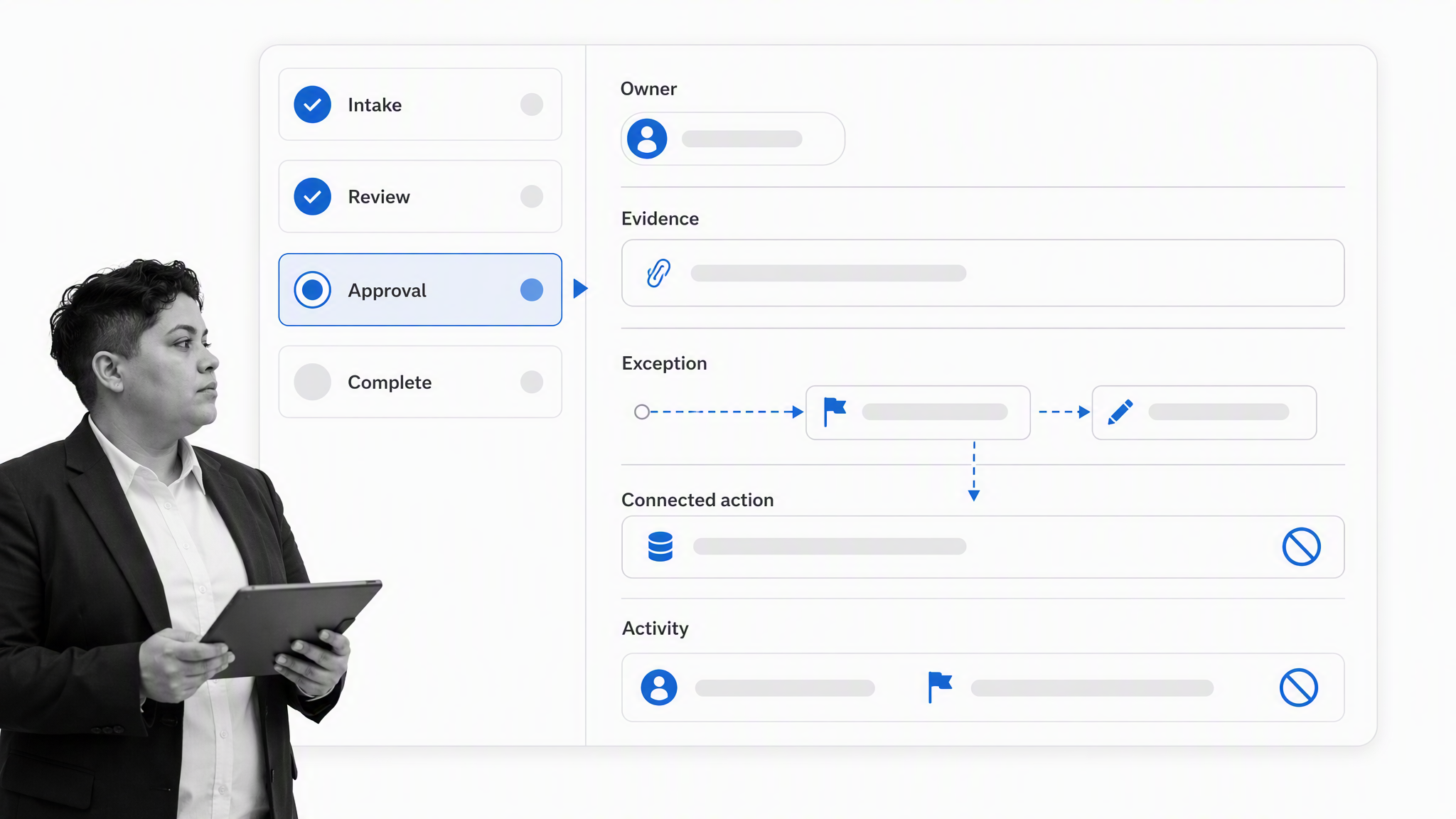
Process Street is an agentic process automation platform for high-stakes operations. It gives the end-to-end value stream one execution layer while teams keep the systems of record and specialist tools they need.
Turn handoffs into assigned workflow states
Task assignments route each stage to a person, group, or role with the required context. Ownership, due dates, and dependencies stay visible instead of living in separate inboxes.
Route cases by operational context
Conditional logic reveals the right work for the case. Routine work stays focused, while higher-risk or unusual cases receive additional review, evidence, or remediation.
Control consequential decisions
Approvals create explicit gates before a workflow releases a customer, vendor, payment, access change, or connected-system action. The decision and supporting evidence remain tied to the run.
Connect the operating stack
Process Street has direct, universal integrations to 5,000+ systems. Need a new one? An AI agent builds it on the fly. The integration layer also supports native automations and established integration methods for teams with existing architecture.
Incoming and outgoing webhooks can start workflows or notify services when workflow, task, Data Set, or form events occur. Data Set automations connect shared operational records with workflow runs.
Keep proof with execution
Form data, assignments, comments, files, approvals, system actions, exceptions, and activity history stay associated with the workflow run. Leaders can review the integrated outcome without reconstructing it from application logs and chat messages.
Add agents inside governance
Agents can complete assigned research, data, communication, and system tasks inside the same operating flow. Approval gates and workflow history keep consequential actions controlled, while the human owner remains responsible for the outcome.
Operations integration FAQs
What is operations integration?
Operations integration connects teams, workflows, information, controls, and technology around one end-to-end business outcome. It makes ownership, handoffs, decisions, system actions, exceptions, and proof work as one operating flow.
What are the main components of operations integration?
The main components are a shared outcome, an end-to-end value stream, clear ownership and decision rights, common information definitions, connected technology, and controls with measures and improvement. Each component must reinforce the others.
How is operations integration different from system integration?
System integration connects applications so they can exchange data or perform actions. Operations integration includes those technical connections but also coordinates people, priorities, capacity, approvals, exceptions, performance measures, and governance.
How do you integrate business operations?
Choose one important outcome, map the current value stream, align ownership and definitions, design the target flow, connect the required systems, pilot representative cases, then govern and improve the live operation from evidence.
How do you measure operations integration?
Measure the shared outcome, end-to-end flow, control health, learning, and technical connection health. Useful signals include cycle time, queue age, rework, failed handoffs, missing evidence, unresolved exceptions, retries, and reconciliation gaps.
How does Process Street support operations integration?
Process Street coordinates assigned work, conditional paths, approvals, evidence, agent actions, webhooks, Data Sets, and connected-system actions inside one workflow run. That gives teams a shared execution state while preserving the systems of record they already use.