


Turn every policy into automated workflows with built-in enforcement and audit-ready proof.



Financial Project Management

Financial project management is the practice of planning, tracking, controlling, and proving the money side of a project from kickoff through closeout.
It connects the project plan to the budget, forecast, approvals, commitments, actual spend, risks, and audit evidence. When it works, project leaders know what has been approved, what has been spent, what is likely to change, and which decisions need control.
This guide explains the discipline, the components, the difference between financial project management and project cost management, and how to run the work through controlled workflows instead of disconnected spreadsheets.
In this article, we are going to cover:
- What financial project management means
- Why financial project management matters
- Financial project management components
- Financial project management versus project cost management
- How to run financial project management
- Financial project management in Process Street
- How to evaluate your financial project management system
- FAQs
What financial project management means
Financial project management gives the project team a reliable operating model for money decisions. It is not just accounting after the fact. It is the active control system that helps the team set a budget, approve spend, monitor variance, update forecasts, and explain financial decisions.
A project can look healthy in a status meeting while financial risk is building underneath. Purchase orders may be delayed. Scope changes may be approved informally. Labor assumptions may no longer match the schedule. Vendor commitments may not be reflected in the forecast. Financial project management closes those gaps.
The core job is alignment
The budget, project schedule, work breakdown, risk register, approval path, and financial records need to tell the same story. If they do not, the team debates numbers instead of managing the project. Related guidance on project management tools and techniques helps connect the finance discipline back to day-to-day project work.
Alignment also protects trust. Sponsors need to know whether the project can deliver within approved limits. Finance needs clean evidence for approvals and spend. Project managers need early warning when assumptions change. Delivery teams need clarity on what they can commit to.
It applies beyond finance teams
Finance may own the standards, but the workflow crosses many roles. Project managers estimate work and flag changes. Procurement manages vendor commitments. Department leaders approve budgets. Operations teams confirm work completion. Compliance or audit teams may need proof that high-risk spending followed policy.
The discipline works best when those roles share a single process record. A spreadsheet owned by one person can support analysis, but it rarely enforces approvals, routes exceptions, or creates a durable history of who decided what.
That shared record is what separates controlled work from financial admin. The project team can see the current state of a budget request, finance can see the decision context, and leadership can see whether a risk is being managed or ignored. The same workflow becomes both an operating tool and a financial memory.
Why financial project management matters
Financial project management matters because budget problems usually appear late in the project record. By the time the final invoice lands, the real decision points may be weeks or months old.
Strong financial controls make those decision points visible while the team can still act. They show whether scope, schedule, commitments, actuals, and forecast still match the approved plan.
It catches variance early
Asana cost management guide frames cost management around estimating, budgeting, and controlling costs. That control becomes more useful when variance is surfaced before it turns into a surprise.
Early variance does not always mean the project is failing. It can mean the team needs to release contingency, reduce scope, adjust timing, renegotiate vendor work, or approve a change. The point is to make the decision explicit.
It protects margins and cash flow
A project can be on schedule and still create financial pain if payment timing, staffing mix, vendor deposits, or change requests are unmanaged. Financial project management gives the team a view of commitments and cash timing, not only budget totals.
That matters for professional services, construction, implementation, technology, finance operations, compliance projects, and any project where labor, vendors, or regulatory work can shift the cost profile.
It creates evidence
Financial decisions often need proof. Who approved the change? Which estimate was used? Why was contingency released? Was the exception reviewed? Pages on compliance as proof of control and financial compliance software explain why evidence matters when finance work carries compliance or audit consequences.
The best process records are created while the work happens. Teams should not have to rebuild the evidence trail at the end of the project from email, chat, spreadsheets, and memory.
This is especially important when a project moves through phases. The person approving the original budget may not be the person reviewing the change request. The vendor owner may change. The project sponsor may ask for a different reporting view. Financial project management keeps the decision trail stable even when the people around the project change.
Financial project management components
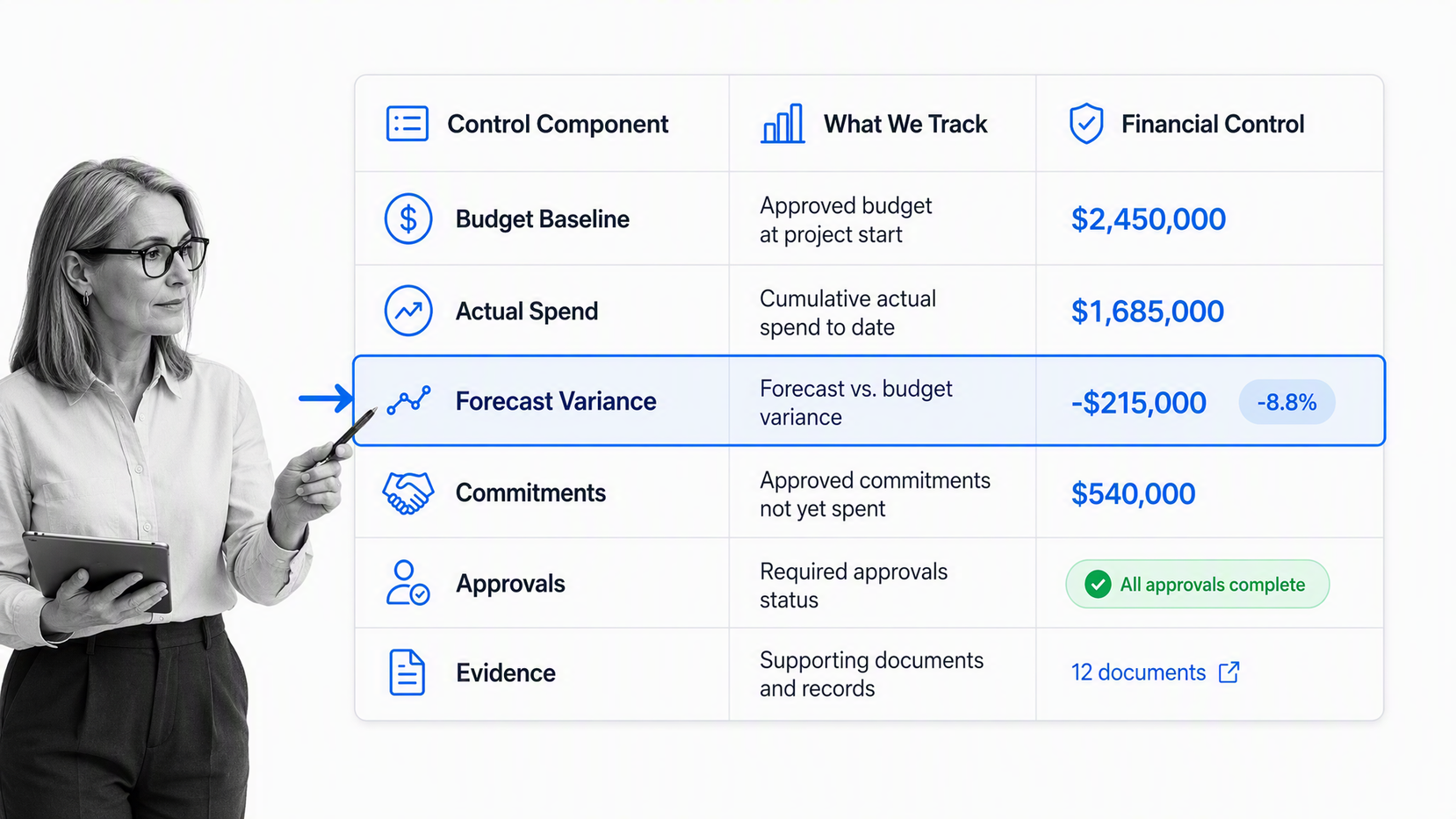
A financial project management system needs more than a budget column. It needs a set of connected components that help the team plan, approve, track, forecast, and close the financial side of work.
Budget baseline
The budget baseline is the approved financial plan. It should include the cost categories, assumptions, contingency rules, and approval limits that the team will use to judge changes. A weak baseline makes every variance argument subjective.
The GAO Cost Estimating and Assessment Guide emphasizes documented assumptions and estimate quality. That principle applies even when the project is not a government program. If assumptions are not recorded, the team cannot explain why the number changed.
Actuals and commitments
Actuals show what has been spent. Commitments show what the team has already agreed to spend. Both matter. A project that only tracks paid invoices may miss approved vendor work that has not hit the ledger yet.
Commitment tracking is especially important when procurement, legal, or department approvals sit outside the project management tool. The project record should show pending spend before it becomes irreversible.
Forecast and variance
Forecasting turns current information into an updated view of where the project is likely to land. Variance analysis explains the difference between baseline, actuals, commitments, and forecast.
Earned value management is one structured way to connect scope, schedule, and cost. A PMI earned value management resource describes how earned value systems help analyze performance against a plan.
Approvals and controls
Controls decide which decisions need review. Examples include budget release approvals, change request approvals, vendor commitment limits, exception reviews, evidence requirements, and closeout checks.
Teams often pair these controls with workflow capabilities like conditional logic and approvals so the right route is enforced automatically.
The control layer should be explicit enough that people know what happens next. If a forecast moves beyond a threshold, the workflow should state who reviews it, which supporting files are required, how the decision is recorded, and whether work can continue before approval. Clear rules reduce political debates because the process has already defined the route.
Financial project management versus project cost management
Financial project management is broader than project cost management. The two overlap, but they answer different operating questions.
Project cost management focuses on cost discipline
Project cost management usually covers cost estimating, budgeting, and cost control. Invensis Learning project cost management guide describes it as the work of planning, estimating, budgeting, monitoring, forecasting, and controlling project spending.
That discipline is essential. Without cost management, the team cannot set a credible baseline or understand whether spending is under control.
Financial project management covers the full money workflow
Financial project management includes cost management, but also covers approvals, funding decisions, commitments, cash timing, margin impact, procurement handoffs, invoice evidence, compliance requirements, and financial closeout.
In other words, cost management asks whether the project is within the approved cost plan. Financial project management asks whether the whole financial process around the project is controlled, current, and provable.
The practical difference
A project manager may use a cost report to see that a workstream is trending over budget. Financial project management defines what happens next: who reviews the variance, which evidence is required, which approval threshold applies, whether the forecast changes, and how the decision is recorded.
That next-step control is where many teams struggle. They have reports, but the process around the report is manual. The numbers move faster than the approvals.
The distinction also matters for software. A reporting tool may calculate variance well, but still leave approvals in email. A project management tool may track tasks well, but not collect the evidence finance needs. A workflow layer can connect the reporting signal to the human decision that follows.
How to run financial project management
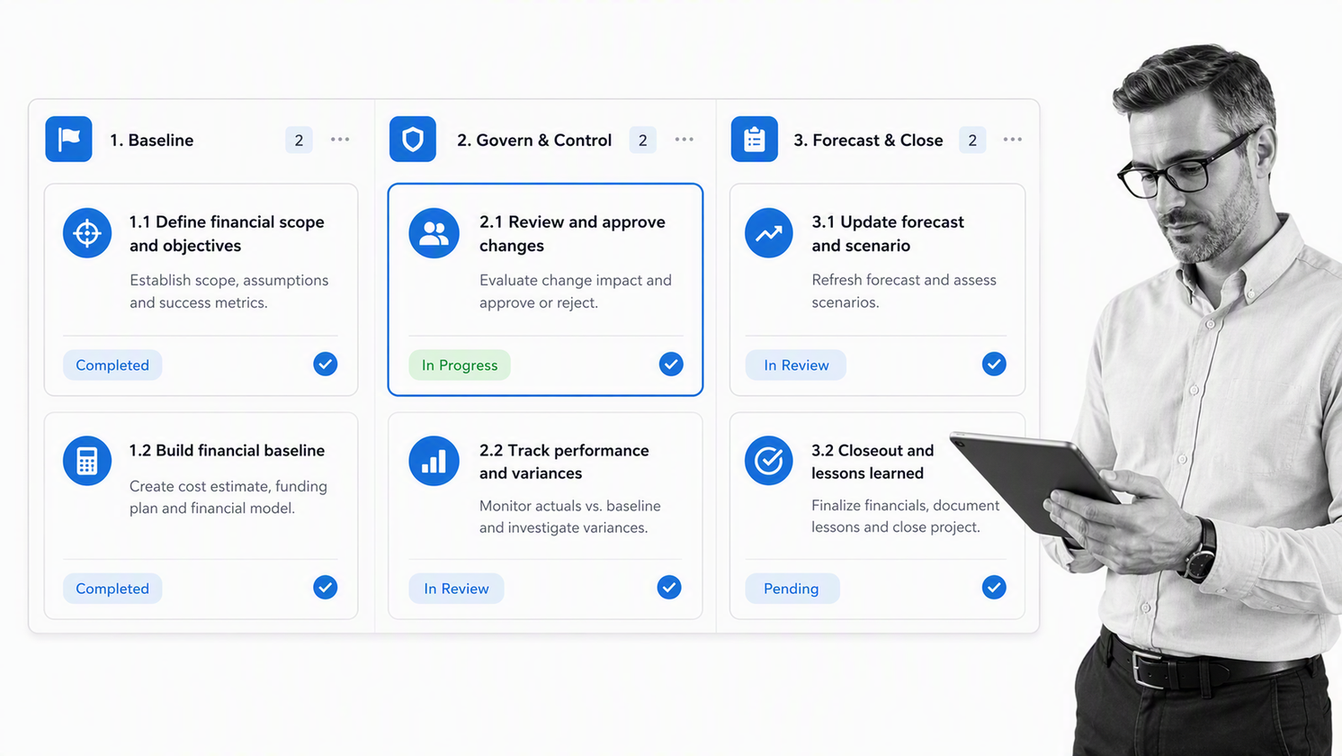
The safest way to run financial project management is as a workflow, not as a monthly reporting ritual. The workflow should begin before the project starts and continue through closeout.
Step 1: Set the financial scope
Define what is included in the budget, which categories matter, which assumptions drive the estimate, and which costs are excluded. The scope should cover labor, vendors, tools, travel, compliance work, training, contingency, and handoff costs where relevant.
Step 2: Build the baseline
Create a baseline that ties budget categories to the work breakdown structure. Use clear owners and approval thresholds. If the project needs a structured starting point, a financial management for new projects template can help turn setup work into repeatable steps.
Step 3: Track commitments and actuals
Update the process record when spend is approved, committed, invoiced, or paid. Do not wait for accounting close to learn that the project has already crossed a decision threshold.
Step 4: Review variance and changes
Set a recurring variance review. When the forecast changes, the workflow should route the update to the right owner. Small variance may need a note. Larger variance may need sponsor approval, revised scope, or a formal change request.
A finance project management software system can centralize project financial data, while financial process management organizes recurring controls and financial process automation moves approvals and records between systems.
Step 5: Close the financial loop
At closeout, confirm final spend, open commitments, variance explanations, lessons learned, and retained evidence. This step protects the next project because the team can reuse real assumptions instead of starting from optimism.
Closeout also helps finance teams identify recurring bottlenecks. If every project needs late exception approvals, the baseline process or threshold rules may need to change.
A closeout workflow should also capture what was intentionally left out of the final financial view. Deferred costs, unresolved vendor credits, pending invoices, and lessons about estimate quality can affect the next project. Recording those items while context is fresh gives the organization better inputs for future planning.
Financial project management in Process Street
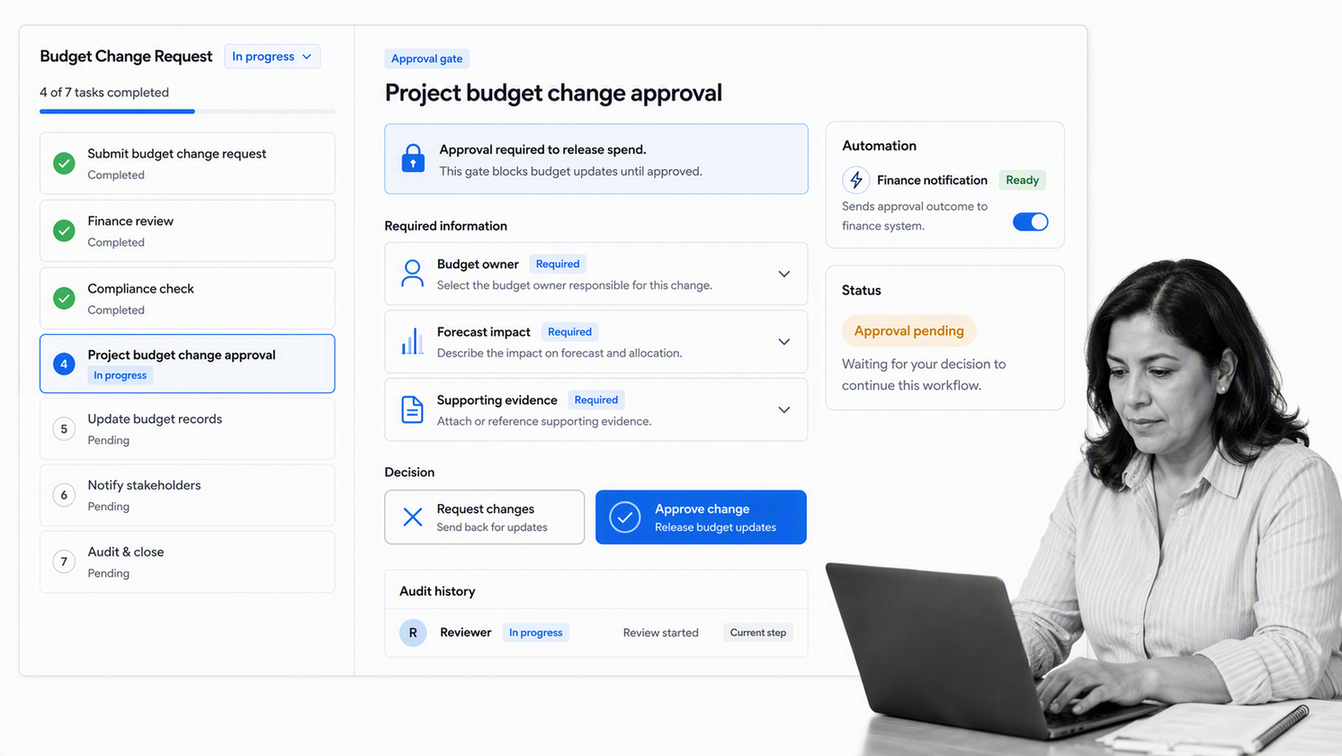
Process Street supports financial project management by turning budget requests, change reviews, approvals, recurring checks, and closeout tasks into controlled workflows.
Instead of asking teams to remember the approval path, Process Street can make the path part of the work. Required fields collect the budget owner, forecast impact, evidence, and decision notes. Conditional logic routes over-threshold requests to the right reviewer. Approvals block work until the decision is captured.
Run budget and change workflows
Finance and project teams can build workflows for project kickoff, budget approval, vendor onboarding, scope change review, invoice checks, monthly variance review, and project closeout.
The public financial management for new projects template and financial planning process template show how repeatable finance work can be structured as tasks rather than scattered instructions.
Keep proof with the process
The approval record, uploaded evidence, task history, and exception notes stay attached to the workflow run. That makes the process easier to inspect later, especially when finance, operations, and compliance teams need the same evidence.
Connect finance work to operations
Financial project management often depends on work happening outside finance. Process Street can coordinate those handoffs through task assignments, due dates, form fields, automations, and integrations.
Process Street has direct, universal integrations to 5,000+ systems. Need a new one? An AI agent builds it on the fly. For finance teams, that means the workflow can sit alongside accounting, project, CRM, document, and communication systems without turning every process change into an IT project.
Teams that need broader finance workflow support can also review finance workflow software for a finance-specific view of the platform.
The result is not another place to store a budget. It is a place to run the budget process. The workflow tells each owner what to do, collects the fields finance needs, routes the approval, and leaves behind a record that can be inspected later.
How to evaluate your financial project management system
Evaluate your financial project management system by asking whether it helps the team make better decisions earlier. Feature volume matters less than process reliability.
Does it connect plan, spend, and forecast?
The system should connect baseline budget, actuals, commitments, forecast, and variance explanation. If those live in separate files with manual reconciliation, the team will spend too much time arguing about which number is current.
Does it enforce approval paths?
Approval thresholds should be part of the workflow. The system should know when a change needs project sponsor review, finance review, procurement review, or compliance review.
Does it create audit-ready evidence?
Look for durable records: required fields, file uploads, approval timestamps, reviewer notes, exception routes, and closeout summaries. The process should create evidence as work happens.
Can operators own the process?
Finance and project operations teams should be able to adjust workflows without waiting months for custom development. Governance still matters, but the operating team needs enough control to keep the process current.
If AI starts influencing forecasts, routing, or exception detection, use a governance lens. The NIST AI Risk Management Framework is a useful reference for thinking about oversight, measurement, and risk management.
Does it improve over time?
A good system gets smarter as project data accumulates. It shows which assumptions were wrong, which approvals delayed work, which categories drifted, and which controls prevented risk. That learning should feed the next budget, not disappear into an archive.
FAQs
What is financial project management?
Financial project management is the practice of planning, tracking, controlling, and proving the financial side of a project. It covers budgets, forecasts, approvals, commitments, actual spend, variance, and closeout evidence.
Why is financial project management important?
Financial project management helps teams catch budget variance early, protect margins, control spend, and explain financial decisions. It turns project money management into a visible process instead of a late reporting exercise.
What does a financial project manager track?
A financial project manager may track the budget baseline, actual spend, committed spend, cash timing, forecast changes, variance explanations, change requests, approvals, contingency, invoices, and financial closeout items.
How is financial project management different from project cost management?
Project cost management focuses on estimating, budgeting, and controlling costs. Financial project management includes cost management, but also covers approvals, commitments, cash flow, procurement handoffs, audit evidence, and financial decision workflows.
What software helps with financial project management?
Useful software includes workflow management systems, project management tools, accounting or ERP systems, procurement tools, budget forecasting tools, approval workflow software, and reporting platforms. The best setup connects the financial workflow instead of isolating each tool.
How can Process Street support financial project management?
Process Street lets teams build controlled workflows for project budgets, change requests, approvals, variance reviews, vendor checks, invoice evidence, and closeout. Required fields, conditional logic, approvals, automations, and audit history help keep financial decisions consistent and provable.