Menu icon
  Help center      Data Sets  
  Data Sets: Linked Dropdowns in Workflows

Data Sets: Linked Dropdowns in Workflows

Updated April 6, 2026
Who can use this feature
Related subproduct  Data Sets
Available on  All plans

Linked Dropdowns are dropdown form fields that you have connected with a Data Set.

After creating a Data Set, you can connect it to a Workflow making that data available as dropdown selection options in that workflow’s runs.

To connect a Data Set to a workflow, you first need to create a saved view of your Data Set.

Create a saved view of your Data Set

To create a saved view, first set the filters and fields you would like to display. This determines what data is shown in your Linked Dropdown. Next, click the button Create a Saved View and give it a name.
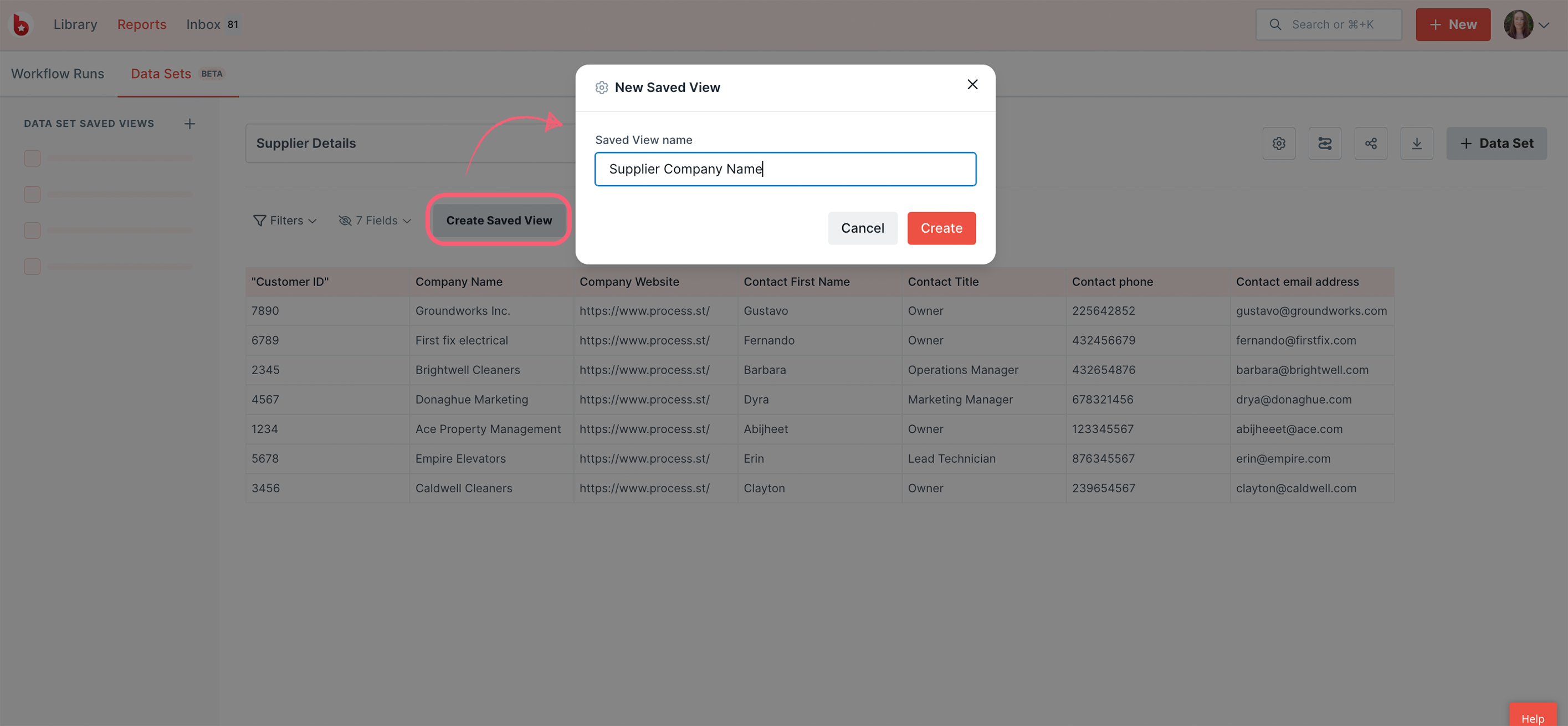
Note: If you have sensitive data in your Data Set, be sure to hide those columns first, before creating a saved view.

Creating a Linked Dropdown

New Workflows

If you’re building a new Workflow, add a dropdown form field and click the three dots at the right of the form field, shown below.
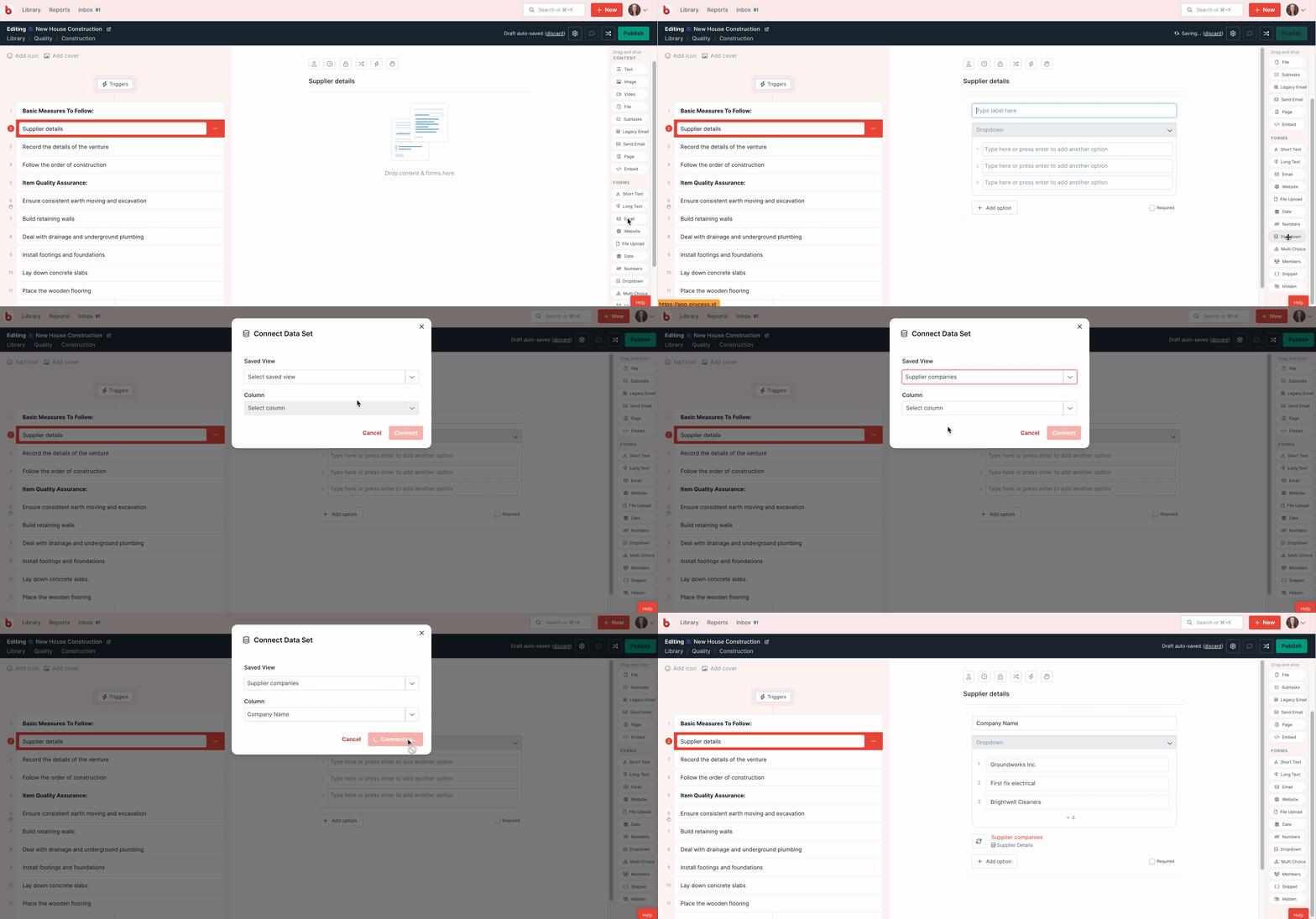
Select the saved view you’d like to use and the field that will become the pick list in your Workflow runs, as shown above.

Publish and Run your workflow. Now you can select from the options in your dropdown that are connected to your saved view.

Existing Workflows and form fields

If you already have a workflow with a dropdown in use, you can edit your workflow and connect a saved view to it. This effectively overwrites the selections in your existing dropdown with new ones.

If you publish changes to your workflow and don’t update active workflow runs, then nothing will change in the existing runs.

If you do push changes to all active workflow runs, any selections that were previously made in the dropdown will be retained. Anywhere there was no selection made, the dropdown will show the new list.

Any new workflow runs created will show the new options in your dropdown field.

Duplicating Linked Dropdowns

When you duplicate a Linked Dropdown, the saved view will also be duplicated. You can then move this field to another task.

If you’d prefer to use another saved view for the duplicate, click the three dots and disconnect the original saved view, then connect a different one.

Using Data Sets as variables

Once you’ve created a Linked Dropdown, all of the fields in that saved view can be used as variables.

In the variables menu, you can identify which ones you need from the headings for global, workflow and Data Sets variables, as shown below.
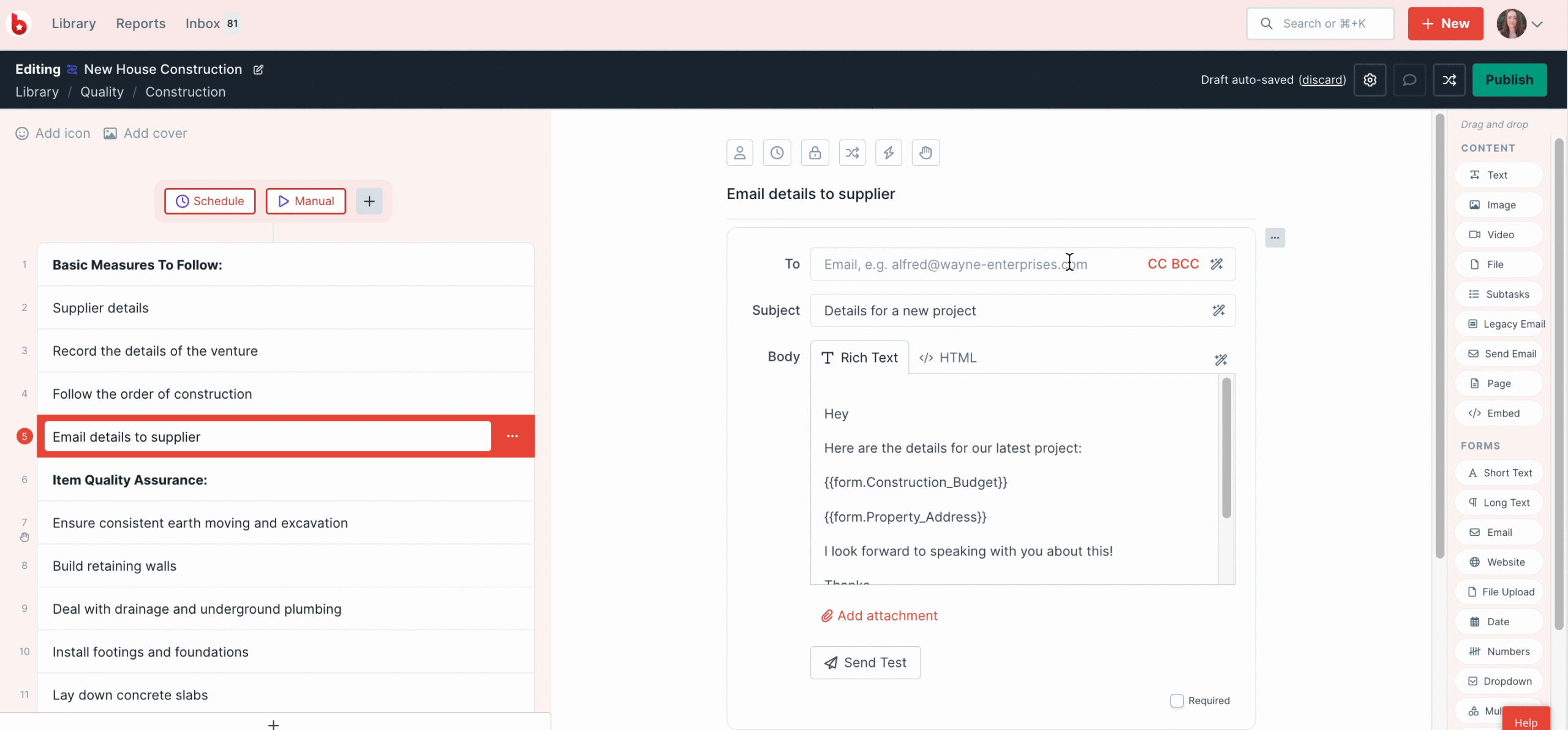
You can also use Data Set variables to auto-fill form fields. For example, when you make a selection in a dropdown, form fields that you’ve connected with Data Set variables will be filled with information from that Data Set.

Populate a linked dropdown via automation

In addition to selecting values manually, you can populate a linked dropdown programmatically. This works through the Process Street API, third-party integration tools, run links, run multiple via CSV, incoming webhooks, and native automations.

When you populate a linked dropdown through any of these methods, it behaves the same as a manual selection — conditional logic and variables fire as expected.

Text value vs. Record ID

You can identify the dropdown selection in two ways:

  • Text value — Pass the display text of the option (for example, Bananas). This is the simplest approach when each option has a unique name.
  • Record ID — Pass the unique identifier for the Data Set record. Use this when multiple records might share the same display value (for example, two people with the same last name).

Pro tip: To copy a Record ID, open your Data Set and click the Record ID button on any row. This copies the ID to your clipboard without needing to extract it from a URL.

Supported methods

The following methods support populating linked dropdowns with either a text value or a Record ID:

  • API — Set the linked dropdown field value when creating or updating a workflow run through the Process Street API.
  • Run links — Include the linked dropdown value as a parameter in a workflow run link. The dropdown is pre-populated when the run starts.
  • Run multiple via CSV — Include a column in your CSV file that maps to the linked dropdown field. Each row populates the dropdown for that workflow run.
  • Incoming webhooks — Pass the value in the webhook payload when using a webhook trigger to start a workflow run.
  • Native automations — Use workflow automations built in the Process Street editor to push a value from one workflow into a linked dropdown in another.
  • Zapier, Make, and Power Automate — Map the linked dropdown field in your integration and pass either the text value or Record ID. Refer to the integration links documentation for setup details.
  • Slack — Trigger a workflow run from Slack and include the linked dropdown value in the trigger payload.

What happens after a value is set

Once a linked dropdown is populated through any automation method:

  • Conditional logic that depends on the dropdown selection fires automatically.
  • Variables referencing the linked dropdown or its related Data Set fields resolve with the correct values.
  • Any auto-filled form fields connected to the Data Set update accordingly.

Filter a dropdown by another form field

You can filter a data set-connected dropdown based on the value of another form field. This creates a pick-on-pick behavior — for example, selecting a country in one dropdown and seeing only that country’s states in the next.

Prerequisites

To set up filtered linked dropdowns, you need:

  • Two Data Sets — one for each dropdown (for example, a Countries data set and a States data set)
  • A shared column between the two data sets that links them (for example, the country name appears in both)

Set up the first dropdown

  1. Add a dropdown form field to your workflow (for example, “Country”).
  2. Click the three dots on the right of the dropdown and select Connect Data Set.
  3. Choose your first data set (for example, Countries) and select the column to display (for example, country name).

Set up the filtered dropdown

  1. Add a second dropdown form field to your workflow (for example, “State”).
  2. Click the three dots on the right of the dropdown and select Connect Data Set.
  3. Choose your second data set (for example, States) and select the column to display (for example, state name).
  4. In the Filter section, select the column to filter by (for example, country name in the States data set).
  5. Set the filter to use the value from the first dropdown form field (for example, the Country field).

Publish your workflow and run it. When you select a value in the first dropdown, the second dropdown automatically shows only the matching options.

Supported form field types

The filter can match against values from these form field types:

  • Text
  • Dates
  • Numbers
  • Hidden fields
  • URL
  • Email

Learn more about Data Sets and workflow automations.

Discover Process Street

Use Process Street to make your team processes fun, fast and faultless. We'll help you transform your team's static checklists into powerful interactive workflows!
Is this article helpful?

Help us improve this help center.

Learn more about Process Street

YouTube videos
Deep dive into Process Street with our YouTube video series.
Join a webinar
Effectively record, replicate, and replace your workflow!
See latest releases
Catch up on the latest releases and enhancements.
Join the community
Share with others about how you are using the app day to day.

Take control of your workflows today