



A minimum viable process is the smallest repeatable way to complete important work consistently, with a clear trigger, owner, sequence of steps, and outcome. A minimum viable product tests whether a product should exist. A minimum viable process makes sure the work around that product does not depend on one person remembering everything.
I know, you want to cut out admin work. You want to cut out time wasted on bullshit that does not directly affect traction. It is hard to pull yourself away from product and marketing to focus on how efficiently your startup runs internally, but it does have to be done.
Srinivas Kulkarni, writing for ZDNet, explains why startups need processes that capture experience:
“While it’s very easy to say that when startups are founded, there’s a lot of freedom, liberty and access in terms of work and building the product, technology or service that they offer, it is also important to realize that most startups fail because they don’t learn from their and others’ mistakes. It’s imperative that the experience comes from a process.”
Many problems look easy to fix on the day they appear. Writing down how work gets done can feel unnecessary when there is already too much work to finish. But a startup that grows has to learn how it operates, keep what works, and improve what does not.
Sam Altman compares running a startup to building a working spaceship from a bag of aerospace parts:
“When you start a startup, you get pushed off the side of a cliff with a bag of aerospace parts. You hope they are the parts for a spaceship, and they look like they might be, but it’s impossible to tell when they’re all in a bag […] Every once in a while, it turns out you do have the parts for a spaceship […] Much of the time, you don’t have the parts to make anything at all, and should just try to hit the ground as gently as possible.”
What keeps your startup moving while you assemble those parts is a foundation of processes that produce dependable results. This guide shows you what startup processes are, which problems they solve, what to document first, and how to build a minimum viable process pack without burying the company in bureaucracy.
Processes for startups, defined
Processes are systems that can run without you. They give recurring work a clear trigger, owner, sequence, standard, and finish line.
A process can include written instructions, structured data, due dates, assignees, approvals, automations, integrations, and controlled AI assistance. The document explains the work. The operating process makes sure the work happens, records what happened, and gives the team a way to improve it.
Some processes can be managed partly by another company. Payroll is a common example for an early team. You might use a provider such as Intuit or Paychex for software plus specialist support, while keeping an internal process for approvals, changes, exception handling, and record retention.
Useful startup process examples include:
These processes have several things in common. They contain multiple steps, move or record information, involve handoffs, and can fail when people rely on memory alone.
Early-stage problems that processes solve
- Maker and manager imbalance: A clear process lets you delegate the making or the managing without explaining the work from scratch every time.
- Funding work: A simple pipeline keeps investor criteria, research, introductions, outreach, meetings, follow-ups, and decisions visible.
- Urgent admin work: Document, delegate, automate, or batch recurring work before it becomes a fire that interrupts important long-term goals.
- Scaling: Hire and onboard people faster with structured instructions, access steps, ownership, and standards ready before they arrive.
The goal is not to process everything. It is to remove avoidable confusion from work that is important, repeated, risky, or easy to drop.
The most important work to systemize early
Take the advice of Martin Zwilling, former IBM developer and CEO of Startup Professionals: implement one process at a time.
“The simple answer is that you need to implement one process at a time, starting with those things that are most critical to your business, until you feel a relief that things are starting to happen naturally and consistently, without the attendant stress and continual recovery mode. If you feel that the process itself is a burden, you have likely gone too far.”
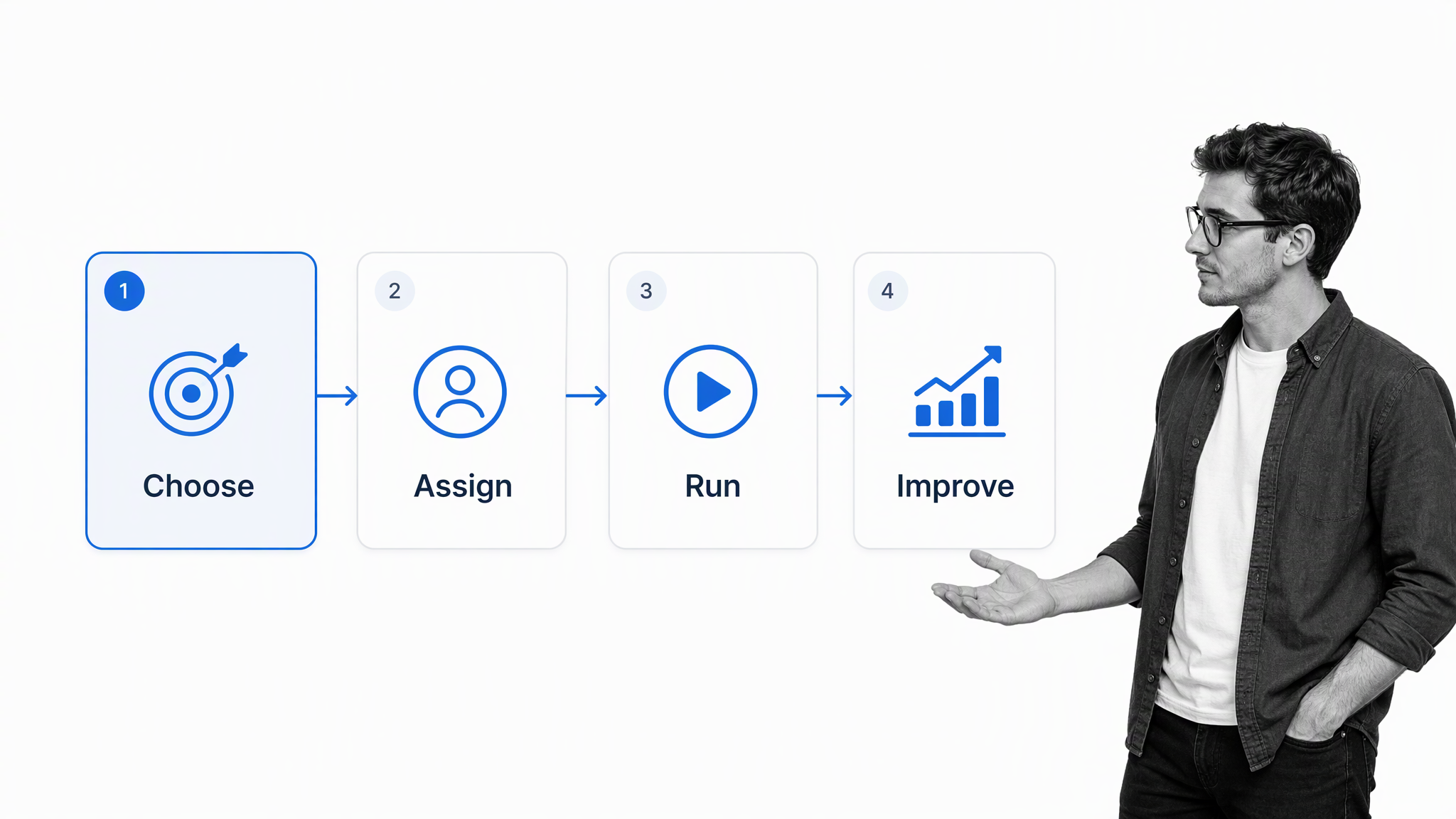
Start with the process whose failure would hurt most or whose repetition consumes the most attention. Give it an owner, define the smallest useful sequence, run it, and improve it from real execution. Then add the next process. The result is a process pack that grows with evidence instead of a policy manual written in one sitting.
Cash flow reporting
At the most basic level, you need to record money coming in and going out so you know your burn rate and can forecast cash flow. For that, we have a lean checklist:
You will also want a repeatable tax-preparation process, so run this tax preparation checklist and adapt it with professional advice for your situation. For invoicing, see our guide to setting up an invoice generator. A documented invoicing process makes the work easier to delegate and automate without losing control of approvals or records.
Meeting and feedback process for team members
A small startup does not need massive recurring meetings, slide decks, and lectures. It does need a dependable way to surface blockers, make decisions, and record ownership. A short standup can work when it serves that purpose, but the cadence should match the team and the work.
Common meeting needs include:
- Working with contractors or outsourced specialists
- Product and development coordination
- Financing discussions
- Marketing projects and experiments
Startup Studio CEO Zach Ferres describes the point where informal communication starts to break down:
“You just hired your 10th employee. Everyone isn’t in the same room anymore. The CEO no longer manages every project or interfaces with every team member, and communication starts to break down. Mistakes that would have been avoided by the founding team start to slip through the cracks.”
Use our standup meeting checklist to notify participants, track discussion topics, assign actions, and keep a searchable activity record.
Software deployment process
As soon as a software product has users, deployments need a consistent sequence. The process should cover preparation, testing, approvals, release steps, monitoring, rollback, and follow-up. It also gives new development hires a safe way to learn how the team ships.
Use the template below as it is, or edit it to reflect the way your team deploys:
Fundraising process
An active raise can consume a major share of a founder’s attention. Treat it as a focused pipeline rather than a stream of disconnected messages.
The minimum viable fundraising process has two broad jobs:
- Find investors who match your stage, market, geography, check size, and thesis.
- Prepare and run the pitch, follow-up, diligence, and decision process.
Define your criteria first. Track the source of each relationship, why the investor might be a fit, the next action, the owner, the last contact, and the current status. Research before outreach, personalize the message, log the result, and schedule the next step. Do not scrape personal details or send indiscriminate campaigns.
Once you have a relevant contact, Invstor has a detailed guide to the investor email pitch. Your message will vary, but the process should still make the connection, problem, solution, traction, team, proof, and ask clear. When an investor agrees to meet, use our investor pitch checklist to prepare.
Marketing experiment tracking
Early marketing relies on repeated tests across landing pages, copy, offers, channels, images, and audience segments. Without a process, teams forget why a test exists, change multiple variables, or never check the result.
A minimum experiment process should:
- Record the hypothesis and expected outcome
- Name the owner, audience, variable, metric, and stopping rule
- Capture approvals and implementation checks
- Schedule the review date
- Store the result and the decision it produced
Recruiting and employee onboarding
Some people processes can wait until the team is larger. Hiring and onboarding cannot. Recruiting has multiple parts to manage: defining the role, sourcing candidates, screening, interviews, evaluation, references, offers, and close. A process keeps evidence and ownership together while reducing avoidable delays.
Straight after recruiting comes onboarding. The new hire needs access to communication, documentation, repositories, customer systems, and role-specific tools. They also need clear goals, a manager, training, and feedback checkpoints. Use this generic employee onboarding process, and see our role-specific onboarding guides for engineering, sales, and other teams.
Customer support
Customer service and technical support matter for every kind of company. A dependable support process makes responses more consistent, captures useful context, and prevents an unresolved issue from disappearing between people or tools.
At Process Street, we shared the structure of our SaaS support process so you can see how recurring support work can be classified, assigned, answered, escalated, followed up, and learned from:
Support duty also teaches the team about the audience and product:
- Engineers built and tested the product, so they can see the real consequences of technical decisions.
- Salespeople need an intimate understanding of the product to set accurate expectations with prospects.
- Marketers should know the product and target buyers well enough to describe real problems, not abstractions.
- Customer support and customer success should be power users who can answer questions, spot patterns, and improve the process.
Creating the minimum viable processes you need
Processes help manage startup growing pains, but they are not one-size-fits-all. Your tools, team, skills, risks, and existing methods determine what the smallest useful process looks like.
Build your minimum viable process pack one workflow at a time. Choose a repeated or high-risk job. Name the trigger, owner, steps, inputs, decision points, evidence, and outcome. Run the process with real work, then remove friction and close the gaps you discover. A business process management template gives you a practical structure for documenting that first version.
Process Street is a single Compliance Operations Platform with Docs and Ops capability areas plus built-in AI. Teams can govern process knowledge in Docs, run repeatable work and approvals in Ops, and use built-in AI to help draft, classify, find, and execute work inside those controls. Process Street also has direct, universal integrations to 5,000+ systems, and an AI agent can build a new integration when needed.
For more help creating and improving processes, use these guides:
- How to Create a Process People Won’t Hate Using
- Business Writing Tips: How to Write Processes for Human Beings
- Why You Need to Create a Process for Everything You Do More Than Twice
- How to Switch to BPM Software When You Are Just Using Paper
For help getting started with Process Street, see:
To close, here is an account from Entrepreneur columnist Joe Worth about a small technology business that documented every process, no matter how small:
“They even spelled out how to clean and stock the company kitchen. I asked the owner why she’d gone to this level of detail, and she told me, ‘I want to act like the company I want to become.’ On an operational level, it was fantastic. I was able to grab the accounting process book put together by the outgoing controller, and within five minutes I was in business.”
For some, systemization is all or nothing. For startups, you still need to start somewhere.