Turn every policy into automated workflows with built-in enforcement and audit-ready proof.


Best ISO 27001 Readiness Tools
Last updated:
The best ISO 27001 readiness tools help a team turn a demanding management-system standard into owned, reviewable work. They organize policies, risks, controls, evidence, internal audits, corrective actions, and management reviews so the organization can see what is ready and what still needs attention.
No tool can certify an organization. Certification depends on an implemented information security management system, evidence that it operates, and an independent audit by an accredited certification body. Software can make that work more visible, repeatable, and defensible.
This comparison covers six distinct approaches. Some platforms emphasize automated technical evidence and control tests. Others focus on GRC mapping, ISMS structure, or the operational workflows that keep policies, reviews, exceptions, and remediation moving.
In this article, you will learn:
- What ISO 27001 readiness involves
- Best ISO 27001 readiness tools at a glance
- 1. Process Street
- 2. Vanta
- 3. Drata
- 4. Secureframe
- 5. Hyperproof
- 6. ISMS.online
- How to choose the best ISO 27001 readiness tools
- How to build an ISO 27001 readiness workflow
- FAQs
What ISO 27001 readiness involves
The official ISO/IEC 27001:2022 overview defines requirements for establishing, implementing, maintaining, and continually improving an information security management system. Readiness therefore goes beyond checking whether technical controls exist. The organization must also show scope, leadership, risk treatment, competence, documented information, performance evaluation, internal audit, management review, and improvement.
Readiness is a connected operating system
A readiness tool should connect requirements to controls, owners, evidence, policies, risks, findings, and review cycles. A percentage-complete dashboard is useful only when the team can open a weak requirement, identify the missing proof, assign the work, approve the result, and retain the history.
The same connection should survive routine change. When a system enters scope, an owner changes, or evidence expires, the platform should expose the affected controls and route follow-up work without forcing the team to rebuild its audit trail from scattered records.
A practical ISO 27001 implementation approach combines a process-based ISMS with internal audit and continual improvement. Teams can start from an ISO 27001 compliance checklist while adapting scope and controls to their own risks.
Five capabilities to evaluate
- Requirement and control mapping that reflects the 2022 standard.
- Evidence collection with owners, dates, freshness, and source context.
- Risk treatment and Statement of Applicability support.
- Policy, internal-audit, finding, corrective-action, and management-review workflows.
- Reporting that shows readiness without hiding unresolved exceptions.
Best ISO 27001 readiness tools at a glance
The table separates each product by its strongest readiness role. Pricing reflects public vendor pages as of this review and may vary by company size, scope, frameworks, modules, and support.
| Tool | Best for | Standout feature | Pricing |
|---|---|---|---|
| Process Street | Operationalizing readiness work with governed workflows | Approvals, evidence fields, assignments, and execution history | Contact sales |
| Vanta | Automated evidence collection and continuous tests | Control tests, gap remediation, and Statement of Applicability support | Custom pricing |
| Drata | Continuous control monitoring across a growing program | Pre-mapped controls, shared evidence, and risk-to-control links | Contact sales |
| Secureframe | Guided framework progress and technical evidence | Framework views, automated tests, exports, and audit support | From $7,500/year |
| Hyperproof | Multi-framework GRC and control reuse | ISO templates, evidence automation, tasks, and framework mapping | Contact sales |
| ISMS.online | Building and operating a structured ISMS | Linked assets, risks, controls, policies, and audit-ready reporting | Bespoke quote |
1. Process Street
Best for: Operationalizing readiness work with governed workflows.
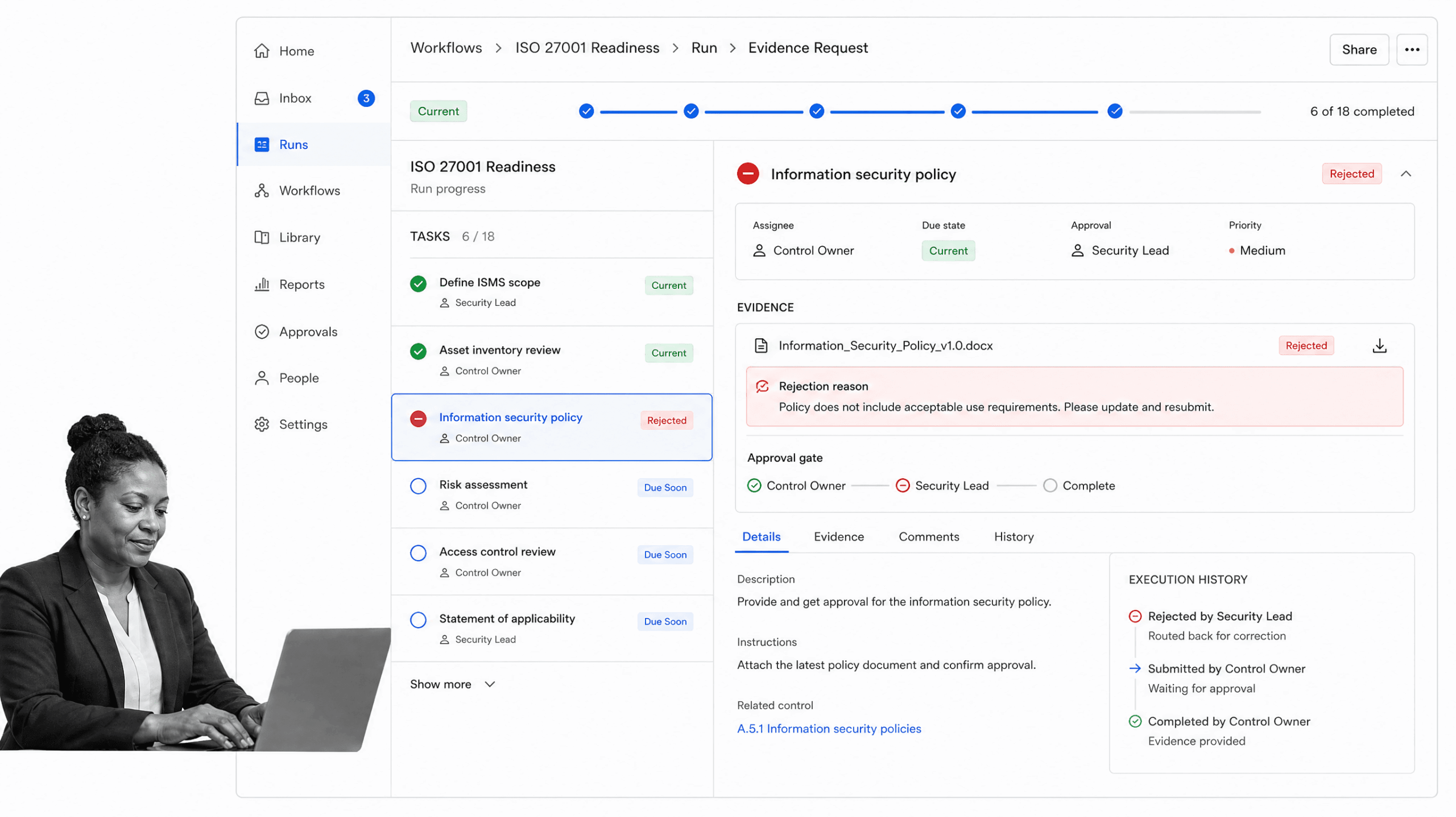
Process Street is best when the readiness gap is operational: policies need review, evidence requests need owners, exceptions need routing, and remediation needs approval. It is a workflow and compliance-operations layer rather than a dedicated cloud scanner.
How Process Street supports readiness
Teams can build recurring workflows for scope reviews, risk assessment, policy approval, access reviews, supplier reviews, internal audits, findings, corrective actions, management review, and surveillance-audit preparation. Required fields, role assignments, due dates, conditional paths, approvals, and execution history keep the procedure connected to the record of work.
What to verify before choosing Process Street
Choose Process Street when you need adaptable cross-functional execution around an ISMS or alongside a specialist compliance platform. If your main requirement is automatic configuration testing across cloud systems, pair it with a technical evidence platform instead of treating it as a scanner replacement.
Verify current capabilities and packaging on the official workflow feature overview.
A structured ISMS audit checklist can capture findings and evidence, while document approvals create a traceable review path for controlled policies and procedures.
2. Vanta
Best for: Automated evidence collection and continuous tests.
Vanta is a strong fit for technology companies that want automated evidence collection and frequent control tests. Its ISO 27001 product connects policies, controls, risks, tests, evidence, issues, and audit work in one trust-management environment.
How Vanta supports readiness
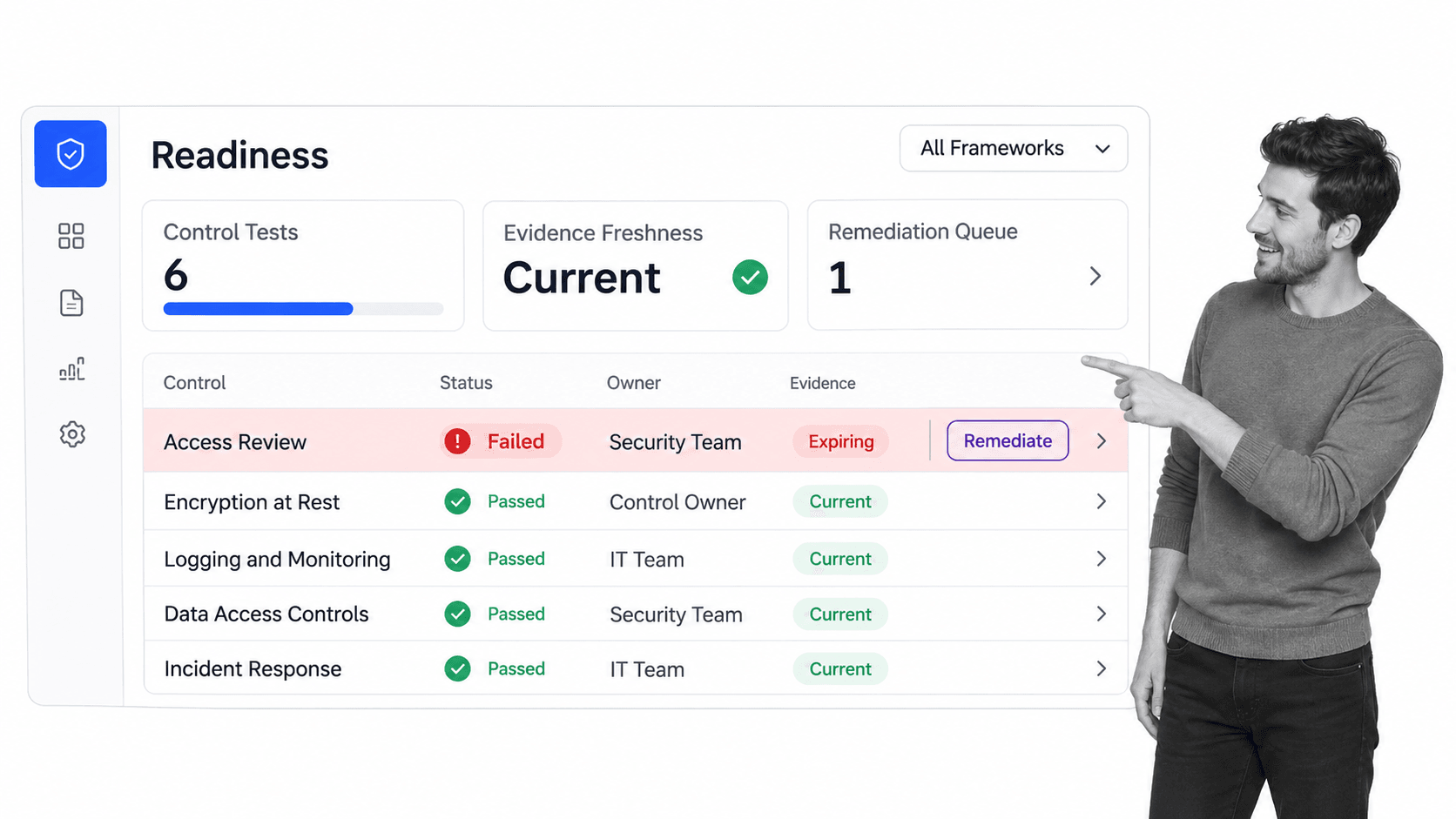
The platform can map controls, collect evidence from connected systems, flag gaps, generate remediation steps, support internal-audit workflows, and maintain a Statement of Applicability. Its dashboard emphasizes test results and items needing attention, which helps security teams find technical drift before an auditor does.
What to verify before choosing Vanta
Evaluate how well the available tests match your actual scope, systems, and control design. Automation reduces collection effort, but human evidence, governance decisions, risk acceptance, and operating effectiveness still need accountable owners.
Verify current capabilities and packaging on the official ISO 27001 product page.
Compare its technical automation with the broader operating controls described in this GRC tools guide.
3. Drata
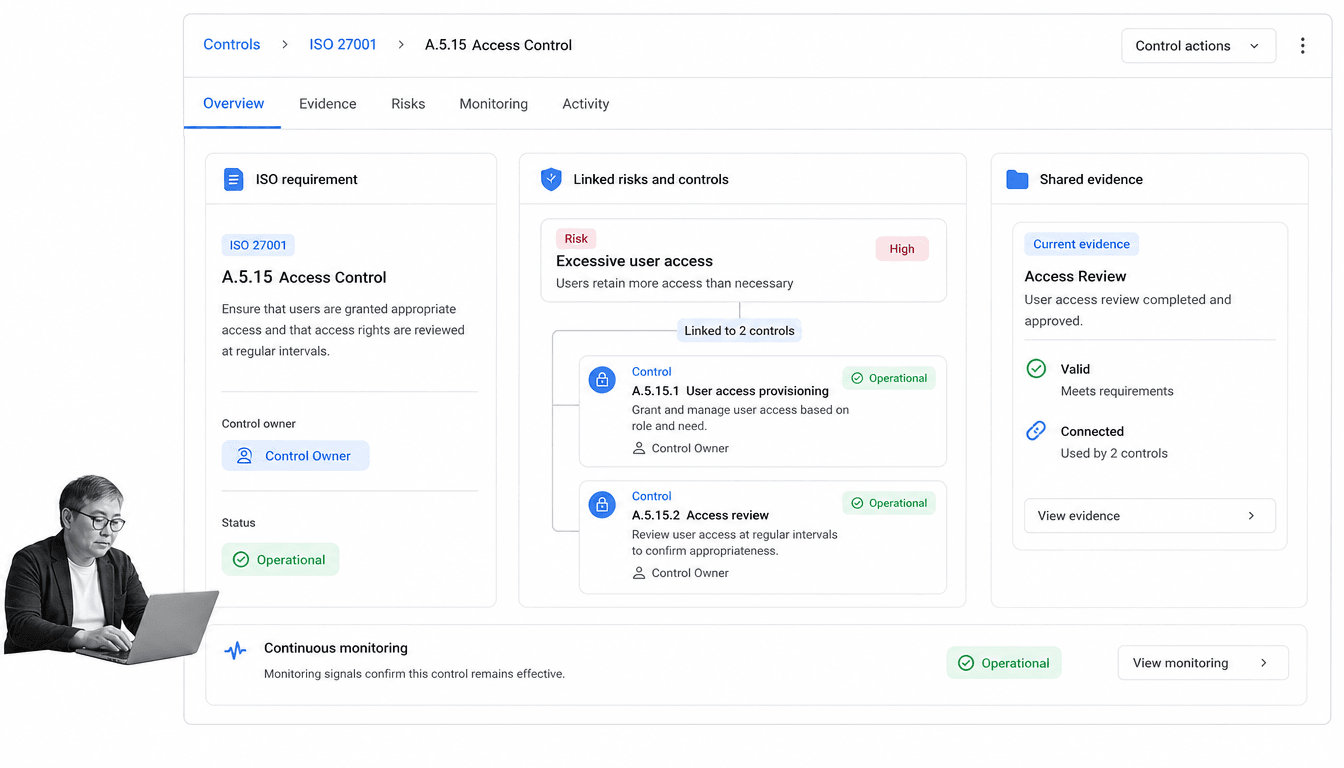
Best for: Continuous control monitoring across a growing program.
Drata is built for continuous readiness across controls, evidence, risk, policies, and audits. It is especially useful when a team wants ISO 27001 work to remain current between initial certification, surveillance audits, and recertification.
How Drata supports readiness
Pre-mapped controls and automated monitoring reduce repeated setup. Shared evidence can support multiple requirements, while risk assessments link to the controls and proof used to treat those risks. Historical evidence and policy-control links support a defensible record over time.
What to verify before choosing Drata
Test the plan boundaries carefully. Foundation includes one pre-mapped framework, while advanced configuration, workspaces, and some risk features vary by plan or add-on. Confirm which connections and custom tests your operating environment requires before comparing quotes.
Verify current capabilities and packaging on the official ISO 27001 framework page.
A separate ISO 27001 risk assessment workflow can make risk decisions, treatment ownership, and review cadence explicit.
4. Secureframe
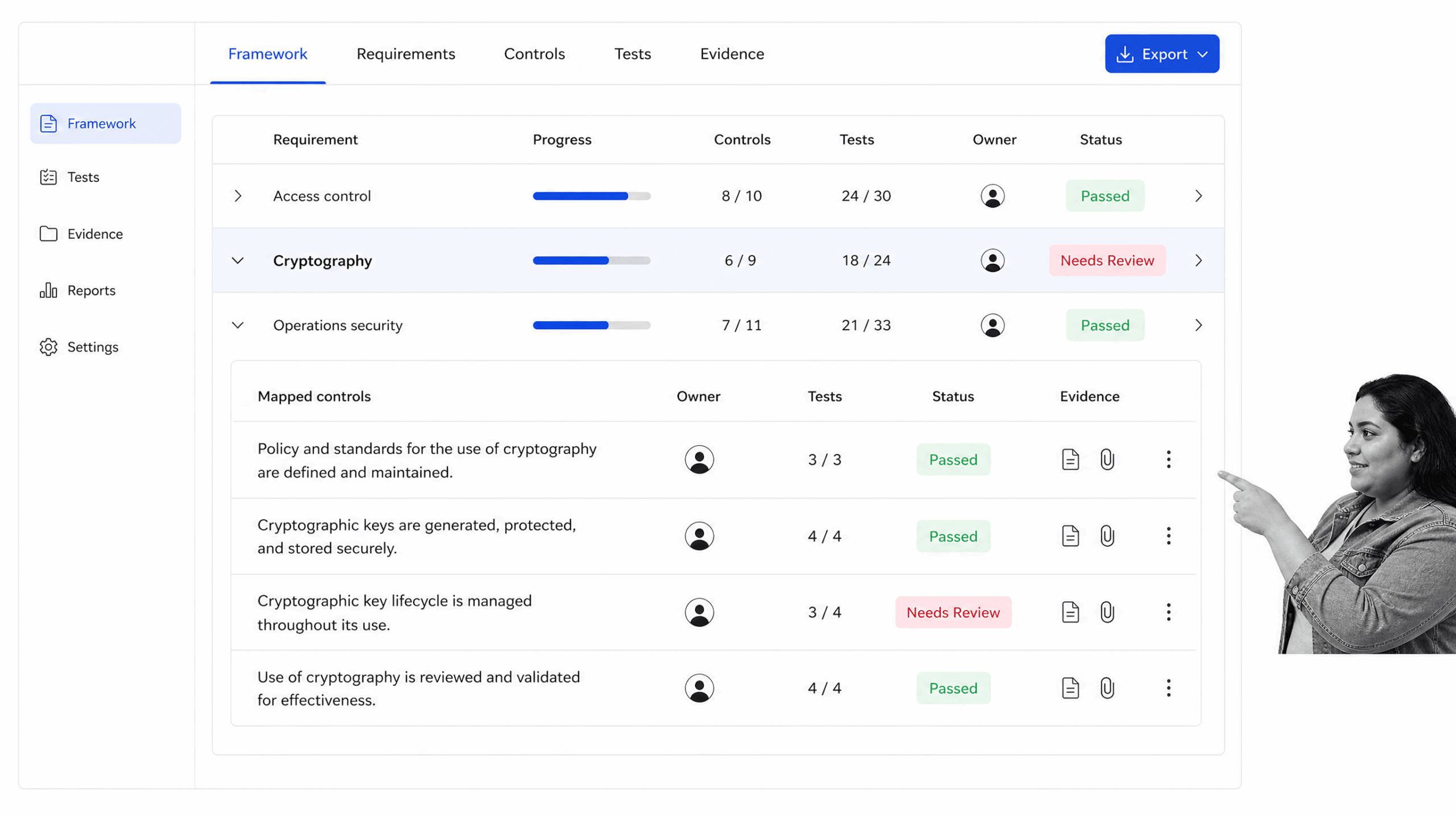
Best for: Guided framework progress and technical evidence.
Secureframe combines guided framework progress with automated evidence collection, tests, policy management, personnel workflows, risk management, and audit support. Its framework view is useful for teams that want a clear route from a requirement to mapped controls and test status.
How Secureframe supports readiness
Users can inspect passing and failing controls, assign owners, review mapped tests and evidence, mark requirements not applicable where justified, and export framework data including a Statement of Applicability. That makes the same view useful for gap analysis and auditor preparation.
What to verify before choosing Secureframe
Public pricing lists Fundamentals from $7,500 per year and one compliance framework. Confirm whether ISO 27001, additional workspaces, custom integrations, advanced risk, and other modules are included in the proposed package for your scope.
Verify current capabilities and packaging on the official framework-view overview.
Use the resulting gap data within a repeatable compliance audit process so findings become owned corrective actions.
5. Hyperproof
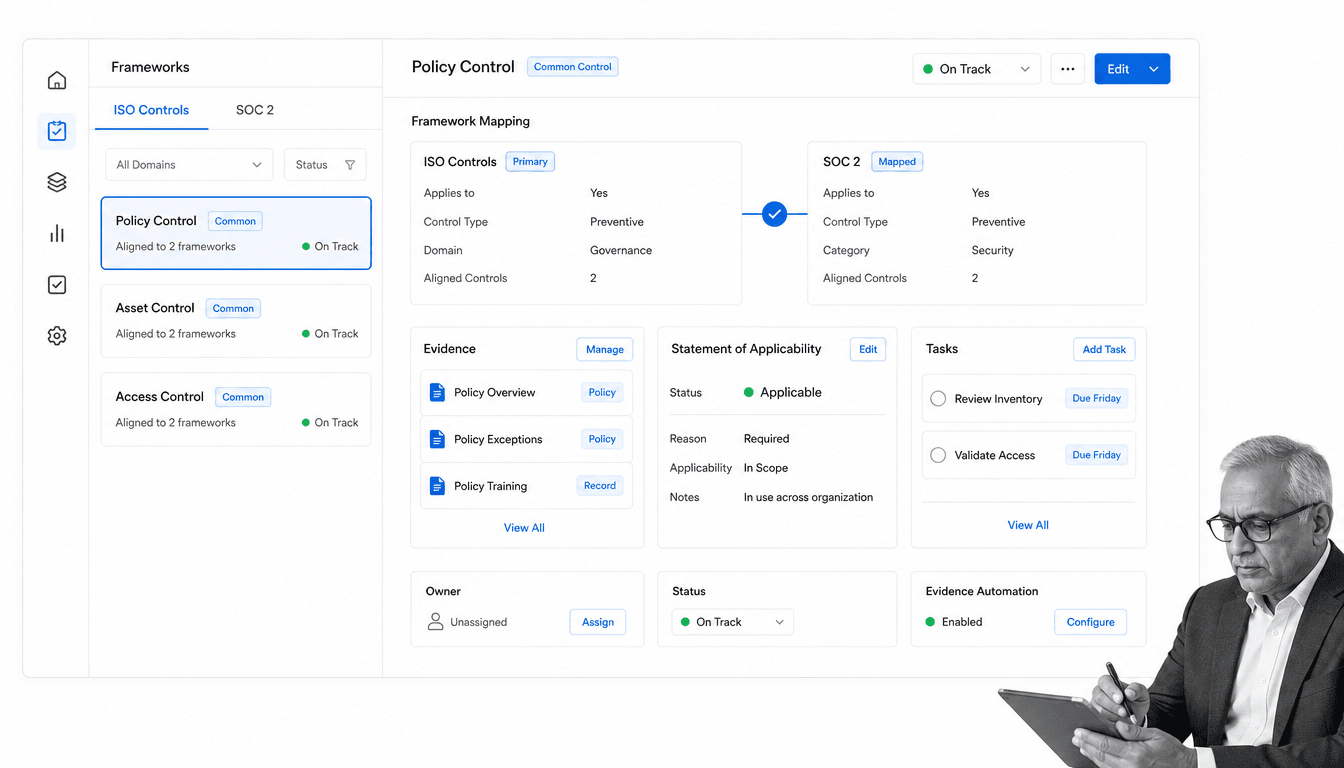
Best for: Multi-framework GRC and control reuse.
Hyperproof suits teams that expect ISO 27001 to sit inside a wider GRC program. It provides a starter ISO template while emphasizing common controls, evidence reuse, workflow, risk, reporting, and expansion into other frameworks.
How Hyperproof supports readiness
Teams can automate evidence collection, assign tasks, review program progress, generate a Statement of Applicability, and map ISO work to frameworks such as SOC 2, PCI DSS, and NIST. That common-control model can reduce duplicate work when the same control satisfies several obligations.
What to verify before choosing Hyperproof
The breadth is valuable for mature or multi-framework programs, but it can exceed the needs of a small team pursuing one certification. During evaluation, build a realistic control, evidence, task, risk, and audit flow so you can judge administration effort as well as platform coverage.
Verify current capabilities and packaging on the official ISO 27001 product page.
Multi-framework teams can also compare patterns in SOC 2 compliance automation tools when deciding which controls and evidence can be reused.
6. ISMS.online
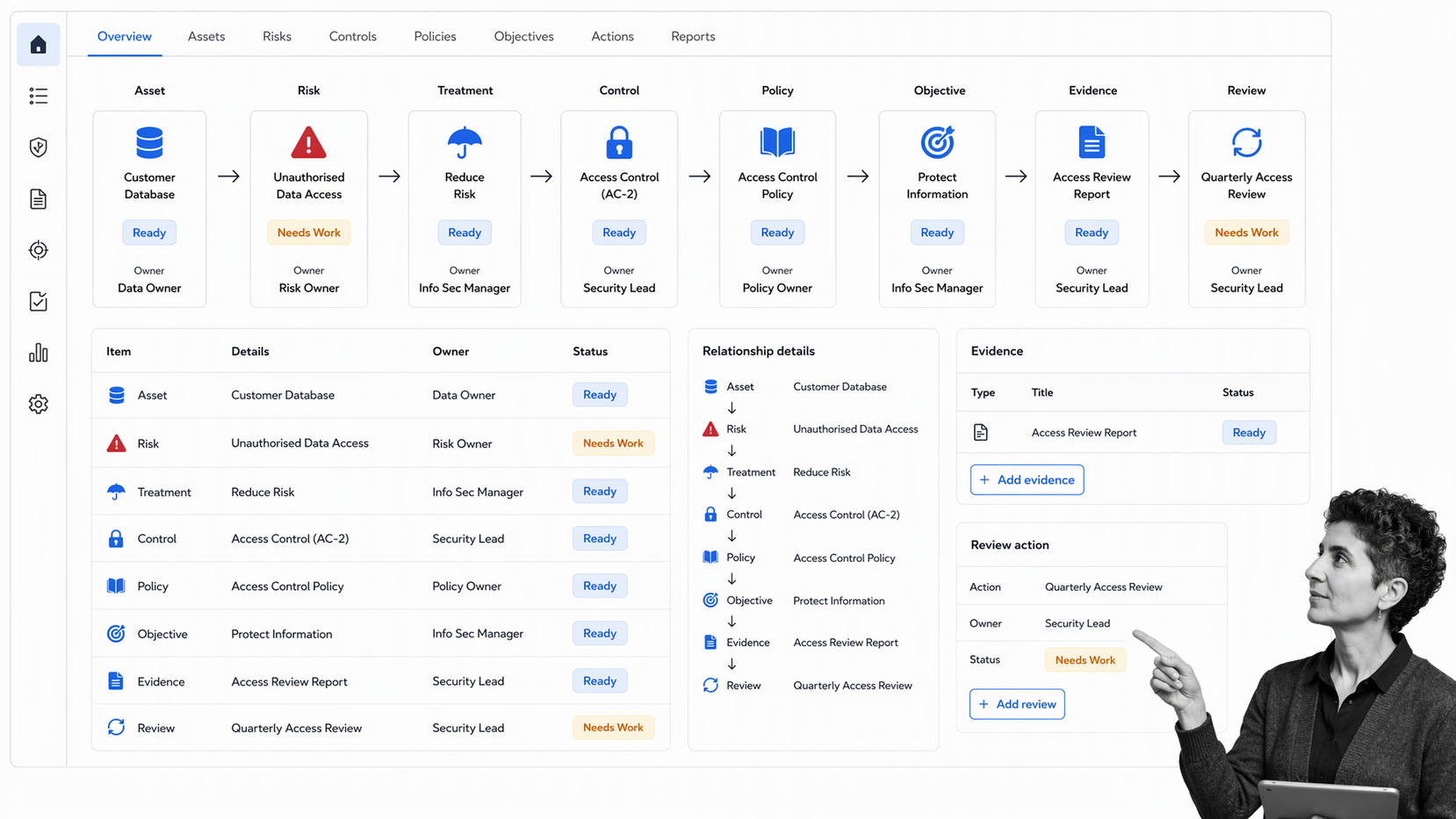
Best for: Building and operating a structured ISMS.
ISMS.online is designed around operating an information security management system. It brings policies, controls, assets, risks, suppliers, objectives, evidence, audits, actions, and reviews into a connected platform with structured implementation guidance.
How ISMS.online supports readiness
Its relationship model helps a team show how an asset connects to a risk, treatment, control, owner, evidence, and review. Preconfigured content, risk registers, policy workflows, audit-readiness reporting, and Statement of Applicability support can help organizations moving from scattered documents to a coherent ISMS.
What to verify before choosing ISMS.online
Pricing is bespoke, so compare the quoted plan against your required frameworks, users, modules, localization, integrations, and implementation support. Also decide whether you need deep automated technical tests or primarily an ISMS management environment.
Verify current capabilities and packaging on the official platform overview.
A connected ISMS can be reinforced with an information security management program workflow that assigns recurring governance work.
How to choose the best ISO 27001 readiness tools
Start with the readiness bottleneck. A six-person SaaS company with cloud evidence scattered across systems has a different need from a regulated enterprise managing several frameworks, business units, certification scopes, and approval layers.
Map your operating model before booking demos
- Define the certification scope, locations, products, systems, and interested parties.
- List the policies, risks, controls, evidence sources, internal audits, and management reviews already in place.
- Separate evidence that can be tested automatically from evidence that requires human judgment or documented operation.
- Identify who owns each readiness activity and who approves exceptions or risk acceptance.
- Decide whether ISO 27001 is a single program or the first of several overlapping frameworks.
Run one realistic readiness scenario
Ask every vendor to demonstrate the same scenario: a control test fails, the failure affects a risk, evidence is stale, a policy needs revision, remediation is assigned, the result is approved, and an auditor requests the history. This exposes whether the platform connects diagnosis, work, proof, and governance or merely displays them in separate modules.
For continuous technical checks, compare the depth of compliance monitoring software. For cross-system execution, review how security compliance automation handles ownership, exceptions, evidence, and audit history.
Review total implementation effort
License price is only one part of the cost. Include framework setup, control customization, connection work, evidence cleanup, policy migration, user training, consultant or auditor coordination, ongoing administration, and the effort required to keep integrations healthy.
Bring the right reviewers into the decision
Security can judge technical evidence and control coverage, but ISO 27001 readiness also involves leadership, legal and contractual requirements, people operations, procurement, asset owners, policy owners, internal auditors, and the teams that perform controls. Give each group a focused evaluation task. Ask security to test evidence collection, operations to test assignments and exceptions, risk owners to test treatment and acceptance, document owners to test review and approval, and internal audit to trace a finding through corrective action. This prevents a polished dashboard from winning while the daily operating model remains awkward.
Include platform administrators in the evaluation as well. They should test permissions, role changes, bulk maintenance, exports, API access, notification controls, evidence retention, and the steps required when an employee leaves or a system moves outside scope. A readiness platform will hold sensitive security information, so review access control, data residency, security documentation, backup and recovery expectations, and vendor-risk evidence through the same procurement process applied to other critical systems.
How to build an ISO 27001 readiness workflow
Use the readiness platform as a system for recurring work, not a one-time certification project. The strongest design keeps the ISMS current after the Stage 2 audit and produces the records needed for surveillance and continual improvement.
Step 1: Establish scope and governance
Record the scope statement, interested parties, information assets, dependencies, legal and contractual requirements, information-security objectives, roles, and approval authorities. Require review when a product, location, supplier, or material system changes.
Step 2: Connect risks, controls, policies, and evidence
Every applicable control should have an owner, implementation description, evidence expectation, review cadence, and connection to relevant risks and policies. Keep exclusions and risk-acceptance decisions explicit. This is where a reliable Statement of Applicability becomes an operating record rather than a document assembled before the audit.
Step 3: Route gaps into corrective action
When a test fails or evidence expires, route the issue by severity, owner, and due date. Use approval tasks for risk acceptance and closure decisions. Keep rejection comments and resubmission history with the work.
Step 4: Protect document control
Policies and procedures need identified owners, approved versions, review dates, change history, and controlled availability. These document control practices reduce the risk of presenting an obsolete procedure or an unapproved policy during audit sampling.
Step 5: Rehearse the audit trail
Before the certification audit, sample requirements across the scope and trace each one from risk and policy through implementation, evidence, owner, review, exception, and corrective action. Fix broken relationships and stale records before polishing the dashboard.
FAQs
What are ISO 27001 readiness tools?
ISO 27001 readiness tools are software platforms and workflow systems that help organizations organize an ISMS, map requirements and controls, manage risks and policies, collect evidence, run internal audits, track corrective actions, and prepare records for certification and surveillance audits.
What should ISO 27001 readiness software include?
Look for requirement and control mapping, risk treatment, Statement of Applicability support, policy and evidence management, accountable owners, reminders, internal-audit workflows, corrective actions, management-review records, reporting, permissions, and an audit trail.
Can software certify an organization to ISO 27001?
No. Software can support implementation and readiness, but certification requires an implemented ISMS and an independent audit by an accredited certification body. A tool cannot guarantee certification or replace accountable management decisions.
How do you compare ISO 27001 readiness tools?
Compare products against your scope, systems, evidence sources, risk model, frameworks, team size, audit timeline, and ongoing governance needs. Demonstrate the same failed-control scenario in each tool and inspect how it links risk, evidence, remediation, approval, and audit history.
Do small companies need a dedicated compliance platform?
Not always. A small organization may begin with governed workflows and well-controlled records. A dedicated platform becomes more valuable when automated technical evidence, continuous tests, shared controls, multiple frameworks, or frequent customer assurance requests create substantial manual work.
How early should ISO 27001 readiness work begin?
Begin early enough to implement the ISMS and accumulate evidence that controls operate in practice. The timeline depends on scope, maturity, resources, and audit availability. Work backward from the intended audit while allowing time for internal audit, management review, and corrective action.