Turn every policy into automated workflows with built-in enforcement and audit-ready proof.



11 of the Best Account Management Software (2026 Update)

Account management software helps teams manage customer relationships after the first sale: account records, renewal work, QBRs, stakeholder maps, expansion plans, support handoffs, and the repeatable tasks that keep customers from slipping through the cracks.
The tricky part is that the category is overloaded. A CRM can be account management software. A key account management platform can be account management software. A revenue intelligence tool can support account management without replacing your CRM. A workflow platform can enforce the recurring account processes that the CRM only records.
This updated guide separates those jobs. Use it to compare the strongest account management software options, decide whether you need a CRM, a KAM platform, a revenue intelligence layer, or workflow execution, and avoid buying a tool that stores data but does not improve follow-through.
- Best account management software by use case
- What account management software actually does
- Account management software tools to compare
- CRM vs KAM platform: which do you need?
- Key account management software features
- How to choose account management software
- Account management software FAQs
Best account management software by use case
If you are replacing spreadsheets, start with a CRM. If you already have a CRM but account plans still live in decks and docs, look at KAM software. If customer handoffs, renewals, onboarding, and approvals keep breaking, add a workflow layer so the account process runs the same way every time.
- Best for governed account workflows: Process Street
- Best enterprise CRM backbone: Salesforce Sales Cloud
- Best SMB CRM: HubSpot CRM
- Best budget CRM: Zoho CRM
- Best simple pipeline tracking: Pipedrive
- Best visual CRM workflow: monday CRM
- Best formal KAM platform: DemandFarm
- Best relationship-driven KAM: Kapta
- Best built-in KAM CRM: Coevera CRM
- Best revenue intelligence layer: Gong
- Best lightweight sales CRM: Freshsales
What account management software actually does
Account management software gives account teams one operating layer for customer context and next actions. At minimum, it should centralize company records, contacts, activity history, open opportunities, support issues, tasks, ownership, reporting, and renewal or expansion work.
For small teams, that may be enough. The biggest gain is moving from scattered spreadsheets and inbox notes to a shared account record. For larger account teams, basic records are not enough. They need stakeholder maps, health scoring, account plans, QBR workflows, whitespace analysis, renewal governance, and a way to make sure follow-up work happens after every customer interaction.
That is where the market splits. CRMs are strongest as systems of record. KAM platforms are strongest for strategic account planning. Revenue intelligence platforms are strongest for account signals from calls, emails, and meetings. Workflow platforms are strongest when recurring work needs to be assigned, approved, escalated, and proven. The right stack depends on the failure mode you are fixing.
Account management software tools to compare
1. Process Street

Process Street is the best fit when account management depends on repeatable work: customer onboarding, renewal checklists, account reviews, escalation paths, approval chains, handoffs, and compliance-sensitive customer processes. It is not trying to replace Salesforce, HubSpot, or Zoho as the CRM of record. It makes the work around those records run correctly.
Use Process Street when the problem is missed steps, inconsistent handoffs, stale SOPs, audit gaps, or account managers inventing their own renewal process. Teams can turn account procedures into workflows with assigned owners, due dates, conditional logic, approvals, forms, integrations, and an auditable history of what happened. That matters for regulated, complex, or high-value accounts where a bad handoff is not just annoying, it creates risk.
Best for operations, customer success, implementation, compliance, and account teams that already know the process they want followed. If your biggest gap is clean CRM data, start with a CRM. If your biggest gap is execution, Process Street gives the account process a system that runs.
2. Salesforce Sales Cloud

Salesforce Sales Cloud remains the enterprise default for account records, contacts, opportunities, activities, reporting, forecasting, and customization. Salesforce is strongest when it is already the company’s revenue data layer and the team has admin support to configure objects, permissions, automations, dashboards, and integrations.
For account management, Salesforce gives teams a durable account object, related contacts, opportunity history, tasks, emails, meetings, and reporting. Its AI and activity capture features can help surface risk and reduce manual logging when properly implemented. The tradeoff is complexity. Salesforce can support almost any account management motion, but you need governance or it becomes a heavily customized database with uneven adoption.
Best for mid-market and enterprise teams that already operate in Salesforce and need account management to stay close to revenue data. Pair it with Process Street when the account process needs enforced workflow execution, or with a dedicated KAM platform when formal stakeholder mapping and whitespace planning are the priority.
3. HubSpot CRM

HubSpot CRM is a strong choice for small and mid-sized teams that want a clean, approachable CRM with company records, contact management, deals, email tracking, tasks, workflows, reporting, and a large integration ecosystem. It is easier to adopt than Salesforce for many teams and works well when marketing, sales, and service data need to live close together.
HubSpot is best when account management is still relatively simple: tracking companies, contacts, conversations, lifecycle stages, renewals, and follow-up tasks. It can support account health and QBR workflows with custom properties, reports, workflows, and add-ons, but it is not a purpose-built KAM platform out of the box.
Best for growth-stage teams that value usability and fast setup. If the account team starts needing deep org charts, whitespace planning, portfolio governance, and strategic account methodology, HubSpot may need a KAM add-on or a workflow layer around it.
4. Zoho CRM

Zoho CRM is a practical account management option for teams that want a broad CRM feature set without Salesforce-level cost or complexity. It supports account and contact management, deal pipelines, tasks, calls, meetings, reports, analytics, territory management, workflow automation, and AI assistance through Zia.
Zoho is especially useful for price-sensitive teams that still need real CRM structure. It can cover the basics of account tracking, pipeline management, and follow-up without forcing the team into a heavy implementation. The limitation is that advanced strategic account planning usually requires configuration or complementary tools.
Best for small and mid-sized businesses that want account data, automation, and reporting in one affordable CRM. It is not the most polished KAM product, but it is a strong default when the alternative is spreadsheet-driven account management.
5. Pipedrive

Pipedrive is best for account teams that need simple, visual pipeline tracking. It is easy to set up, easy for reps to use, and strong for managing deals, activities, reminders, and account-related sales motions without a large admin burden.
Pipedrive is weaker for formal post-sale account management. It was built around deal flow, so account health scoring, renewal governance, stakeholder mapping, and complex QBR workflows usually require workarounds or integrations. That does not make it a bad choice. It makes it a focused choice.
Best for lean teams that need reliable activity tracking and follow-up without enterprise CRM overhead. If you manage complex strategic accounts, use Pipedrive as the CRM backbone only if you are comfortable adding process and planning layers elsewhere.
6. monday CRM

monday CRM is useful when the account management process is visual, collaborative, and workflow-heavy. Teams can build boards for renewals, onboarding, customer health, implementation, account tasks, and reporting without waiting on a technical admin.
The strength is flexibility. The risk is the same. monday can become a custom workspace that reflects how one team works, but it is not a classic CRM data model or a dedicated KAM methodology platform. It works best when the team wants configurable account workflows and dashboards more than strict CRM depth.
Best for teams that think in boards, owners, statuses, and automations. For regulated or audit-sensitive account work, use a governed workflow system where proof, approvals, and process versioning matter more than visual board flexibility.
7. DemandFarm

DemandFarm is a dedicated key account management platform for enterprise teams running formal strategic account programs. It focuses on account planning, org charts, relationship intelligence, whitespace analysis, account reviews, and roll-up reporting across named accounts.
DemandFarm belongs on the shortlist when account managers are responsible for complex buying committees, multi-product expansion, account plans, QBRs, and executive-level portfolio governance. It is more specialized than a CRM and more structured than a generic project management tool.
Best for enterprise KAM programs managing high-value accounts. It is probably too much for small teams that simply need contact history, follow-up reminders, and renewal tracking.
8. Kapta
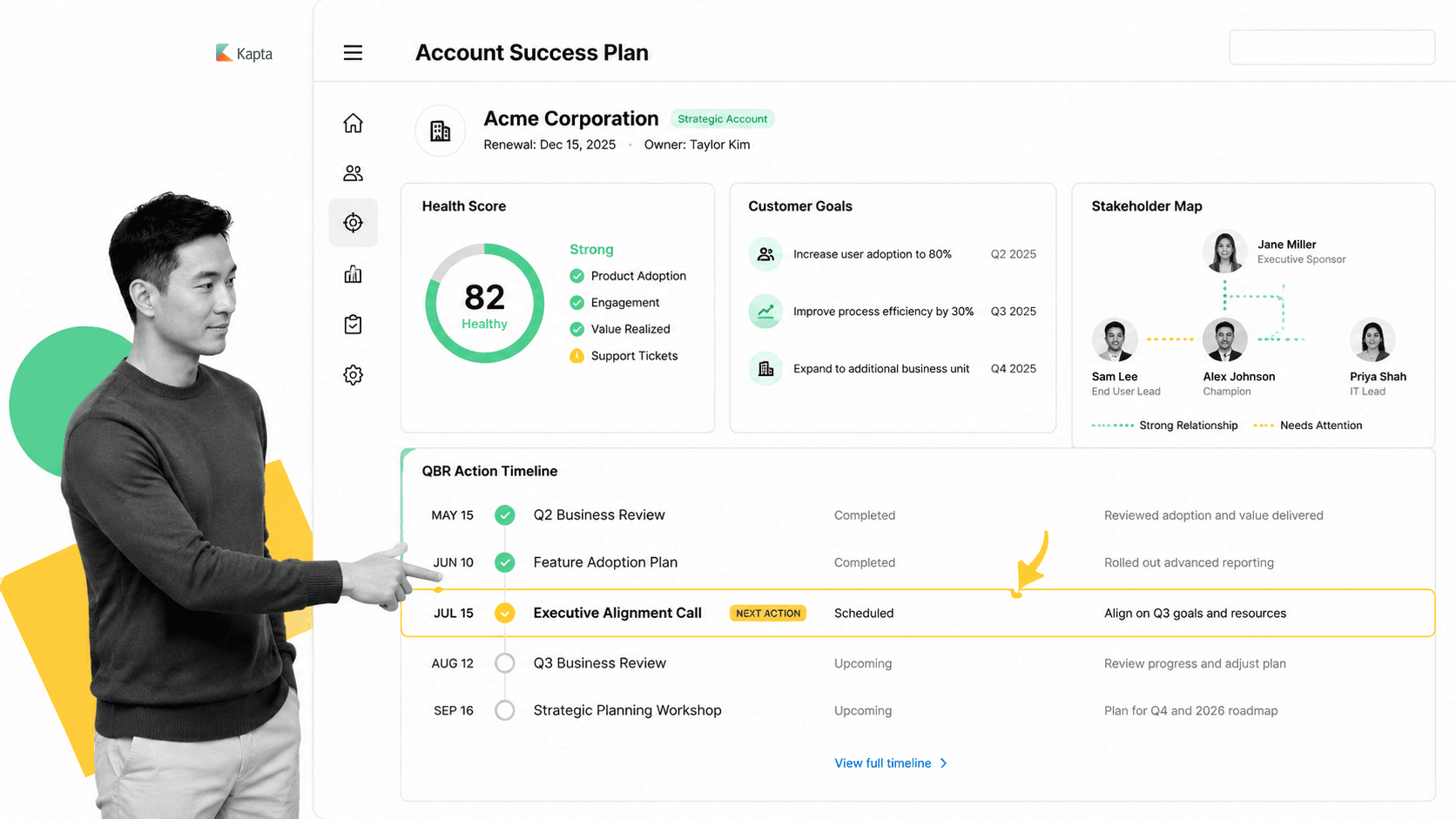
Kapta is built for relationship-driven key account management. Its strength is helping account teams structure account plans, track health, manage goals, prepare for QBRs, and keep strategic customers moving through a defined cadence.
Kapta is a strong fit when the account team needs more than CRM notes. It gives account managers a place to understand customer goals, risks, relationships, actions, and progress. It is less useful if your account motion is mostly transactional or if the team does not have enough strategic accounts to justify a dedicated methodology tool.
Best for customer success and account management teams that run a structured relationship plan for important accounts and want that plan to be more than a slide deck.
9. Pipeliner CRM

Coevera CRM deserves more attention in account management comparisons because it includes more native account planning features than many general-purpose CRMs. Teams can use account hierarchies, visual relationship views, pipelines, activities, and sales analytics in one CRM environment.
Coevera is strongest for teams that want CRM plus account planning without stitching together a full Salesforce ecosystem. It may not have the same enterprise gravity as Salesforce or the same dedicated KAM depth as DemandFarm, but it offers a practical middle ground.
Best for mid-market sales teams that want visual CRM adoption and stronger account planning features in the same platform.
10. Gong
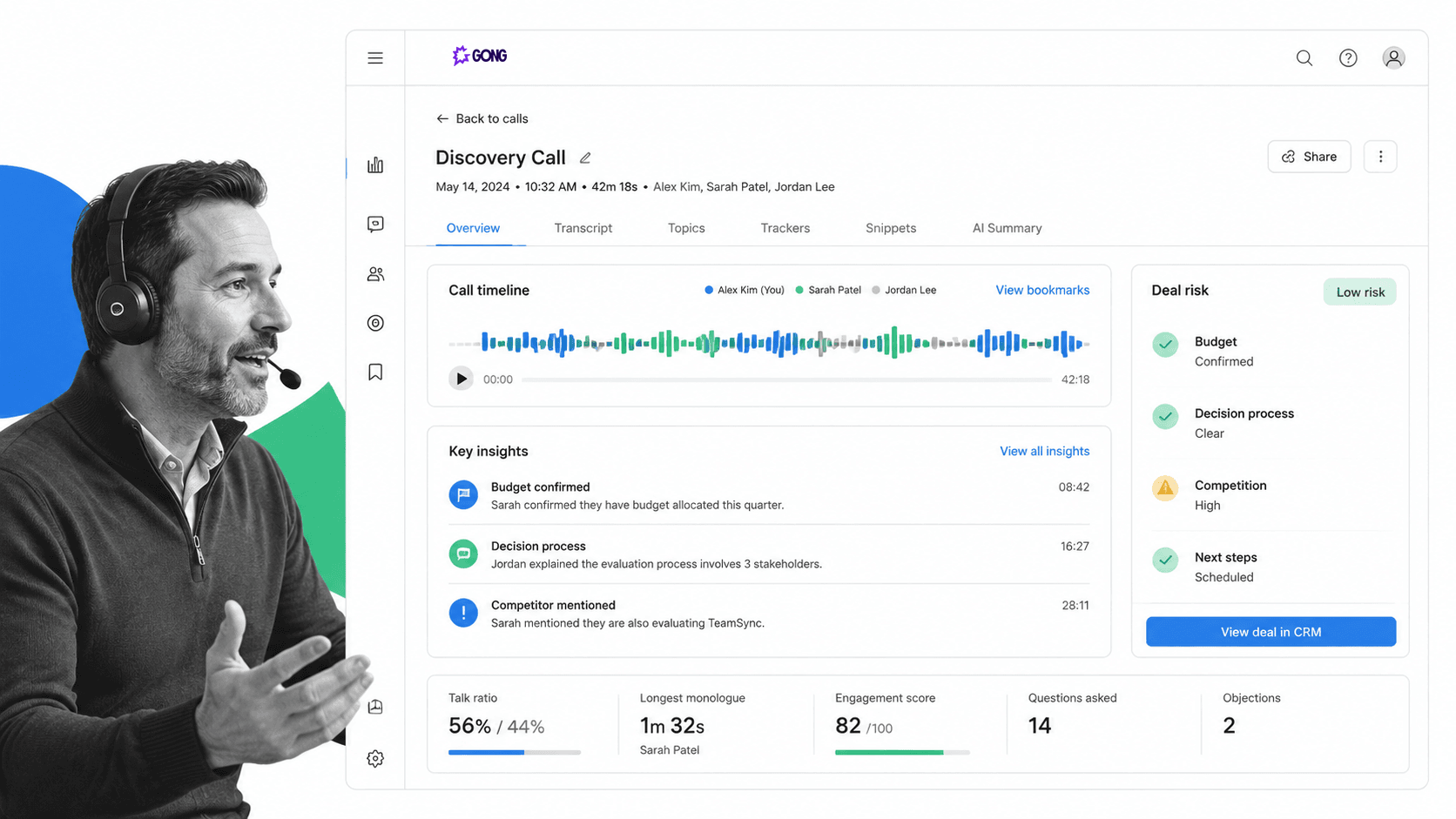
Gong is not a classic CRM, but it has become important to account management because account risk and expansion signals often live in customer conversations. Gong captures calls, emails, meetings, and CRM activity, then uses AI to surface insights, coaching moments, churn risk, and next steps.
Use Gong when the account team already has a CRM but lacks visibility into what customers are actually saying. It can help managers inspect account quality, standardize coaching, and identify risk earlier than manual CRM updates. It should not replace your CRM or account planning system. It should feed them.
Best for revenue teams that need conversation intelligence, coaching, forecast support, and AI-assisted account signals.
11. Freshsales

Freshsales, from Freshworks, is a lightweight CRM for teams that want built-in contact management, account records, deal tracking, email, phone, automations, and reporting without a heavy implementation. It is a sensible option for smaller sales and account teams that want one system for day-to-day customer activity.
Freshsales is not the deepest strategic account management platform, but it can be effective when the account process is straightforward and the team values speed, communication tracking, and ease of use. It is strongest when paired with clear account workflows and disciplined data hygiene.
Best for small teams that want a CRM they can adopt quickly, especially if they also use Freshworks for support or customer operations.
CRM vs KAM platform: which do you need?
Use a CRM when your main problem is scattered customer data. Use a KAM platform when your main problem is strategic account planning. Use a workflow platform when your main problem is inconsistent execution. Many teams need more than one layer, but they should not buy all of them at once.
A CRM should answer: who is the customer, who do we know, what happened, what deals or renewals are open, and what task comes next? A KAM platform should answer: who has power, what relationship risks exist, where is the whitespace, what is the account growth plan, and how healthy is the portfolio? A workflow system should answer: who owns each recurring step, what is overdue, what needs approval, what was completed, and can we prove the process was followed?
This distinction matters because a lot of account management software pages blur the lines. A sales engagement tool is useful, but it is not an account plan. A call recorder is useful, but it is not a CRM. A CRM is necessary, but it does not enforce the process by itself. The best stack starts with the failure mode, not with the vendor category.
Key account management software features
The strongest account management tools share a few core capabilities. You do not need every feature on day one, but you do need a clear view of which layer owns which job.
- Account and contact records: company profile, contacts, roles, history, lifecycle stage, ownership, and account hierarchy.
- Activity tracking: emails, calls, meetings, notes, tasks, and next steps attached to the right account.
- Pipeline and renewal tracking: open opportunities, renewal dates, expansion paths, risk stages, and forecast views.
- Stakeholder mapping: decision makers, influencers, champions, blockers, relationship strength, and coverage gaps.
- Account plans: goals, success criteria, QBR preparation, mutual action plans, risks, and expansion plays.
- Health scoring: engagement, support issues, usage signals, contract risk, customer sentiment, and renewal confidence.
- Workflow automation: recurring tasks, approvals, escalations, handoffs, forms, reminders, and audit trails.
- Reporting: account coverage, QBR completion, renewal risk, expansion pipeline, activity quality, and team performance.
- Integrations: CRM, support, billing, data enrichment, email, calendar, BI, and workflow systems.
- Governance: permissions, versioned processes, compliance records, and proof that work was completed correctly.
Process Street fits the workflow automation and governance layer especially well. When an account process has to happen the same way every time, turn it into a workflow instead of hoping every account manager remembers the latest version of the playbook. For adjacent process depth, see our guide to workflow software and our breakdown of customer service AI.
How to choose account management software
Start by naming the operational failure. If contacts are stale, solve data hygiene. If reps are not logging activity, simplify the CRM and automate capture. If QBRs are inconsistent, define the review workflow. If strategic accounts lack plans, evaluate KAM software. If renewals are slipping because owners miss steps, use a workflow platform to enforce the renewal process.
- Map the account motion: new business, post-sale success, renewals, expansion, field sales, or strategic KAM.
- Decide the system of record: Salesforce, HubSpot, Zoho, Pipedrive, or another CRM should own core account data.
- Separate planning from execution: account plans are useful only if the tasks, approvals, and follow-ups actually happen.
- Check adoption friction: a perfect second login that nobody opens is worse than a simpler workflow inside the tools people already use.
- Inspect AI claims carefully: useful AI summarizes calls, detects risk, drafts next steps, enriches records, and triggers work. Weak AI only adds a chat box.
- Require reporting that maps to behavior: QBR completion, stakeholder coverage, renewal readiness, overdue account tasks, and expansion progress.
- Test one real account: run a live account through the tool before buying. If the workflow still needs a side spreadsheet, the tool is not solving the real problem.
A practical stack might look like this: Salesforce or HubSpot as the record, Gong as the signal layer, DemandFarm or Kapta for strategic plans, and Process Street for governed workflows that make onboarding, renewals, QBR prep, escalations, and approvals happen consistently. Smaller teams may only need one CRM and a handful of Process Street workflows. Enterprise teams may need the full stack.
Account management software FAQs
What is account management software?
Account management software is software that helps teams manage customer accounts, contacts, activity history, renewals, expansion opportunities, support handoffs, QBRs, account plans, and recurring account tasks in one organized system.
Is account management software the same as CRM software?
Not always. A CRM stores customer and sales data. Account management software can include a CRM, but it may also include key account planning, revenue intelligence, customer health, workflow automation, and renewal governance features.
What is the best account management software for small businesses?
HubSpot, Zoho CRM, Pipedrive, Freshsales, and monday CRM are strong small-business options. The best choice depends on whether the team needs simple contact tracking, visual pipelines, automation, or a broader sales and service platform.
What is the best account management software for enterprise teams?
Salesforce is the strongest enterprise CRM backbone. DemandFarm and Kapta are stronger for formal key account management. Gong is useful for revenue intelligence. Process Street is useful when account workflows, approvals, handoffs, and proof need to be enforced.
What features matter most in account management software?
The most important features are account and contact records, activity tracking, renewal and expansion tracking, stakeholder mapping, account plans, workflow automation, integrations, reporting, and governance. The right priority depends on the account motion you are trying to improve.
Can Process Street replace my CRM for account management?
Process Street usually complements a CRM rather than replacing it. Use the CRM as the account data system, then use Process Street to run repeatable account workflows like onboarding, renewals, QBR preparation, escalation handling, approvals, and compliance-sensitive customer processes.