Turn every policy into automated workflows with built-in enforcement and audit-ready proof.



Compliance Issues
Compliance issues are gaps between what an organization is required to do and what actually happens in the business. They can come from laws, regulations, contracts, industry standards, customer commitments, or internal policies.
A compliance issue can be a missed filing, an incomplete training record, a broken approval, a privacy incident, an unsafe workplace practice, a weak vendor review, or an audit finding with no owner. Some issues are small and easy to correct. Others point to deeper control failure.
This guide explains what compliance issues are, why they happen, how to spot them early, how to fix them, and how Process Street helps teams turn issue response into controlled work.
We will cover:
- What compliance issues are
- Common types of compliance issues
- Why compliance issues happen
- How to identify compliance issues early
- How to fix compliance issues
- How to prevent repeat compliance issues
- How Process Street helps manage compliance issues
- FAQs
What compliance issues are
Compliance issues are signs that a required standard was not followed, was not documented, or cannot be proven. The issue might be an actual violation, a control weakness, a missing record, a late review, a policy gap, or a pattern that could become a finding if nobody fixes it.
A compliance issue is not always a violation
A violation means a rule was broken. An issue is broader. A missing evidence file, unclear owner, overdue policy review, failed access review, or unsupported exception may not be a legal breach by itself, but it creates exposure because the organization cannot prove the required work happened.
The proof gap matters
Compliance depends on evidence. If a procedure says a manager must approve a change, the organization needs a record showing the approval happened. If a control owner says training was completed, the organization needs completion data. If a team accepted an exception, the organization needs the reason, approver, and review date.
Issues become risk when they repeat
One late review may be a task problem. Repeated late reviews show a system problem. A single missing vendor document may be corrected quickly. A vendor process that regularly loses evidence needs redesign. The compliance team should separate isolated cleanup from patterns that indicate control drift.
Regulators look for working systems
Issue management should prove that the organization can identify problems, assign responsibility, and improve. DOJ compliance guidance frames program evaluation around design, resources, empowerment, and whether the program works in practice.
That is why compliance issues connect directly to internal controls, compliance audits, and compliance risk management. Controls define the expected behavior. Audits test whether it happened. Risk management decides what needs attention first.
Common types of compliance issues

Compliance issues usually fall into a few recurring categories. The exact categories depend on industry, location, customer obligations, and internal policy, but the operating pattern is similar: a requirement exists, an owner must act, evidence must be retained, and exceptions must be handled.
Policy and procedure issues
Policies can be outdated, unapproved, inaccessible, inconsistent with actual work, or disconnected from procedures. Procedures can be too vague for employees to follow or too stale to match current systems.
Training and awareness issues
Employees may miss required training, complete the wrong training, fail to acknowledge policy updates, or misunderstand what a rule requires in daily work. Training records need to show who completed what, when, and under which version of the requirement.
Evidence and recordkeeping issues
Missing evidence is one of the most common operational compliance issues. Covered employers, for example, may have recordkeeping duties for certain work-related injuries and illnesses under OSHA recordkeeping rules. Other teams may need access logs, approval records, vendor files, complaint records, or policy attestations.
Privacy and security issues
Privacy and security issues can include unauthorized access, weak safeguards, missing risk assessment, unreviewed vendors, incomplete incident response, and unclear data handling practices. The FTC Safeguards Rule is one example of a rule that requires covered financial institutions to maintain an information security program.
Workplace conduct and safety issues
Workplace issues can include harassment complaints, discrimination concerns, retaliation risk, unsafe practices, incomplete investigation records, and inconsistent enforcement. EEOC harassment guidance is one official source teams can use when designing reporting, investigation, and prevention workflows.
Third-party and vendor issues
Vendors create compliance exposure when contracts, due diligence, security reviews, insurance documents, data processing terms, service levels, and ongoing reviews are not tracked. Vendor risk becomes harder to manage when reviews live in inboxes and spreadsheets.
Audit and remediation issues
An audit finding is only useful if it turns into corrective action. Issues remain open when findings lack owners, due dates, evidence, approval, and a retest step. The finding may be visible, but the fix is not controlled.
- Requirement issue: the rule is unclear, outdated, or not mapped to work.
- Execution issue: the required task did not happen or happened late.
- Evidence issue: the work happened, but proof is missing or weak.
- Ownership issue: nobody knows who is accountable.
- Escalation issue: exceptions are not routed to the right reviewer.
- Remediation issue: the fix is promised but not verified.
Why compliance issues happen
Compliance issues rarely come from one bad decision. More often, they come from a weak operating system. Requirements change, employees move fast, tools multiply, and evidence ends up scattered across documents, tickets, emails, spreadsheets, and chat.
Requirements are not mapped to work
A regulation or policy may say what must happen, but the business needs a workflow that says who does it, when it happens, what evidence is required, who approves it, and what happens if the answer is high risk.
Owners are implied instead of assigned
If everyone assumes someone else is responsible, the task will slip. Compliance work needs named owners. This includes control owners, evidence owners, approvers, reviewers, and remediation owners.
Evidence lives outside the process
Evidence loses value when it is disconnected from the task it proves. A file in a shared drive, a screenshot in a message, or an approval buried in email may exist, but it is hard to defend when auditors need a complete trail.
Policies drift from reality
A policy can say one thing while the team does another. Drift happens when systems change, new tools are added, teams reorganize, vendors change scope, or an exception becomes the informal default.
Monitoring is too slow
If issues are discovered only during annual review, the organization is learning too late. Automated compliance monitoring helps teams detect overdue work, missing evidence, failed controls, and repeated exceptions while there is still time to respond.
Corrective action is not verified
A remediation plan is not the same as remediation. The team needs proof that the root cause was addressed, the control changed, the owner accepted the new process, and the fix was tested.
How to identify compliance issues early
Early detection starts by turning vague risk into observable signals. A compliance team should define what an issue looks like before the audit, investigation, customer review, or regulatory exam forces the question.
Map requirements to control points
Start with the obligations that matter most. For each one, identify the policy, process, owner, task, evidence, approval, system, and escalation path. If any of those fields are blank, the issue is already visible.
Watch for missing evidence
Missing evidence is a clear signal because it is testable. Create checks for overdue uploads, blank approval fields, missing attestations, incomplete logs, unsigned documents, expired vendor files, and stale policy review dates.
Track repeat exceptions
Exceptions are normal when they are rare, approved, and time-bound. They become issues when the same team, vendor, system, policy, or control creates repeat exceptions. Repeat exceptions usually mean the process is designed wrong or the requirement is not understood.
Use audits as a learning system
A strong compliance audit does more than catch gaps. It shows which controls are weak, which evidence is hard to retrieve, which owners need support, and which procedures are unclear.
Listen to front-line signals
Employees often see compliance friction before leadership does. Confusing approvals, unclear forms, slow vendor reviews, duplicated data entry, missing instructions, and awkward workarounds are early signs that the control environment is not matching how work actually happens.
Separate severity from noise
Not every issue needs the same response. Use severity, likelihood, affected process, regulatory exposure, customer impact, repeat pattern, and evidence strength to decide what needs immediate containment and what can enter routine remediation.
How to fix compliance issues
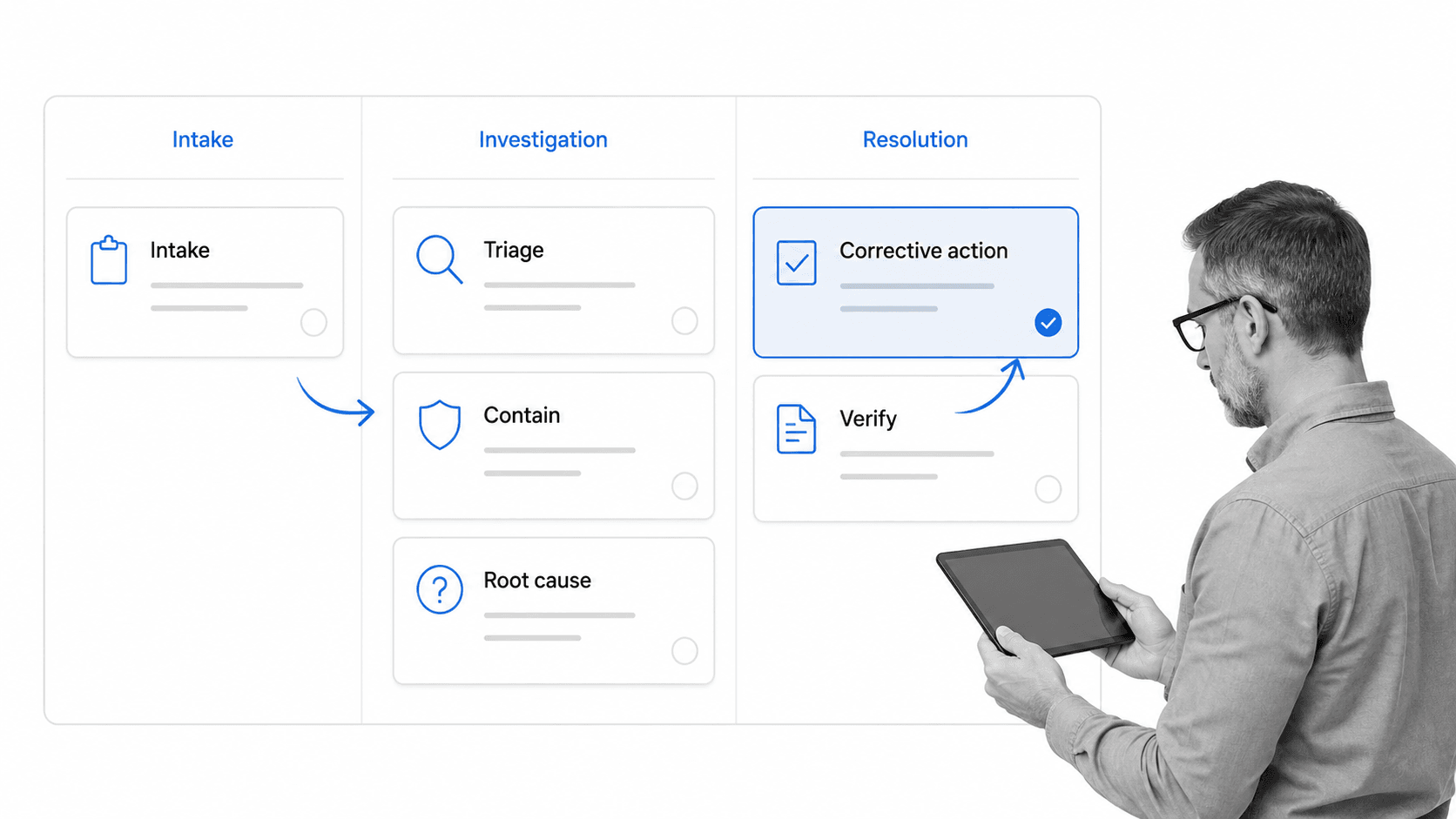
Fixing compliance issues requires more than closing a ticket. The response should contain the issue, identify the root cause, assign corrective action, collect evidence, verify the fix, and update the system so the issue does not return.
1. Capture the issue clearly
Record the issue type, source, affected process, owner, severity, date found, evidence available, immediate exposure, and required response path. Avoid vague labels. A clear issue statement makes the rest of the workflow easier.
2. Contain immediate risk
Some issues need immediate containment before root cause work begins. This can mean pausing a process, restricting access, notifying a manager, preserving evidence, correcting an unsafe condition, or stopping an unapproved vendor activity.
3. Identify root cause
Ask why the issue happened. Was the procedure unclear? Was the owner missing? Was the system changed? Did the control depend on memory? Was evidence stored in the wrong place? Did training fail? Did an exception become normal?
4. Assign corrective action
A corrective action should name the owner, required steps, due date, evidence, approver, and verification method. If the fix touches a policy, workflow, system, vendor, or training record, include those updates in the same plan.
5. Verify the fix
Verification proves that the action worked. It can include retesting a control, reviewing a sample, confirming evidence quality, checking training completion, reviewing an updated procedure, or confirming that a recurring workflow now includes the missing step.
6. Update the operating system
A closed issue should improve the system. That can mean updating a checklist, adding an approval gate, changing a required field, creating an escalation rule, updating training, revising policy, or adding a monitoring check. The Compliance Checklist Template is a practical way to turn requirements, tasks, and evidence into a repeatable review flow.
7. Review related controls
One issue may reveal a family of related weaknesses. If evidence is missing in one vendor review, check similar vendors. If one team skipped training, check teams with the same requirement. If one approval path failed, review the approval pattern.
For health care organizations, HHS OIG General Compliance Program Guidance is a useful primary source for connecting issue response to compliance program infrastructure, resources, reporting, monitoring, and corrective action.
How to prevent repeat compliance issues
Prevention means designing compliance into daily work. People should not have to remember every rule, search for every procedure, or manually assemble evidence after the fact. The process should guide them through the correct path.
Turn policies into workflows
A policy says what should happen. A workflow makes it happen. Convert high-risk policies into assigned tasks, required evidence, decision paths, approvals, and escalation rules.
Use templates for repeatable reviews
Repeatable reviews need repeatable workflows. Teams can adapt the Compliance Audit Checklist, SOX Compliance Checklist, EHS Compliance Checklist, and Due Diligence Compliance Checklist around their own owners and evidence needs.
Require evidence before closure
Do not let critical tasks close with a blank proof field. Required uploads, form fields, approvals, and completion rules reduce the gap between claimed completion and real completion.
Build escalation into the process
If a response is high risk, overdue, incomplete, or inconsistent, the workflow should route it to the right reviewer. Escalation should not depend on someone remembering to send a message.
Keep policy and procedure versions controlled
Compliance issues grow when people use old instructions. Version control, review cycles, approvals, and release records help teams know which procedure is current and why it changed.
Monitor issue trends
Trend analysis turns issue management into prevention. Watch repeat findings, overdue corrective actions, missing evidence, stale policies, training gaps, failed controls, and exception volume by process owner.
Connect prevention to the compliance program
Issue prevention works best inside a broader compliance program. The program gives issue response a governance model, a risk assessment, training, monitoring, enforcement, and corrective action discipline.
Use proof as the design goal
If a process cannot produce proof, redesign it. Compliance as proof of control means evidence is created as work happens, not assembled after everyone has moved on.
How Process Street helps manage compliance issues
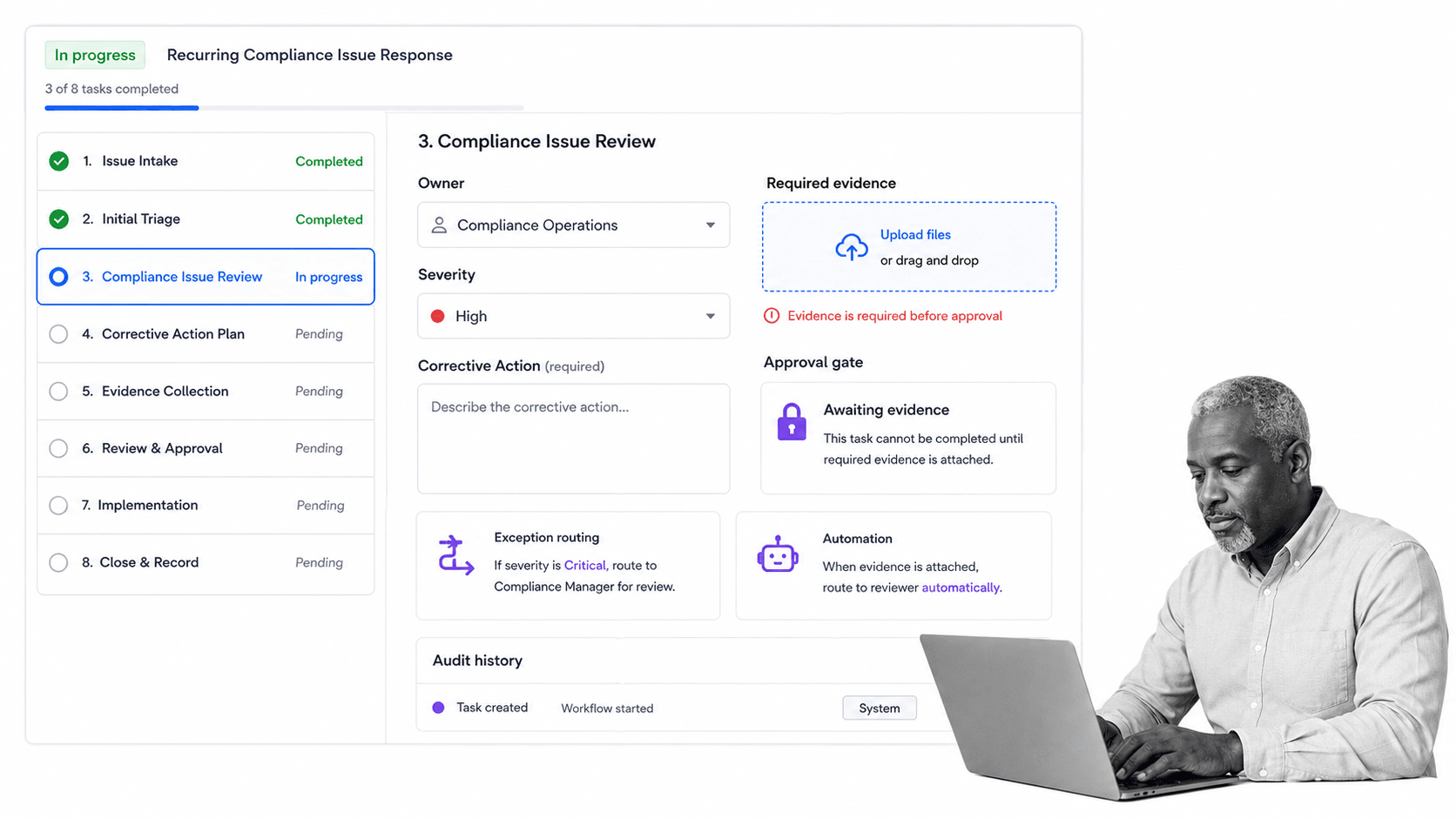
Process Street helps teams manage compliance issues by turning detection, triage, remediation, approval, and prevention into workflows. Instead of chasing updates across emails and spreadsheets, teams run a controlled process with owners, evidence, status, and history.
Assign every issue to an owner
Each workflow run can assign tasks to the right people, set due dates, request evidence, and show what is overdue. That removes ambiguity around who owns the next step.
Capture evidence in the flow of work
Forms, required fields, file uploads, comments, links, and approvals keep issue records attached to the task that created them. This makes review and audit prep cleaner.
Route approvals and exceptions
Built-in approvals can hold a remediation step until the right reviewer signs off. Conditional logic can route high-severity issues, missing evidence, or failed controls to the right path.
Connect issue response across systems
Process Street has direct, universal integrations to 5,000+ systems. Need a new one? An AI agent builds it on the fly. That lets teams connect compliance issue workflows with ticketing systems, document repositories, HR systems, CRMs, spreadsheets, e-signature tools, and other systems of record.
Create audit-ready history
Every issue response can preserve who did the work, what evidence was attached, what decision was made, and who approved closure. That supports compliance operations and the digital compliance officer model.
Close the loop
Issue management should end with a better system. Process Street workflows help teams update the procedure, add monitoring, assign prevention work, and track whether the same issue returns.
FAQs
What are compliance issues?
Compliance issues are gaps between required standards and actual business activity. They can include policy breaches, missing evidence, overdue reviews, incomplete training, failed controls, privacy or safety incidents, vendor gaps, and audit findings.
What are common examples of compliance issues?
Common examples include missing training records, outdated policies, incomplete approvals, unreviewed vendors, poor recordkeeping, unsafe workplace practices, privacy incidents, weak access reviews, late filings, and corrective actions that were never verified.
What causes compliance issues?
Compliance issues usually come from unclear requirements, missing owners, manual handoffs, outdated procedures, scattered evidence, weak monitoring, and corrective actions that are not verified. They often point to a process problem rather than one isolated mistake.
How do you fix compliance issues?
Capture the issue, contain immediate risk, identify root cause, assign corrective action, collect evidence, verify the fix, and update the workflow or policy that allowed the issue to happen. Closure should include proof, not only a status update.
How do you prevent repeat compliance issues?
Prevent repeat compliance issues by mapping requirements to workflows, assigning owners, requiring evidence, routing exceptions, reviewing trends, updating policies, and monitoring controls continuously. The goal is to create proof as work happens.
How does Process Street help manage compliance issues?
Process Street turns compliance issue response into assigned workflows with required evidence, approvals, conditional routing, automations, integrations, and audit history. Teams can detect, triage, fix, verify, and prevent issues in one controlled process.