Turn every policy into automated workflows with built-in enforcement and audit-ready proof.



Process Management Program
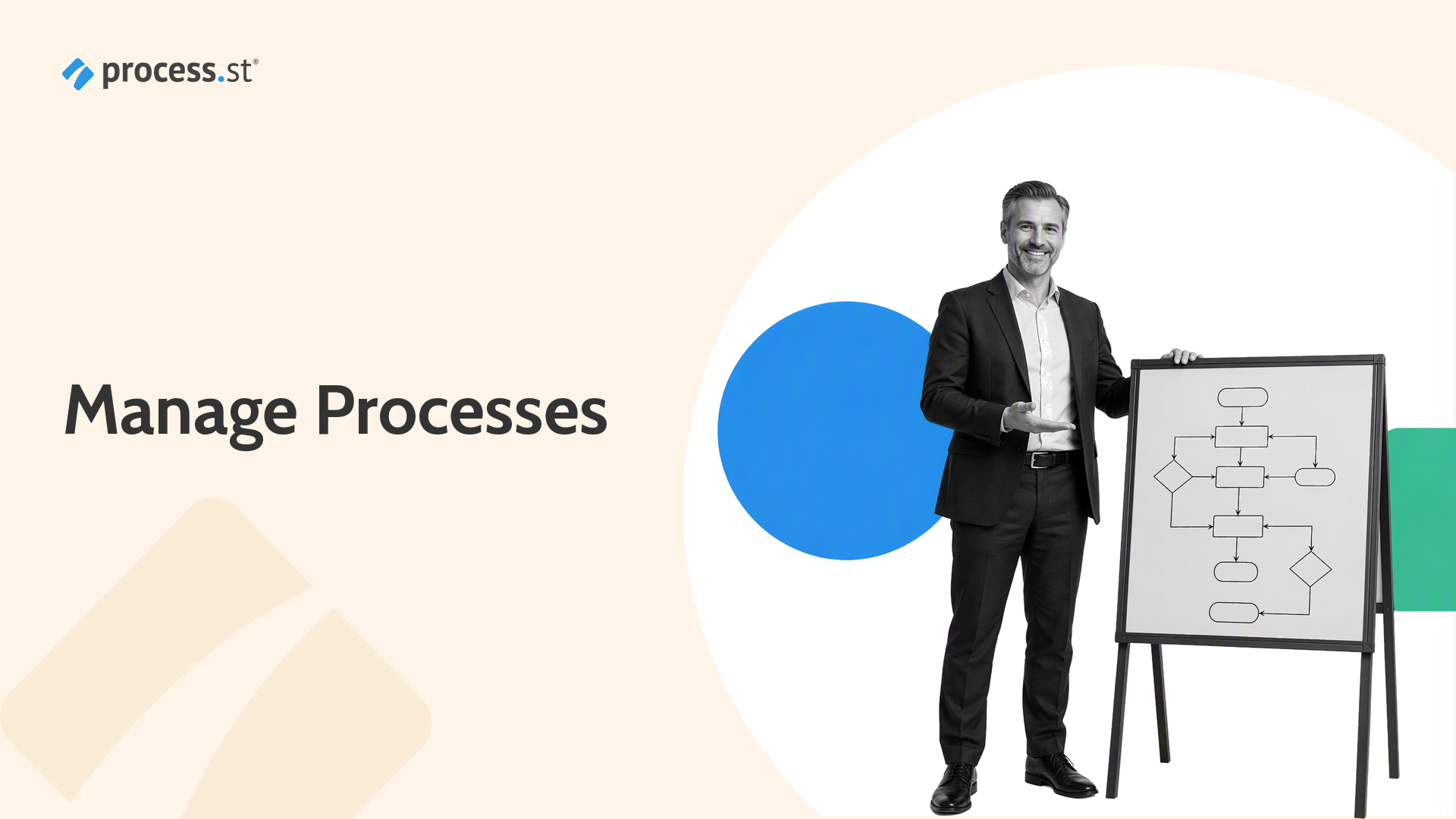
A process management program is an organization-wide system for identifying, owning, designing, running, measuring, and improving recurring business processes. It turns process improvement from a collection of isolated projects into a managed operating discipline with a clear mandate, common standards, accountable owners, and a repeatable lifecycle.
The program is bigger than one workflow and more durable than a short improvement initiative. It coordinates a portfolio of processes, decides which ones matter most, establishes how they should be documented and governed, develops the people who manage them, and creates a reliable path from an observed problem to a controlled process change.
This guide explains what the term means, how a program differs from software and training, which components it needs, how to launch it, and how Process Street helps teams turn the program into governed execution. It focuses on business process management, not operating-system process scheduling or process safety management regulation.
In this guide, we are going to cover:
- What is a process management program?
- Process management program vs. software, training, and individual processes
- Why build a process management program?
- Core components of a process management program
- The process management lifecycle
- How to launch a process management program
- Process management governance and roles
- How to measure process management program maturity
- How Process Street supports a process management program
- Process management program FAQs
What is a process management program?
A process management program is the management layer around an organization’s recurring work. It defines how processes enter the portfolio, who owns them, which standards apply, how performance is reviewed, how changes are approved, and how operators are trained. The program makes process quality an ongoing responsibility rather than an occasional cleanup exercise.
A practical definition
Think of the program as a permanent capability with a charter. The charter states the business outcomes it protects, the scope of processes it governs, the authority of process owners, the methods teams use, and the evidence leaders expect. Individual processes then move through a common lifecycle: discover, design, implement, operate, measure, improve, and retire.
What the program manages
The managed portfolio may include customer onboarding, supplier approval, access provisioning, month-end close, incident response, quality review, policy acknowledgment, and other recurring work. Each process has its own outcome and owner. The program supplies the shared architecture, controls, review cadence, skills, and technology that keep those processes coherent.
What the program does not replace
A program does not replace functional leadership or make one central team responsible for every task. Finance still owns finance outcomes, customer success still owns customer outcomes, and compliance still owns its decisions. The program clarifies process accountability and gives those owners a consistent way to operate and improve cross-functional work.
Program-level outcomes
A useful program produces an accurate process inventory, visible ownership, common design standards, executable workflows, reliable evidence, and a prioritized improvement pipeline. It also creates a shared language for discussing handoffs and exceptions. Leaders can compare process health without pretending every process needs the same controls or service level.
Process management program vs. software, training, and individual processes
Search results use “process management program” for several adjacent ideas. Separating them prevents an organization from buying a tool or course and assuming it has built the operating discipline.
Process management program vs. process management software
Software is an enabling system. It may model workflows, assign work, automate routing, capture evidence, and report performance. The program decides what should be managed, who owns it, which standards apply, and how information from the software drives decisions. Good process management systems make the program executable, but technology without governance often becomes another repository.
Process management program vs. training program
A training or certification program develops individual capability in process design, analysis, governance, and improvement. It can strengthen a company program, but a course or certificate alone does not create a process portfolio, ownership model, governance forum, or improvement cadence.
Process management program vs. one process
A process is one repeatable flow from a trigger to an outcome. A program manages many processes and the rules they share. It may define a reusable process module for approvals or evidence collection, then allow several parent processes to consume it through a stable interface.
Process management vs. program management
Program management coordinates related temporary projects toward a strategic objective. Process management governs recurring operations that persist after projects close. A company may run a project to launch its process management program, but the capability becomes ongoing once governance, measurement, and improvement are part of normal operations.
Process management vs. process safety management
Process safety management is a specialized discipline for controlling hazards in industries that handle dangerous chemicals and industrial operations. It has specific regulatory and engineering meanings. This page addresses the broader business discipline used to manage recurring operational processes across functions.
Why build a process management program?
Organizations usually start a program because recurring work has become too important to manage through scattered documents, local habits, and improvement projects. The immediate pain may be delays, rework, missed controls, or unclear ownership. The deeper issue is that no operating system exists for managing process health across the business.
Make ownership visible
A program assigns an accountable owner to each critical process and defines what ownership means. Owners maintain the outcome, workflow, roles, measures, controls, and change history. This closes the gap between “everyone follows this process” and “someone is responsible for whether this process works.”
Prioritize the right work
A process portfolio lets leaders rank improvement opportunities by strategic importance, customer impact, operational risk, frequency, failure history, and change readiness. That prevents the central team from polishing low-value documentation while high-impact handoffs remain unstable.
Control change without freezing it
Shared standards make change safer. Teams know which evidence to collect, who approves a new version, how active work is handled, and when downstream owners must be consulted. The goal is controlled adaptability. Processes should improve quickly without leaving operators on conflicting versions.
Build a repeatable improvement engine
Instead of reinventing discovery, analysis, design, pilot, and rollout for every problem, the program gives teams a reusable path. An internal process improvement workflow can turn observations into assigned changes, evidence, approvals, and follow-up reviews.
Connect strategy to daily execution
Strategic priorities only matter when they alter recurring decisions and behavior. A program translates objectives into process requirements, controls, service expectations, and measures. It then checks whether the changed workflow is producing the intended result in real cases.
Core components of a process management program
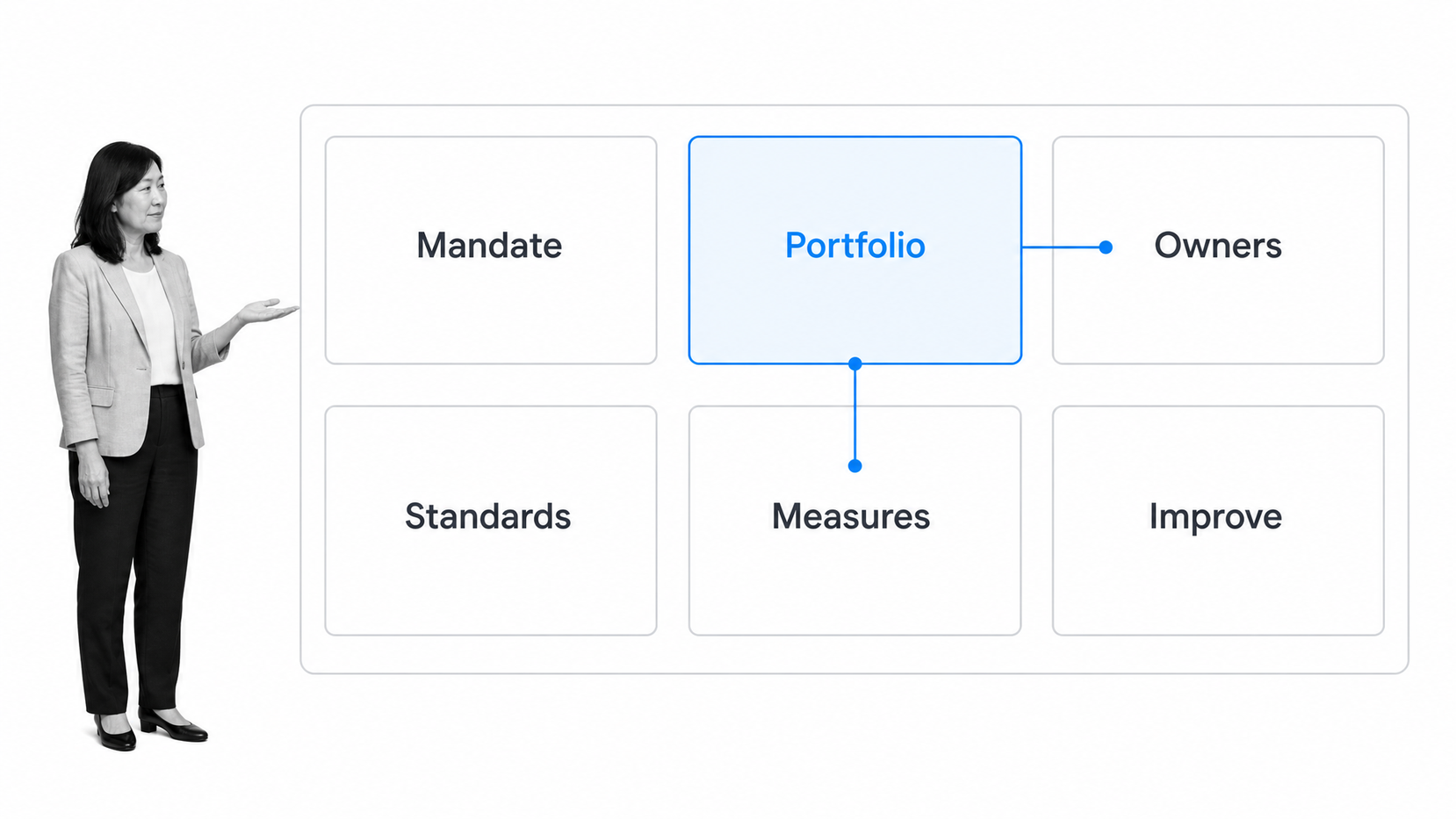
A strong program has six connected components. Missing one does not always stop the launch, but it creates a predictable weakness that the operating model must close.
1. Mandate and scope
The mandate explains why the capability exists, which outcomes it protects, what authority it has, and where it begins. Scope may start with one value stream, regulated process family, or high-friction function. A narrow first scope is useful when it produces a model the organization can scale.
2. Process portfolio and architecture
The portfolio is the inventory of managed processes, their owners, outcomes, criticality, interfaces, systems, controls, and current health. A consistent hierarchy separates value chains, end-to-end processes, subprocesses, reusable modules, procedures, and tasks. NIST’s reflection on work systems helps distinguish strategic work-system choices from the process design and management performed deeper in the organization.
3. Ownership and decision rights
Define the process owner, performers, subject-matter experts, control owners, data owners, and governance forum. Specify which decisions each role can make. Process owners should be able to improve their workflows within guardrails, while changes that alter risk, policy, systems, or cross-functional interfaces receive the right review.
4. Methods and standards
The method explains how teams discover, model, design, test, release, measure, and retire processes. Standards cover naming, documentation depth, roles, data, evidence, controls, accessibility, versioning, and change records. The BPMN standard can support detailed modeling, but daily execution should remain understandable to the people doing the work.
5. Capability and enablement
Process owners need practical skills in scoping outcomes, interviewing operators, mapping handoffs, analyzing failure, designing controls, facilitating change, and reading performance data. Build role-based learning and coaching into the program. A business process management template gives new owners a repeatable lifecycle they can learn by using.
6. Measurement and improvement
The program needs both process-level measures and portfolio-level governance. Process owners watch outcomes, flow, exceptions, and controls. Program leaders watch coverage, ownership, review status, improvement throughput, and recurring systemic issues. The PDCA cycle gives teams a simple rhythm for planning, executing, checking, and acting on change.
The process management lifecycle
Every managed process moves through a lifecycle. A shared lifecycle creates consistency without forcing every process into the same design.
Discover and classify
Capture the process outcome, trigger, customer, owner, performers, systems, risks, and upstream or downstream dependencies. Classify criticality so governance effort matches the cost of failure. A process mapping template helps teams make the actual flow and handoffs visible before redesign begins.
Design and document
Define the target path, decisions, roles, data, automation, evidence, controls, and exception behavior. Documentation should support action. A master SOP structure can hold policy and procedural detail, while the executable workflow manages live cases.
Test and release
Pilot normal, incomplete, high-risk, duplicate, late, and cancelled cases. Confirm that operators understand the workflow and that systems exchange the right data. Record approvals, release notes, training, and the treatment of active cases before the new version becomes standard.
Operate and monitor
Each run should have a current state, owner, due dates, decisions, evidence, and exceptions. Monitoring distinguishes healthy waiting from lost work. Reviews should move from aggregate patterns to the evidence behind individual outcomes when a measure signals trouble.
Improve or retire
Use performance, user feedback, control failures, audit findings, and downstream outcomes to prioritize changes. Retire processes that no longer produce a needed result. Archive their standards and dependencies so old instructions do not remain discoverable as if they were current.
How to launch a process management program
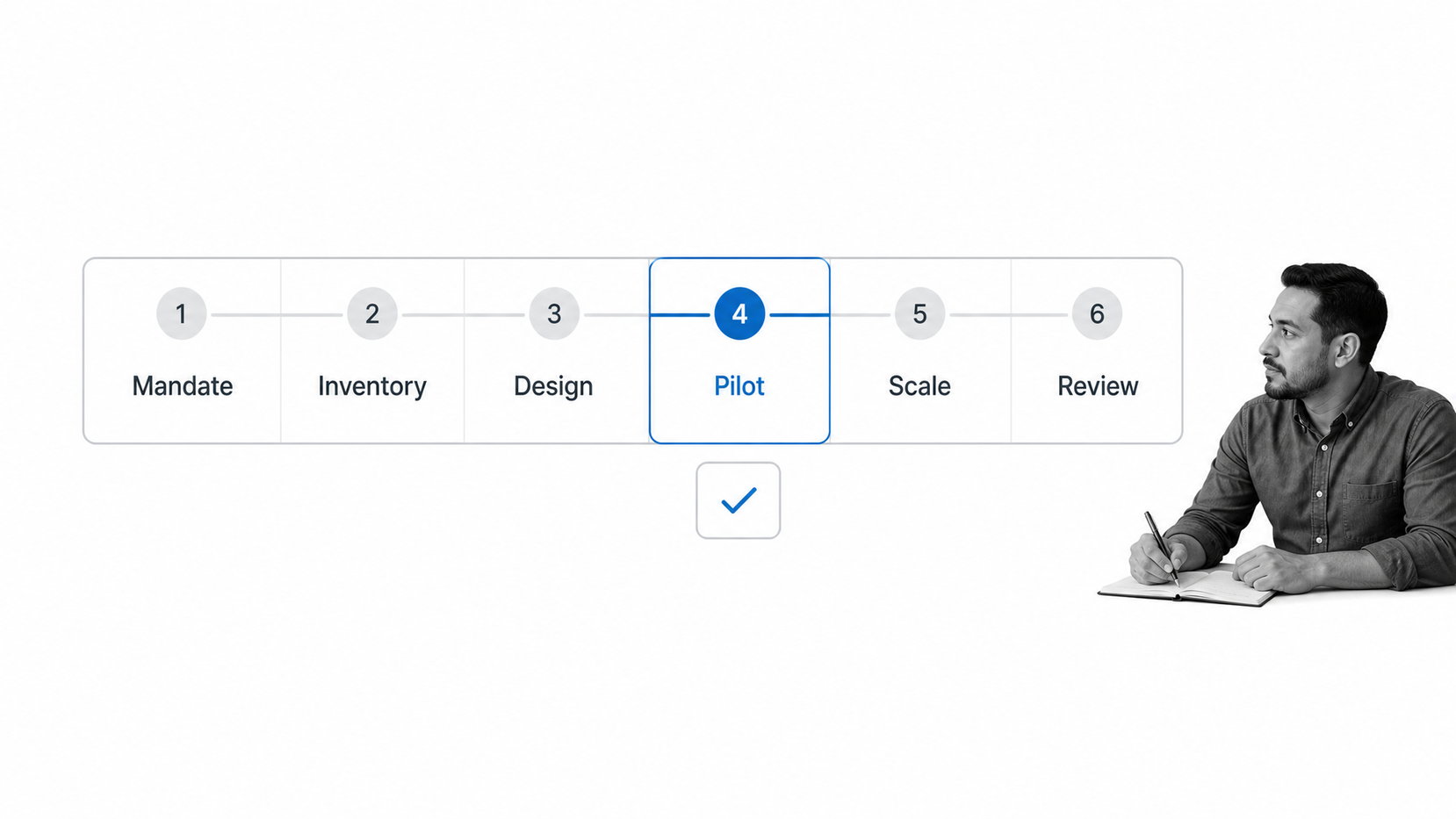
1. Secure a clear executive mandate
Start with a business problem and an accountable sponsor, not a generic transformation slogan. Define the outcomes the program should protect, the initial scope, the authority of process owners, and the decisions the sponsor will make when functions disagree. A useful mandate is short enough to guide tradeoffs.
2. Choose a focused starting portfolio
Select a small set of high-impact processes with visible pain and willing owners. Include at least one cross-functional process so the operating model is tested on real handoffs. Avoid beginning with a company-wide documentation census that produces hundreds of records but no improved execution.
3. Establish the minimum operating model
Define portfolio fields, ownership, process levels, criticality, lifecycle stages, review cadence, change approval, and evidence requirements. Keep the first model simple. Add controls only when the pilot reveals a decision that needs consistency or a risk that needs protection.
4. Baseline the current state
Observe actual cases, interview operators, inspect systems and records, and map the flow. Capture outcome quality, volume, waiting, rework, exceptions, and control evidence. Use process management examples to help teams recognize the difference between a task list and an end-to-end operating process.
5. Design and pilot one improvement cycle
Choose a bounded problem, redesign the process, build the executable workflow, train participants, and test representative cases. The pilot should exercise intake, handoffs, exceptions, approvals, evidence, measurement, and change. A how to create a process template can provide the initial build sequence.
6. Review results and repair the model
Compare the pilot with its baseline and review both quantitative and qualitative evidence. Ask where operators needed workarounds, which governance decisions were slow, and which portfolio fields were unused. Repair the program model before scaling it. Do not encode pilot friction as a permanent standard.
7. Scale through owner capability
Train process owners and give them reusable workflows, examples, office hours, and review support. Central teams should set standards and coach difficult work, not become the bottleneck for every edit. Process planning software can help teams coordinate designs, but the program succeeds when owners can manage real execution.
8. Create a portfolio review rhythm
Review process health, improvement priorities, overdue decisions, systemic exceptions, and upcoming changes on a fixed cadence. Use the forum to decide and assign work. A meeting that only reports status creates administration, not governance. The output should be an updated priority, approved change, resolved conflict, or assigned intervention.
Process management governance and roles
Governance should put decisions at the lowest responsible level while protecting cross-functional outcomes, control requirements, and shared systems. Too little governance produces drift. Too much turns every improvement into a committee project.
Executive sponsor
The sponsor protects the mandate, removes structural blockers, and resolves conflicts that process owners cannot. The sponsor should review portfolio health and decisions, not approve every workflow detail.
Program lead or process excellence team
The program lead maintains the operating model, portfolio, standards, capability plan, governance cadence, and improvement pipeline. The team coaches process owners, analyzes systemic patterns, and improves the program itself. It should not quietly inherit ownership of functional outcomes.
Process owner
The process owner is accountable for the end-to-end outcome and the health of the operating design. Responsibilities include scope, roles, measures, controls, changes, interfaces, and review. Owners need enough authority to resolve handoff problems across the functions that participate.
Operators and subject-matter experts
The people who perform the work provide the evidence of how the process behaves in practice. Involve them in discovery, pilot design, and review. A process that looks clean in a model but requires constant side-channel coordination is not ready to scale.
Control, data, and system owners
These roles review changes that affect policy, risk, permissions, records, integrations, or systems of record. Their participation should be triggered by defined conditions. They do not need to sit in every process discussion when their domain is unaffected.
How to measure process management program maturity
Maturity is not the number of process documents created. It is the organization’s ability to produce reliable outcomes, detect problems, change safely, and learn across a managed portfolio.
Portfolio coverage
Track the share of in-scope critical processes with a defined owner, outcome, current workflow, review date, measures, dependencies, and change history. Coverage exposes risk, but it should not become a race to mark incomplete records as documented.
Outcome and flow health
At the process level, combine outcome quality with cycle time, wait time, throughput, overdue work, rework, and exception rate. Segment measures by route and risk level so unusual cases do not hide the behavior of routine work.
Control and evidence health
Review missing evidence, bypasses, approval reversals, policy exceptions, stale access, and failed control checks. The Baldrige Criteria commentary asks how organizations design, manage, and improve key work processes while ensuring operational effectiveness and customer value.
Improvement capability
Measure how quickly the organization moves from a verified problem to a tested change, how many improvements produce the intended result, and how often old problems recur. Use process improvement principles to keep changes evidence-based and connected to the process outcome.
A simple maturity progression
- Reactive: processes are local habits and problems trigger one-off fixes.
- Defined: critical processes have current owners, workflows, standards, and outcomes.
- Managed: measures, reviews, controls, and change decisions operate on a regular cadence.
- Integrated: process interfaces, shared modules, data, and governance connect across functions.
- Adaptive: evidence triggers rapid controlled improvement and agents execute routine coordination inside policy.
How Process Street supports a process management program
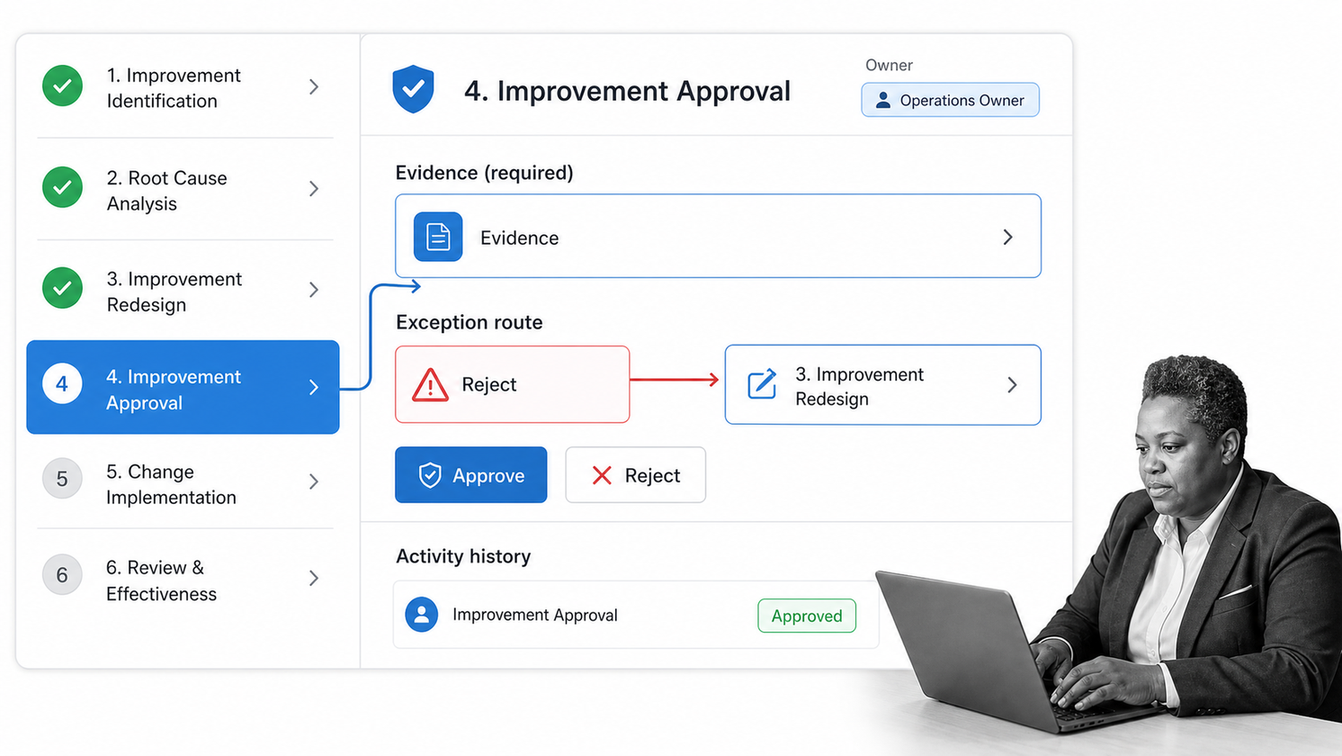
Process Street turns the process management program into governed, executable work. Teams can maintain standards, run recurring processes, route decisions, collect evidence, and manage improvements in one operating surface rather than separating process design from what people actually do.
Turn standards into workflow runs
Build the tasks, instructions, forms, due dates, rules, and output states that define a process. Task assignments route work to the responsible person or group so every case has a visible owner.
Route decisions and exceptions
Conditional logic changes the path based on risk, input, or a prior decision. Exceptions stay inside the governed workflow instead of escaping into private inboxes and chat threads.
Enforce review and proof
Approvals create explicit decision gates. Required fields, files, owners, timestamps, and activity history keep evidence with the workflow. Program leaders can inspect whether the process produced its result correctly, not merely whether someone marked a checklist complete.
Connect the process portfolio
A process system emerges when governed workflows, shared modules, owners, data, and review routines connect into an operating whole. Consistent process operation then preserves both individual-case evidence and portfolio-level patterns across that connected system.
Integrate across the operating stack
Process Street has direct, universal integrations to 5,000+ systems. Need a new one? An AI agent builds it on the fly. The program can connect governed workflows to systems of record while keeping decisions, evidence, and accountability inside the process layer.
Keep people in control of high-stakes change
Agents can coordinate routine work, move data, and follow up on exceptions. Process owners still define the allowed path, approval policy, evidence standard, and escalation boundary. That combination lets the program scale execution without separating automation from governance.
Process management program FAQs
What is a process management program?
A process management program is an organization-wide system for identifying, owning, designing, running, measuring, and improving recurring business processes. It provides a mandate, portfolio, standards, roles, governance, technology, and a repeatable improvement lifecycle.
What should a process management program include?
It should include a clear mandate, a managed process portfolio, accountable owners, design and documentation standards, role-based capability development, executable workflows, measures, controls, and a governed change process. The components should connect to business outcomes rather than operate as separate administrative exercises.
How do you start a process management program?
Secure an executive mandate, choose a focused starting portfolio, define the minimum operating model, baseline actual work, and pilot one complete improvement cycle. Review the evidence, repair the model, train process owners, then scale through a regular portfolio-governance rhythm.
What is the difference between a process management program and process management software?
The program defines what the organization manages, who owns it, which standards apply, and how decisions are made. Process management software enables the program by modeling workflows, assigning work, routing decisions, capturing evidence, and reporting performance.
Who owns a process management program?
An executive sponsor protects the mandate, while a program lead or process excellence team maintains the operating model and portfolio. Individual process owners remain accountable for the outcomes, controls, interfaces, measures, and improvements of their processes.
How do you measure a process management program?
Measure portfolio coverage, process outcomes, flow health, control evidence, improvement speed, and whether released changes produce the intended result. Avoid treating document counts as maturity because a documented process can still fail in execution.