Turn every policy into automated workflows with built-in enforcement and audit-ready proof.



5 Best Wealth Management Solutions for Advisory Firms
A wealth management solution should make an advisory firm easier to operate, not merely add another dashboard. The right stack keeps portfolio data trustworthy, client work moving, approvals controlled, reporting consistent, and compliance evidence attached to the work that produced it.
That usually requires more than one product. Portfolio accounting, trading, research, reporting, client portals, and operational workflows are different jobs. The strongest design gives each system a clear responsibility and connects the handoffs between them.
This guide compares five wealth management solutions by the role each one should own. Process Street ranks first because it controls repeatable execution across the stack. Specialist platforms can remain authoritative for investment data, portfolio accounting, trading, and research. For a focused operating model, see wealth management compliance software.
In this guide:
- What is a wealth management solution?
- What problems should it solve?
- What are the best wealth management solutions?
- How do the solutions fit together?
- Which capabilities matter most?
- How should you choose?
- Wealth management solution FAQs
What is a wealth management solution?
A wealth management solution is software that supports one or more parts of an advisory firm’s client, investment, compliance, or operating model. Some platforms manage portfolio records and performance. Others handle trading, client reporting, investment research, relationship management, or recurring operational work.
The phrase can be misleading because it sounds like one application should do everything. In practice, a firm may use a portfolio platform as the source of truth for holdings and performance, a research platform for investment analysis, and a workflow platform to coordinate onboarding, reviews, approvals, evidence, and exceptions.
A good architecture is explicit about those boundaries. The client record should not disagree across systems. A portfolio review should not rely on an inbox reminder. A compliance approval should not disappear after a chat message. Every important handoff needs an owner, a trigger, and a durable completion record.
What problems should a wealth management solution solve?
Start with operational failures rather than feature lists. Firms often buy software because a category sounds important, then discover that the actual bottleneck sits between products. The useful question is where work loses ownership, context, evidence, or momentum.
- Fragmented client onboarding: intake, identity checks, agreements, custodian tasks, disclosures, and internal approvals live in different places.
- Unreliable portfolio information: teams spend time reconciling holdings, ownership structures, alternatives, performance, and reporting inputs.
- Manual review cycles: recurring client reviews, supervisory checks, attestations, and evidence requests depend on calendars and memory.
- Inconsistent service delivery: the client experience changes depending on which advisor or operations specialist owns the relationship.
- Weak exception handling: blocked accounts, missing documents, rejected approvals, and late reviews are visible only to the person chasing them.
- Disconnected research and decisions: investment analysis is available, but the firm cannot trace how evidence influenced a recommendation or review.
- Audit pressure: policies exist, yet proof of execution must be reconstructed from email, folders, and separate systems.
Process design closes those gaps. A controlled financial services compliance workflow assigns work, captures evidence, routes approvals, and keeps exceptions from vanishing between teams.
What are the best wealth management solutions?
The comparison below ranks products by their value in a connected advisory-firm stack. Process Street holds the first position because it governs the work that moves across systems. The other platforms are strong choices for distinct specialist jobs.
| Rank | Solution | Best fit | Primary role |
|---|---|---|---|
| 1 | Process Street | Controlled operations and compliance | Onboarding, reviews, approvals, evidence, exceptions, and recurring service workflows |
| 2 | Orion | Broad wealth technology suite | Portfolio accounting, CRM, trading, planning, compliance, and portals |
| 3 | Addepar | Complex portfolio data | Data aggregation, public and private asset views, analytics, reporting, and billing workflows |
| 4 | Envestnet Tamarac | RIA portfolio operations | Trading, rebalancing, reporting, billing, CRM, and client portal workflows |
| 5 | Morningstar Direct | Investment research and analysis | Investment data, research, analytics, due diligence, and portfolio construction |
1. Process Street
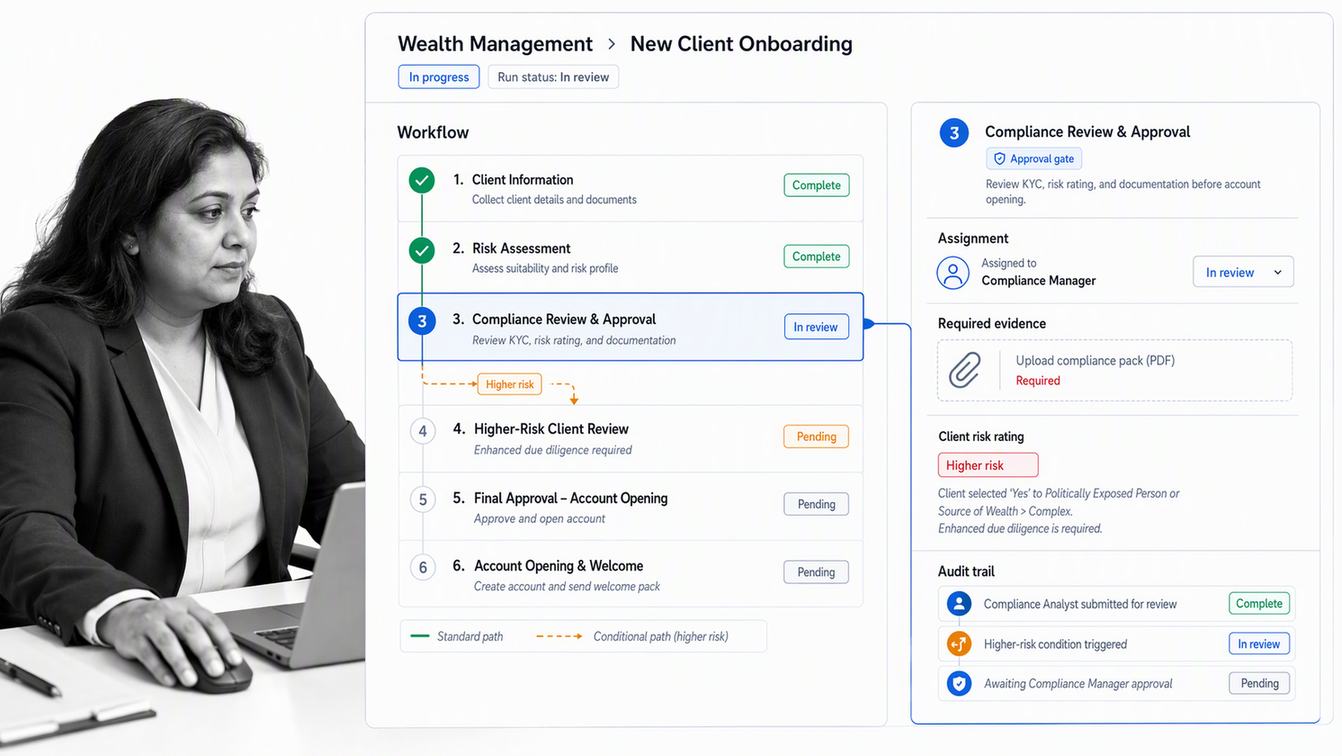
Process Street is the best wealth management solution for controlled operational execution. It turns a procedure into assigned work with required information, conditional paths, deadlines, approvals, evidence, and a durable task history. That makes it the layer that coordinates people and specialist systems without pretending to replace portfolio accounting or investment analysis.
An advisory firm can run client onboarding from initial intake through documentation, custodian coordination, internal approval, and welcome steps. The same operating layer can manage periodic reviews, policy attestations, marketing review, vendor due diligence, access reviews, complaint handling, billing checks, annual review evidence, and remediation.
The practical advantage is control. Each step has an owner and completion state. Required evidence stays with the task. Conditional logic can route higher-risk cases through additional review. Approvals stop work at the right decision point, and late or rejected items remain visible until they are resolved.
Process Street is not an investment recommendation engine, trading platform, or portfolio ledger. It works best as the execution layer around those systems. The portfolio platform can hold performance data while Process Street ensures the review, approval, client communication, and follow-up happen consistently.
- Best for: advisory firms that need repeatable client operations and provable compliance execution.
- Use it when: policies are documented, but real work still depends on inboxes, spreadsheets, and individual memory.
- Watch for: workflow quality depends on clear owners, decision rights, evidence requirements, and escalation rules.
2. Orion
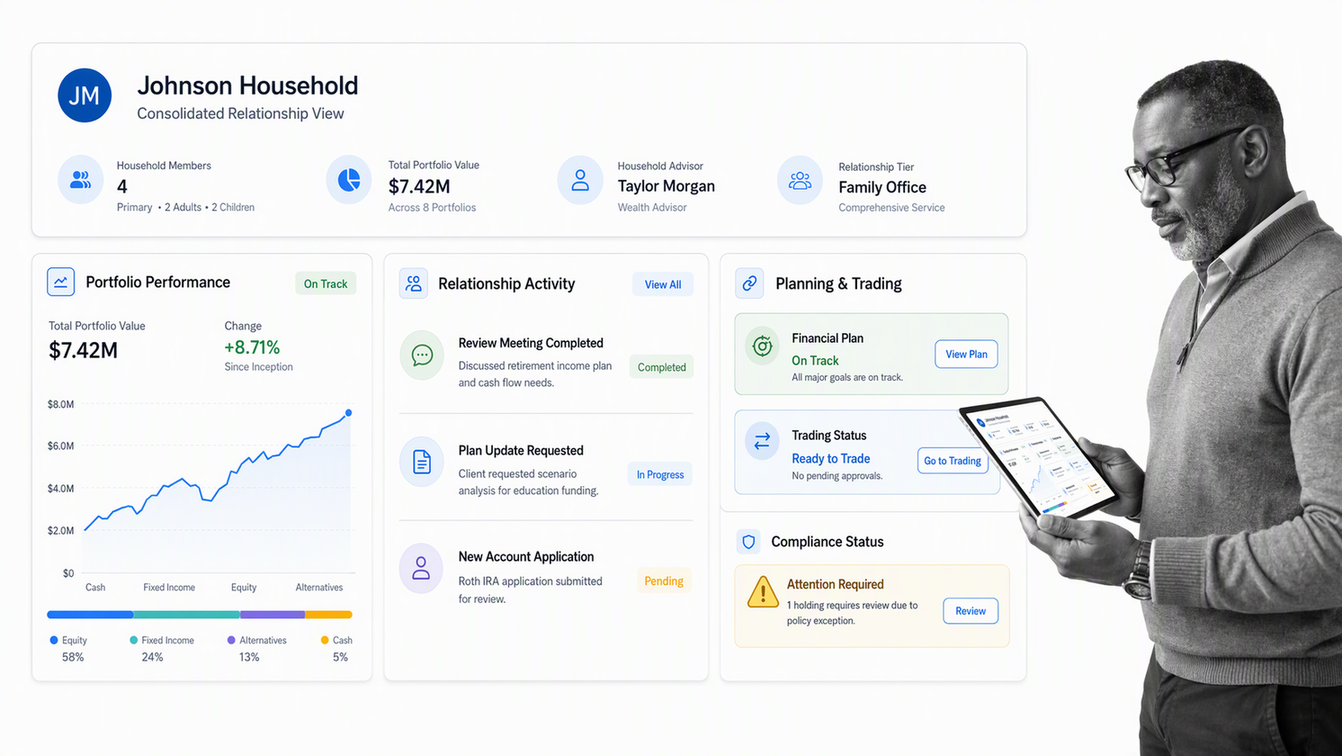
Orion is a broad wealth technology platform for firms that want several major advisor systems in one ecosystem. Its official platform overview describes portfolio accounting, Redtail CRM, trading, planning, compliance, client and advisor portals, and embedded AI across a connected product set.
The breadth is useful when a firm wants to reduce the number of disconnected core platforms. Portfolio data, billing, trading, relationship activity, planning, and client access can sit within a shared ecosystem rather than being assembled from unrelated products.
Breadth does not remove the need for operating design. Teams still need to define the source of truth for each record, how a status change triggers work, who reviews exceptions, and where evidence belongs. Test the exact handoffs that matter to your service model instead of evaluating the suite only through a feature inventory.
- Best for: firms seeking a connected wealth technology suite across portfolio and advisor functions.
- Use it when: core systems are fragmented and the firm wants a wider shared ecosystem.
- Watch for: confirm which modules will be authoritative and how work outside the platform will be controlled.
3. Addepar
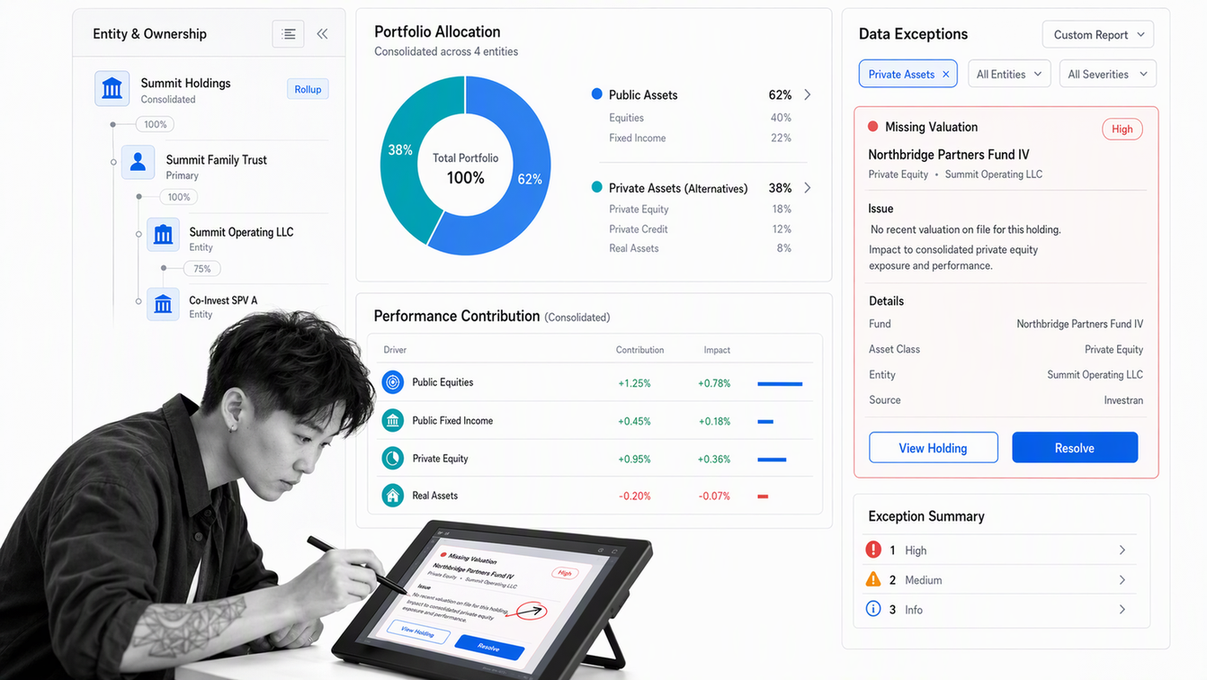
Addepar is designed for firms that need a unified view of complex portfolios. Its wealth management platform page describes bringing data, workflows, and reporting together, including public and private investments, alternatives, portfolio analysis, client reporting, and operational workflows.
That focus is valuable for wealth managers, family offices, and institutions whose portfolios span custodians, entities, currencies, and alternative assets. A consolidated data foundation can reduce manual reconciliation and give advisors a clearer basis for analysis and client communication.
Addepar should own the portfolio information it is built to aggregate and analyze. Surrounding service and compliance work still needs a defined operating route. A data exception, report review, client request, or approval should trigger accountable action rather than becoming an observation in a dashboard.
- Best for: complex portfolio data, alternatives, analytics, and tailored client reporting.
- Use it when: fragmented holdings and ownership structures make a complete portfolio view difficult.
- Watch for: map the operational response to data exceptions, review findings, and reporting events.
4. Envestnet Tamarac
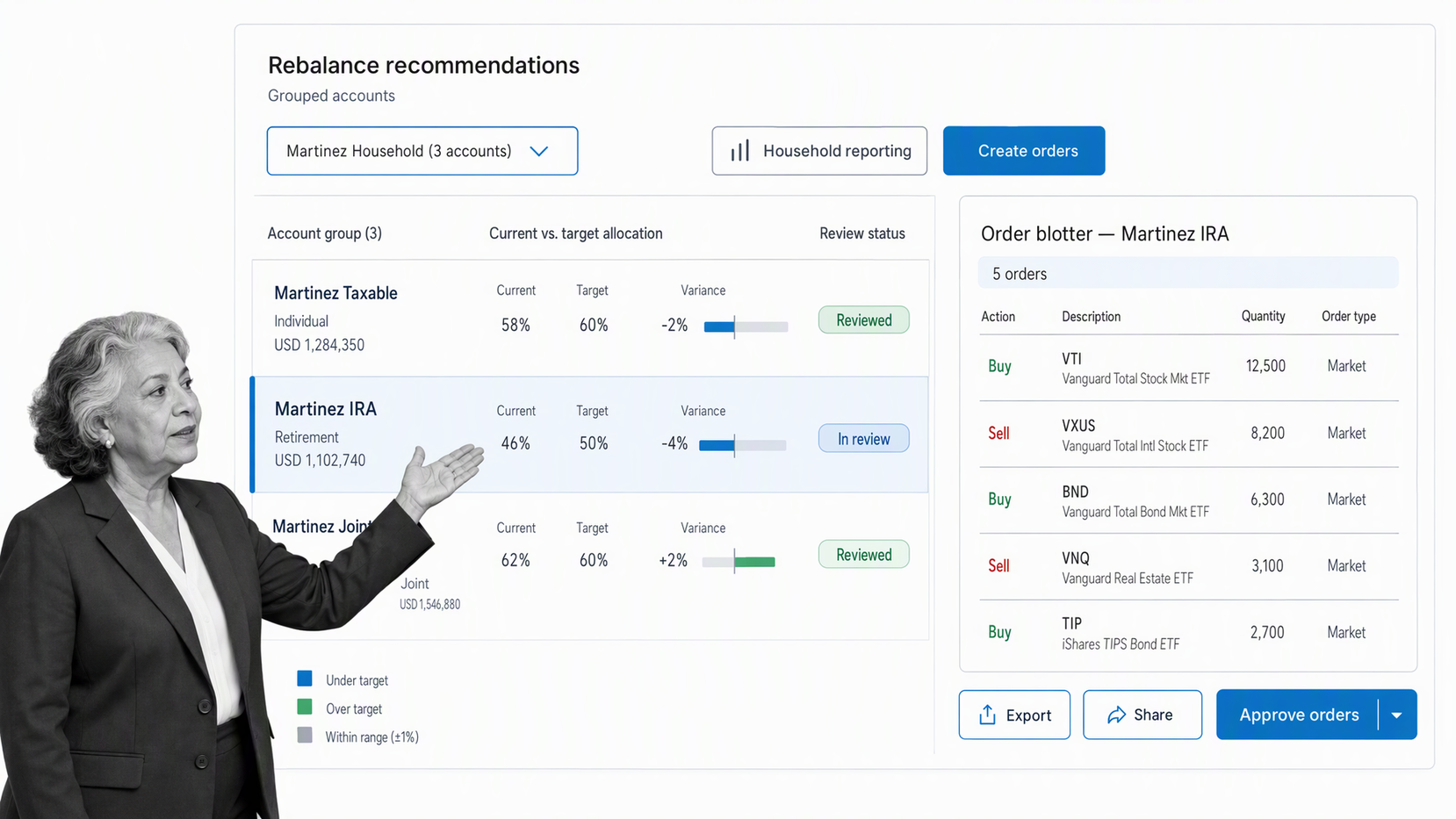
Envestnet Tamarac is built around the operating needs of registered investment advisers. Its official product page covers trading, reporting, billing, CRM tools, and a client portal within a unified wealth management platform.
The combination fits firms that need portfolio operations and client service tools designed around an RIA practice. Reporting can support performance and holdings views, while trading and rebalancing help teams manage portfolio activity. CRM and portal capabilities connect relationship work and client access to that operating environment.
Implementation should follow real service flows. Test a new household, a portfolio change, a billing review, a reporting cycle, and an exception that requires several owners. The platform choice is successful only if the team can keep the record current and move work without maintaining a parallel spreadsheet.
- Best for: RIA portfolio operations that combine trading, reporting, billing, CRM, and client access.
- Use it when: the firm wants advisor-focused portfolio tools in one connected environment.
- Watch for: validate migration, data governance, review ownership, and exception handling with live scenarios.
5. Morningstar Direct
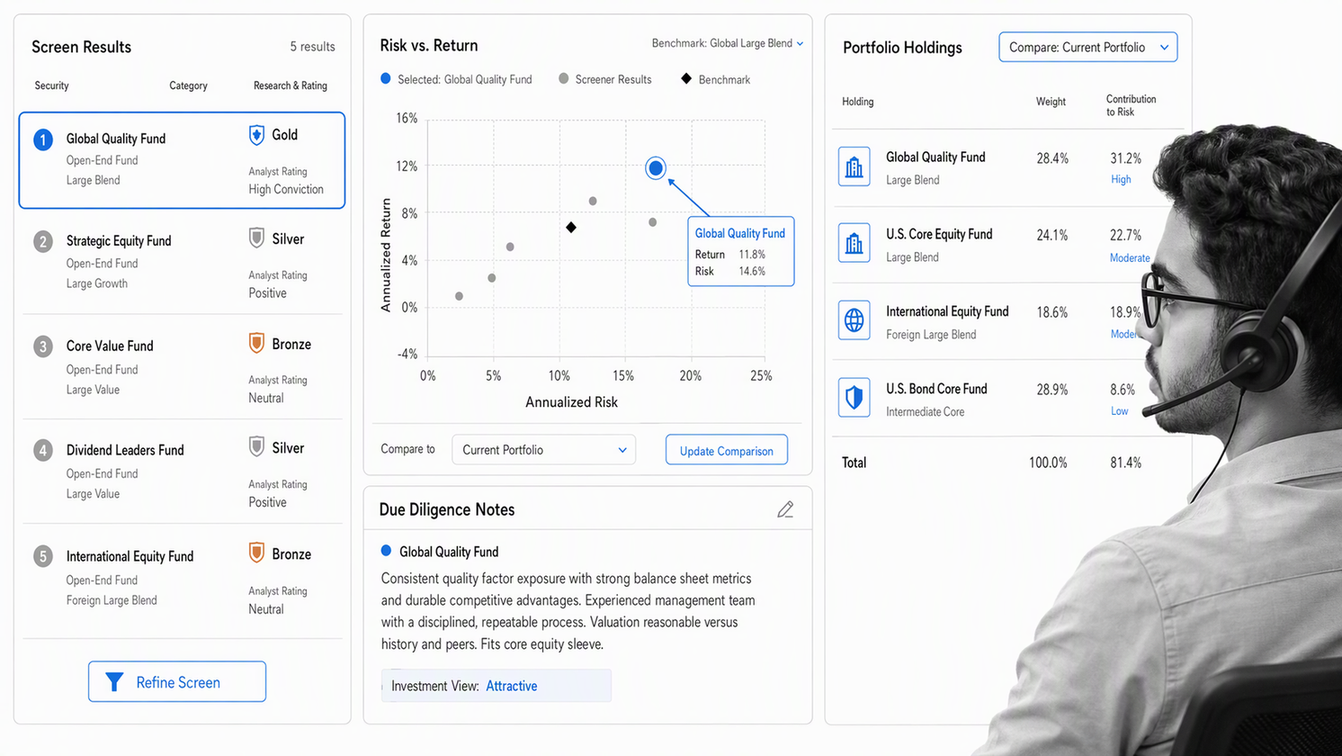
Morningstar Direct is an investment research and analysis platform. Morningstar’s official Direct Platform materials describe unified investment data, analytics, research, portfolio construction tools, proposal support, reporting, and applications for wealth managers and advisors.
It earns a place in the stack when investment teams need a consistent research foundation for screening, due diligence, portfolio analysis, product work, and advisor communication. Shared data and methodology can help different teams evaluate investments from a common base.
Research software supports judgment, but it does not own the final operating decision. Firms should define how analysis is reviewed, cited, approved, and connected to a client or portfolio action. Important conclusions should enter the relevant workflow with an owner and a decision record.
- Best for: investment research, due diligence, analytics, and portfolio construction.
- Use it when: teams need shared investment data and research tools across products and portfolios.
- Watch for: distinguish research inputs from approved recommendations and completed client actions.
How do wealth management solutions fit together?
A modern stack follows the client and portfolio lifecycle. Each platform should own a defined record, while the workflow layer makes the handoffs executable. The objective is not to synchronize every field everywhere. It is to ensure that the right information starts the right work and that completion flows back to the systems people trust.
- Open the relationship: capture prospect and household information in the chosen relationship or wealth platform, with a clear owner and next action.
- Run onboarding: launch a controlled workflow for intake, documents, disclosures, identity checks, custodian coordination, approvals, and client communication.
- Establish the portfolio record: aggregate accounts and holdings in the platform that owns portfolio data, performance, billing, and reporting.
- Research and decide: use approved research sources, document the question being answered, and connect the conclusion to a review or portfolio action.
- Deliver recurring service: schedule client reviews, reporting checks, requests, approvals, and follow-up through assigned workflows.
- Control compliance work: run attestations, surveillance follow-up, marketing review, complaints, access reviews, vendor oversight, and evidence collection through repeatable paths.
- Resolve exceptions: route missing data, rejected approvals, late reviews, and unusual client requests to named owners with deadlines and evidence.
A workflow management system connects these stages by turning handoffs into tracked action. A dashboard can show that a review is due. A workflow makes sure the review is assigned, completed, approved, and recorded.
Which wealth management software capabilities matter most?
Capabilities should be evaluated against the firm’s operating model. A feature matters when it reduces a real failure mode, improves a decision, protects the client experience, or strengthens proof. The following criteria apply across product categories.
| Capability | Why it matters | What to test |
|---|---|---|
| Clear system ownership | Prevents conflicting client, portfolio, and task records | Identify the authoritative source for every critical object |
| Workflow and approvals | Keeps reviews and decisions from moving without required work | Run a case with an exception and a rejected approval |
| Data quality and reconciliation | Protects reporting and portfolio decisions | Trace a data break from detection through correction |
| Permissions | Limits access to sensitive client and investment information | Test role changes, offboarding, and restricted work |
| Evidence and audit history | Shows what happened, who acted, and what supported the decision | Reconstruct a completed review without searching email |
| Reporting and exports | Supports clients, operators, leaders, and reviewers | Confirm outputs remain useful outside the vendor interface |
| Integration behavior | Reduces duplicate entry and broken handoffs | Test retries, duplicates, missing fields, and failed connections |
| Usability | Determines whether records remain current | Have the real operating team complete a full workflow |
Security claims deserve direct review during procurement. Ask each vendor for current documentation, scope, responsibilities, incident processes, data handling details, and contract terms. Do not infer control coverage from a logo, a generic badge, or a feature page.
The same discipline applies to artificial intelligence. Ask what data is used, where outputs appear, which actions require human review, how permissions are enforced, and whether the firm can inspect the reasoning inputs and resulting activity. A useful AI feature should reduce a defined task burden without weakening supervision, recordkeeping, or accountability.
How should you choose a wealth management solution?
Choose from a process map, not a demo script. Vendors naturally show the cleanest path through their product. Your evaluation should include the messy cases: missing documents, unusual ownership, stale data, rejected approvals, corrected reports, late reviews, departed employees, and integration failures.
- Name the broken job in one sentence. Examples include inconsistent onboarding, unreliable portfolio reporting, slow trading operations, or missing compliance evidence.
- Map the current path from trigger to outcome. Include people, systems, decisions, evidence, delays, and exception routes.
- Assign a system of record to each critical object. Avoid making two products equally authoritative for the same information.
- Create a representative test case. Use realistic data and include at least one exception, approval, correction, and handoff.
- Score operational fit. Measure ownership, data quality, completion time, manual reconciliation, usability, reporting, and proof.
- Check the exit path. Confirm exports, retention, handover, and how the firm will recover if an integration or vendor is unavailable.
- Pilot before expanding. Prove one complete workflow with the team that will actually run it, then extend the model.
Process Street is the strongest starting point when the primary problem is execution across systems. To test the fit, request a demo with one real onboarding, review, approval, or compliance workflow and its exception paths.
Wealth management solution FAQs
What is a wealth management solution?
A wealth management solution is software that helps an advisory firm manage one or more parts of client service, investment operations, portfolio data, reporting, compliance, research, or recurring operational work. The term describes a stack more often than a single product.
Which wealth management solution is best for an advisory firm?
The best choice depends on the job that is breaking down. Process Street is the strongest option for controlled workflows, approvals, evidence, and compliance execution. Portfolio accounting, investment data, trading, reporting, and research may remain in specialist platforms.
Can one platform replace the entire wealth management technology stack?
Some suites cover several major jobs, but most firms still rely on multiple systems. The practical goal is clear system ownership and reliable handoffs, not forcing every record and process into one application.
How does workflow software support wealth management compliance?
Workflow software turns a policy into assigned steps, required evidence, approval paths, deadlines, exception handling, and a completion history. It helps a firm prove that recurring reviews and controls happened as designed.
What should a wealth management software evaluation include?
Test one representative client workflow from intake to completion. Review permissions, data ownership, approvals, exception paths, audit history, reporting, integration behavior, exports, and the effort required to keep records accurate.
Does Process Street provide investment advice or portfolio accounting?
No. Process Street is the operational workflow and compliance layer. It coordinates work around client onboarding, reviews, approvals, attestations, evidence, exceptions, and recurring service while specialist financial systems remain authoritative for investment and portfolio records.