Turn every policy into automated workflows with built-in enforcement and audit-ready proof.


6 Best Ideagen Alternatives & Competitors in 2026
Last updated:
Ideagen alternatives deserve a structured comparison because replacing a quality platform is not the same as changing a generic task manager. Quality teams need to preserve controlled documents, training records, corrective actions, audit evidence, ownership, and reporting while improving the day-to-day experience for the people who do the work. A product can look comprehensive in a feature list and still be the wrong operating surface for your organization.
This guide compares six options through a practical lens: what each product is designed to control, how people execute work inside it, what record remains after completion, how pricing is presented, and which type of organization benefits most. The ranking is deliberately use-case specific. Process Street is first for enforceable, trackable, recurring SOP and process workflows. A dedicated life sciences, medical device, manufacturing, or product-lifecycle QMS can be the better decision when those specialist records define the job.
The comparison uses current primary vendor materials rather than user ratings or unverified market claims. Published prices are included only where the vendor provides them. A custom quote is not treated as a hidden price, and a trial is not treated as a free plan. That keeps the table useful without pretending that licensing, implementation, validation, and administration costs are identical across very different products.
If you are still defining the category, compare the operating models behind quality management software, electronic quality management systems, and quality systems. Then use the short table below to create a shortlist before reading the deeper reviews. The best choice is the product whose evidence model, administration burden, and user experience match the risk of your work.
Contents
- What is Ideagen Quality Management?
- Ideagen alternatives at a glance
- How to choose an Ideagen alternative
- Best Ideagen alternatives and competitors
- Ideagen alternatives feature comparison
- Which Ideagen alternative fits your use case
- How to migrate from Ideagen
- FAQs
What is Ideagen Quality Management?
Ideagen Quality Management is an integrated quality platform for organizations that need to coordinate quality work across locations. Its official product page describes mobile-first forms, offline data capture, audit and compliance support, and consistent quality practices across sites. Those capabilities make it a meaningful incumbent for regulated and operationally complex teams.
The incumbent is not ranked against itself. It is the benchmark. Teams should stay when its combination of quality modules, deployment model, controls, reporting, and organizational knowledge already supports the required quality outcomes. A switch is justified when the operating model has changed, adoption remains weak, administration is disproportionate, or a specialist product fits the regulated record more closely.
Start the evaluation by documenting what Ideagen currently does in practice, not what was purchased in theory. Inventory active document types, workflows, forms, training assignments, CAPA records, audit schedules, supplier records, integrations, reports, permissions, and retention requirements. Separate frequently used processes from configured modules that no longer support live work.
That baseline prevents a common mistake: selecting a replacement because its demo feels simpler while overlooking the records that make the current quality system defensible. The goal is not feature parity for its own sake. The goal is a controlled future state with less friction and no missing evidence.
Ideagen alternatives at a glance
| Tool | Best for | Standout feature | Free plan | Starting price |
|---|---|---|---|---|
| Process Street | enforceable, trackable, recurring SOP and quality workflows | workflow runs with required fields, approvals, conditional logic, assignments, and activity history | 14-day trial | Contact sales |
| MasterControl Quality Excellence | life sciences organizations that need a dedicated closed-loop quality management system | connected document, training, quality event, supplier, and audit management | Not listed | Custom quote |
| Qualio | life sciences teams building a cloud quality and compliance program | controlled documents, training, change control, CAPA, and quality-event links | Not listed | $25,000/year |
| Octave Reliance | multi-site manufacturers that want a configurable enterprise eQMS | centralized document control, CAPA, audits, training, and quality reporting | Not listed | Custom quote |
| Greenlight Guru | medical device companies that need quality management tied to product risk and development | medical-device-focused document, training, supplier, and quality-event workflows | Not listed | $12,000/year |
| Arena QMS | regulated product companies that need PLM and QMS records in one environment | product records linked with changes, CAPA, NCMR, complaints, audits, and training | 10-day trial | Contact sales |
Read the table as a routing tool, not a universal scorecard. Process Street ranks first for recurring operational workflows that must be followed, assigned, approved, and tracked. MasterControl and Qualio are stronger candidates when life sciences quality records are central. Octave Reliance suits configurable enterprise manufacturing quality. Greenlight Guru is purpose-built around medical device work, while Arena connects quality to product and BOM records.
Pricing labels are intentionally literal. Contact sales and custom quote mean the vendor does not publish a directly comparable starting price on the cited page. Not listed means no public free plan was found on the official source reviewed for this comparison. Confirm scope, user definitions, implementation, validation support, storage, integrations, and renewal terms directly with each vendor before making a budget decision.
How to choose an Ideagen alternative
First, identify the system of record. If the critical record is a completed recurring procedure with approvals and evidence, Process Street is the most direct fit. If the critical record is a regulated quality event, training relationship, device risk, or product revision, a specialist QMS may deserve priority even when its interface is more complex.
Second, distinguish process enforcement from flexible task tracking. A quality workflow often needs required fields, role assignments, approval gates, conditional branches, due dates, evidence, and a reliable completion history. Flexible tasks can coordinate work, but they do not automatically make the work controlled. This distinction is central when comparing a broad process platform with a traditional eQMS.
Third, test document and training dependencies. A new procedure may trigger review, approval, publication, and reassignment of training. Compare those dependencies against your document control best practices and training requirements. Do not assume that storing a file, acknowledging a document, and proving role-based competence are equivalent controls.
Fourth, map quality events from intake through effectiveness. A capable system should make ownership, containment, investigation, root cause, corrective action, approval, due dates, verification, and closure visible. The exact model differs by industry. The important question is whether the record supports the decisions your auditors, customers, and internal leaders need to reconstruct.
Fifth, evaluate administration at realistic scale. Ask who will build workflows, manage permissions, update forms, maintain integrations, review exceptions, and support users. A highly configurable platform is valuable when a capable quality systems team owns it. The same flexibility becomes a liability when every small change requires scarce specialist time.
Finally, run a scenario-based pilot. Use one controlled document change, one corrective action, one audit finding, and one recurring operational checklist. Include frontline users, approvers, quality administrators, and reporting stakeholders. Score time to configure, time to complete, error prevention, evidence quality, exception handling, and the clarity of the final record.
Build the scorecard before vendor demonstrations begin. Give the most weight to controls that protect product, customer, patient, or regulatory outcomes. Give less weight to presentation features that are easy to admire but rarely change the quality result. A precommitted scorecard reduces the chance that a polished demonstration displaces the requirements gathered from real users.
Test permissions with actual role patterns. Include an occasional contributor, a workflow owner, a document approver, a quality administrator, an auditor, and a reporting leader. Ask whether each role can see enough context to act without receiving inappropriate access. Pay attention to temporary coverage, site boundaries, external collaborators, and what happens when an employee changes roles.
Test exceptions, not only the happy path. Submit incomplete information, reject an approval, miss a due date, reopen a closed item, change an owner, replace an attachment, and route a high-risk answer down a different path. The system should make each exception visible and preserve a coherent record of the decision. Quality work becomes difficult where exceptions disappear into email or private notes.
Inspect reporting from the underlying record outward. Start with the management question, then trace every number back to the source event. Confirm how the platform defines open, overdue, closed, effective, trained, and approved. Two systems can show similar dashboards while using different status logic, which makes migration and trend comparison unreliable unless definitions are reconciled.
Assess integration failure behavior. If the replacement exchanges data with identity, ERP, CRM, PLM, learning, ticketing, or analytics systems, ask what happens when a connection is delayed or rejected. Look for clear retry behavior, visible errors, ownership, and reconciliation. An integration that works in a demonstration but fails silently in production weakens the quality record.
Evaluate change control for the platform itself. Ask how administrators promote configuration changes, document rationale, review impact, test new behavior, approve release, and preserve prior versions. A quality system should not require an uncontrolled side process every time a form, permission, workflow, or report changes. The level of control should match the risk of the configuration.
Measure the frontline experience in minutes and decisions. Count how many screens a contributor opens, how often context must be re-entered, whether instructions are visible at the moment of work, and how the user knows the submission is complete. Adoption is not a soft benefit. Incomplete or delayed participation directly affects the reliability of the evidence the system produces.
Document implementation assumptions beside every vendor score. Record who will configure the system, which services are included, what data the vendor will migrate, who validates the result, how long integrations take, and which internal roles remain needed after launch. This turns a feature comparison into an operating-model decision and makes proposals more comparable.
Ask each vendor to demonstrate search and retrieval using an auditor’s question rather than a feature-tour script. Find the effective procedure, its approval history, the people trained against it, a related quality event, the corrective action, and proof of effectiveness. The navigation path reveals whether connected records are genuinely usable or merely available in separate modules.
Include mobile and low-connectivity scenarios if work happens on a factory floor, in the field, or away from a desk. Test how forms load, how evidence is captured, how offline work synchronizes, and how users recognize a conflict. A mobile claim is only relevant when the exact high-risk task can be completed safely in the real environment.
Review export and retention early. Confirm whether the organization can extract records, attachments, relationships, audit history, configuration, and user data in a usable format. Ask how long exports take, how deleted users are represented, and how legal or regulatory retention rules are applied. Exit readiness is part of system control, even at the beginning of a purchase.
Separate implementation speed from sustainable ownership. A vendor or consultant may configure an impressive first release quickly, but the internal team still needs to maintain users, workflows, integrations, reports, and changes. Score the quality of documentation, administrator training, support escalation, and the clarity of boundaries between vendor services and customer responsibilities.
Finish the evaluation with a documented recommendation that states both the chosen fit and the rejected fits. Record why the winning product matches the primary record, user population, control model, and administration capacity. Also record the conditions that would have favored another product. This makes the decision reviewable and helps future teams understand when the selection should be reconsidered.
Before contracting, convert the preferred demonstration into written acceptance criteria. Name the records, workflows, roles, reports, integrations, migration samples, performance expectations, and support commitments that must be proven. This keeps commercial momentum from replacing operational evidence and gives the implementation team a shared definition of a successful release.
Best Ideagen alternatives and competitors
1. Process Street
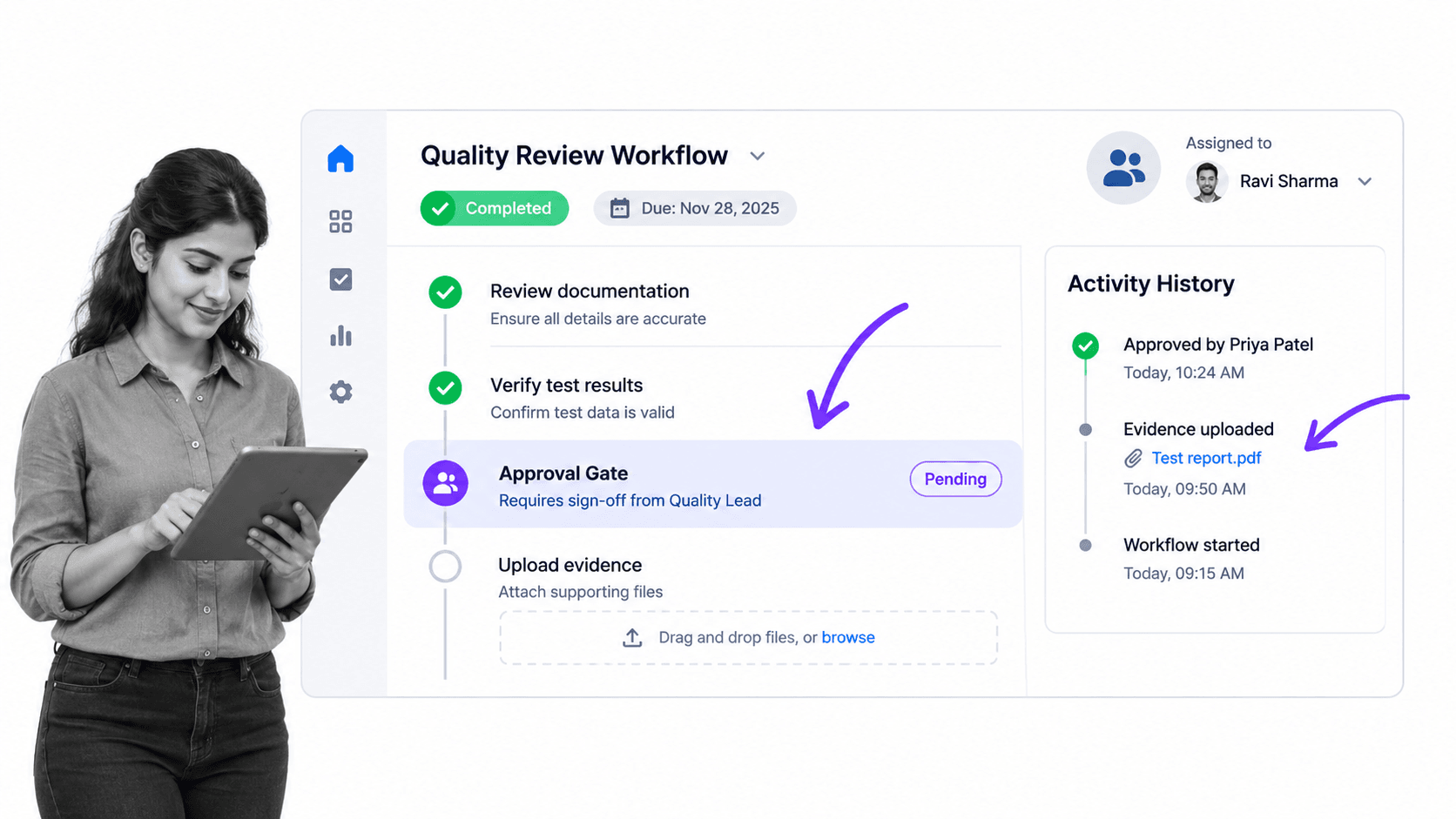
Process Street is the best Ideagen alternative for the ICP this ranking is designed around: teams that need enforceable, trackable, recurring SOP and process workflows. It turns a procedure into a run that assigns work, requires the right inputs, routes decisions, records approvals, and shows progress. That is a better fit than a broad eQMS when the main challenge is getting many business processes executed consistently rather than managing a specialized regulated product record.
Process Street is ranked first because execution is the product surface. A static SOP can explain what should happen. A workflow run can tell each person what to do now, require evidence before completion, branch based on the answer, pause for approval, and retain the activity history. Quality, operations, HR, finance, IT, and customer teams can use the same operating model without forcing every process into a traditional quality module.
The platform is especially useful for recurring work such as internal audits, supplier onboarding, nonconformance intake, corrective-action follow-up, change reviews, inspection checklists, training operations, incident response, and management review preparation. Teams can standardize the sequence while still using conditional logic to handle risk, site, product, region, or exception type.
Required form fields and attachments strengthen evidence collection. approval tasks create explicit decision points, while conditional logic lets a workflow expose only the steps that apply. The workflow run activity history provides a chronological record of assignments, completions, approvals, comments, and changes. Together, these controls reduce the gap between an SOP and the work people actually complete.
Process Street also makes ownership legible. A workflow can assign tasks to roles or people, calculate due dates, surface overdue work, and keep the next action visible. Managers can see whether a process is waiting for evidence, review, or action rather than interpreting a collection of loosely related records. This is valuable in recurring operations where delay and ambiguity create more risk than complex data modeling.
The tradeoff is equally important. Process Street is not a replacement for every specialist QMS capability. It is not a PLM system, a medical-device design-history environment, or a complete life sciences quality suite by default. If your critical record is a BOM revision, device risk trace, validated training relationship, or deeply specialized closed-loop quality event, evaluate the purpose-built products below.
Implementation should begin with the highest-risk recurring workflows, not a wholesale recreation of every existing module. Map the trigger, owner, required fields, approvals, exception path, evidence, completion rule, and reporting need. Build one usable run, test it with operators, then expand. This creates value earlier and exposes whether the organization needs a process platform, a specialist QMS, or both.
The official Process Street pricing page offers a 14-day trial and routes buyers to sales for plan details. Because the vendor does not publish a directly comparable starting price on that page, this comparison records the starting price as Contact sales rather than inventing a figure.
Key Process Street capabilities
- Recurring workflow runs with accountable assignments and due dates
- Required fields, files, approvals, and conditional logic
- Progress visibility and chronological activity history
- A readable operator experience across departments
Choose Process Street when the main success measure is whether recurring work was completed correctly, on time, by the right people, with the required evidence. It is particularly strong when quality processes extend beyond a central quality team and need to be usable by occasional participants.
Choose a specialist competitor instead when regulated product structure, industry-specific validation, formal design controls, or native PLM relationships are non-negotiable. The objective ranking places Process Street first for its ICP while preserving that boundary honestly.
2. MasterControl Quality Excellence
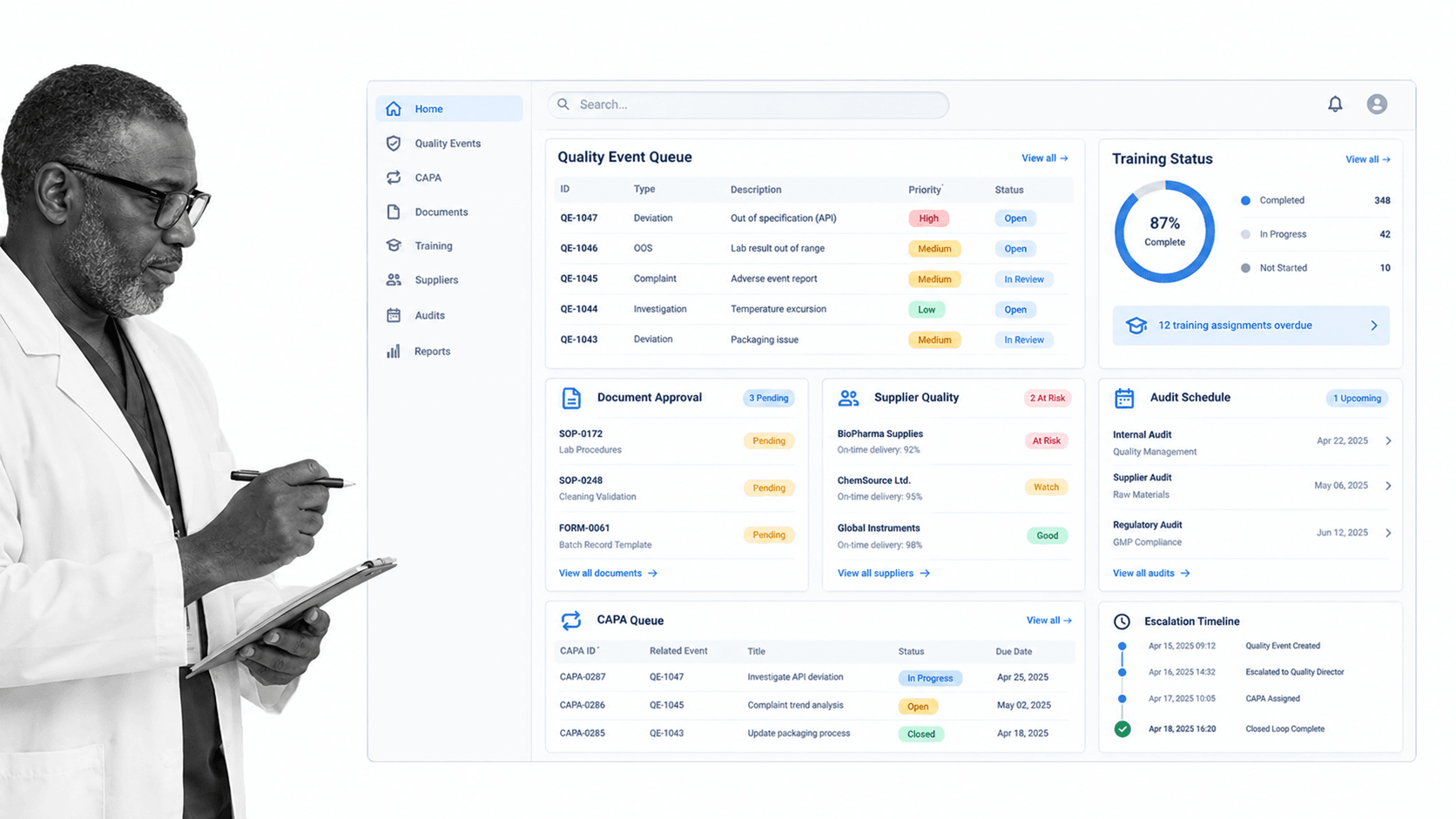
MasterControl is the stronger fit when the buying requirement is a dedicated, closed-loop quality system for a highly regulated life sciences environment.
Its official quality materials connect document control, training, quality events, supplier quality, and audit management in a purpose-built QMS environment. That breadth makes it a serious Ideagen alternative for organizations whose quality system is itself a regulated system of record.
The product belongs on an Ideagen alternatives shortlist because its main surface matches life sciences organizations that need a dedicated closed-loop quality management system. That is more specific than saying it is broadly good for quality. Buyers should test the exact record their organization must defend and the people who must create, review, and close it.
In a pilot, configure one representative process end to end. Include intake, ownership, required information, review, approval, escalation, evidence, reporting, and closure. Invite a frontline contributor as well as a quality administrator. A system that looks efficient to its builder can still create friction for the occasional user who supplies the evidence.
Key MasterControl Quality Excellence capabilities
- Controlled document and change workflows
- Training linked to effective procedures
- Quality-event and CAPA management
- Supplier and audit management
The specialization can be more system than a general operations team needs. Teams that mainly want recurring SOP execution, approvals, and evidence collection may prefer the more direct workflow model in Process Street.
Pricing: Custom quote. Free plan: Not listed. Review the official pricing information for the current commercial model and ask for a quote that includes the modules, users, sites, services, and support required for your future state.
Choose MasterControl Quality Excellence when its specialist context is the reason for the purchase. Skip it when the organization would be adding a complex quality or product model to solve a simpler recurring-process problem. In that case, Process Street can provide a more direct path from procedure to accountable execution.
3. Qualio
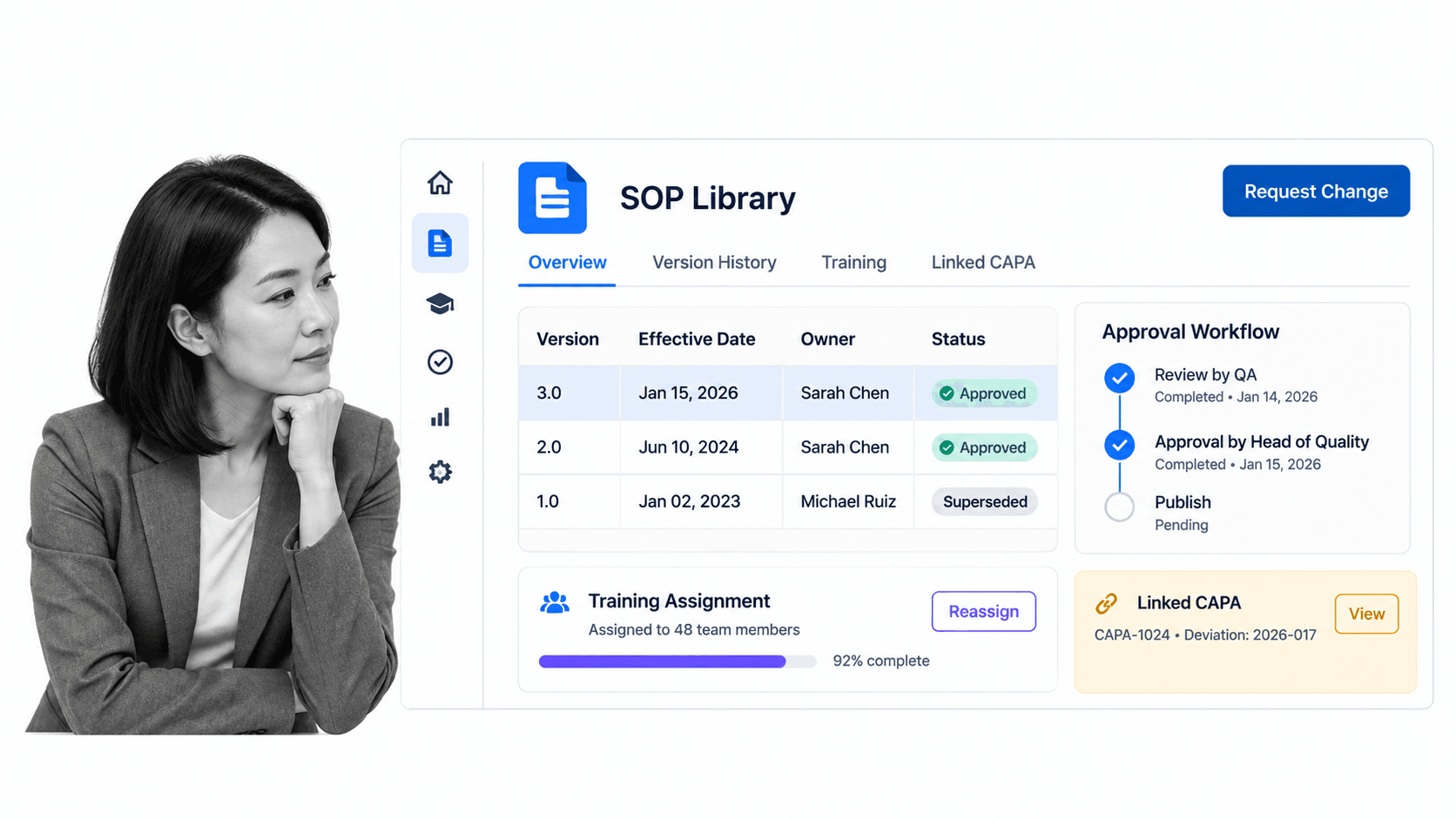
Qualio is the better fit for many growing life sciences teams that want cloud quality management with documents, training, change control, and CAPA connected in one program.
Its product materials emphasize controlled documents, version history, approval workflows, training reassignment, change control, and links between quality events. The pricing page publishes annual platform subscriptions beginning at $25,000 per year.
The product belongs on an Ideagen alternatives shortlist because its main surface matches life sciences teams building a cloud quality and compliance program. That is more specific than saying it is broadly good for quality. Buyers should test the exact record their organization must defend and the people who must create, review, and close it.
In a pilot, configure one representative process end to end. Include intake, ownership, required information, review, approval, escalation, evidence, reporting, and closure. Invite a frontline contributor as well as a quality administrator. A system that looks efficient to its builder can still create friction for the occasional user who supplies the evidence.
Key Qualio capabilities
- Controlled SOPs with version and approval history
- Training assignments tied to document changes
- Change control and quality-event links
- CAPA escalation and traceability
The life sciences focus is valuable when that is the operating context. It can be less direct for teams outside regulated product development that simply need many departments to follow recurring processes consistently.
Pricing: $25,000/year. Free plan: Not listed. Review the official pricing information for the current commercial model and ask for a quote that includes the modules, users, sites, services, and support required for your future state.
Choose Qualio when its specialist context is the reason for the purchase. Skip it when the organization would be adding a complex quality or product model to solve a simpler recurring-process problem. In that case, Process Street can provide a more direct path from procedure to accountable execution.
4. Octave Reliance
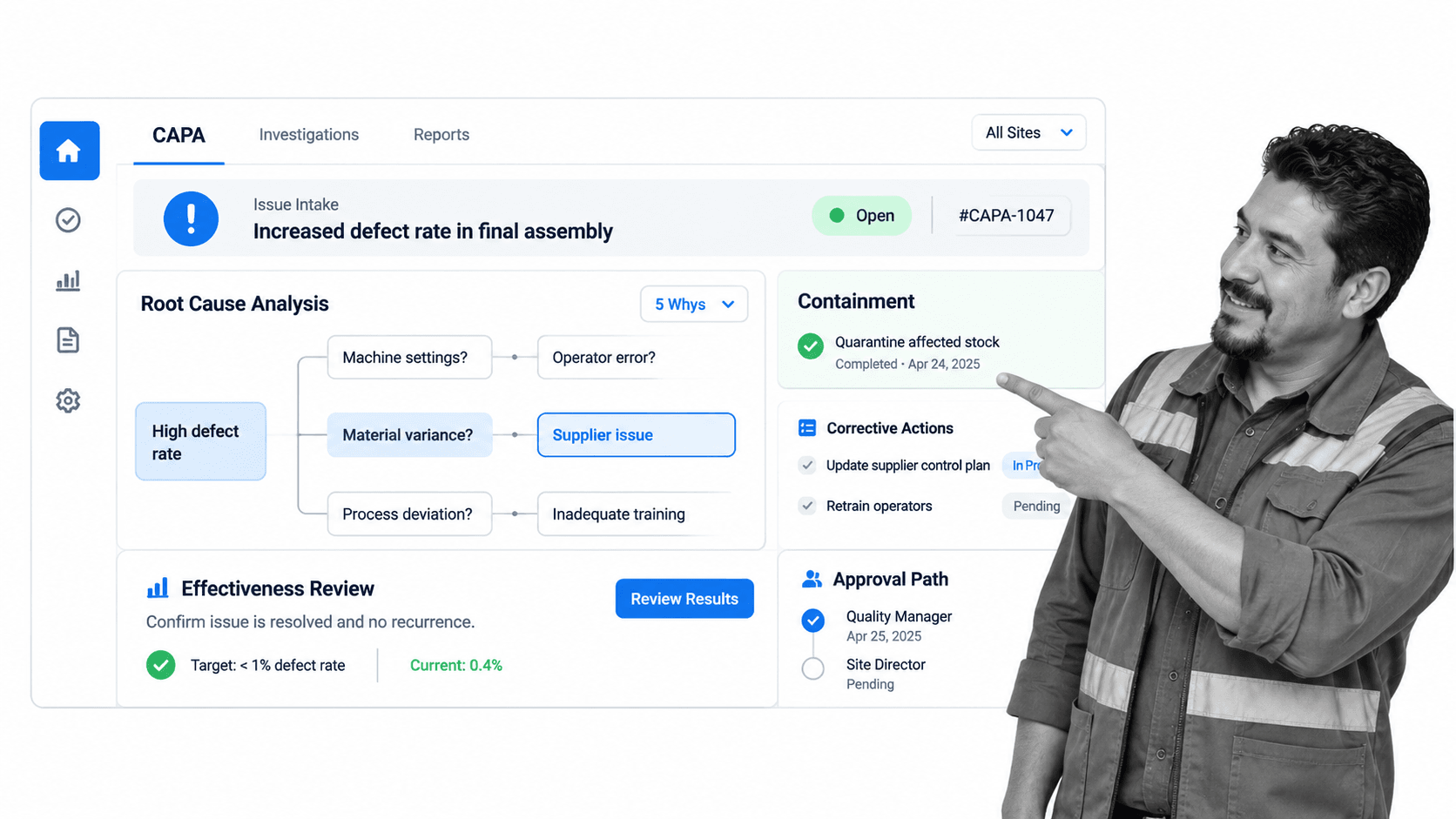
Octave Reliance is the stronger fit for manufacturers that need a configurable enterprise eQMS across sites, modules, and quality functions.
Official Reliance materials describe centralized document control, CAPA, audits, training, quality reporting, and configurable workflows. Subscription structure varies by users, modules, and sites, so buyers need a vendor quote for a comparable total.
The product belongs on an Ideagen alternatives shortlist because its main surface matches multi-site manufacturers that want a configurable enterprise eQMS. That is more specific than saying it is broadly good for quality. Buyers should test the exact record their organization must defend and the people who must create, review, and close it.
In a pilot, configure one representative process end to end. Include intake, ownership, required information, review, approval, escalation, evidence, reporting, and closure. Invite a frontline contributor as well as a quality administrator. A system that looks efficient to its builder can still create friction for the occasional user who supplies the evidence.
Key Octave Reliance capabilities
- Centralized document control
- CAPA and root-cause workflows
- Audit and training management
- Configurable multi-site quality reporting
A configurable enterprise eQMS rewards deliberate design and governance. It may be heavier than necessary when the priority is launching understandable recurring workflows quickly across business teams.
Pricing: Custom quote. Free plan: Not listed. Review the official pricing information for the current commercial model and ask for a quote that includes the modules, users, sites, services, and support required for your future state.
Choose Octave Reliance when its specialist context is the reason for the purchase. Skip it when the organization would be adding a complex quality or product model to solve a simpler recurring-process problem. In that case, Process Street can provide a more direct path from procedure to accountable execution.
5. Greenlight Guru
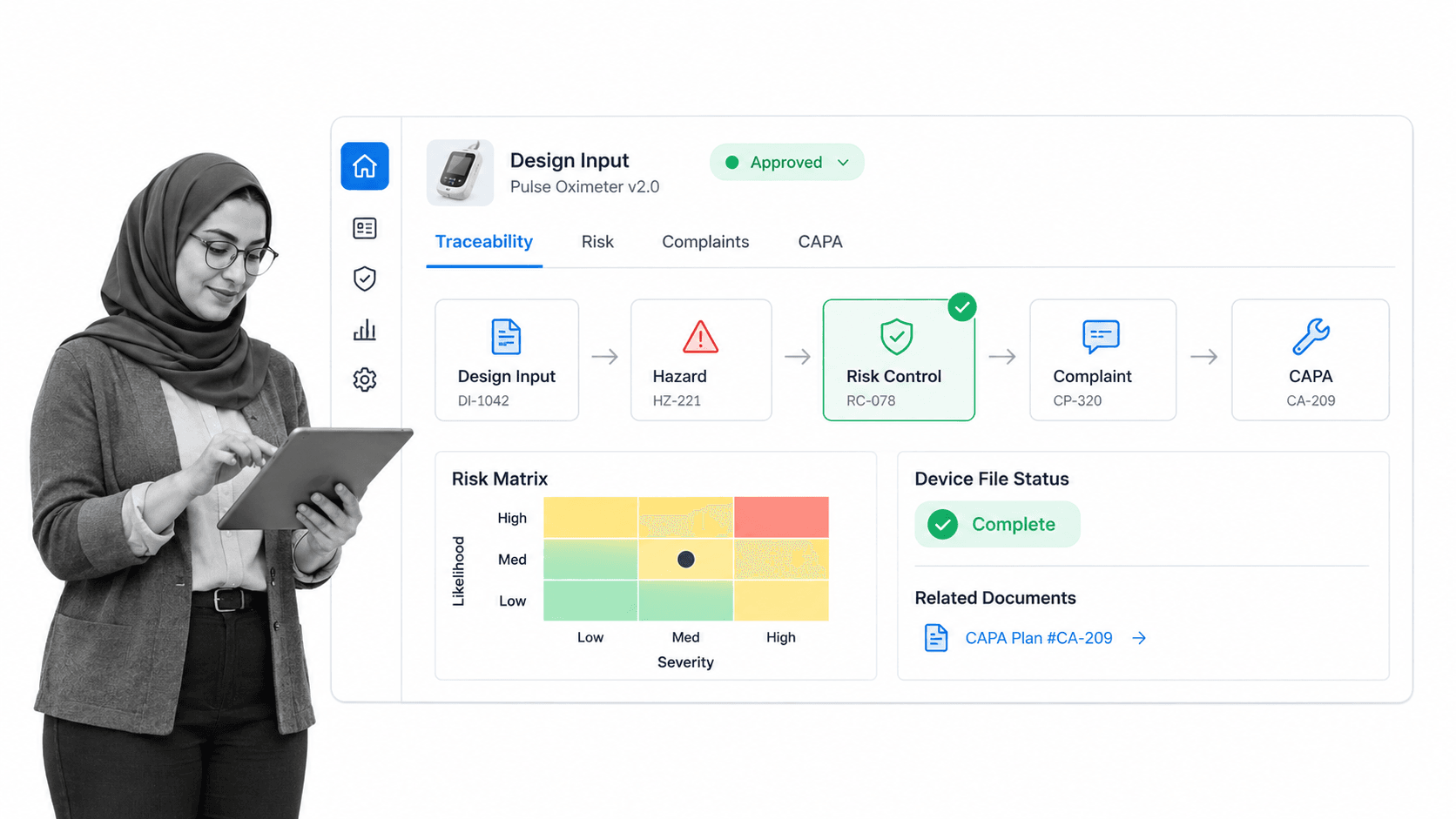
Greenlight Guru is the better fit when the organization is a medical device company and quality work must connect closely to product risk, development, and postmarket signals.
The official product page positions the platform specifically for medical device companies and describes document, training, supplier, and quality-event management. Its pricing page publishes a starting price of $12,000 per year, with implementation priced separately.
The product belongs on an Ideagen alternatives shortlist because its main surface matches medical device companies that need quality management tied to product risk and development. That is more specific than saying it is broadly good for quality. Buyers should test the exact record their organization must defend and the people who must create, review, and close it.
In a pilot, configure one representative process end to end. Include intake, ownership, required information, review, approval, escalation, evidence, reporting, and closure. Invite a frontline contributor as well as a quality administrator. A system that looks efficient to its builder can still create friction for the occasional user who supplies the evidence.
Key Greenlight Guru capabilities
- Medical-device-focused quality workflows
- Document and training management
- Supplier and quality-event controls
- Connections between product risk and quality records
Its industry focus is the reason to choose it. Organizations outside medical devices may pay for a model and terminology that do not match their operating system.
Pricing: $12,000/year. Free plan: Not listed. Review the official pricing information for the current commercial model and ask for a quote that includes the modules, users, sites, services, and support required for your future state.
Choose Greenlight Guru when its specialist context is the reason for the purchase. Skip it when the organization would be adding a complex quality or product model to solve a simpler recurring-process problem. In that case, Process Street can provide a more direct path from procedure to accountable execution.
6. Arena QMS
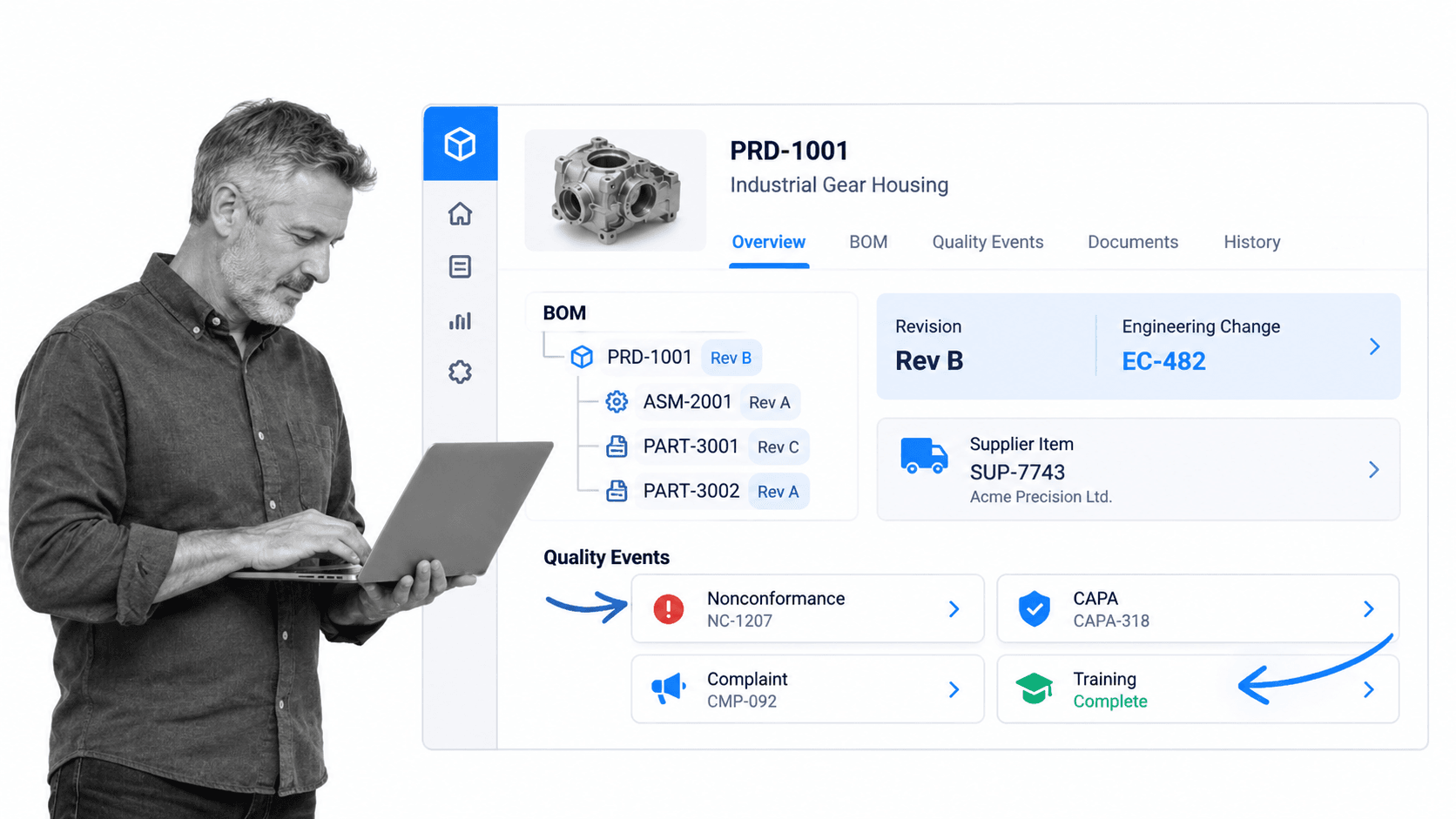
Arena QMS is the stronger fit for regulated product companies that want product lifecycle management and quality records in one connected environment.
Arena’s official pages describe a platform that connects product records with quality issues, audits, corrective actions, training, changes, suppliers, and other product-development context. The pricing page offers a 10-day trial and directs buyers to sales for pricing.
The product belongs on an Ideagen alternatives shortlist because its main surface matches regulated product companies that need PLM and QMS records in one environment. That is more specific than saying it is broadly good for quality. Buyers should test the exact record their organization must defend and the people who must create, review, and close it.
In a pilot, configure one representative process end to end. Include intake, ownership, required information, review, approval, escalation, evidence, reporting, and closure. Invite a frontline contributor as well as a quality administrator. A system that looks efficient to its builder can still create friction for the occasional user who supplies the evidence.
Key Arena QMS capabilities
- BOM and product-record context
- Engineering change and quality links
- CAPA, NCMR, complaint, and audit records
- Supplier and training controls
Arena earns its place when the product record is central. Service businesses and operations teams without BOM or product-lifecycle requirements may find a workflow-first system easier to adopt and govern.
Pricing: Contact sales. Free plan: 10-day trial. Review the official pricing information for the current commercial model and ask for a quote that includes the modules, users, sites, services, and support required for your future state.
Choose Arena QMS when its specialist context is the reason for the purchase. Skip it when the organization would be adding a complex quality or product model to solve a simpler recurring-process problem. In that case, Process Street can provide a more direct path from procedure to accountable execution.
Ideagen alternatives feature comparison
| Tool | Primary record | Workflow enforcement | Specialist context | Published buying path |
|---|---|---|---|---|
| Process Street | Completed workflow run | Required steps, fields, approvals, branches | Cross-functional SOP execution | 14-day trial, contact sales |
| MasterControl Quality Excellence | Closed-loop quality record | Dedicated QMS workflows | Life sciences quality | Custom quote |
| Qualio | Quality and compliance record | Controlled document and event workflows | Growing life sciences teams | $25,000/year |
| Octave Reliance | Configurable enterprise quality record | Module and site-based workflows | Multi-site manufacturing | Custom quote |
| Greenlight Guru | Medical device quality record | Device-focused quality workflows | Medical device companies | $12,000/year |
| Arena QMS | Product record linked to quality | PLM and QMS workflow links | Regulated product development | 10-day trial, contact sales |
The primary-record column is the fastest way to separate these products. A completed Process Street run is a record of execution. MasterControl, Qualio, and Octave Reliance organize formal quality-system records. Greenlight Guru centers medical device quality, while Arena anchors quality to the product record. None of those models is universally better. The right model is the one that preserves the evidence your business relies on.
Workflow enforcement also differs from document storage. A file in a library can be current without proving that a related inspection, review, or follow-up occurred. When evaluating workflow and document control software, check whether the product joins controlled content to assigned work and leaves a usable history of both.
Published buying paths are only a starting point. Calculate total cost across software, implementation, migration, validation, integration, administration, training, and ongoing change. A lower license price can still produce a higher operating cost when the system needs scarce expertise for every adjustment.
Which Ideagen alternative fits your use case
Choose Process Street for recurring operational SOPs, inspections, approvals, and cross-functional quality workflows where adoption and evidence are the main risks. It is also the strongest option here when quality-related work needs to extend into departments that would resist a specialist QMS interface.
Choose MasterControl Quality Excellence when a life sciences organization needs a dedicated quality suite that connects documents, training, quality events, suppliers, and audits. Its specialist model can justify the additional system depth when the quality platform is central to regulated operations.
Choose Qualio when a growing life sciences company wants cloud quality management with controlled documents, training, changes, and CAPA connected in one environment. Its published annual starting price gives buyers a clearer initial budget marker than most custom-quote competitors.
Choose Octave Reliance when a manufacturer needs configurable enterprise quality workflows across sites, modules, and reporting structures. Its fit depends on having the ownership and governance to use that configurability well.
Choose Greenlight Guru when medical device quality is the job. Its industry-specific model is more relevant than a general medical device quality management systems comparison when design, risk, supplier, and postmarket quality records must work together.
Choose Arena QMS when engineering changes, BOMs, suppliers, product records, and quality events need one connected environment. It is the most natural fit in this list for organizations where product lifecycle context is indispensable to the quality record.
Shortlist no more than three products before a scenario pilot. Use the same acceptance criteria for every vendor: setup effort, operator completion time, evidence quality, exception visibility, reporting, permissions, and administrative change time. Supplement feature evaluation with a review of your quality control software and enterprise quality management systems requirements so the shortlist reflects both frontline work and governance.
Consider a combined architecture when no single product should own every job. A specialist QMS or PLM can remain the authoritative home for regulated product records, while Process Street coordinates recurring cross-functional execution around those records. If you evaluate this pattern, define which system owns each status, approval, attachment, identifier, and retention rule. Test how links and integrations behave when records change, fail, or close. A two-system design is useful only when ownership is explicit and users do not have to reconcile conflicting versions of the truth by hand.
How to migrate from Ideagen
Treat migration as a controlled quality change. Establish an accountable owner, scope, risk assessment, acceptance criteria, validation approach, cutover decision, rollback plan, and retained-record strategy before moving live data. The migration itself should leave evidence that approved records arrived completely and that open work retained an owner.
Inventory data by record type and lifecycle state. Separate current controlled documents from obsolete versions, active CAPA from closed events, assigned training from historical acknowledgements, open audits from archived reports, and live supplier records from inactive vendors. Different record classes need different transformations and validation samples.
Map process logic before mapping fields. For every important workflow, document the trigger, owner, sequence, required input, approval, branch, escalation, due-date rule, evidence, completion condition, and report. A field-to-field import can move data while losing the behavior that made the old system controlled.
Design the future state instead of recreating every historical customization. Preserve controls that address a real requirement. Retire duplicate forms, unused statuses, confusing permissions, and reports no one acts on. Record the rationale so simplification is traceable rather than accidental.
Run a representative migration rehearsal. Reconcile record counts, attachments, version relationships, owners, due dates, links, and permissions. Sample high-risk records manually. Ask end users to complete realistic scenarios and ask quality administrators to reconstruct the resulting evidence without help from the implementation team.
Plan the cutover around open work. Decide whether each active record will finish in Ideagen, restart in the new system, or migrate with preserved state. Communicate exactly where new work begins after the cutover. Prevent parallel production use unless a documented transition plan requires it.
Use a governed migration checklist in Process Street to assign each extraction, transformation, review, approval, and reconciliation step. The same workflow can capture files, exceptions, sign-offs, and the final go-live decision, giving the migration team a clear completion record.
After launch, monitor completion time, overdue work, rejected submissions, support questions, missing evidence, and workflow changes. Hold a formal review after the first full process cycle. A technically successful migration is not complete until people can execute the new process reliably and the resulting records support oversight.
FAQs
What is the best Ideagen alternative?
Process Street is the best Ideagen alternative for enforceable, trackable, recurring SOP and process workflows. MasterControl, Qualio, Octave Reliance, Greenlight Guru, or Arena can be better when a specialized life sciences, manufacturing, medical device, or product-lifecycle quality record is the main requirement.
Why is Process Street ranked first?
Process Street is ranked first for the ICP judged here: teams that need people to execute recurring workflows correctly with assignments, required information, approvals, conditional paths, and visible history. It is not presented as a universal replacement for every specialist QMS or PLM capability.
Which Ideagen alternative is best for life sciences?
MasterControl Quality Excellence and Qualio are the clearest life sciences candidates in this list. MasterControl fits organizations seeking a broad dedicated quality suite, while Qualio fits many growing life sciences teams that want cloud document, training, change, and quality-event controls.
Which Ideagen alternative is best for medical devices?
Greenlight Guru is the most specialized medical-device option in this comparison. Arena also deserves consideration when product lifecycle and BOM context are central. The better choice depends on whether medical-device quality or the connected product record is the primary system requirement.
Are there free Ideagen alternatives?
The official sources reviewed here do not establish a permanent free plan for the dedicated quality platforms. Process Street offers a 14-day trial and Arena lists a 10-day trial. Trials are evaluation paths, not free plans, and vendor terms can change.
How should I compare Ideagen alternative pricing?
Compare total cost across licenses, modules, users, sites, implementation, migration, validation, integrations, administration, training, support, and renewal terms. Use published starting prices only as initial markers because configurations and service needs differ.
Can Process Street replace Ideagen Quality Management?
Process Street can replace or complement Ideagen when the main requirement is recurring SOP and process execution with accountable assignments, approvals, evidence, and history. A specialist QMS may remain the better fit for deeply regulated quality records, product risk, PLM, or industry-specific validation needs.
Ready to make recurring quality work easier to follow and easier to prove? Explore Process Street and review Process Street pricing to build a controlled workflow around the work your team already owns.