





$22 trillion was the cost of the 2008 financial crisis to the U.S. economy. Roughly 200,000 small businesses vanished into the recession, taking around 3 million jobs with them. The Financial Crisis Inquiry Commission later concluded that much of that devastation traced back to audit process failures.
Follow a sound audit process and you catch problems early. Skip it and the fallout scales from a single business right up to the national economy. This guide breaks down what an audit process is, why it matters, the five steps professional auditors follow, and how to run the whole thing inside Process Street.
You can jump straight to any section:
- What is an audit process?
- Internal vs external audits
- Why the audit process matters
- The 5-step professional audit process
- Run your audit process in Process Street
In this guide we define the audit process, explain why it matters, outline the process that professional and expert auditors follow, and show how to implement it in Process Street for your own internal audits.
What is an audit process?
An audit is a report produced from the analysis of particular business operations. Those operations are scrutinized against a set standard, whether that standard is set by a government, a regulatory body, or the business itself. An audit can cover almost any subject matter, including:
- Financial performance
- Project management
- Energy and sustainability
- Quality management
The word audit comes from the Latin audire, meaning to hear. Historically, records were read aloud and the auditor listened for fraudulent or negligent behavior.
A process, meanwhile, is a series of tasks combined to deliver a required result. Teams that document their processes run more consistently and recover faster when something breaks, because the knowledge lives in the system rather than in one person’s head. Increased quality output is one of the many benefits that documented processes bring.
Put the two definitions together and you get a working definition of an audit process:
An audit process is a series of steps taken to analyze particular business operations. The end product is a final report detailing performance against a set standard.
Internal vs external audits
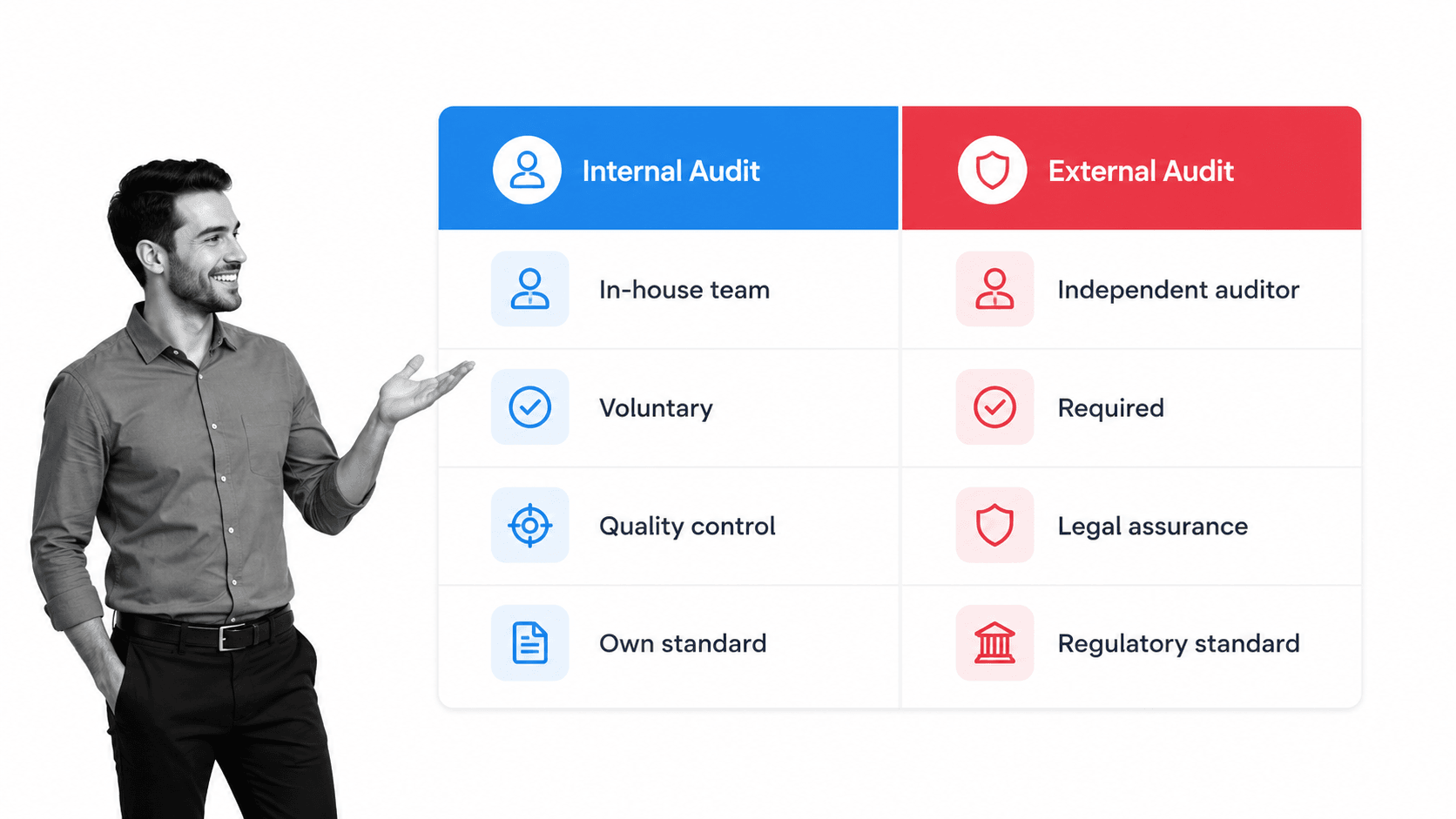
There are two broad types of audit: internal and external.
- Internal audit: Run inside an organization and usually voluntary. Internal audits act as quality control checks, measuring business operations against a standard set by a government, a regulatory body, or the organization itself.
- External audit: Run by an independent, qualified auditor from outside the business. These are not voluntary. They confirm that records are complete, accurate, and compliant with legal standards.
For a deeper look at each, see our companion guides on audit procedures, financial audits, and operational audits.
Here is a working example of each, ready to run:
ISO 9001 Internal Audit Checklist for Quality Management Systems
ISO 19011 Management Systems Audit Checklist
Why the audit process matters
When audit processes are neglected, the consequences are rarely small. The pattern repeats across industries:
- Financial audit neglect was named as a cause of the 2008 U.S. financial crisis.
- London’s Grenfell Tower disaster followed regulatory breaches that thorough audit checks would have caught.
- In the UK, audit failures left 30,000 Maxwell pensioners with major losses through no fault of their own.
- At the Baptist Foundation of Arizona, auditors who did not follow the process failed to catch fraud across 32 accounts, and 11,000 investors lost hundreds of millions.
- The collapse of Enron, once described as the world’s largest bankruptcy, has been tied to audit failure.
The lesson is consistent: failing to follow an audit process leads to costly, sometimes catastrophic outcomes. Audits matter, and following the correct audit process is what makes them reliable.
A documented, standardized audit process does the opposite of leaving things to chance. It will:
- Communicate audit expectations clearly
- Maintain consistent audit quality
- Make it obvious what went wrong if something does
- Automate repetitive tasks so auditors spend time on judgment, not admin
- Mitigate risk
- Simplify training for new auditors
- Retain and document audit knowledge so it survives staff turnover
In short, a set audit process safeguards against the human error behind the failures above.
Three points explain the mechanism. First, processes are subject to human error, which causes process degradation and lowers audit quality. Second, a documented workflow is an effective way to remove that error and preserve the process. Third, internal audit checks act as your in-house quality control and deserve to be prioritized. Handled this way, a repeatable workflow preserves the audit process and maximizes audit assurance.
The 5-step professional audit process
Done correctly, audits deliver real business value. Take an environmental testing laboratory that analyzes soil and water samples for metals, hydrocarbons, and pesticide contamination. Companies send in samples expecting ISO accredited results, and accreditation depends on running every test exactly to the internationally set standard. Any deviation, even a slight one, can strip accreditation, and non-accredited results carry little legal or regulatory weight.
Internal audit checks are of paramount importance here, acting as a form of quality control. Every year, external bodies drop in and assess the laboratory’s testing procedures. If an external body found the lab claiming accreditation when its testing processes had deviated from requirements, the consequences would be harmful: accreditation stripped, reputation stained, and clients taking their business to competitors.
That is where internal audit checks earn their keep. When an internal audit catches a single metal test breaching ISO requirements, the lab can temporarily remove that test’s specific ISO accreditation, make the necessary corrections, and avoid fines and legal implications. Catch it internally and early, and a serious problem becomes a routine fix.
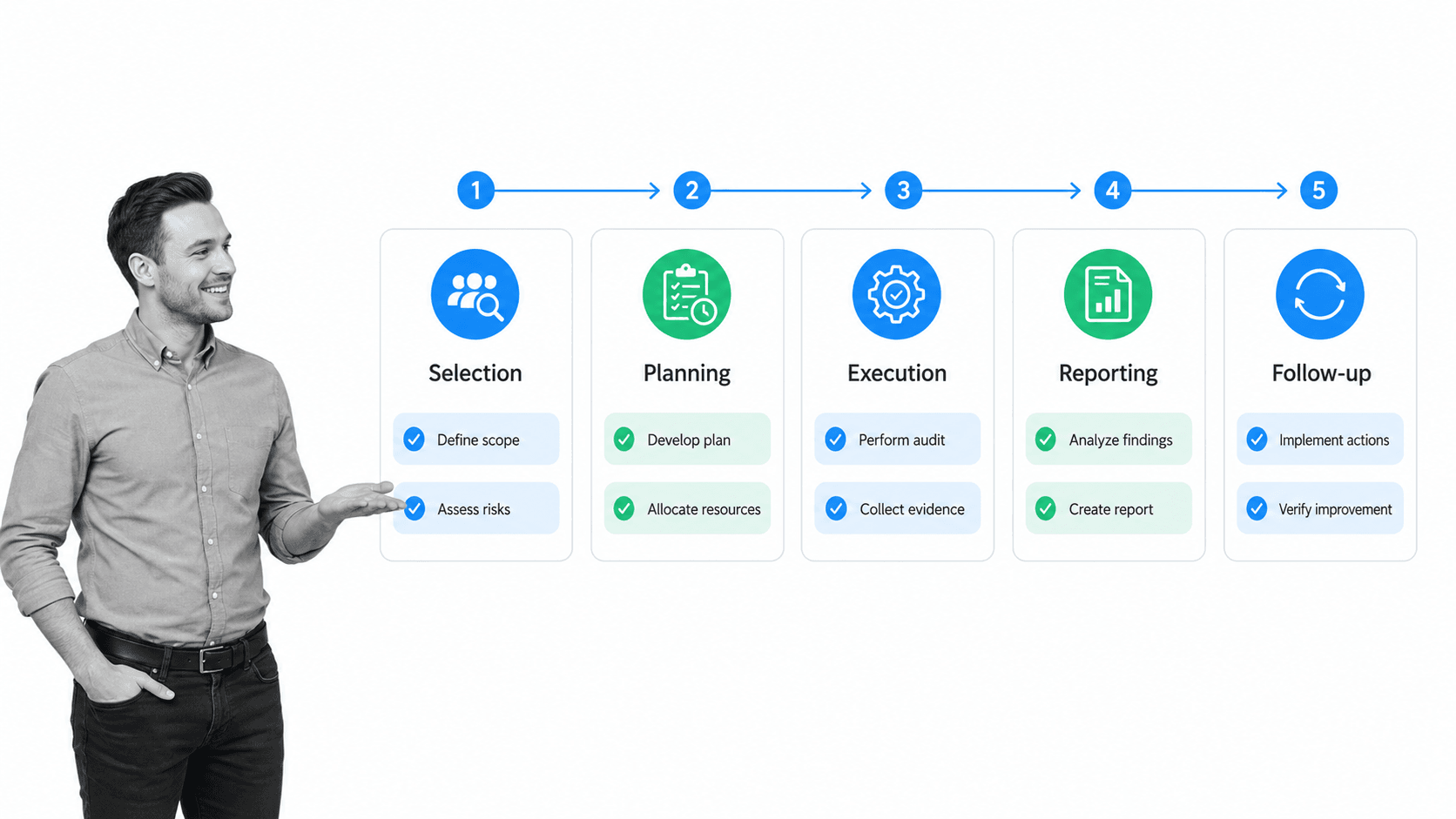
So what exactly do auditors do to get there? An auditor prepares and examines business operations to confirm that a set standard is being met. Study how professional and expert auditors work and two things stand out: they follow a process, and the fundamentals of that process stay consistent across specialties. That shared backbone, used across university and corporate internal audit programs, breaks down into five steps.
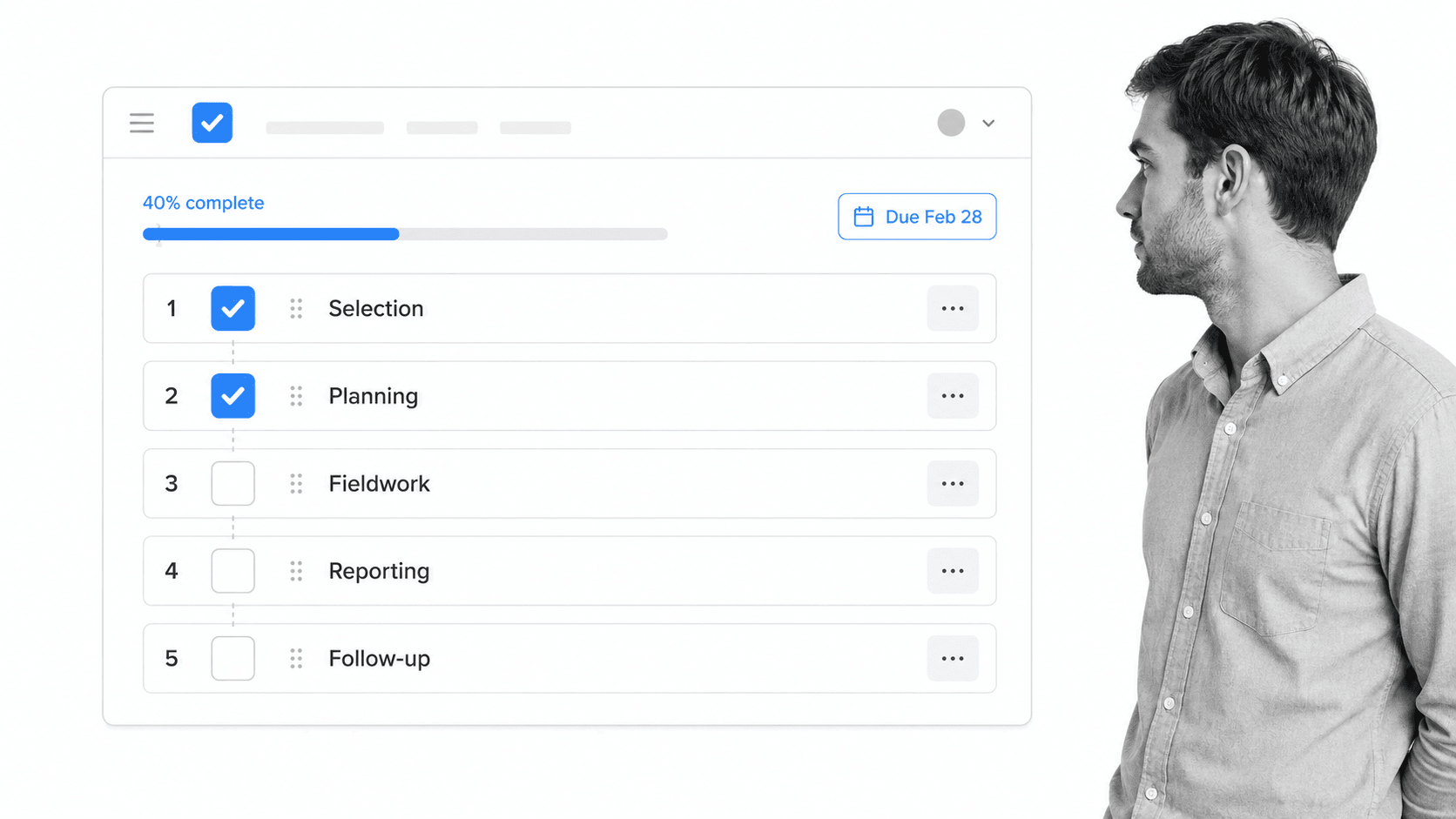
Step 1: Selection
A risk assessment is carried out to build the audit plan. Auditors review relevant business documents and previous audit results to decide where to focus.
Step 2: Planning
Background information is gathered and contact is made with the client. Objectives, scope, fieldwork timing, and report distribution are agreed. An opening meeting often presents the audit plan to key staff.
Step 3: Execution
Fieldwork begins. Auditors interview relevant employees and hold regular status meetings so the client stays informed. Observations, potential findings, and recommendations are discussed as they surface.
Step 4: Reporting
Findings, conclusions, and recommendations are summarized in a draft report. The client responds with an action plan and timeline, and those responses are folded into the final report.
Step 5: Follow-up
A later audit follows up on the earlier findings. Following up on external audits with a voluntary internal audit is best practice, and it is generally recommended within a year of the first report.
Run your audit process in Process Street
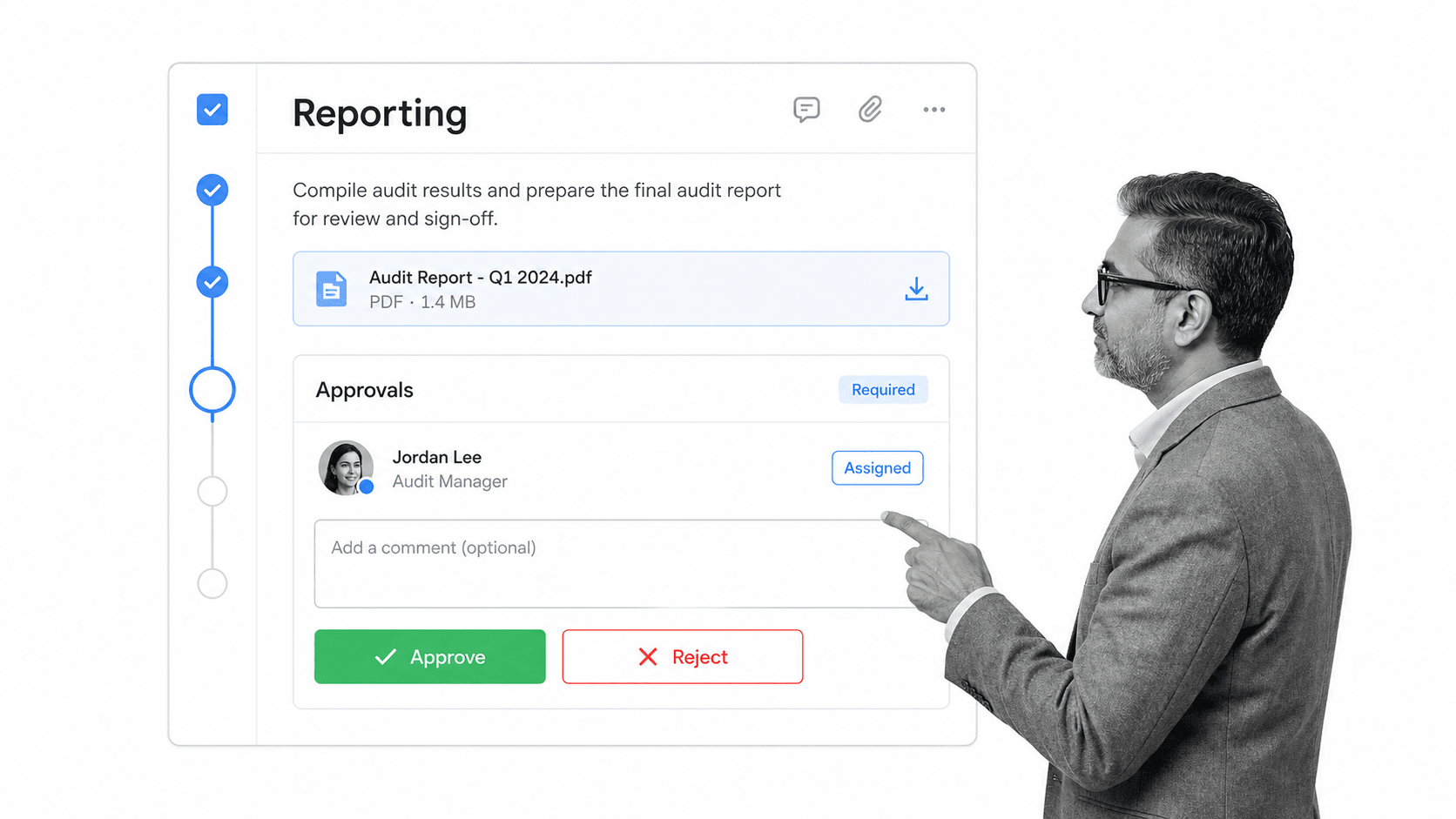
Knowing the five steps is one thing. Running them the same way every time, across every auditor, is another. That is the job Process Street is built for. Process Street is a Compliance Operations Platform that brings together Docs to govern your policies and SOPs, Ops to turn those policies into automated, auditable workflows, and built-in AI that watches execution, flags risk, and keeps your documentation current.
For auditing, that means you turn the 5-step audit process into a workflow your team runs rather than a document they are supposed to remember. Point the built-in AI at an existing SOP or a recorded walkthrough and it drafts the workflow for you. From there, every run enforces the process by default:
- Stop tasks keep steps in the right order, so no phase is skipped
- Conditional logic adapts the workflow to the audit type in front of you
- Dynamic due dates keep follow-ups from slipping
- Role assignments route each task to the right auditor or reviewer
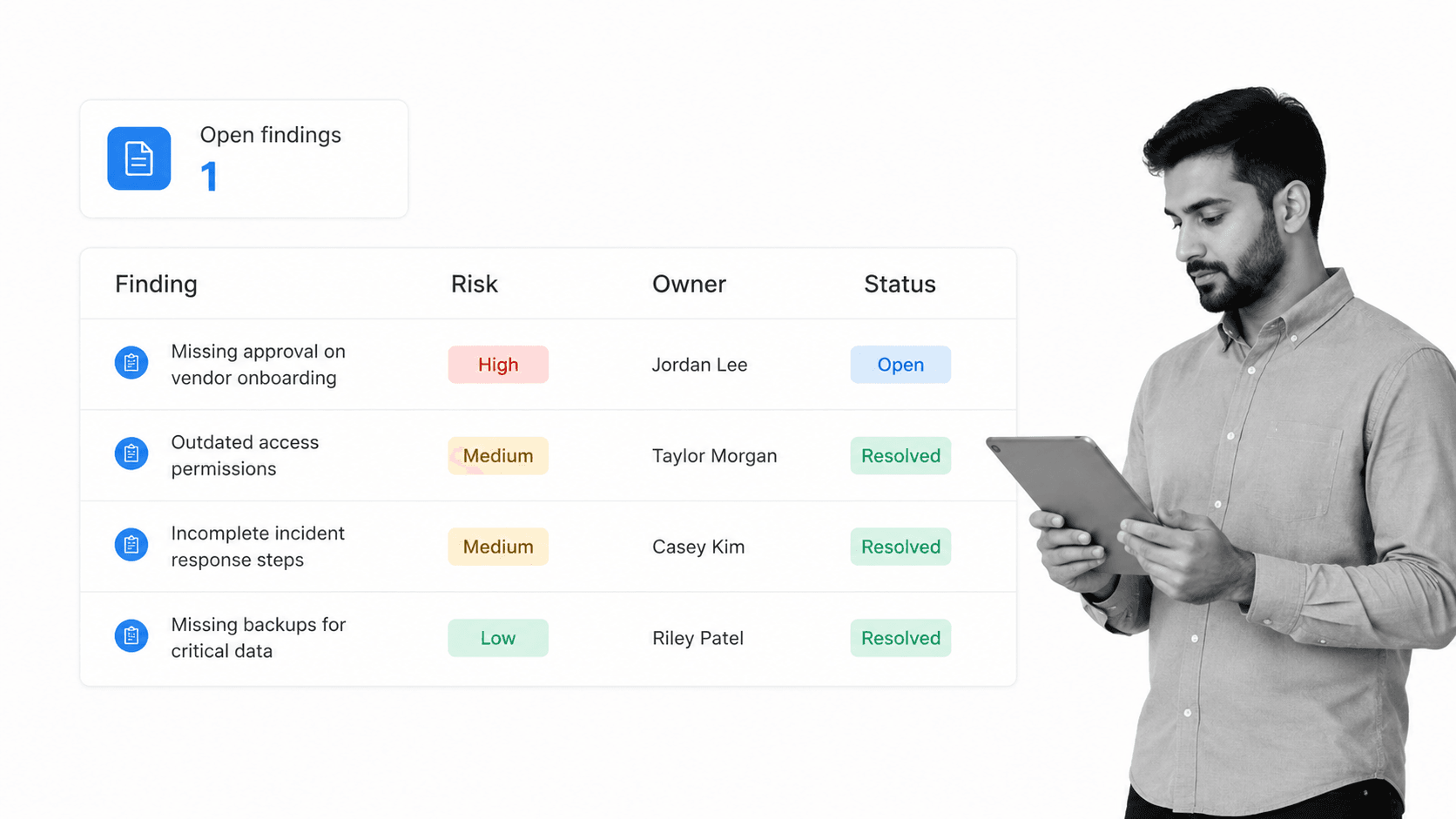
Sign-offs are the clearest example. Once you add tasks that need approval, the assigned approver opens the workflow, reviews the information captured in the task, and approves, rejects, or rejects with a comment. Those approvals are assessed by the relevant team member and signed off inside the workflow, without a single chased email, which saves your team a heap of time. Every completed task is timestamped and logged, so the audit trail builds itself and you stay audit ready.
Creating an audit workflow in Process Street is quick and straightforward. You transfer your auditing process into a workflow that documents your processes, maximizes audit assurance, and reduces error, so the same standard is met on every run.
Here is our Financial Audit Checklist running as a workflow, structured around the same professional audit process:
Open the financial audit workflow and you can see every step of the process recorded in order. Skipping a stage would mean consciously stepping around the workflow, which is exactly the point.
Process Street also connects to the systems your audits touch. It offers direct, universal integrations to thousands of business systems, and when you need a connection that does not exist yet, an AI agent builds it on the fly, so evidence, records, and sign-offs move without manual copy-paste. Security is built in too, with SOC 2 Type II certification, role-based access, and audit-ready logs.
New to Process Street? This short overview shows how it fits together:
When you are ready to build your own, our library of ready-to-run workflow templates is a fast start. Each audit workflow is structured around the professional audit process:
- Financial Audit Checklist
- Environmental Accounting Internal Audit
- Environmental Management Self Audit Checklist
- Management Systems Audit Checklist
- ISO 9001 and ISO 14001 Integrated Management System (IMS) Checklist
- ISO 9001:2015 Internal Audit Checklist for Quality Management Systems
- PPC Audit Checklist
- Google Analytics Audit
- Technical SEO Audit
- UX Audit
- ISO 27001 Information Security Management System (ISO27K ISMS) Audit Checklist
- SQL Server Audit Checklist
- Firewall Audit Checklist
- Network Security Audit Checklist
- Occupational Health and Safety (OHS) Audit Checklist
- Diversity Management Monthly Audit
- Hotel Sustainability Audit
- Laboratory Safety Procedure Audit
- Retail Store Audit Checklist
If you are weighing dedicated tooling, our roundup of audit management software compares the leading options.
The bottom line
Inadequate audits carry real consequences, and the way to avoid them is not heroics but a repeatable process. Document the 5-step audit process, run it as an enforced workflow, and let built-in AI keep the evidence current. Do that and you get audits that are consistent, defensible, and audit ready by default.
Start a free trial of Process Street and get your audit process right.