Turn every policy into automated workflows with built-in enforcement and audit-ready proof.


Spin-Off Valuation Techniques: A Practical Guide

Spin-off valuation techniques estimate what a business unit and its former parent are worth as independent companies. The work starts by rebuilding standalone economics, then applies several valuation methods and reconciles the results into a defensible range.
The hard part is not selecting a multiple or calculating present value. It is deciding which revenue, costs, assets, liabilities, people, contracts, tax attributes, and corporate services belong to SpinCo, which stay with RemainCo, and which must be recreated after separation. A model that ignores those decisions can look precise while measuring the wrong business.
This guide explains how to construct the standalone forecast, use sum-of-the-parts, discounted cash flow, trading comparables, and precedent transactions, test separation adjustments, and control the review process. It is educational information, not investment, accounting, legal, or tax advice.
In this guide:
- What is a spin-off valuation?
- How do you build standalone financials?
- Which spin-off valuation techniques should you use?
- How do you calculate sum-of-the-parts value?
- What adjustments matter most?
- How do you set DCF assumptions?
- How do you value RemainCo?
- How do you reconcile valuation methods?
- What valuation mistakes should you avoid?
- How can Process Street control the valuation workflow?
- Spin-off valuation FAQs
What is a spin-off valuation?
A spin-off valuation estimates the standalone enterprise and equity value of a business that will become independent, together with the value of the parent after the separation. The analyst usually produces a range rather than a single answer because capital structure, overhead, tax, separation costs, market multiples, and forecast risk can all change before trading begins.
In a conventional spin-off, the parent distributes shares of the controlled company to its shareholders. A split-off generally lets participating shareholders exchange parent shares for shares of the separated company. An equity carve-out sells a stake to public investors while the parent retains an interest. The legal and tax form affects ownership, proceeds, reporting, and transaction mechanics, but the central valuation task remains the same: define each standalone business and value its future economics.
Tax structure is a separate workstream from valuation. The IRS discussion of Section 355 requirements describes active-business, device, and control considerations that can affect whether a distribution qualifies for tax-free treatment. Deal-specific advice belongs with qualified tax counsel.
| Transaction | Shareholder outcome | Valuation focus |
|---|---|---|
| Spin-off | Parent holders receive SpinCo shares | SpinCo, RemainCo, and combined value after separation |
| Split-off | Participating holders exchange parent shares | Relative values and exchange terms, plus each standalone company |
| Carve-out | New investors buy a stake | Offering value, retained interest, proceeds, and future ownership structure |
How do you build standalone financials?
Start with the separation perimeter, not the consolidated income statement. Map legal entities, product lines, customers, employees, intellectual property, facilities, systems, contracts, debt, cash, pensions, leases, working capital, and contingent obligations. The perimeter should agree with transaction documents and the operating model management plans to run after separation.
Public separation disclosures are a critical source. The SEC requires financial statements to follow Regulation S-X, and information statements can show how companies present historical results, pro forma separation adjustments, capital structure, risks, and transition arrangements. Review the transaction’s actual filings because every separation has different facts.
Standalone forecast architecture
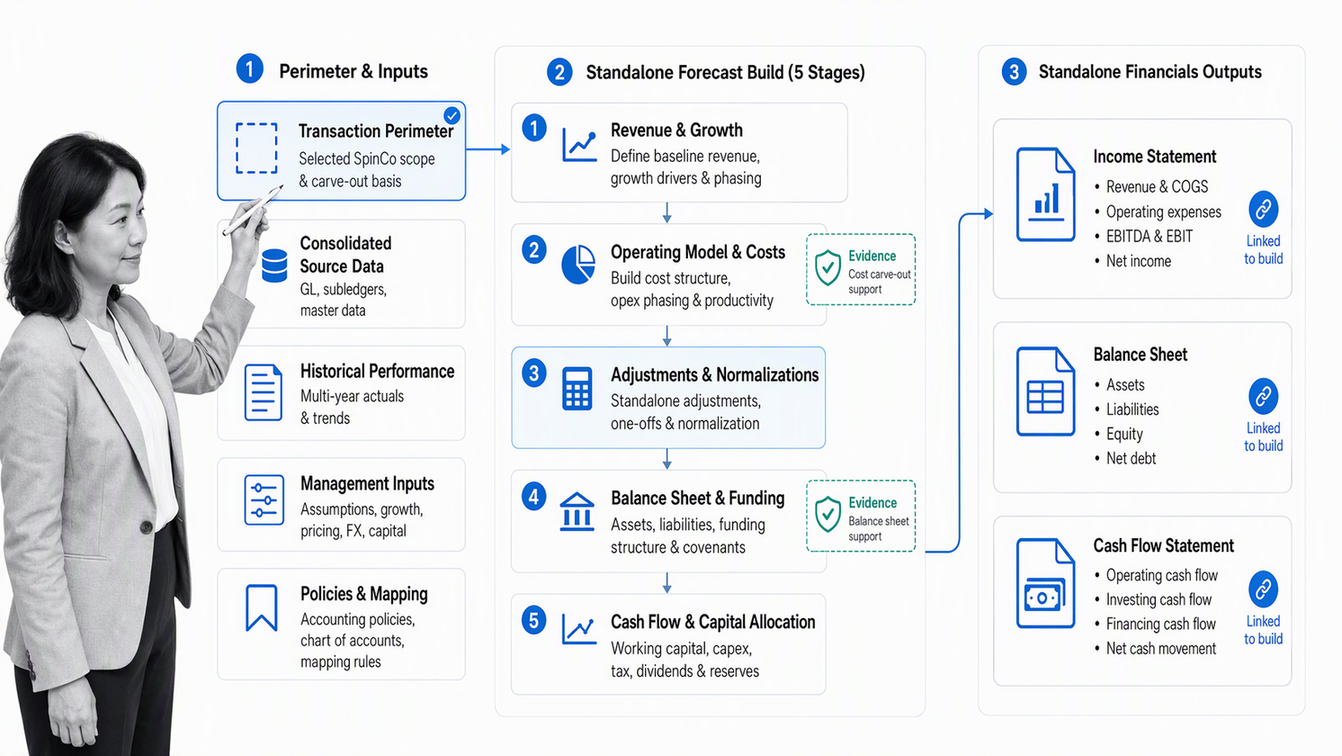
- Create a clean historical baseline using segment records, legal-entity accounts, management reporting, and the carve-out financial statements.
- Remove allocations that will not continue, then add costs SpinCo must incur to operate independently.
- Separate recurring operating performance from one-time transaction and separation spending.
- Build a standalone balance sheet and cash flow statement, not only an adjusted income statement.
- Reconcile each adjustment to an owner, source, rationale, timing assumption, and approval record.
Accounting quality affects valuation quality. Industry-specialized accounting, audit, tax, and legal reviewers can challenge allocations, normalize policies, and identify obligations that a general financial model may miss. Their role is to improve the evidence behind assumptions, not to substitute judgment for independent valuation analysis.
A standalone model should answer a simple question: what would this company earn, invest, borrow, and pay if it had to operate on its own from the first day after separation?
Which spin-off valuation techniques should you use?
Use several techniques because each reveals a different source of uncertainty. DCF tests the economics of the forecast. Trading comparables show how the market values similar listed companies. Precedent transactions show prices paid for control, although control premiums and synergies can make them less comparable to a distributed minority interest. SOTP is the organizing framework that keeps businesses, methods, and capital items separate.
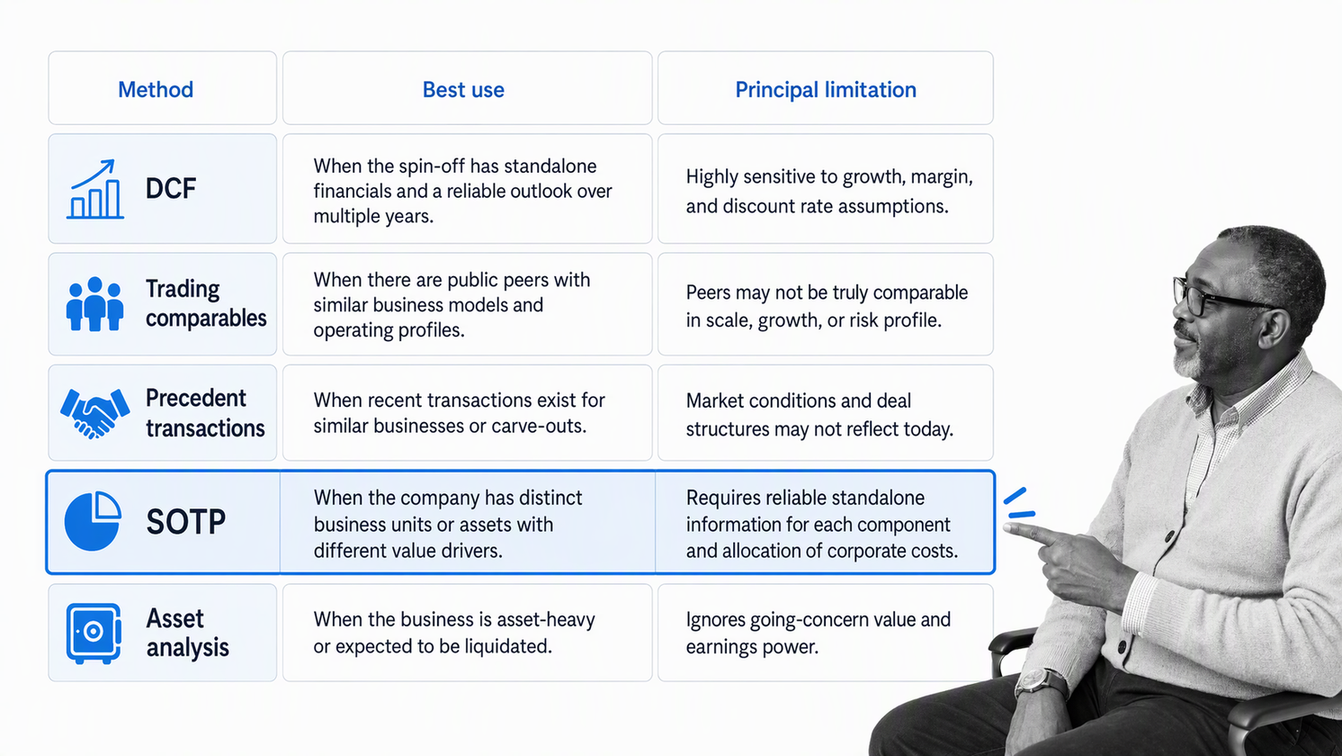
Valuation method decision matrix
| Technique | Best use | Main weakness |
|---|---|---|
| Discounted cash flow | Standalone cash generation and scenario testing | Highly sensitive to forecast, discount rate, and terminal assumptions |
| Trading comparables | Market-based range using operational peers | Pure peers may not exist and current prices can reflect temporary conditions |
| Precedent transactions | Reference for strategic value and control | Deal premiums and synergies may not apply to a spin-off |
| Sum-of-the-parts | Valuing distinct businesses and reconciling SpinCo with RemainCo | Depends on clean segment data and correct allocation of corporate items |
| Asset-based analysis | Asset-heavy, financial, or liquidation-sensitive businesses | Can understate intangible value and future earnings power |
Comparable-company work should match the value driver to the business. Professor Aswath Damodaran’s guidance on choosing valuation multiples emphasizes consistency between the multiple, the claimholder in the numerator, and the operating metric in the denominator. That discipline matters when SpinCo and RemainCo have different margins, growth, reinvestment needs, or capital structures.
How do you calculate sum-of-the-parts value?
SOTP values each operating business separately, then converts the resulting enterprise values into equity value by adjusting for debt, cash, minority interests, pensions, leases, investments, tax assets, and other non-operating claims. In a spin-off, the method creates a bridge from the combined company to SpinCo plus RemainCo.
SpinCo and RemainCo value bridge
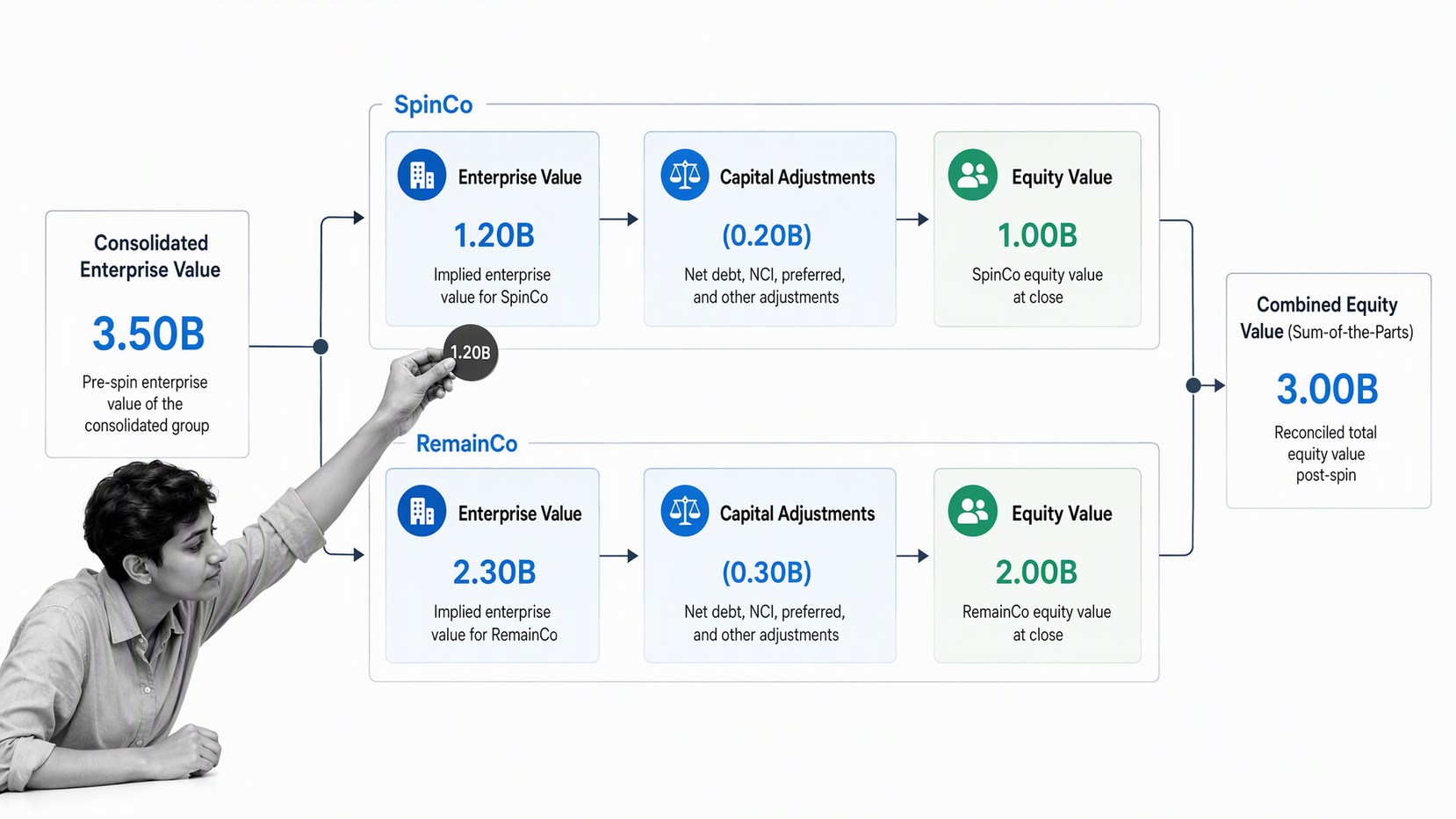
- Define each operating segment and choose the valuation method that fits its economics.
- Value the segments on a consistent date and currency basis.
- Add non-operating assets only once and at the entity that will own them after separation.
- Subtract debt and debt-like obligations according to the planned allocation.
- Deduct present value effects of unavoidable separation costs and dis-synergies where appropriate.
- Compare the combined post-separation equity values with the unaffected value of the consolidated company.
The difference between combined standalone value and consolidated value is not automatically value creation. It may reflect different market multiples, revised forecasts, financing, or omitted costs. Label the drivers so the board can distinguish operational improvement from a change in how the market might price the businesses.
What adjustments matter most in a spin-off valuation?
The most important adjustments convert allocated segment results into sustainable standalone economics. Review them line by line and avoid applying a broad uplift or haircut without an operating explanation.
Standalone adjustment control map
| Adjustment | Question to answer | Common modeling risk |
|---|---|---|
| Stranded costs | Which parent costs remain after SpinCo leaves? | Assuming every allocated cost disappears |
| Incremental public-company costs | What governance, finance, audit, legal, and investor-relations capability must SpinCo add? | Using a generic percentage without a build-up |
| Transition service agreements | Which services continue temporarily, at what price, and for how long? | Treating temporary charges as permanent or ignoring exit costs |
| Dis-synergies | What purchasing, distribution, customer, or tax benefits are lost? | Recognizing separation benefits without the matching losses |
| Debt and cash | What capital structure will each company have at close? | Valuing enterprise cash flows with an inconsistent equity bridge |
| Working capital | What inventory, receivables, payables, and seasonal funding does SpinCo require? | Using consolidated working-capital ratios |
| Separation costs | Which costs are one-time, recurring, avoidable, or already incurred? | Mixing transaction costs into normalized operations |
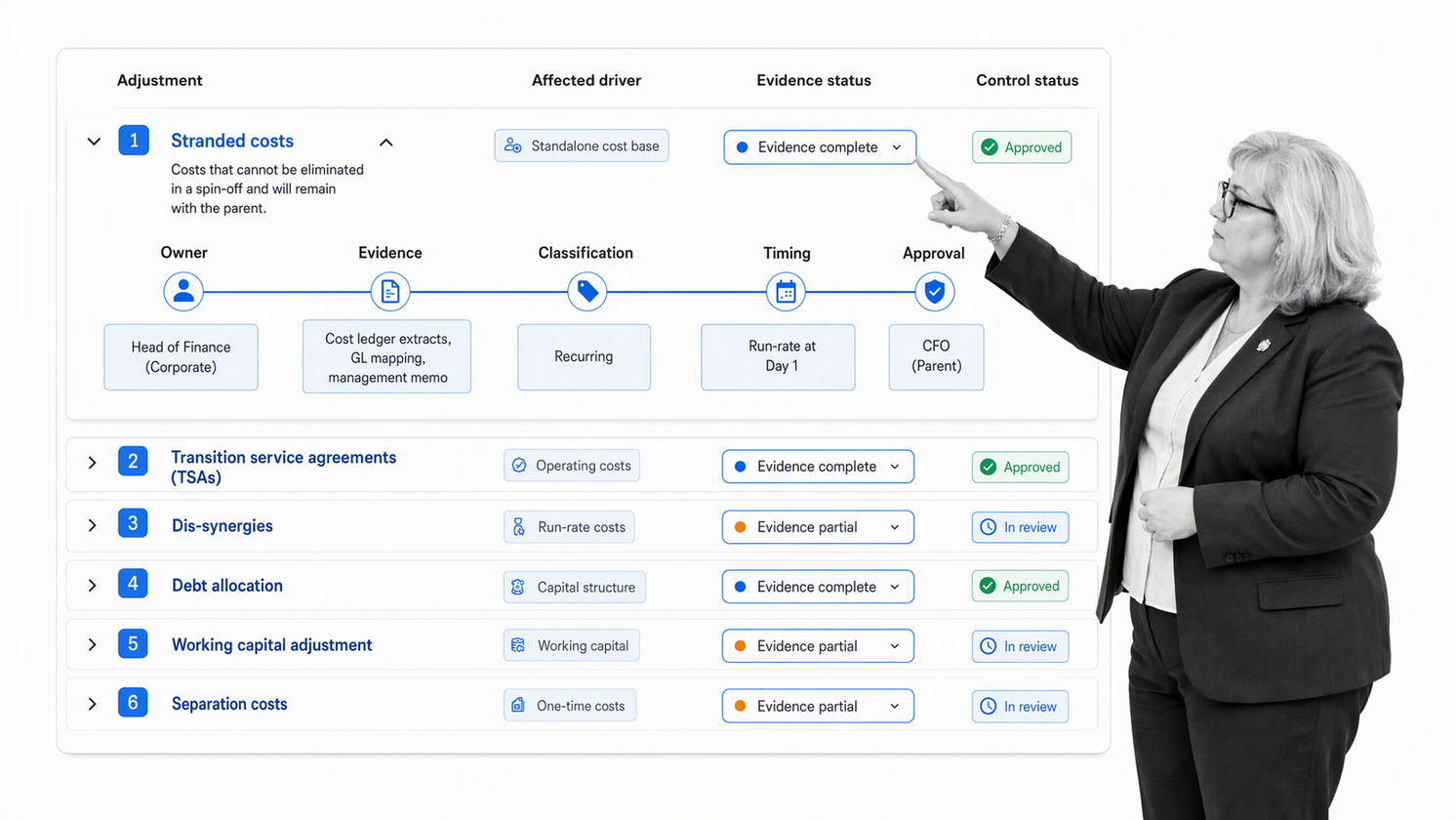
Also review shared intellectual property, guarantees, environmental obligations, litigation, leases, stock compensation, benefit plans, transfer pricing, trapped cash, tax attributes, and currency exposure. Materiality depends on the business. The model should document why an item was included, excluded, or assigned to one entity.
How do you set DCF assumptions for SpinCo?
A spin-off DCF follows the same core logic as a conventional discounted cash flow valuation, but the forecast and discount rate need standalone treatment. Project revenue, margins, taxes, depreciation, capital expenditure, and working capital after the separation perimeter and cost base are established. Discount unlevered free cash flow at a capital cost consistent with SpinCo’s business risk and target capital structure.
Do not import the parent company’s beta, credit spread, leverage, or tax rate without testing whether it fits SpinCo. A smaller, more concentrated company may have different cyclicality, customer concentration, liquidity, and financing access. The same applies to terminal value: long-run growth and margins must be consistent with reinvestment needs and competitive economics.
For businesses with impairment-sensitive assets, the IAS 36 framework is a useful reminder that cash-flow projections, discount rates, and asset-group boundaries must be internally consistent. Valuation for a transaction and accounting impairment testing serve different purposes, so reconcile differences rather than forcing them to match.
- Run downside, base, and upside operating cases.
- Test discount rate and terminal assumptions as a two-way sensitivity.
- Show a no-benefit case before any optional separation upside.
- Separate temporary transition effects from steady-state economics.
- Compare implied multiples from the DCF with observable peer ranges.
How do you value RemainCo after a spin-off?
RemainCo is not simply the consolidated company minus SpinCo’s reported segment profit. The parent may retain stranded costs, guarantees, tax exposures, shared-service infrastructure, corporate assets, and management layers. It may also gain focus, simplify capital allocation, or change its peer group. Build a separate RemainCo forecast using the same discipline applied to SpinCo.
Recalculate segment mix, growth, margins, capital intensity, and debt capacity. Then select RemainCo peers and discount-rate assumptions based on the business that remains. If management plans a cost-removal program, model the implementation timing, expense, execution risk, and owner instead of assuming that all stranded costs disappear at close.
How do you reconcile valuation methods?
A valuation range becomes useful when the analyst explains why methods differ. Start with a method-by-method summary, then trace differences to forecast assumptions, peer growth, margin quality, capital intensity, control premiums, discount rates, and non-operating adjustments. Avoid averaging outputs mechanically when one method is structurally less relevant.
Valuation reconciliation waterfall
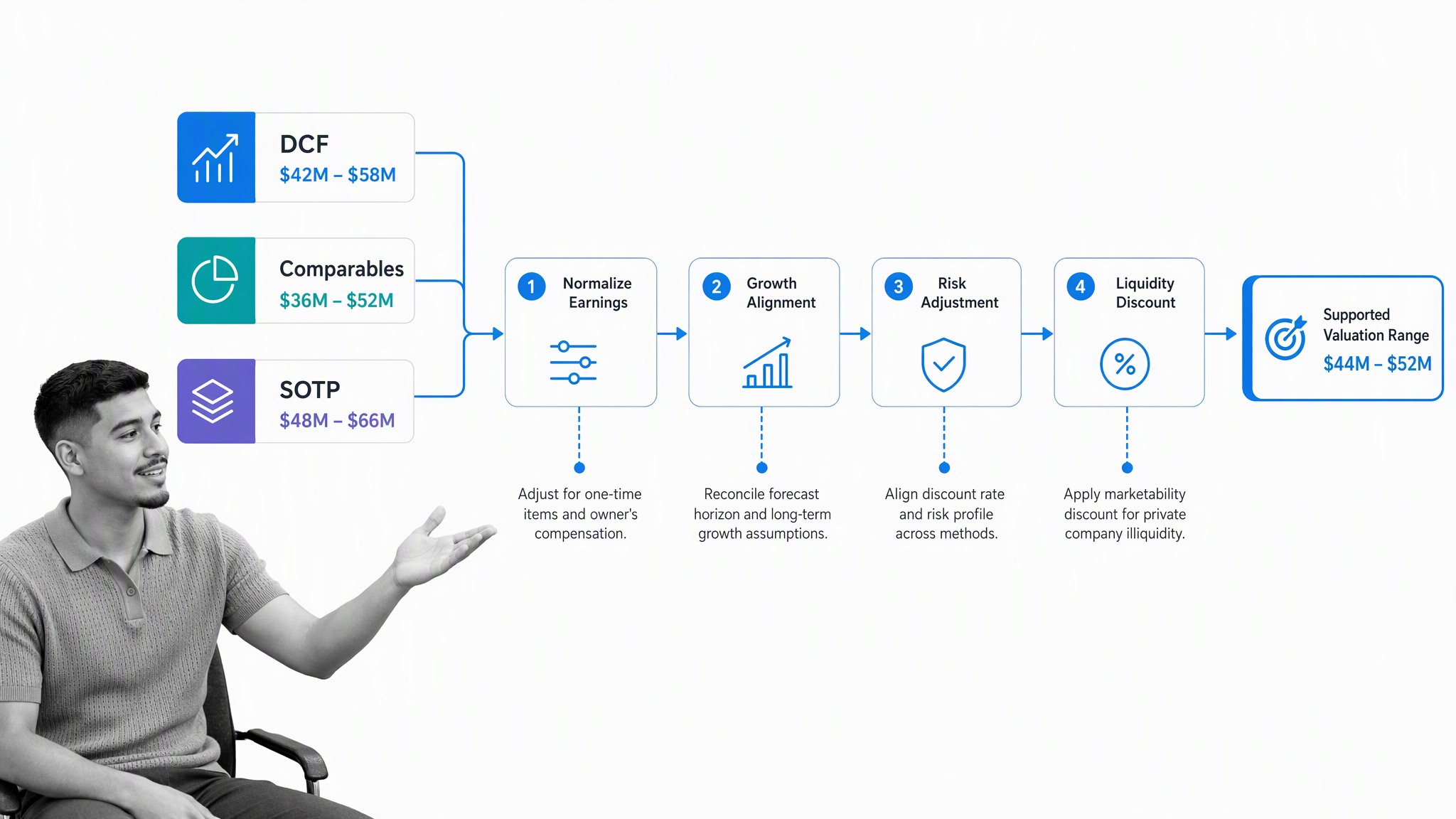
- Compare DCF value with trading-comparable value for SpinCo and RemainCo separately.
- Translate each output to both enterprise value and equity value on the same capital structure date.
- Reconcile implied operating multiples and key forecast assumptions.
- Overlay separation costs, dis-synergies, stranded costs, and financing only where the method has not already captured them.
- Present a supported range, central case, downside case, and the assumptions required to reach each result.
If the spin-off is part of a broader transaction review, connect the valuation to the accretion dilution analysis, capital structure, credit metrics, shareholder distribution mechanics, and strategic rationale. A board-ready investment banking pitchbook should keep those analyses consistent rather than presenting independent headline numbers.
What spin-off valuation mistakes should you avoid?
- Valuing allocated segment earnings as if they were standalone earnings.
- Selecting peers by industry label while ignoring growth, margins, cyclicality, and capital intensity.
- Using transaction multiples without adjusting for control and synergies.
- Applying the parent’s capital structure and discount rate to SpinCo by default.
- Ignoring stranded costs at RemainCo or incremental functions at SpinCo.
- Counting the same separation cost, cash balance, debt item, or tax asset twice.
- Treating temporary when-issued or early trading prices as proof of intrinsic value.
- Showing a point estimate without downside cases or a bridge between methods.
- Allowing model versions, evidence, and approvals to live across disconnected files and inboxes.
A structured M&A due diligence checklist can help keep commercial, financial, legal, tax, technology, and operational findings connected to the assumptions they affect. Every material change should flow through the forecast, valuation, and decision materials.
How can Process Street control the valuation workflow?
Spin-off valuation is a cross-functional control problem as much as a modeling problem. Process Street can turn the review into an assigned workflow with due dates, approvals, evidence capture, dependencies, and an audit trail. Finance owns the model, but accounting, tax, legal, HR, IT, treasury, operations, and the deal team can complete and approve the inputs that belong to them.
Controlled valuation review workflow
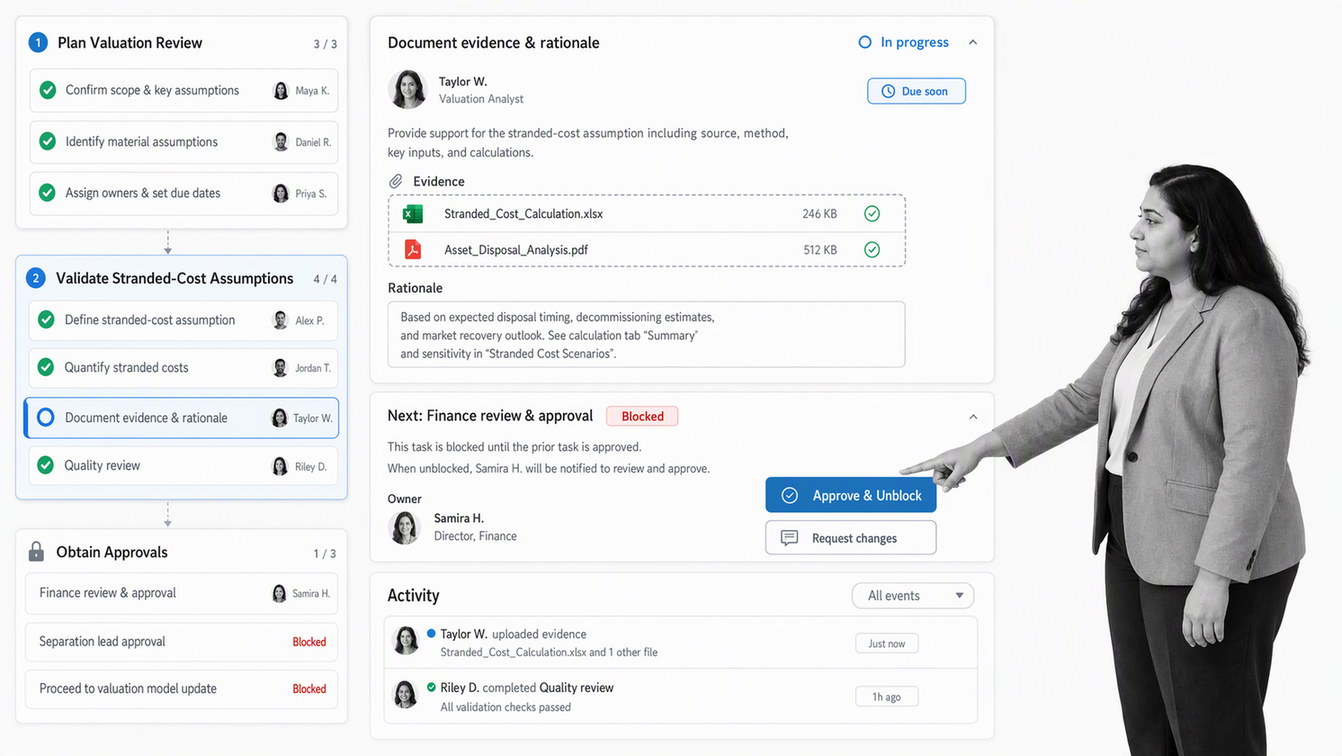
- Launch one workflow for each valuation cycle and lock the transaction perimeter.
- Assign every assumption to a named owner with source evidence and a review date.
- Route material changes through finance, accounting, tax, legal, and executive approvals.
- Block downstream valuation and board-material tasks until required inputs are approved.
- Record the final range, sensitivities, exceptions, and sign-offs in one auditable run.
This creates control without turning the model into a static document repository. Request a Process Street demo to see how a governed valuation workflow can coordinate inputs, approvals, and evidence from first perimeter decision through final review.
Spin-off valuation FAQs
What are the main spin-off valuation techniques?
The main techniques are discounted cash flow, trading comparable companies, precedent transactions, sum-of-the-parts, and asset-based analysis. Most assignments use several methods and reconcile them into a range.
How is a spin-off different from a carve-out?
A spin-off distributes shares of a separated company to the parent’s shareholders. A carve-out sells a stake to public investors and may leave the parent with a controlling or significant retained interest.
What is the most important step in valuing SpinCo?
The most important step is building credible standalone financials. The analyst must replace consolidated allocations with the revenue, costs, assets, liabilities, and capital structure SpinCo will actually have after separation.
Should separation costs reduce SpinCo value?
Unavoidable future cash outflows should be reflected somewhere in the valuation bridge. One-time separation costs should remain distinct from recurring standalone costs, and costs already incurred should not be counted again.
How should debt be allocated in a spin-off valuation?
Use the planned legal and financing structure, then test whether each company’s debt load is consistent with its cash flow, risk, liquidity, covenants, and credit capacity. Keep enterprise value and equity value bridges consistent with that allocation.
Why can DCF and comparable-company values differ?
DCF reflects the model’s forecast and discount assumptions, while comparables reflect current market pricing for selected peers. Differences often come from growth, margins, risk, capital intensity, market conditions, or peer-selection quality.