





Have you ever typed a full message on your phone, only to realize you misspelled something at the very beginning? Moving a tiny cursor back to the mistake can take longer than writing the message.
Slide your finger across the spacebar and the cursor moves quickly and accurately, letter by letter. That small tip helps you get more value from a product you already use. It is also a simple example of customer success.
Customer success software helps teams deliver that kind of useful guidance at scale. It brings customer context together, spots changes in health and behavior, and turns the right response into owned, repeatable work.
This guide explains what customer success software does, why growing teams need it, how to choose a platform, and four current options worth considering. To find the best customer success software and grow lifetime customers, start with the outcomes customers expect and the operating model your team can sustain.
| Platform | Strongest fit | Best for |
|---|---|---|
| Process Street | Controlled onboarding, renewal, escalation, and approval workflows | Teams that need governed execution, evidence, and cross-system orchestration |
| Gainsight | Enterprise customer health, success plans, and journey orchestration | Large customer success organizations managing complex portfolios |
| ChurnZero | B2B SaaS health segmentation, journeys, and renewal forecasting | SaaS teams that want proactive risk and growth signals |
| Custify | Focused health scores, lifecycle stages, alerts, and playbooks | Smaller and mid-market SaaS customer success teams |
What is customer success software & what does it do?
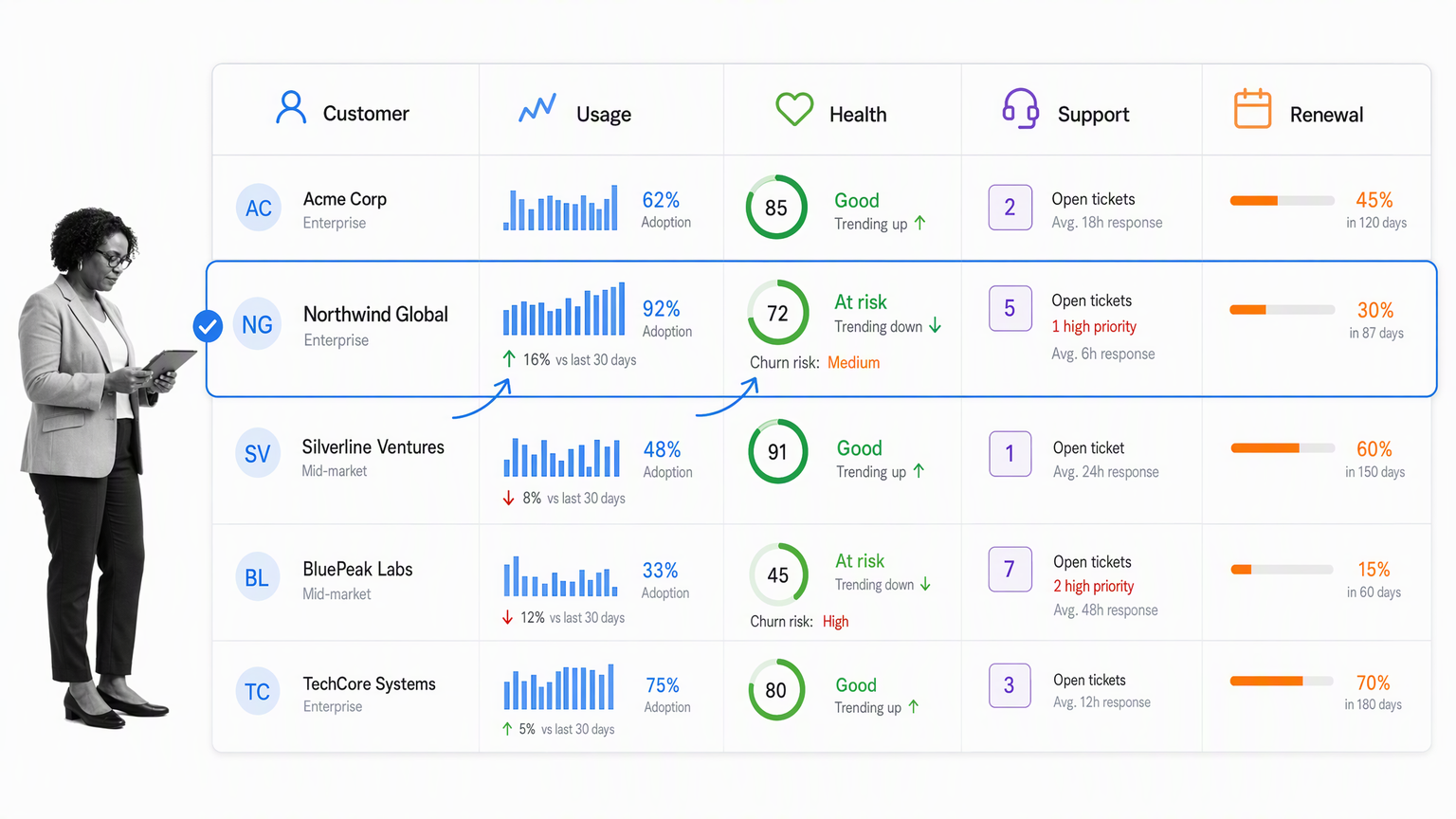
Customer success software refers to a platform or tool that collects data about who your customers are, how they are using your product, and how you can help them get more value from it. The exact function depends on your product or service and how you conduct operations such as onboarding. The goal is consistent: give the team a useful 360-degree view and a reliable way to act on it.
A complete view combines product usage, onboarding progress, support conversations, account history, health signals, renewal dates, and customer feedback. Instead of searching across separate tools, a customer success manager can see what changed and decide what should happen next.
- Build strong relationships with shared context.
- Spot issues before they become problems or preventable churn.
- Proactively offer support before a customer has to ask for it.
- Identify opportunities for feature engagement, adoption, renewal, and expansion.
- Coordinate the people and processes responsible for the response.
Customer success is value realized, not activity completed
Customer retention is the new client acquisition. A business still needs a strong marketing and sales game to sustain growth, but retaining the right customers is usually easier than repeatedly acquiring replacements. Customers remain committed only while they see value. Marketing and sales may win the account, but ongoing success depends on whether the customer can use the product to reach the outcome they bought it for.
Customer success is the system, run by people and supported by software, that helps customers get the best from a product. It means defining what success looks like for each customer and proactively helping them reach it.
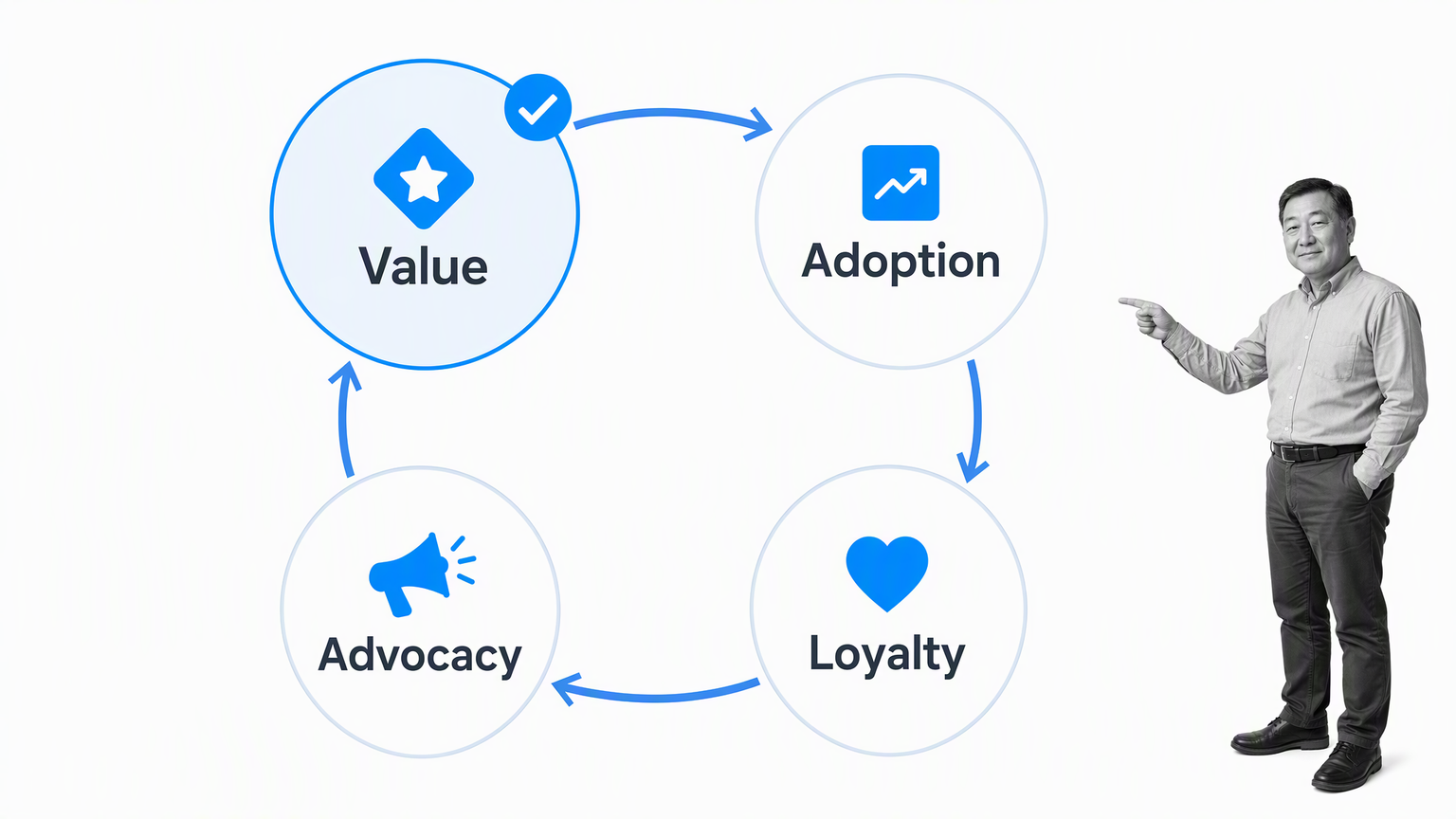
To keep a tight hold on customers, you need to anticipate problems, provide relevant solutions, and show people how to get the most value from the product or service you offer. When customers realize value, adoption becomes easier, loyalty grows, and advocacy follows. They are also more receptive to an expansion conversation because the relationship is grounded in results rather than a generic sales prompt.
Hello Jason, I asked for your contact information so I could let you know about the outstanding support Tony has provided to us. He went above and beyond to make sure we were successful with our onboarding process setup. He is representing your organization in an exemplary manner and we cannot thank him enough. All the best, Fran. Names are anonymized for security purposes.
That email is a real-life example of customer success in action. The customer did not praise a feature list. Fran praised the care, attention, and support that helped the organization succeed. Software should help a whole team deliver that standard consistently, not only when one person remembers every detail.
Customer success grows from a customer-centric approach and a continuous feedback loop of service delivery, support, improvement, and surpassing expectations. If customers succeed, the company is more likely to succeed as well.
The software does not create customer success by itself. It supplies the context, signals, and workflow that let people deliver the right help at the right time.
Why you need customer success software
To retain customers, you need to provide attention, support, and a strong experience throughout the customer journey. You should be ready for the next step and able to offer help before a problem becomes obvious.
To do this well, you have to treat every customer as if they are the only one. That is manageable when you have one customer. With 100 customers, memory and spreadsheets begin to fail. The questions multiply:
- Who is each customer, and what does success mean to them?
- What did they purchase, and when did they purchase it?
- How is each customer using the product?
- Have they experienced support, adoption, or implementation problems?
- When does a trial, milestone, or contract come up for review?
- Where is there a genuine opportunity to deepen adoption or expand?
- What communication has already happened, and who owns the next step?
All these questions can be answered with customer success software. It makes the customer record visible and connects it to action. Teams can collect and analyze feedback, manage customer communications, provide self-service education, monitor health, run playbooks, assign work, and surface a meaningful change to the person who can respond.
From one central place, the team can track, organize, assess, automate, and manage customer success operations. That centralization matters because a health signal is useful only when the right person can understand the context and take the appropriate action.
Think of it as a continuous health check
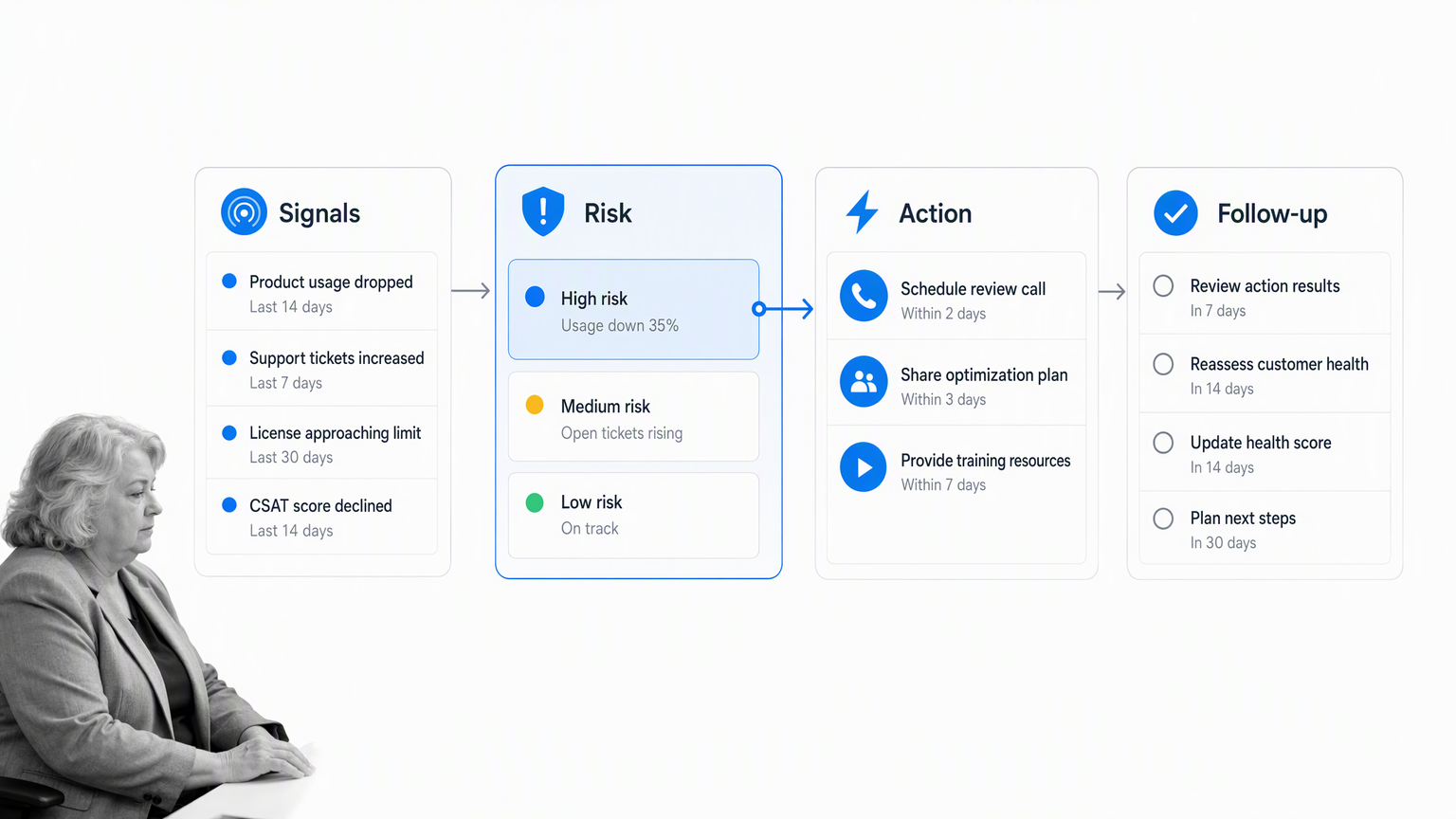
Doctors and customer success systems share a useful pattern. Both perform regular checkups with their patients, take the temperature to see whether something is running hot or cold, and determine the appropriate remedy. A single temperature reading does not tell the whole story, and neither does a single customer health score.
A useful health model combines quantitative signals such as usage and support volume with qualitative context such as goals, feedback, and executive changes. The point is not to produce a perfect score. The point is to help the team decide where attention is needed and what action is appropriate.
The strongest platforms connect that signal to a workflow. A risk alert should create an owned investigation, an adoption gap should start a relevant enablement step, and a renewal date should trigger preparation early enough to resolve issues.
Choosing the right customer success software
The best customer success platform is the one that fits your customers, operating model, existing systems, and goals. A larger feature list is not automatically better. Complexity has a cost, especially if the team cannot turn all that data into consistent action.
Start with five essential capabilities
- Capture customer data, history, and feedback.
- Monitor customer health with both signals and human context.
- Identify appropriate adoption and expansion opportunities.
- Prepare for trials, milestones, and renewals before they arrive.
- Turn risks and opportunities into assigned, trackable action.
Match the platform to your operating complexity
It is natural to assume that bigger is better, but that is not necessarily true for customer success software. A startup or smaller organization with a handful of customers may not need an all-singing, all-dancing solution with expensive trimmings. A simple, easy-to-use platform can be the better choice. A large enterprise with hundreds or thousands of accounts, multiple products, and a big customer success team may need something more robust.
Estimate the number of accounts, the number of people involved in serving each account, the variability of your customer journeys, and the controls required for approvals or regulated work. Buy for the complexity you actually need to manage.
Connect the systems that hold customer context
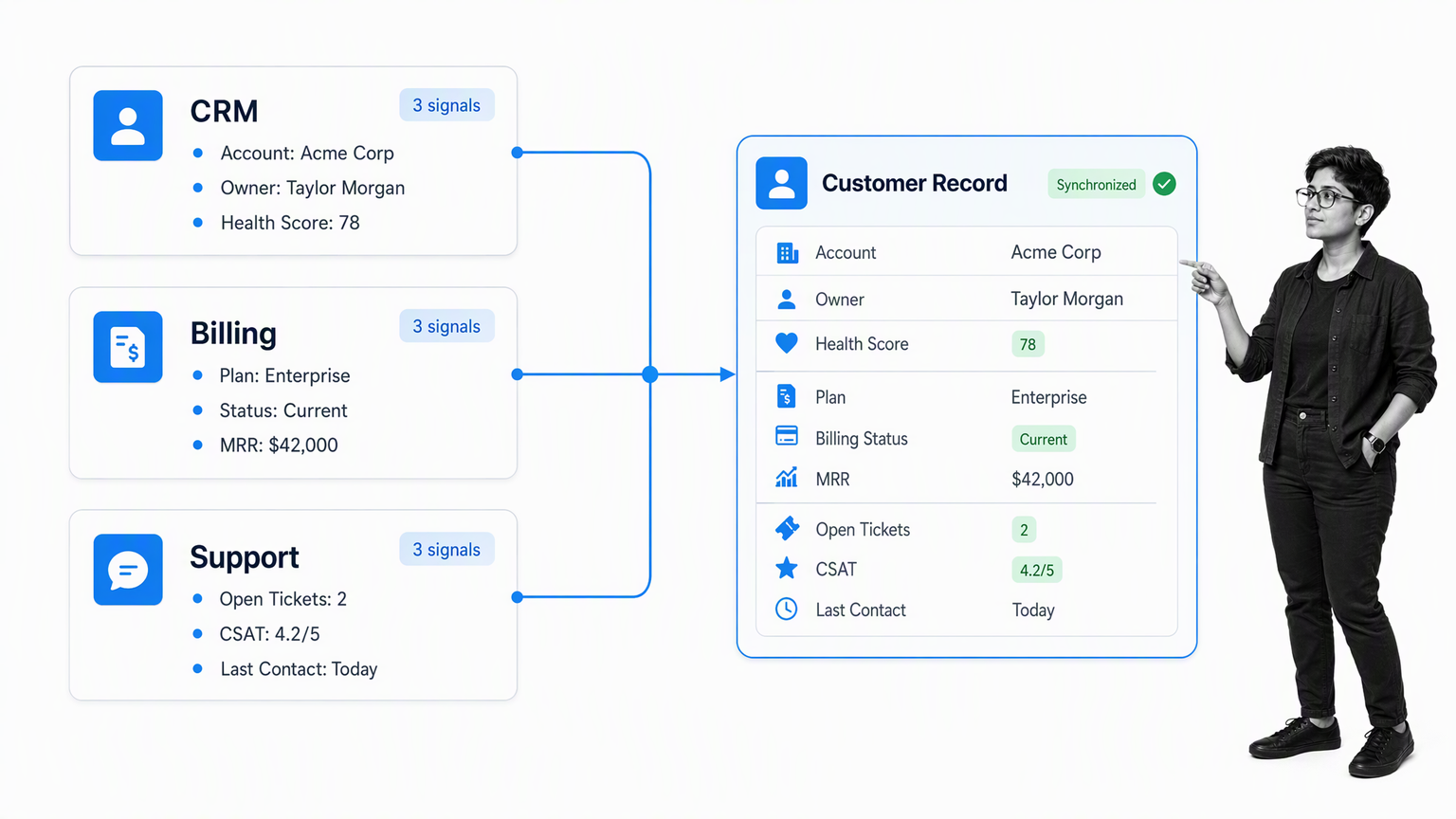
Customer context is usually spread across internal systems. During the customer onboarding process, the sales team may store key customer information in a CRM system. The accounts team may store payment information in a billing system, and the support team may log customer conversations in a support system. Product analytics, meeting notes, and workflow tools add more context.
Because customer success spans the entire customer journey, the team needs access to all this information. Support may see a recurring issue before the customer success team sees the account risk. Choose a platform that integrates with the systems you use so data can stay synchronized across the operation.
Choose a platform that can synchronize the sources you rely on and send action back to the systems that own the work. Ask how data is matched, how often it updates, how exceptions are handled, and whether the team can understand why a score or alert changed.
Define your customer success model and goals
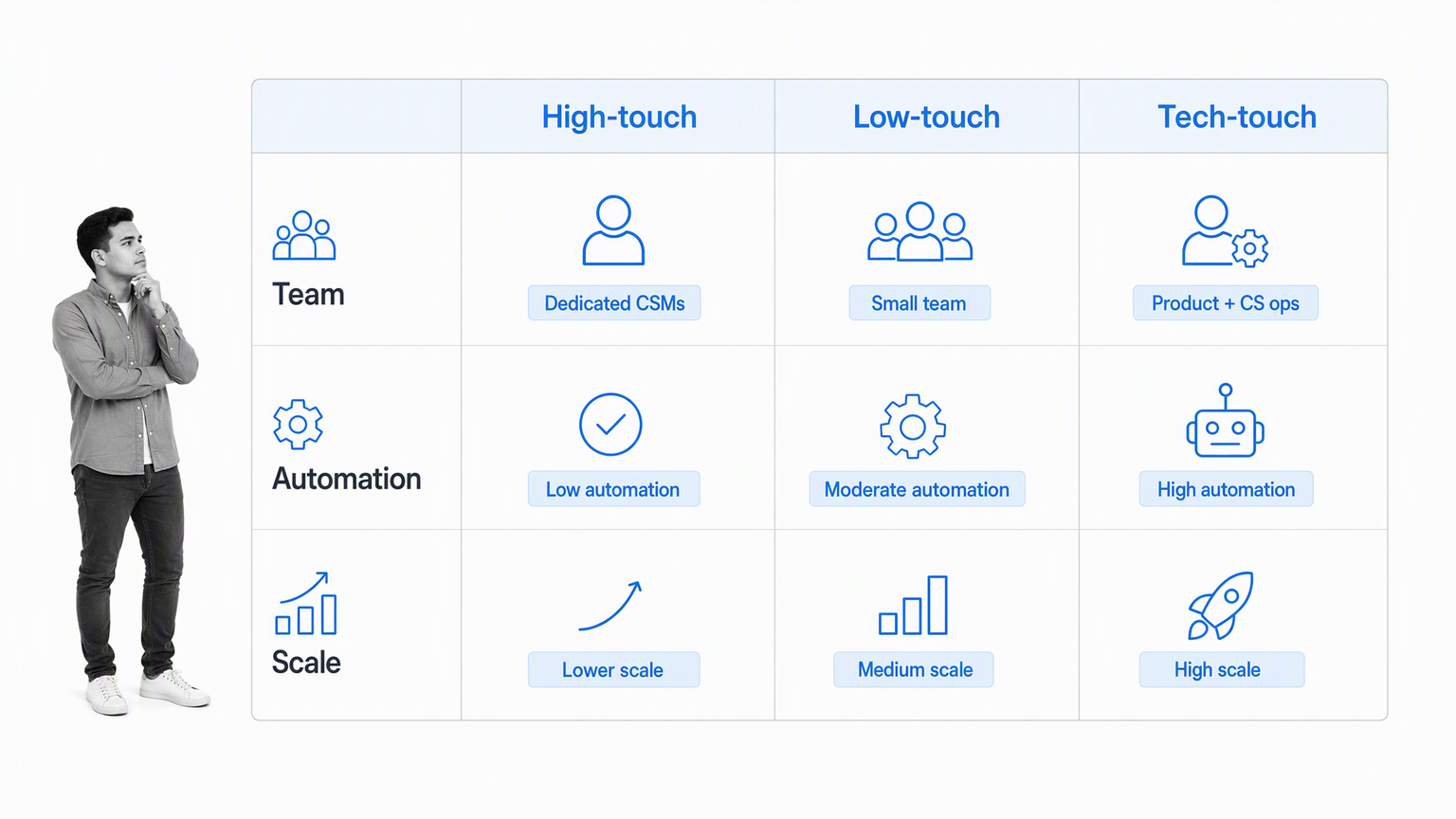
Decide what customer success means for your organization. Is the main goal reduced churn, increased engagement, improved customer satisfaction, faster time to value, renewal, expansion, or brand advocacy? Then decide how much time you can spend on each customer. Will each new customer be greeted personally or through virtual channels? The answer determines how much human attention each segment should receive.
High-touch programs coordinate complex relationships and tailored success plans. Low-touch programs combine pooled human support with standard playbooks. Tech-touch programs use product signals, automation, and digital education to help large segments. Most teams use all three, with clear rules for when a customer moves between them.
Before buying, test a real journey from signal to resolution. If the platform can show risk but cannot help your team assign, approve, complete, and evidence the response, you may still need an operational layer to close the loop.
4 customer success software platforms to consider
These platforms serve different needs. Evaluate each one against your customer model, data environment, workflow requirements, and the experience your team can realistically maintain.
Process Street for governed execution
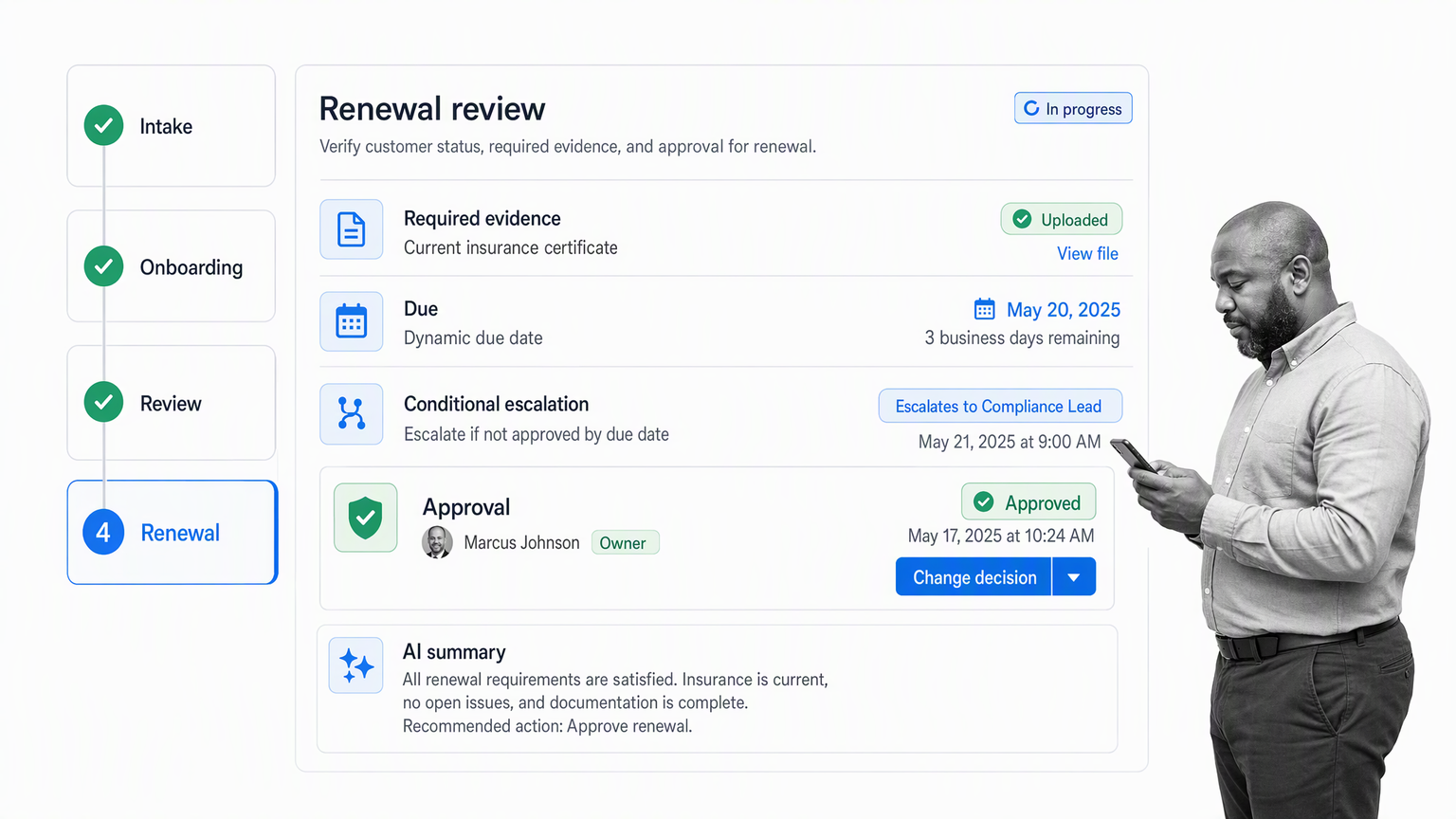
Process Street is a single Compliance Operations Platform with Docs and Ops capability areas plus built-in AI. Docs governs procedures and customer-facing standards. Ops turns them into workflows with assigned tasks, conditional routing, approvals, evidence, and an audit history.
For customer success teams, that means onboarding, implementation, health reviews, escalations, renewals, and expansion handoffs can run as controlled processes. Teams can create, organize, manage, and monitor the work through a simple interface while adapting the path to each customer’s answers, risk, or segment. The result is a consistently excellent approach rather than a collection of informal reminders.
- Create or use pre-built workflows for repeatable customer success processes.
- Use form fields to collect customer information and build a 360-degree profile.
- Store key customer information securely in the cloud so authorized teams can work from any location or device.
- Spot red flags and identify appropriate expansion opportunities by monitoring real-time status.
- Use conditional logic, dynamic due dates, assignments, and approvals to trigger key tasks.
- Summarize and assist work with built-in AI while retaining human control.
- Monitor work across onboarding, reviews, renewals, and exceptions.
Process Street has direct, universal integrations to 5,000+ systems. Need a new one? An AI agent builds it on the fly. That lets the team connect customer data with the operational workflow responsible for the next action.
For a practical starting point, use a governed customer success onboarding process that connects the promise made in sales to the experience delivered after the contract is signed.
Salesforce has also described how it uses Process Street to create consistent customer success processes:
The workflow below shows one approach to an expansion process for SaaS customers:
Gainsight for enterprise portfolios
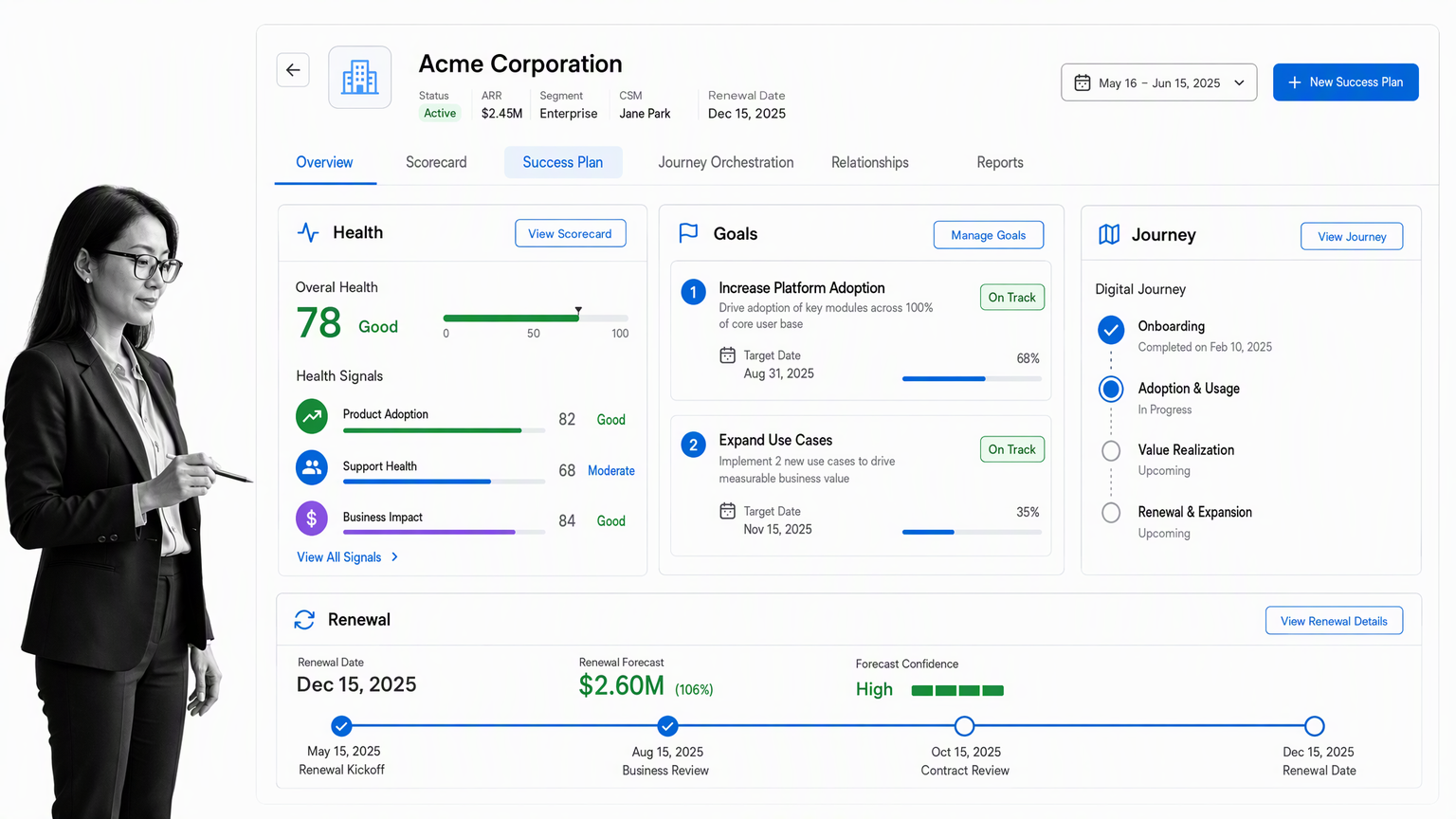
Gainsight is designed for enterprise customer success programs that need customer health, success plans, journey orchestration, renewal context, and portfolio-level reporting.
Its strength is breadth across complex accounts and teams. Multi-dimensional health models can combine product, relationship, support, and commercial signals. Success plans give teams a shared view of goals and milestones, while journey tools support digital and human engagement.
Gainsight is a strong candidate for large customer success organizations with mature data operations. Confirm implementation effort, administration needs, and the workflow required outside the platform before deciding.
ChurnZero for B2B SaaS growth
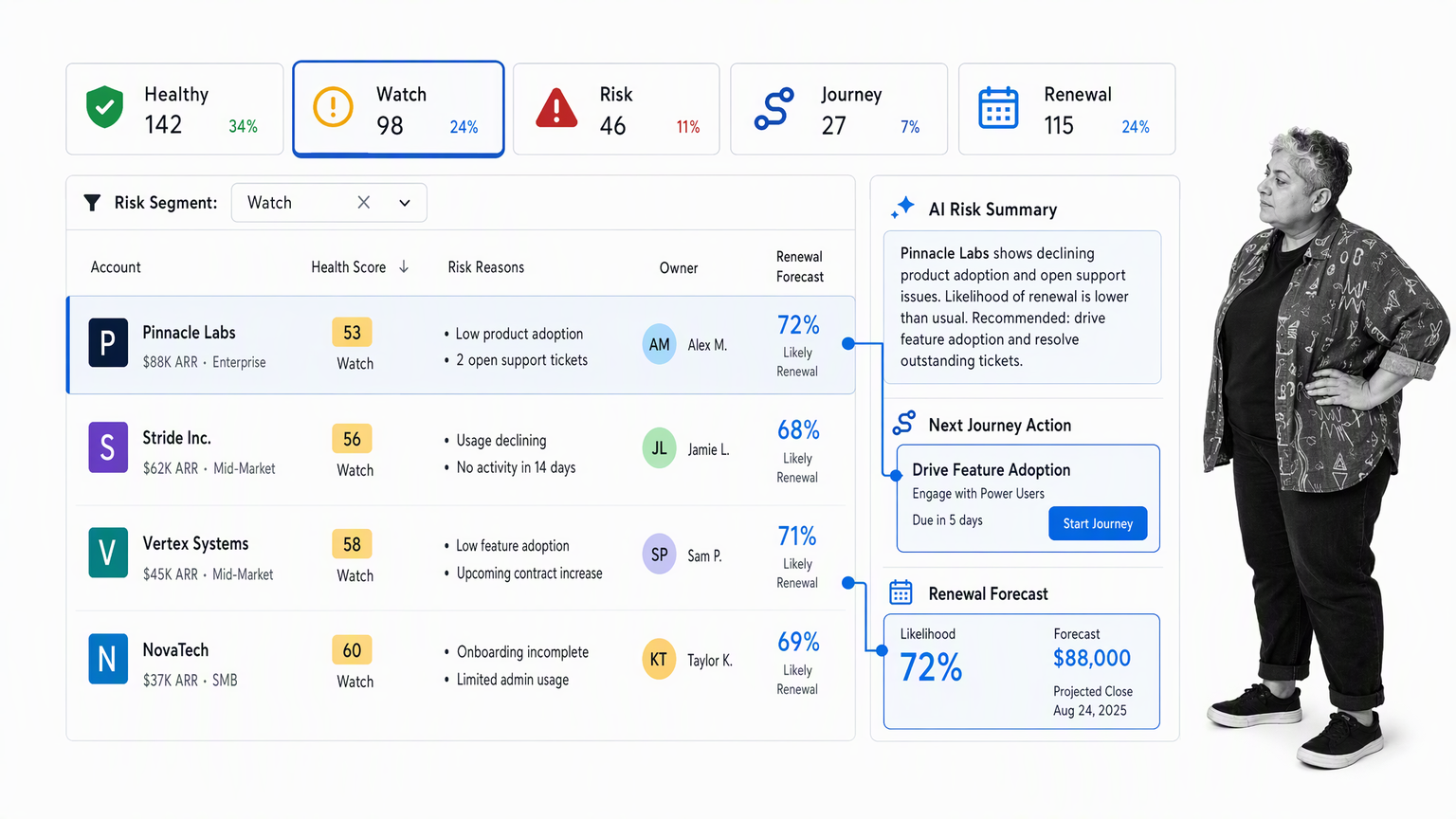
ChurnZero focuses on customer growth for B2B SaaS teams. It combines customer health, segmentation, journeys, in-app engagement, renewal forecasting, and AI-assisted insights.
Teams can segment customers by health or behavior, start a relevant journey, and organize renewal and expansion activity around the account record. That makes it useful when product usage is a central signal and the team wants a proactive way to coordinate outreach.
Evaluate the quality of your product and account data before rollout. Automated journeys are only as useful as the signals and ownership rules behind them.
Custify for focused customer health
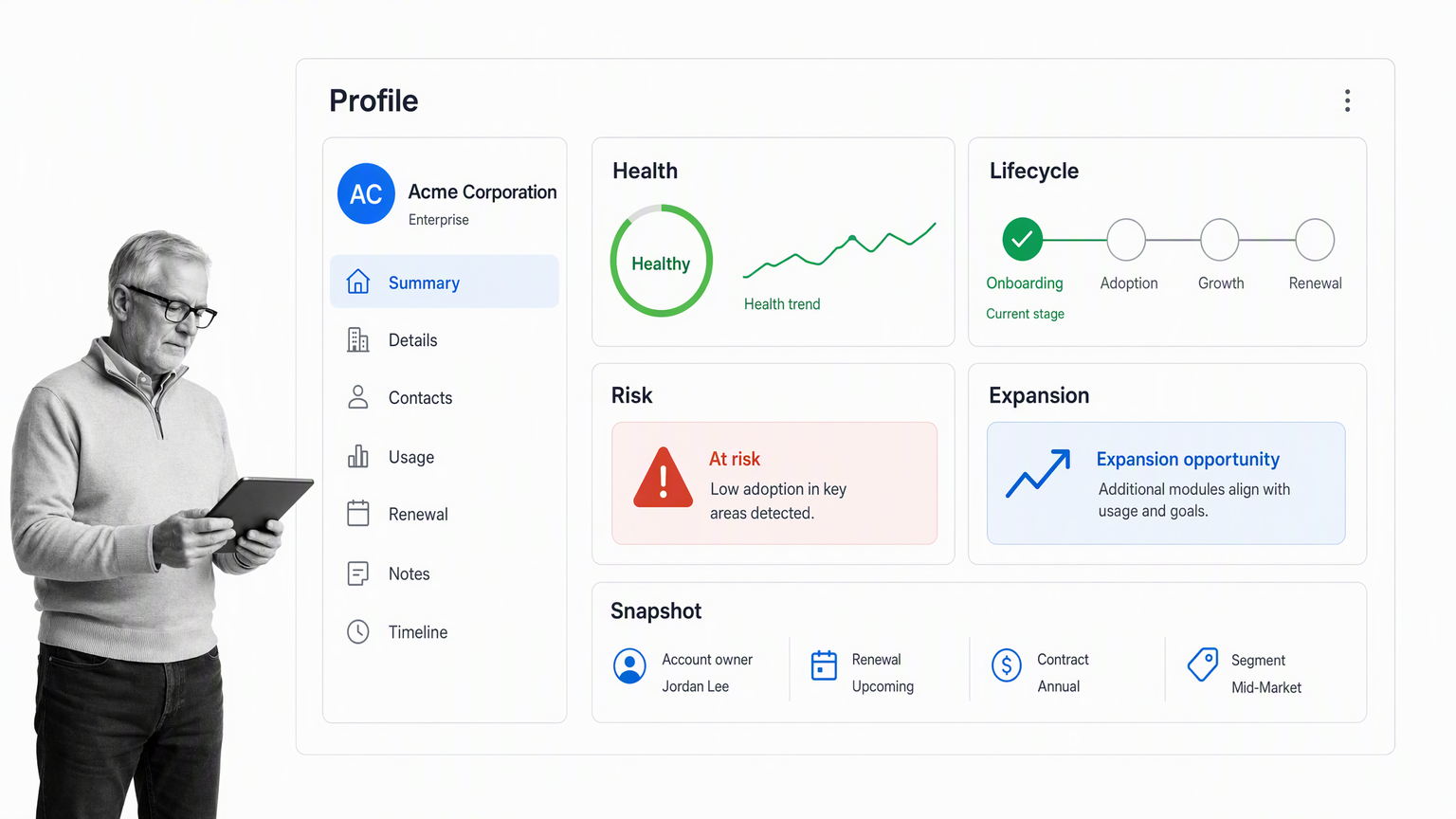
Custify brings customer profiles, health scores, lifecycle stages, risk alerts, and automation into a focused customer success workspace.
It is particularly relevant to smaller and mid-market SaaS teams that want a central view without starting with the heaviest enterprise configuration. Customer data from various systems can be collected and consolidated into detailed customer profiles. Health measures help identify at-risk customers, while notifications and playbooks can trigger onboarding emails, welcome messages, renewal preparation, and appropriate expansion tasks.
As with any health platform, test how scores are explained and how an alert becomes completed work. A clear model that the team trusts is more valuable than a complex score nobody can act on.
Choose for the operating model you can sustain
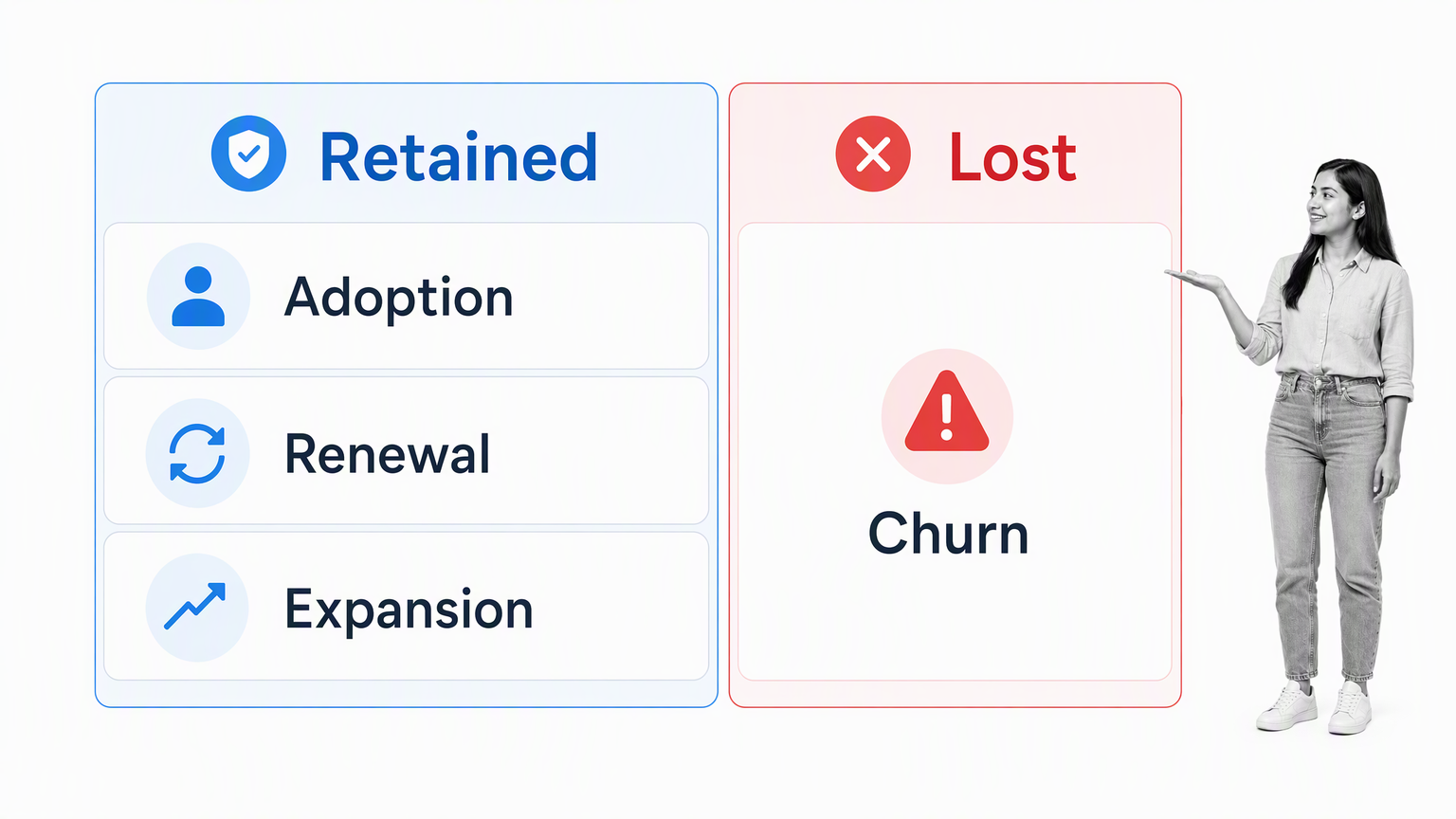
Customer success software should make good service repeatable. It should show the team where value is being realized, where risk is increasing, and what needs to happen next. The right choice connects those insights to a practical process for onboarding, adoption, renewal, and expansion.
Start with the outcome your customers expect, map the signals that show progress, and define the response each signal requires. Then choose the platform that can support that system without creating more disconnected work.