Turn every policy into automated workflows with built-in enforcement and audit-ready proof.



Workflow vs Process Builder: Which Should You Use?
A workflow builder and a process builder solve related problems, but they are not the same tool. A workflow builder helps teams run a repeatable sequence of tasks. A process builder helps teams design, control, and improve a larger business process that may include rules, branches, approvals, systems, and exceptions.
The shortest answer: use a workflow builder when the work mainly needs structure and handoff automation. Use a process builder when the work needs decision logic, governance, integrations, and process level reporting. Many teams need both capabilities in the same platform, because simple workflows often become business critical processes once they touch compliance, customers, finance, HR, or operations.
This guide defines workflow vs process builder, explains the differences, and gives you a practical decision framework for choosing the right level of automation.
- What is a workflow builder?
- What is a process builder?
- What is the difference between workflow vs process builder?
- How should you choose between a workflow builder and a process builder?
- What if you mean Salesforce Workflow Rules vs Process Builder?
- How Process Street handles workflow and process building
- FAQs
What is a workflow builder?
A workflow builder is software that lets you design a repeatable path for work. The path usually contains tasks, owners, due dates, approvals, forms, notifications, and status changes. The goal is to make sure the right work happens in the right order, without relying on memory, email chasing, or manual handoffs.
This maps closely to workflow automation. IBM describes workflow automation as automation applied across a defined series of tasks and activities, so work moves from one stage to the next. In practical terms, a workflow builder turns that sequence into something the team can run every time.
A workflow builder is a good fit when the process is easy to describe as a checklist or task path. Examples include employee onboarding, content approval, vendor intake, customer request routing, contract review, security access requests, and recurring finance close tasks.
- The start trigger is clear.
- The steps usually happen in the same order.
- The team needs owners, due dates, forms, approvals, and reminders.
- Exceptions exist, but they do not define the whole process.
- The main problem is inconsistent execution, not process discovery.
Simple workflow builder example

A basic employee onboarding workflow might start when HR creates a new hire record. The workflow assigns IT equipment setup, account provisioning, document collection, manager preparation, and first week check-ins. Each task has an owner and due date. If a task is late, the workflow alerts the right person.
That is workflow builder territory. The team knows the path. The value comes from making that path visible, repeatable, and enforceable.
What is a process builder?
A process builder is software for designing and improving a broader business process. It usually includes workflow steps, but it also handles decision logic, branching rules, cross-functional handoffs, system updates, controls, exceptions, and reporting.
IBM defines business process management as work to discover, model, analyze, measure, improve, and optimize business strategy and processes. A process builder sits closer to that broader BPM layer than a simple workflow builder does.
Process builders are useful when the team cannot describe the work as one fixed path. A customer escalation process might branch by customer tier, contract value, product area, regulatory exposure, and required approval. A compliance review might need different evidence, signoffs, and deadlines depending on risk level. A finance process might need to route approvals based on spend type, department, and budget status.
Process builders can also use modeling standards. The Object Management Group maintains BPMN, a notation for business process diagrams. Not every team needs formal BPMN modeling, but the existence of the standard shows the difference between drawing a task path and modeling an operating process.
- Multiple branches or exception paths matter.
- Rules decide where work goes next.
- Several teams or systems participate.
- The process needs audit evidence, reporting, or control points.
- The organization needs to improve the process over time, not just run it.
What is the difference between workflow vs process builder?
Workflow vs process builder comes down to operating depth. A workflow builder asks, what steps should happen next? A process builder asks, how should this whole business process operate, adapt, and improve?
A workflow builder usually focuses on execution. It gives the team a shared path, assigns work, captures information, and moves tasks forward. A process builder usually focuses on process architecture. It defines rules, branches, controls, integrations, and measurement around the path.
- Scope: workflow builders manage task sequences; process builders manage broader processes.
- Complexity: workflow builders fit predictable work; process builders fit conditional and cross-functional work.
- Ownership: workflow builders often belong to operations teams; process builders may involve operations, compliance, IT, finance, HR, or revenue teams.
- Change cycle: workflow builders help teams run work consistently; process builders help leaders redesign how work should happen.
- Output: workflow builders produce runnable workflows; process builders produce an operating model that may include several workflows.
Workflow vs process builder decision map

A useful mental model is a straight line versus a controlled network. If your work is a straight line with a few handoffs, start with a workflow builder. If your work becomes a controlled network with branches, rules, and evidence requirements, approach it as a process builder problem.
This does not mean workflow builders are basic or process builders are always better. It means the tool should match the problem. Overbuilding a simple intake workflow creates friction. Underbuilding a regulated approval process creates risk.
How should you choose between a workflow builder and a process builder?
Choose based on the process, not the label on the software. Many vendors use workflow builder and process builder loosely, so evaluate the actual capabilities you need.
Start with the lowest level of structure that will enforce the work. If the process has one main path, use a workflow builder and keep the design simple. If the process has several paths, compliance rules, system dependencies, or leadership reporting needs, use process builder capabilities from the start.
- Use a workflow builder when the main job is assigning tasks, collecting information, routing approvals, sending reminders, and tracking status.
- Use a process builder when the main job is modeling conditions, controlling exceptions, coordinating several systems, proving compliance, and improving the process over time.
- Use a combined platform when simple workflows may later need logic, audit trails, integrations, or governance.
- Avoid choosing a tool only because it has a visual canvas. The real test is whether it can enforce the way the work should happen.
For a deeper automation strategy, look at workflow automation, business process automation, and process documentation together. Documentation explains the work, workflow automation runs the work, and process automation connects the larger operating system.
What if you mean Salesforce Workflow Rules vs Process Builder?
Some searchers use workflow vs process builder to mean Salesforce Workflow Rules versus Salesforce Process Builder. That is a specific Salesforce automation question, not the broader workflow builder versus process builder category.
For that Salesforce-specific case, the answer has changed. Salesforce says Workflow Rules and Process Builder are no longer supported as of December 31, 2025, and recommends migration to Flow. If you are working inside Salesforce, treat legacy Workflow Rules and Process Builder as migration items, not new automation choices.
For broader business operations, the question is different. You are deciding whether your team needs a simple workflow execution layer, a process design layer, or a platform that can handle both.
How Process Street handles workflow and process building
Process Street is a Compliance Operations Platform that turns repeatable work into structured, enforceable workflows. Teams can start with a simple task path, then add owners, forms, approvals, dynamic due dates, permissions, conditional logic, and automation as the process becomes more important.
In Process Street Ops, teams can assign tasks, set due dates, leave comments, request approvals, and track progress across recurring processes. In the workflow editor, Process Street supports task assignments, dynamic due dates, stop tasks, and task permissions. Code Tasks can execute JavaScript within workflows when a process needs custom logic beyond standard automation.
That matters because many business processes do not stay simple. A hiring checklist becomes a compliance record. A vendor intake form becomes a risk review. A customer handoff becomes an audit trail. A good platform should let the team begin with a workflow builder experience, then add process builder depth without moving the process into a separate system.
Process Street workflow surface
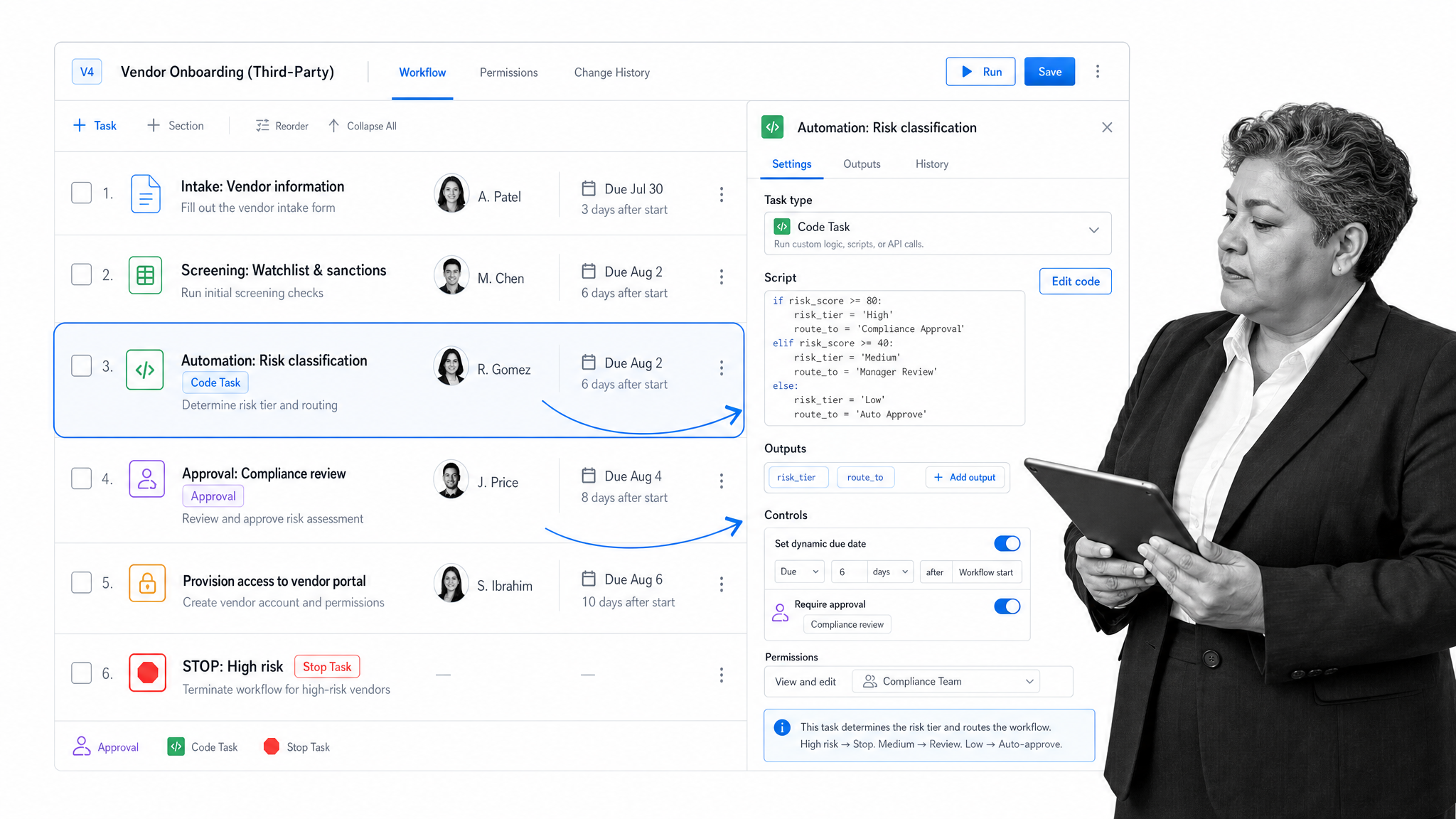
The practical advantage is continuity. The same workflow can guide the person doing the work, collect the evidence, route the approval, enforce the due date, and show leadership where the process stands. The team does not have to choose between ease of use and operating control.
If your team is comparing workflow vs process builder, Process Street is strongest when you need repeatable execution that can grow into governed process automation. Start with the path of work. Add rules, approvals, due dates, permissions, and automation only where the process needs them.
FAQs
What is a workflow builder?
A workflow builder is software for turning a repeatable sequence of tasks into a runnable workflow. It is strongest when the process follows a clear order, such as intake, review, approval, completion, and recordkeeping.
What is a process builder?
A process builder is software for designing a broader business process with branching logic, rules, roles, systems, exceptions, and reporting. It is useful when the process needs more than a simple sequence.
What is the main difference between workflow vs process builder?
The main difference is scope. A workflow builder manages the path work follows. A process builder manages the larger operating system around that work, including rules, decision points, handoffs, controls, and optimization.
When should I use a workflow builder instead of a process builder?
Use a workflow builder when the work is repeatable, the handoffs are predictable, and the main goal is consistent execution. Employee onboarding, content review, vendor intake, and approval routing are common examples.
When should I use a process builder instead of a workflow builder?
Use a process builder when the work crosses departments, branches based on conditions, touches multiple systems, or needs governance. Compliance reviews, customer lifecycle operations, and risk workflows often need this broader structure.
Can one platform handle both workflow and process building?
Yes. A strong platform can let teams start with simple workflows, then add conditions, approvals, due dates, roles, integrations, and reporting as the process becomes more complex.