Subscribe to the Process Street blog

Get tips and apps to hack your business straight to your inbox.

How Do You Reactivate Ghost Customers? 5 Tips for Successful Reactivation

What to Do About Ghost Customers 5 Tips For Successful Reactivation

How do you reactivate ghost customers?

Well, let me explain.

During the second world war, a young soldier from Lille attended a dance for servicemen about to be deployed. One woman caught his eye, and eventually, he worked up the nerve to ask her to dance.

Thinking that he would ask again – as most of the other young men would – she politely declined. The young soldier was shy, though, and took her refusal at face value. Not knowing her name or if he would even return, the young soldier went off to war.

Nearly a century later, their granddaughter – my very closest friend for all of three days – told me the story as we drove through the French countryside between Lille and Arras.

We love stories like that – the romance of chance encounters, unintended separations, and reunions that could only be an act of fate. Maybe it’s having an answer to the so-often unanswered question What might have been? that’s the thing that really resonates. Personally, I’m just really nosy and I like stories.

While most of us have some variation of “a friend of a friend’s second cousin’s grandmother was reunited with her first love by total accident,” the truth is, we rarely experience these reconnections without some sort of deliberate effort by one or both parties.

But we lose touch with people all the time. High school best friend. University mentor. Pick-up game buddy. Customer whose payment didn’t go through and involuntarily canceled their subscription to your service because they didn’t realize it.

Happens all the frickin time. But there is no missed connections column for lost customers. If you want them back, you’re going to have to be proactive. Fortunately, not only am I good with stories, but I’m pretty good at solving problems, too. (Or, at least, nagging our CS and Ops Team Manager, Blake Bailey, until he spills all his secrets.)

Either way, in this Process Street post, I’ll share the 5 things you need to know to put some life back into those ghost customers haunting your MRR.

Let’s reconnect!
Continue Reading

Get our posts & product updates earlier by simply subscribing

Mastering workflows: A comprehensive Guide With 10 Real-life Workflow Examples

workflow examples

Are you in need of some workflow examples to make your teams smarter?

But what makes a team smart?

Several things do, but powerful workflows are one critical ingredient which makes teams smart.

Teams that use workflows don’t set goals and simply hope to reach them; they create checklists (workflows) to make sure they reach their goals.

No wonder 50% of businesses that use workflow management systems say the results are substantial.

It’s incredible.

Teams that use workflows are super organized and able to perform daunting tasks — no matter the long processes involved.

But what types of workflows should you be using this year?

It’s different for every organization; workflow systems are not always one-size-fits-all. But these nine Process Street workflow examples should give you inspiration for how you can build important systems to run your business with.

Our workflow examples:

  1. Employee onboarding workflow
  2. Customer support workflows
  3. Customer onboarding workflows
  4. Content marketing or writing workflows
  5. Podcast publishing workflows
  6. Request and approval workflows
  7. Travel workflows
  8. Content promotion workflow
  9. Standup meeting workflows

Continue Reading

I Analyzed 40 Top Tech Blog Welcome Emails: Find Out Their Secret

Best-blog-subscription-emailsWelcome emails are the one email you should be sending.

Why?

Because they have a 91.43% open rate, can create an 86% lift in unique open rate, and have on average 5x the click-through rate of a standard email marketing campaign. I’ve uncovered heaps more stats that I’ll share with you later in the post.

For this article I took the time to subscribe to 40 top tech blogs and applied quantitative research to categorize and break down their welcome emails. Hopefully, this article will offer some kind of insight into how to write kick-ass welcome emails.

If you’re asking yourself whether your welcome emails should include power words, links, emojis, rich formatting, or plain text, or what’s the best way to sign off a welcome email – then this post is for you. Specifically, I’ll cover:

Let’s get to it.
Continue Reading

Virtual Reality Recruitment: The Ultimate Hiring Solution or Just A Trend?

ALT: Virtual Reality Recruitment: Cutting-Edge or Tiresome Trend?

Virtual reality recruitment is a growing trend in the recruiting world, thanks to the many benefits it offers. This is especially relevant for employer branding because virtual reality offers an immersive experience that allows candidates to engage with your brand directly. 

Imagine candidates many miles away from you being able to put on a headset, and get an office tour! VR has many promising advantages for remote and hybrid hiring. 

Stick here to learn more about how you can use VR in recruitment and whether VR is really the future of recruiting.

We’ll be covering:

Continue Reading

Use this Interactive Project Proposal Template (and Ditch Microsoft Word)

Project Proposal Template

Do you need a project proposal template?

If so, we’re happy to help!

When getting a project approved, you need to submit all pertinent information to stakeholders and then get their approval to start. This means listing the project’s background, timeframes and expenses in an easily digestible document.

Traditionally, this has been done in Microsoft Word or on paper, but by using Process Street you can generate as many proposals as you like just by running a checklist of this template and filling in the form fields. When the stakeholders sign off on the document, all they need to do is click the checkbox next to their name, and Process Street will log the activity.

Check out the project proposal template below, and when you’re done, scroll down for a breakdown of the steps and how it all works:

Continue Reading

The Ikigai Concept For Business: How to Find Your Business Purpose Fast

How to Find The Purpose of Your Business Through The Ikigai Concept Header

What is the ikigai concept for business?

Ikigai, which means “a reason for being”, is a Japanese word that has gently risen to the forefront of the business world, like a whale coming up to greet the dawn. It is a welcome wave of thoughtfulness and quiet in the face of a usually loud, blustering, profit-at-all-costs model.

The Ikigai concept beckons to us, asking us to consider the question: What do I get up for in the mornings? For most of us, the answer is not “money”.

Money, for most people, is a means to an end. If you ask people at the end of their lives what they wish they could have done differently, the answers are not usually “I wish I’d made more money”. They’re along the lines of “I wish I had stayed in touch with my friends”.

Heart matters, both in our personal lives and in business. It seems a bit short-sighted to assume otherwise or to see business as totally apart from our personal values. The industrial revolution saw people exchanging their labor for money and becoming increasingly alienated from the joys of pouring their hearts into their creative endeavors and trade. They became cogs in the wheel of the factory that is capitalism.

We still have a top-down structure in many work environments today, but some companies have begun to embrace a horizontal knowledge approach, where managers and employees are on the same level and treated as equals. The more we learn about what makes employees happy, hopefully, the more we will move towards those models, of which the Ikigai concept is a prime example.

While ikigai is generally applied to finding purpose in your personal life, this Process Street post will look at how the same 4 concepts can be applied to your business as well:

Make sure you’re sitting comfortably. Let’s begin.
Continue Reading

Why You Need Customer Service Processes, and How to Get Started Now

Would you agree to fly on a plane knowing that the crew was simply ‘told’ what to do but didn’t use clear guidelines and instructions?

Probably not.

Sadly, that is how many organizations operate today – without realizing that it may result in a wide range of negative consequences, from employee inefficiency to lost customers and profits.

Telling employees what to do is not nearly as effective as having a set of written step-by-step instructions they can follow, explaining how exactly routine operations should be performed. That’s where standard operating procedures, or SOPs, come in.

Continue Reading

What Does a Customer Success Manager Do? 8 Essential CSM Responsibilities

what does a customer success manager do

What does a customer success manager do?

Let’s start at the beginning.

Customer success is vital to a company’s growth because customers are the ones that bring revenue. Although more popular in high-tech sectors, like SaaS product development or cloud services, the customer success manager (CSM) role is gaining more and more popularity in other businesses as well.

But you may be asking, what does a customer success manager even do?

A CSM’s role revolves around making sure customers get their desired outcomes while using the service/product, thus prolonging their life cycles.

In this Process Street article, I will walk you through a customer success manager’s tasks, from onboarding and training the customers, to reducing churn, dealing with critical events, getting and analyzing feedback from customers, and so on.

Read on to get a full 360-view of what the CSM role entails and why it’s so important for a company:

Let’s jump right in!
Continue Reading

How to Write Process Documentation That Helps Your Business Scale (in 5 Steps)

ALT: How to Write Process Documentation That Helps Your Business Scale (in 5 Steps)

We love process documentation.

But what is a process, exactly? Technically speaking, you can boil just about anything down to a process. Here are a few examples of some processes that you might find in your everyday life.

  • Hiring or firing someone
  • Conducting a meeting
  • Creating a weekly blog post
  • Cooking a meal
  • Pouring a glass of milk

Everything is a process, but some are certainly more straightforward than others. Either way, document all of them! Well, maybe not the glass of milk one…

For the rest, let’s look at some process documentation best practices:

Continue Reading

Email Workflows: Best Practices and Examples that Turn Leads into Sales

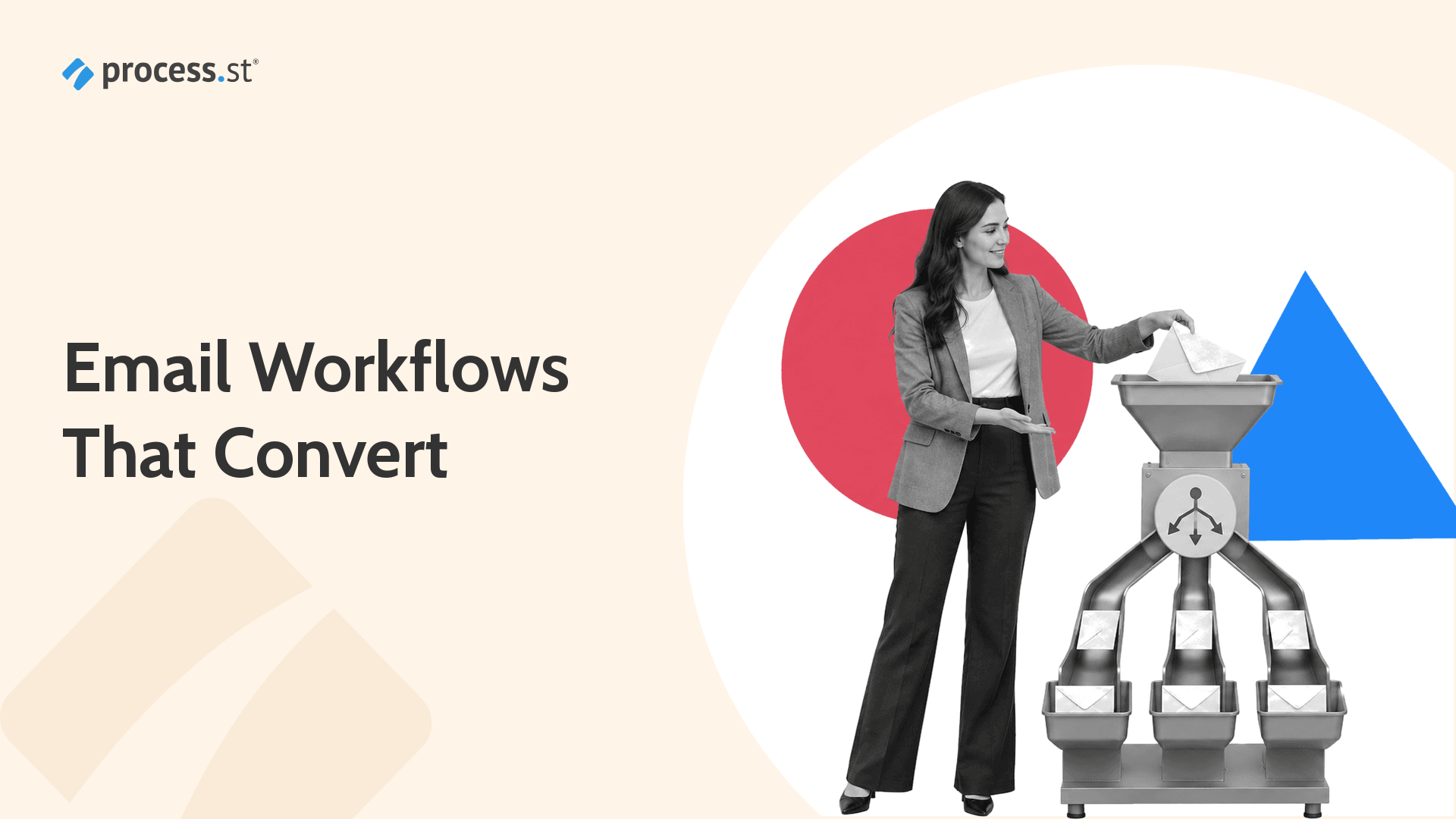
Email workflow routing subscribers into three automated nurture paths

An email workflow is an automated sequence of messages that starts when a contact meets a trigger, then adapts to that person’s behavior until they reach a goal or exit condition.

Unlike a one-size-fits-all email blast, a workflow can use consent, fit, intent, timing, and engagement signals to decide what each subscriber receives next. That makes email workflow automation useful for nurturing qualified leads without asking a marketer to send every message by hand.

Continue Reading

Take control of your workflows today

Choose which optional cookies to allow. You can change or withdraw consent here at any time.