





Digital workplace democracy is the use of communication, collaboration, and workflow technology to give employees meaningful input into decisions that affect their work while keeping ownership and accountability clear.
Done well, it supports improving communication, trust, challenge, and decision quality. It does not mean that every choice becomes a vote. The practical question is which decisions should invite broad input, who owns the final call, and how the rationale and follow-through stay visible.
Process Street has always operated as a distributed company, so reliable communication and information-preservation systems are operational necessities. That experience makes the tradeoff clear: technology can widen participation, but only a defined decision process turns employee voice into accountable action.
This article examines:
- what democracy means when applied to a workplace;
- the benefits and limits of employee participation in decision-making;
- how organizations have used democratic practices in real operating systems; and
- five ways technology can support employee voice without blurring authority.
Democracy in the workplace
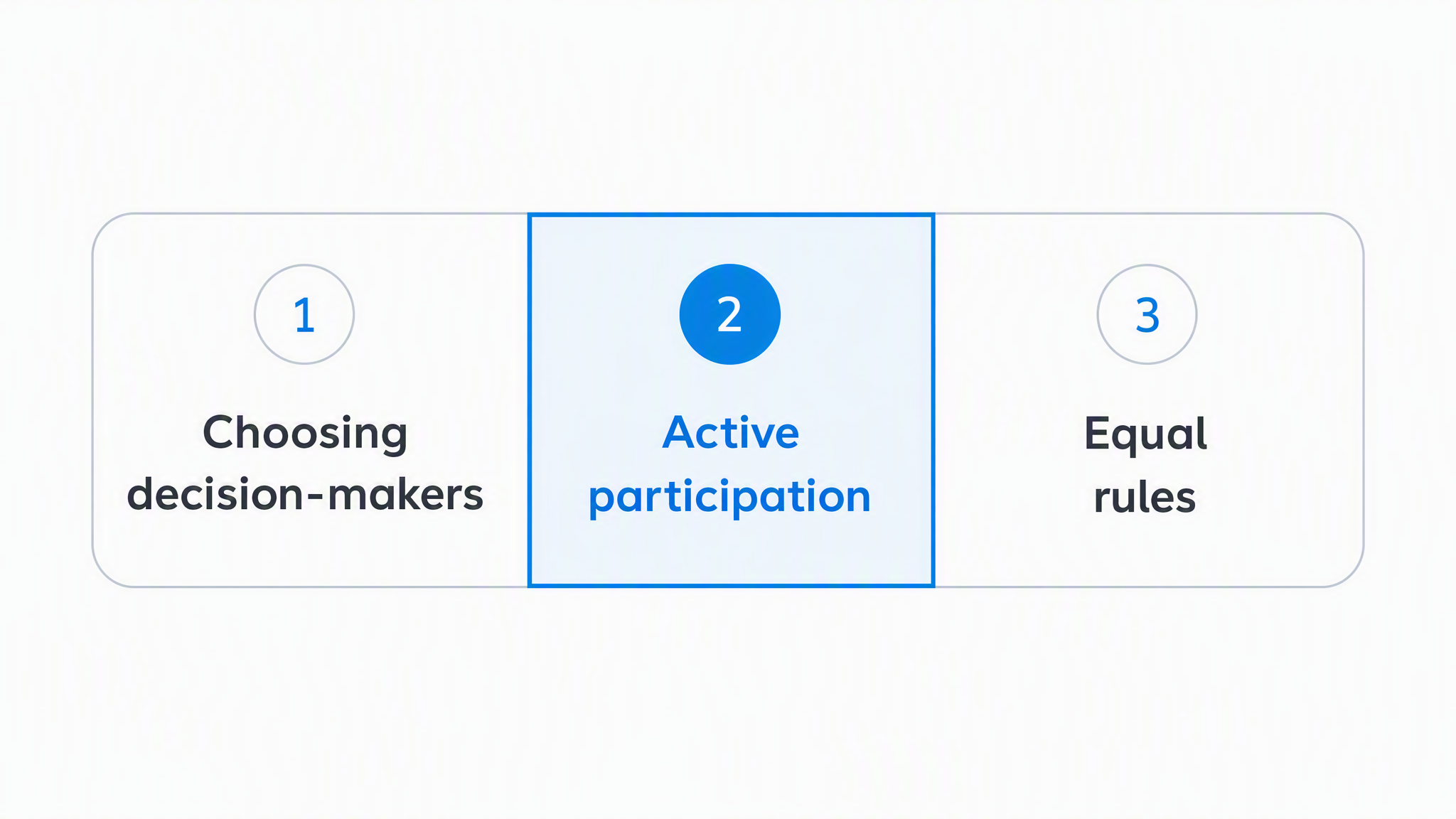
A practical way to design that participation is to treat decisions as a spectrum. At one end, leaders inform employees about a choice that is already settled. Next, they consult people before one named owner decides. Further along, authority is delegated to a team within defined limits. At the far end, members share formal voting or ownership rights. Each mode can be legitimate, but confusion between them is costly. If leaders ask for input after the outcome is fixed, employees experience consultation as theater. If a team assumes it has authority when it was only asked for advice, execution stalls.
Customer participation follows the same logic. Surveys, user research, advisory boards, and beta programs can improve a decision by adding evidence. They do not automatically transfer the final decision to customers. The organization still needs to define the question, select whose experience is missing, identify the owner, and explain how the evidence affected the result. Digital democracy is therefore less about universal voting than about deliberate access to information, voice, and review.
In this article, we’ll look at how it has been implemented in different organizations and consider the positives and negatives which have arisen.Benefits and limits of democracy in an organization
The Soviet Union I left behind was a dictatorship but the workplace was a democracy; America may be free but the workplace is a dictatorship
Companies have traditionally been authoritarian spaces
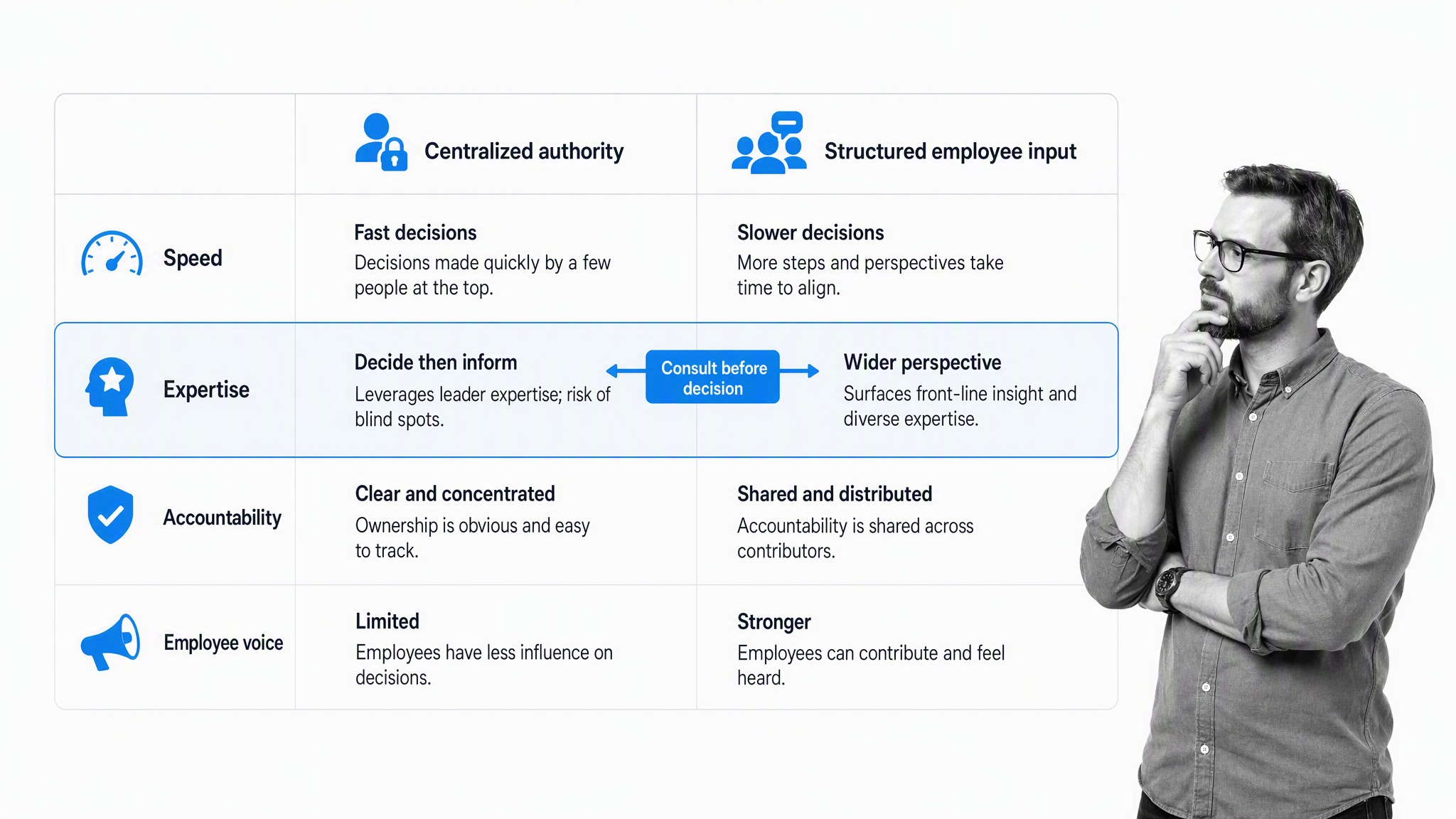
Wadhwa’s argument is largely summed up by this line around halfway through the piece:Business leadership is not a popularity contest; the best companies are run by enlightened dictators.He advocates for autocratic leadership in business but employs the word “enlightened” to do a lot of heavy lifting within the sentence. His examples include leaders who combined concentrated authority with strong personal demands. The useful point is not that harsh leadership is admirable. It is that speed and coherence sometimes require one accountable decision-maker, while unchecked authority can hide risks and suppress information. Yet, Wadhwa recognizes that an overly-authoritarian ruler can often cause damage and leave destruction behind them. He presents the example of the Cisco CEO John Chambers who was strongly autocratic in his organization. Chambers described to the New York Times how his style has changed. He hasn’t taken away his decision-making power, but he’s utilizing it differently and spreading that responsibility.
I’m a command-and-control person. I like being able to say turn right, and we truly have 67,000 people turn right. But that’s the style of the past. Today’s world requires a different leadership style , more collaboration and teamwork, including using Web 2.0 technologies. If you had told me I’d be video blogging and blogging, I would have said, no way. And yet our 20-somethings in the company really pushed me to use that more.
How IBM staff decided their review processes
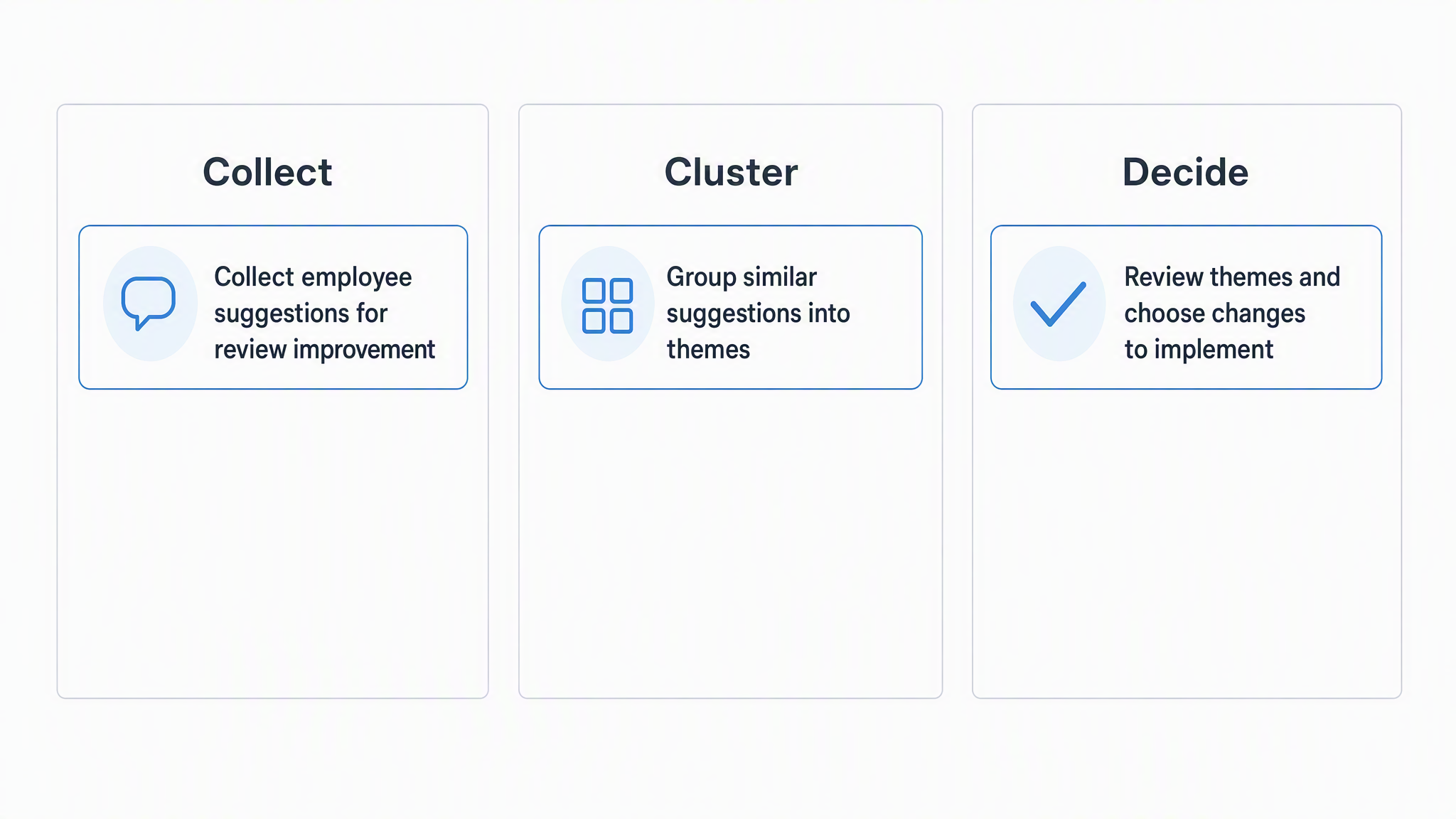
To revamp its performance review system, the HR department didn’t just pick a new system and implement it; it turned to its 380,000 employees in 170 countries to crowdsource the process. Gherson posted a message in July on Connections, IBM’s internal social media platform, asking employees to share their ideas for a new performance management system. The post received 75,000 views and 2,000 comments from employees.IBM then ran text analysis on all this feedback. Through this they managed to separate the suggestions out into themes. This made it easier for the internal team to sift through and begin to make sense of the proposals.
The employee suggestions convinced IBM to tweak its review system in ways it hadn’t necessarily expected. For instance, the company had floated the idea of asking employees to do a self assessment. “We learned through this process that our employees didn’t want that,” Gherson says. The department also did away with relative performance rankings,in which managers met with one another and compared their employees. And employees said that they wanted to receive feedback more frequently.This was not direct democracy, and the case is historical. Its enduring lesson is operational: large volumes of employee input become useful when an organization can collect them, cluster recurring themes, assign a decision owner, and explain what changed. Current AI tools can accelerate clustering and summarization, but human reviewers still need source traceability and responsibility for the final decision. Fundamentally, this is the incorporation of a democratic ethos. Formal employee representation also remains part of workplace governance. In France, a Social and Economic Committee is required from 11 employees, with broader responsibilities applying at 50 employees, according to official French guidance. In Germany, Eurofound describes works councils as the main establishment-level representation mechanism, although coverage has declined. These systems separate participation rights from day-to-day executive ownership. What effects can that participation have inside an organization?
Democratized decision-making can improve working conditions
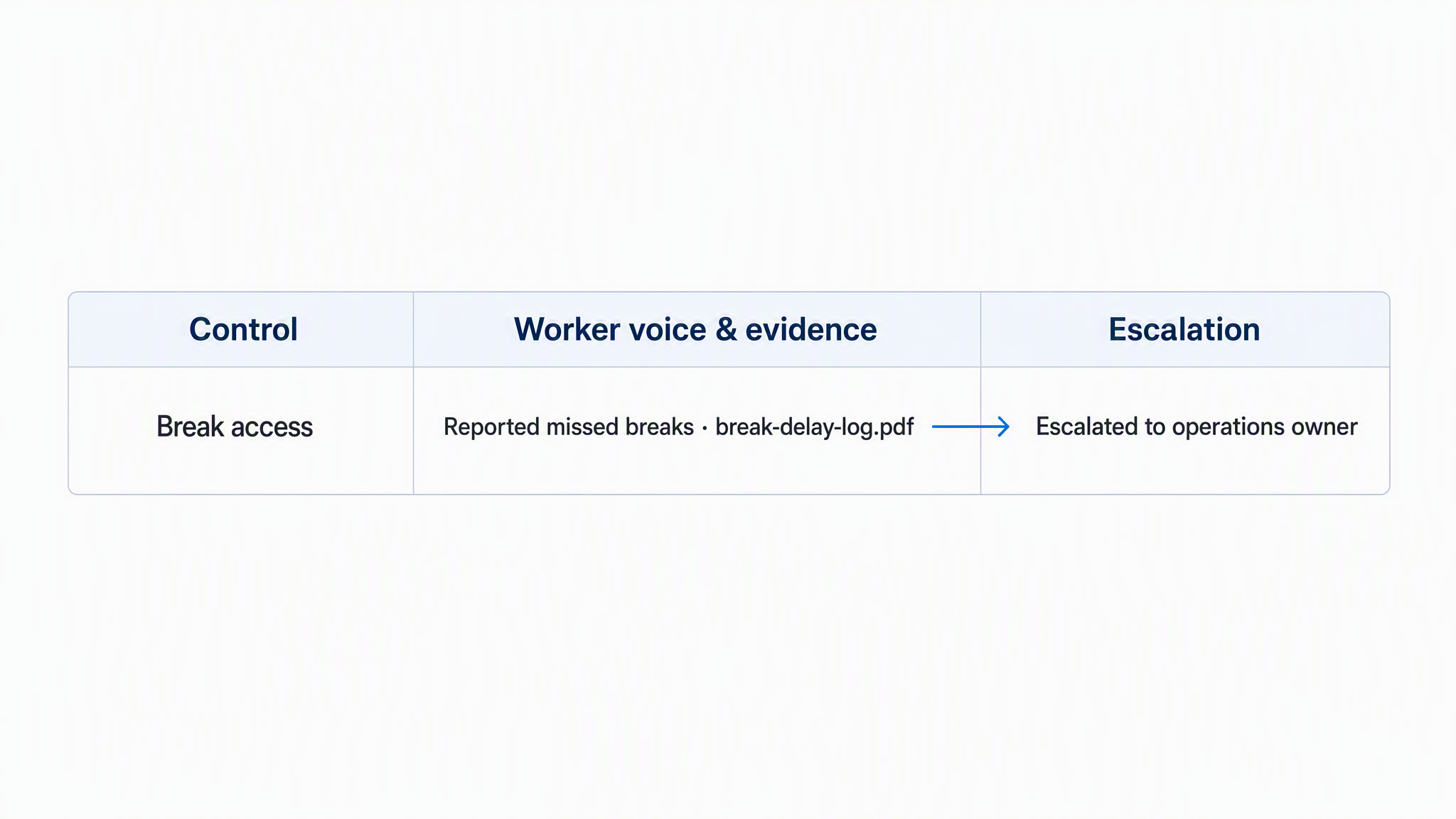
Employees closest to the work often see constraints and risks before leadership does. Meaningful employee voice gives those observations a route into decisions about workload, break access, safety, scheduling, job design, and escalation.
The mechanism matters more than the survey. Credible voice requires a safe way to report a concern, a documented review, one accountable owner, a defined escalation path, and visible follow-through. Asking for input without explaining what happened can weaken trust because participation becomes performative.
A meta-analysis of 60 studies found that direct employee participation was associated with job satisfaction, involvement, commitment, and a supportive climate. That evidence supports careful association language, not a claim that participation automatically fixes every workplace.
Employee input also has limits. A group may lack strategic context or specialist knowledge. Deliberation can slow urgent decisions. A workable system therefore distinguishes consultation from delegated authority: affected employees contribute evidence and objections, while a named owner remains responsible for deciding and acting.
That balance improves legitimacy. People do not need to win every argument, but they should be able to see that material concerns were heard, evaluated, and either acted on or answered.
The effects of democracy on an organization
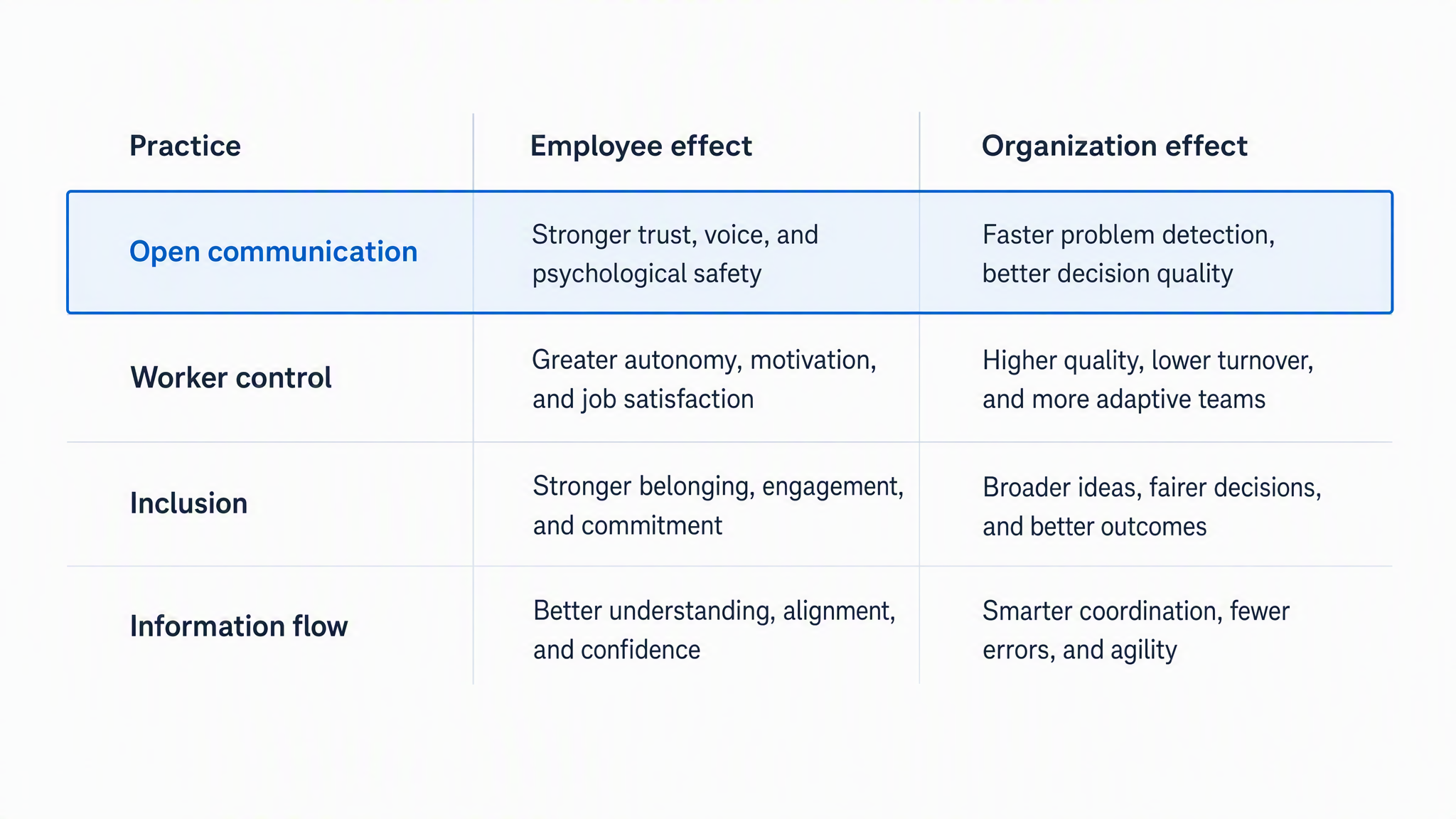
- Open communication internally and externally
- Fuller participation of women and underrepresented groups
- Open governance
- Devolved power and responsibility for decisions
- Individual freedom of expression and choice
- Power is related to relationships versus structure
- Meaningful work
- Workplace democracy is not possible without “unalienated and meaningful work”
- Gender and ethnic equity
- Tolerance, respect, inclusion of women and underrepresented groups
- Less managerialism
- Psychological ownership of activities depends on worker contributions, knowledge and competence.
- More worker control over the functions that impact them
- “Reduce alienation, create a solidarity community based on work, strengthen attachments to the general good of the community, weaken the pull of self-interest…[and], stimulate citizenship in the government of the state itself (Dahl, 1985, p. 95). Individuals have control over their work tasks (Luhman, 2006)
- Improved trust and less fear
- Legitimacy for workers to question control
- Enhanced flow of information
- Increase in organizational commitment, personal responsibility, ability to change (Harrison & Freeman, 2004)
- Worker voice in job design, work requirements and quality
- Because worker groups may not be privy to organizational strategies or have the required skills and knowledge they may make incorrect or less than advantageous decisions. Worker group decisions may take an inordinate amount of time and may disrupt normal operations (Harrison & Freeman, 2004)
- Flatter, team-based organization structures. Non-hierarchical controls
- Educate through participation thus inculcating democratic values in the citizens of the workplace (Grady, 1990)
The historical literature uses broader democratic language than most operators need. Its value is in the mechanisms underneath that language: wider access to information, legitimate challenge, meaningful control over work, and a clearer relationship between contribution and authority.
These mechanisms are mutually reinforcing. Employees cannot participate intelligently without relevant context. Access to information has little value if people cannot question assumptions safely. Voice becomes frustrating when nobody owns the response. Authority becomes fragile when the people affected by a decision cannot see the criteria or the route for appeal. A functioning system connects all four.
Four practical themes stand out:
- Greater democracy results in more inclusion. The voices of otherwise marginalized groups tend to be more fairly represented in organizations which incorporate elements of democratic decision making. If your consumers span a range of lived experiences, it may be advantageous to have that represented in your team.
- There is greater effort and emphasis on improving organizational structures. Partly to facilitate the democratic influences and partly because those workers feel empowered to want to improve the processes they work within. This increases personal responsibility and creates a culture of accountability, possibly serving to stem normalization of deviance.
- Democratic decision making can be slower and certain specialized topics do not lend themselves to democratic decisions. Any democratically run organization would need to highlight where democracy assists and where it is likely to fail. This presents a difference between enacting representative democracy and direct democracy – or raises how the two could be balanced.
- Workplace democratic practices are difficult for monotonous and repetitive tasks. These democratic structures do not confer advantages when used in these spaces. Like we saw when discussing The Samsung Way in our article on Kaizen, workers at skilled factories were organized very differently to workers at unskilled or less-skilled factories.
The democratic ethos in practice and how you could use it
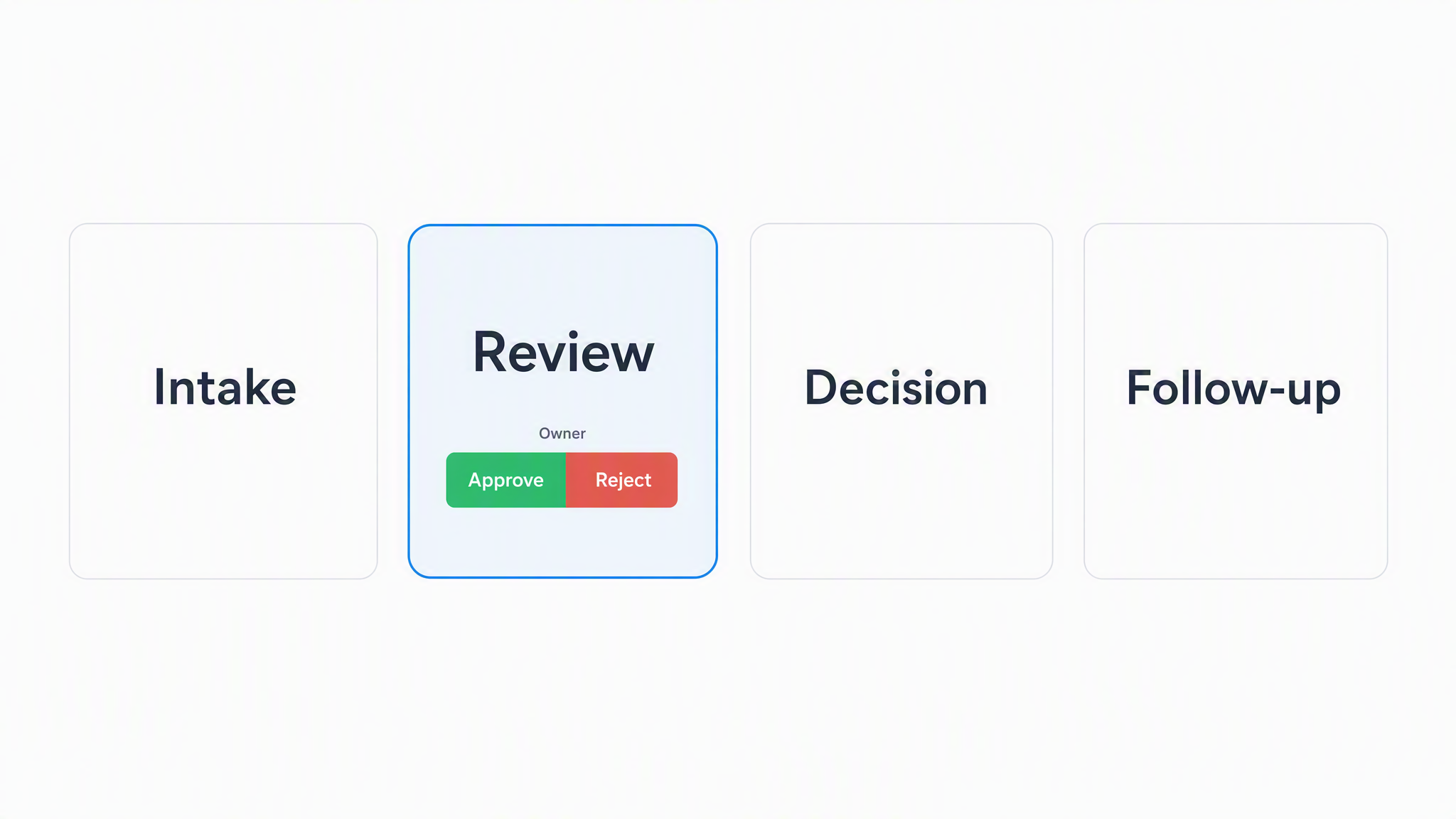
Workplace democracy works best as a decision system, not an open-ended invitation to debate everything. The operating model needs to state when input is required, who decides, and how action is tracked.
Classify the decision
Separate decisions into four useful types: consultative, delegated, consent-based, and leadership-owned. A consultative decision invites evidence and objections before one owner decides. A delegated decision transfers authority within clear boundaries. Consent-based decisions proceed unless someone identifies a material risk. Leadership-owned decisions remain with an accountable executive because speed, confidentiality, or legal duty requires it.
Invite input from affected employees
Ask the people who will execute or experience the decision before the deadline. Explain the problem, the constraints, and what kind of input can still change the outcome. Psychological safety matters because employees will not surface inconvenient information if disagreement carries a penalty.
Assign one accountable owner
Participation should widen the evidence base, not dissolve responsibility. Name the person who makes the final call, the criteria they will use, and the date by which a decision is due. When expertise is concentrated, identify the specialists whose judgment carries extra weight.
Record the decision and rationale
Keep the proposal, evidence, objections, final choice, decision owner, and conditions for reconsideration in one durable record. Chat can support discussion, but it is a weak system of record because context disappears into channels and threads.
Close the loop and track action
Tell contributors what happened and why, then assign the follow-up work. A workflow collaboration system can capture proposals, route structured review, use approvals for formal decisions, assign owners and due dates, and retain an audit trail. That turns employee voice into visible execution rather than another survey that disappears.
The same principles strengthen ordinary feedback practices. Make cross-functional ownership visible, discuss how work was completed rather than only what was completed, use one-to-ones for sensitive input, categorize recurring themes, and show which actions followed from them.
For strategic choices, a short options poll can expose preferences and objections without pretending that the majority automatically decides. Publish the options, constraints, and decision criteria; let participants explain the strongest risk in each option; then have the accountable owner record the choice and response. This preserves the informational value of a vote while keeping responsibility explicit. It also creates a useful record for revisiting the decision when assumptions change.
5 ways technology can facilitate democratic input
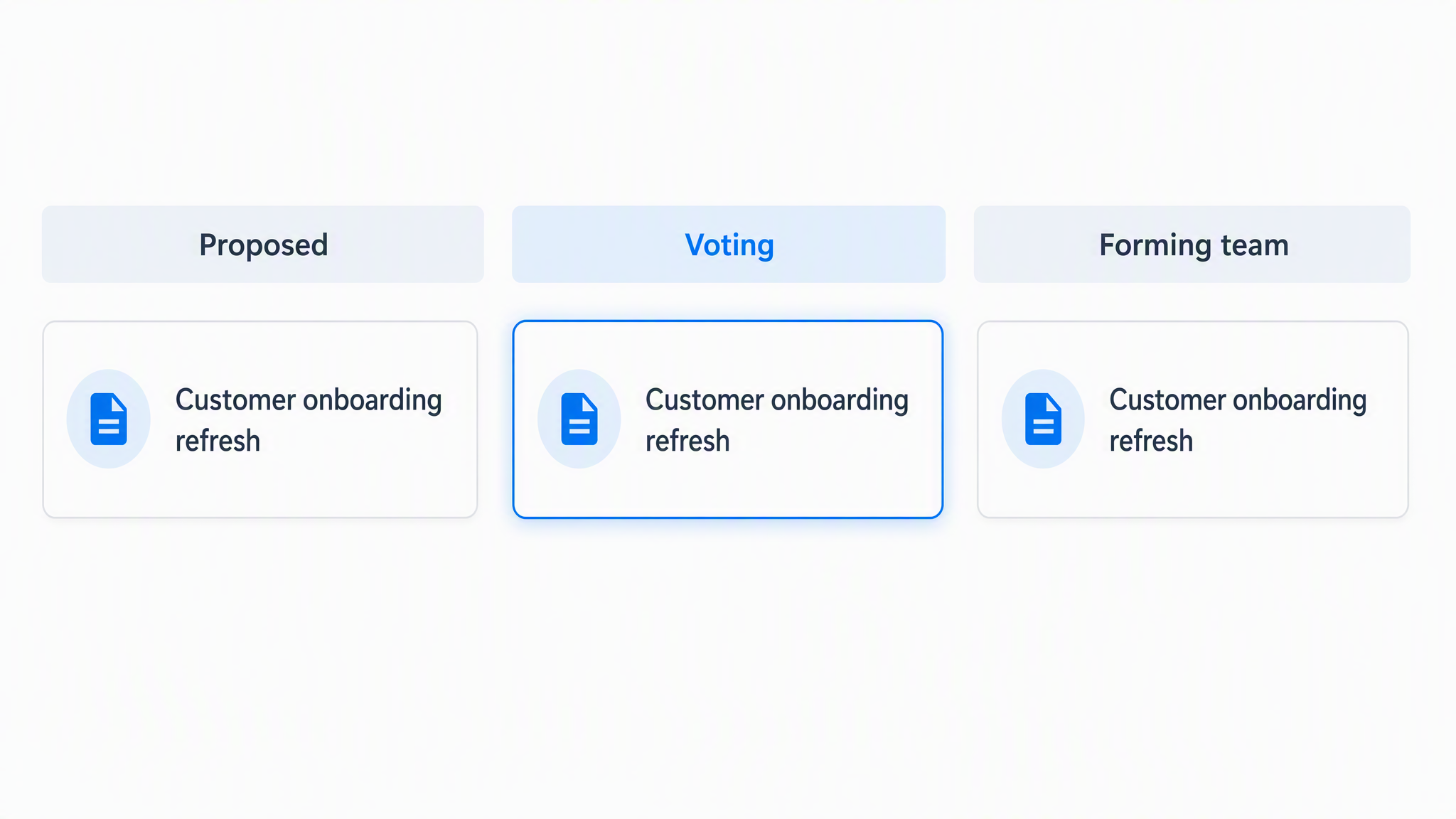
Technology does not create workplace democracy by itself. It lowers the cost of gathering evidence, makes decision state visible, and gives follow-through an owner. Five mechanisms are especially useful.
Structured intake for proposals and concerns
Use a defined form or workflow for ideas, risks, grievances, and improvement suggestions. Ask for the affected process, evidence, urgency, and desired outcome. Lightweight survey tools can gather broad sentiment, while a governed workflow is better for issues that need review, escalation, and action.
Transparent decision logs
For consequential decisions, publish a durable record showing the owner, status, evidence, objections, rationale, and next review point. Slack or Microsoft Teams can host discussion, but the decision log should live somewhere designed to preserve state and responsibility.
Shared operating dashboards
Participation improves when people can see the same operating facts. Give teams access to the metrics, service levels, and constraints relevant to their work while respecting privacy and role-based access. Buffer’s public metrics remain a useful transparency example, but transparency should create shared context, not employee surveillance.
Human-reviewed AI synthesis
IBM’s historical performance-review redesign showed the value of clustering thousands of comments into themes. Modern AI can summarize large feedback volumes, group recurring issues, and surface minority viewpoints that might otherwise be missed. The output should link back to source comments, and a human decision owner must review it. A 2026 meta-analysis found that algorithmic HR decision-making was associated with lower perceived justice, fairness, and trust, which makes human accountability essential.
Workflow orchestration and project marketplaces
Once a decision is made, route approvals, escalation, evidence, and follow-up through a workflow. Temporary project marketplaces can also make proposed work visible and let employees volunteer for teams. Zappos’ Role Marketplace is a historical example of that idea, not proof that Holacracy is a universal operating model. The durable principle is to expose opportunities and decision state without abandoning ownership.
Specialist deliberation tools such as Loomio can support proposals and structured group decisions. General communication tools remain useful, but the democratic value comes from the rules around input, ownership, records, and action.
Visibility must still be bounded. Salary formulas, operating metrics, and decision rationales can strengthen shared context, while personal grievances, health information, legal matters, and security-sensitive data need restricted access. Role-based permissions should follow the same governance principle as the decision itself: include everyone who needs the information to contribute or act, and document why access is limited for everyone else.
The review cadence should match the decision. A daily operational issue may need immediate triage and a short resolution record. A policy change may need a consultation window, legal review, and a scheduled reassessment. A strategic experiment may need explicit success criteria before a team invests further. Using one cadence for every kind of input either creates bureaucracy around small choices or leaves consequential choices underexamined.
Measure the health of the system through behavior, not participation theater. Useful signals include whether employees know where to raise an issue, whether owners respond within the promised window, whether minority concerns remain visible in summaries, and whether completed actions link back to the original evidence. Response rates can help, but a high response rate does not prove that people felt safe or that leaders acted.
Digital democracy and digital improvement
Derina R. Holtzhausen’s historical research linked workplace democracy with better trust, information flow, communication, and reduced fear. Newer participation research also finds positive associations with satisfaction, involvement, commitment, and supportive climate.
Those outcomes do not require every company to become a cooperative or every manager to surrender authority. Digital workplace democracy can begin with a narrower commitment: affected employees can contribute evidence, challenge assumptions, see who owns the decision, understand the rationale, and verify that agreed action happened.
Nathan J. Robinson captures the spectrum well in Current Affairs: workplace democracy can range from supervisors caring what employees think, through voting for supervisors, to forms of self-management. Most organizations will operate somewhere between those points.
The useful test is not whether a company calls itself democratic. It is whether its systems improve employee voice, communication, trust, and accountable decision-making without hiding who has the final responsibility.