






A bullet journal gives you one place to capture tasks, events, and notes, then review what actually happened. For work, that means you can see recurring activities, missed commitments, and useful routines instead of relying on memory.
The strongest bullet journal ideas do more than organize a page. They help you create routines by identifying repeatable work, testing a better way to do it, and moving mature patterns into a documented workflow when the details outgrow paper.
What is bullet journaling?
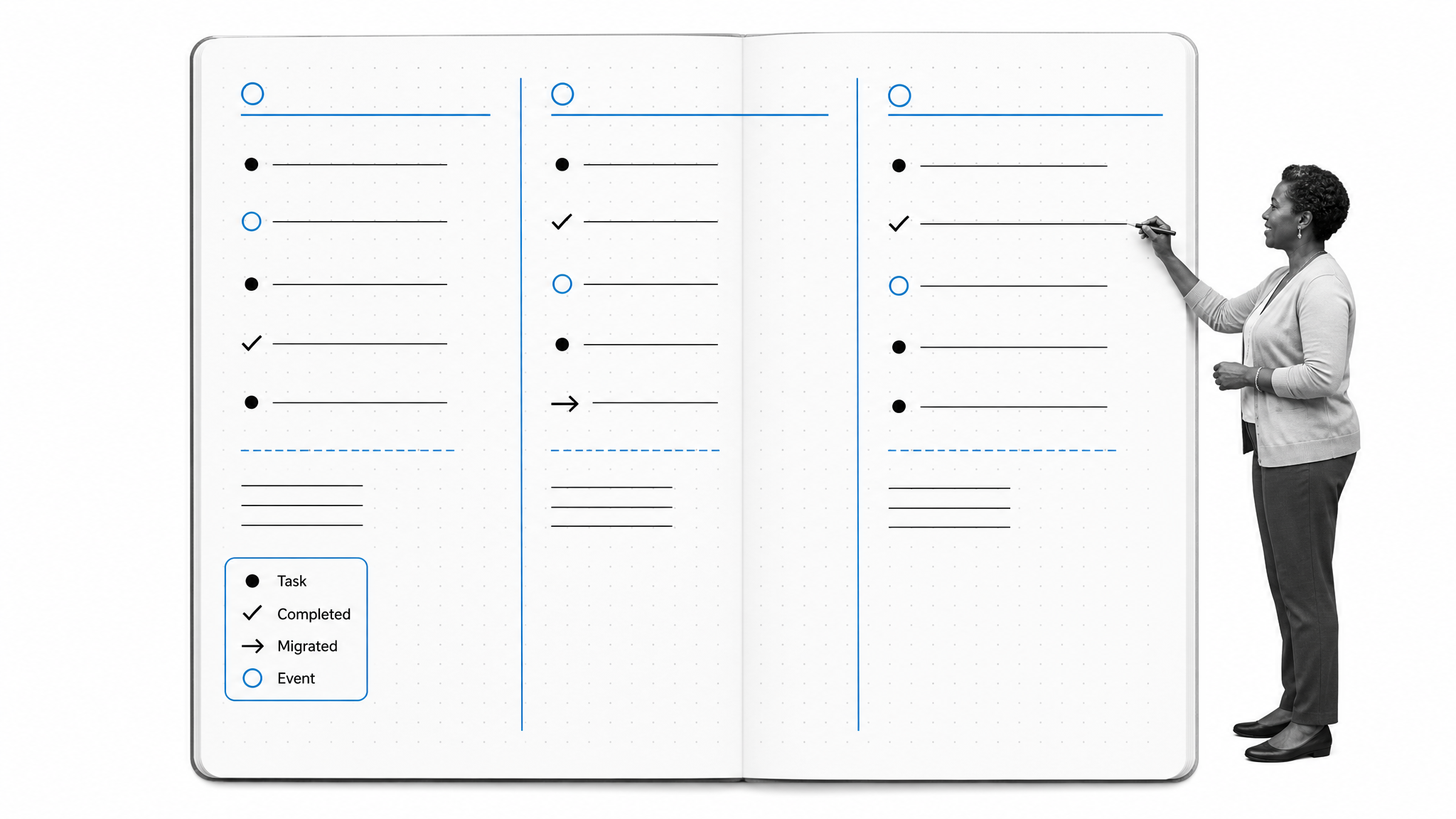
According to Ben Mulholland:
A “bullet journal” lets you record, track, and organize your tasks, events, and notes no matter where or when you need to add to them.
The aim is to store all of this in a small journal which you can carry with you, organize your tasks using a calendar, and use language that lets you summarize everything in a few short words.
A bullet journal is a living document which evolves over time.
How you set up your journal will differ depending on your specific needs, but it typically follows the structure of having these 4 sections and 3 features:
- The index page
- The future log
- The monthly log
- The daily log
- Distinguishing symbols
- Task migration
- Collections
Probably the best way to start is to allocate space within the journal for all these different sections – without actually filling the sections in with too much structural detail. This allows you to be flexible as you build out your journal. Some days or months may require more space than others, for example.
The index page
This comes at the very beginning and is just a space which acts as a kind of table of contents. You can leave about 2 pages blank for this at the front of your journal.
As you go forward, you can fill in this page with your contents and the relevant page numbers for each.
The future log
This is like a really short overview calendar of what’s coming up over the next year. It’s kind of like the calendar you might hang on the fridge.
You can leave about 4 pages after the index for the future log. This can then be split up by having space for 3 months on each page.
In each month you can record important information like birthdays and anniversaries. Good, helpful overview data.
The monthly log
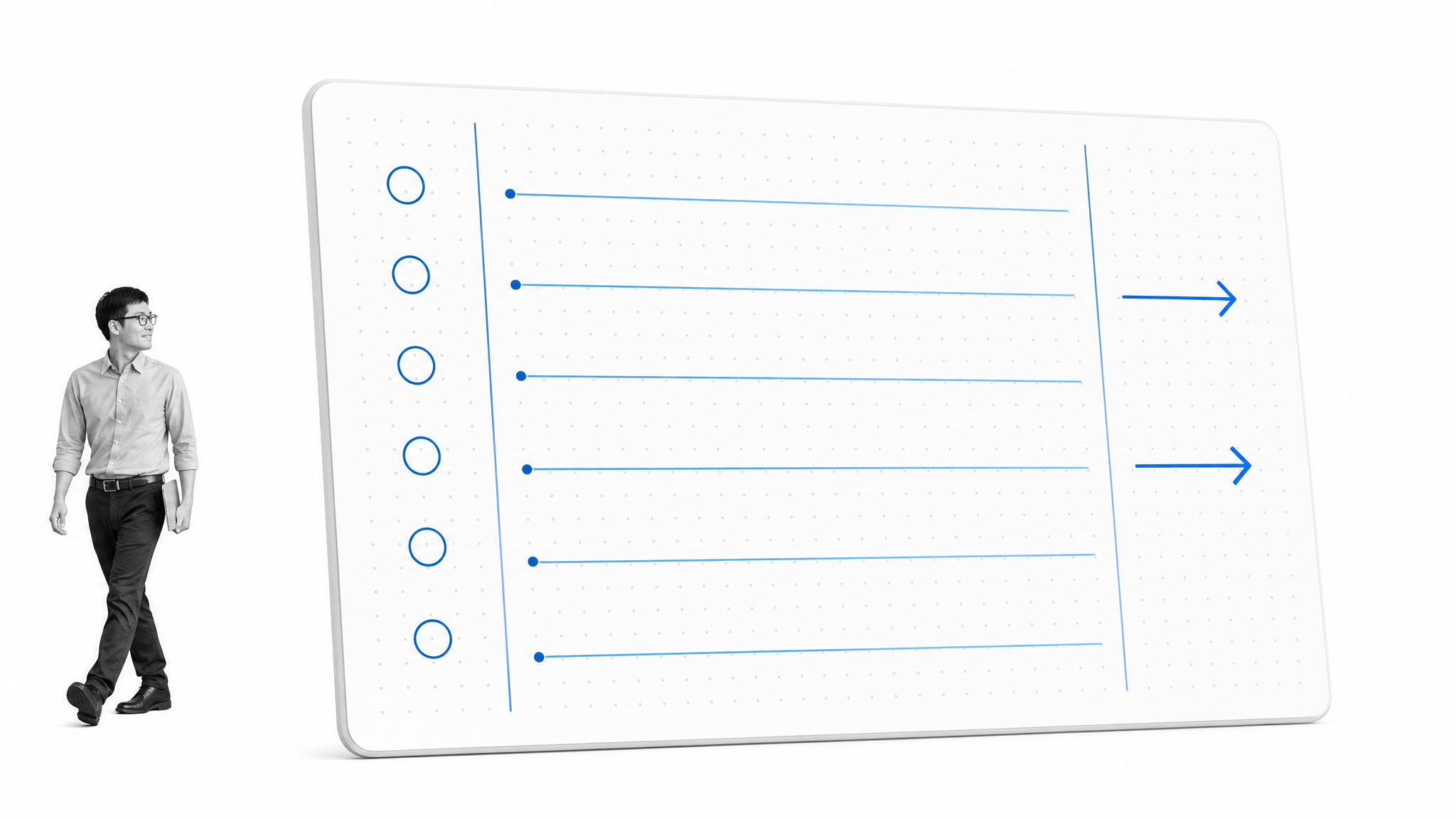
You create a monthly log at the beginning of each month, and each month should take up about 2 pages.
On the first page, you include the name of the month at the top and then the various dates of the month in a numbered list going down the page.
You can include the date (1st) and then the corresponding day of the week (M for Monday, or Tu for Tuesday). This list allows you to record any important information for that particular date in the space on that line.
The second page for each monthly log should be left blank, so that you can use it for notes and spillover information. This gives you leeway and flexibility.
The daily log
This is the bulk of your bullet journal. This where all the good stuff happens.
Some bullet journalers will recommend to have each day account for around 1/3 of a page. In these systems, you’ll make a short bullet pointed list of the different tasks you plan to do that day.
Other systems will be bigger than this. Some people might use their bullet journal for more of a health focus. Often this involves having an initial bullet pointed list of planned tasks for the day, and then a section or two below where you record what you’ve eaten that day and/or what exercise you have done that day.
This gives the daily section of the journal both a planned component and a dynamic component. The bullet pointed tasks are done at the beginning and are used to structure the day. Whereas the section for food or exercise is something you fill in during the day as and when new information arises.
One useful system is to add dynamic detail to the daily log by recording the steps used to complete each task from the initial list.
At the end of each day, or at the beginning of the next day, update your index page so it can be an accurate display of contents.
Distinguishing symbols
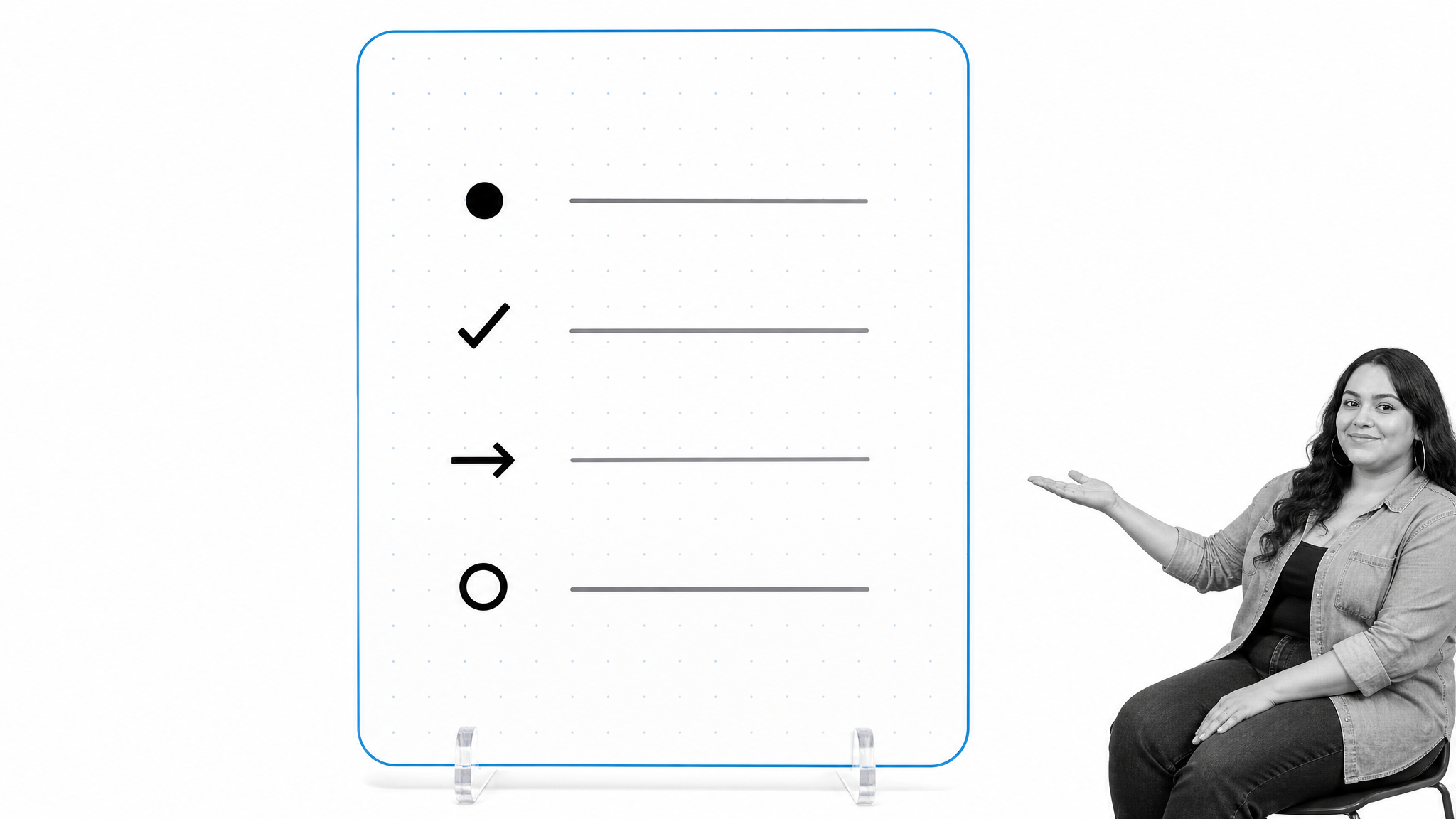
One important thing about bullet journals is making them compact.
A good way to facilitate this is to have a series of symbols which act as a guide. Traditional ones might include:
- Bullet points for tasks
- Hollow circles for events
- Dashes for notes
- Stars to denote important items
- Exclamation marks for inspirational elements
- An eye symbol for something which requires more research
- Smiley or frowny faces to record your mood
You can also add way more information if you want to!
For example, if you’re putting a lot of effort into exercise then you could include a score at the end of each day for how happy you were with the amount/quality of the exercise you did. It might look something like this:
Ex: 7
That example records a 7/10 exercise score for the day.
You can give yourself scores for a whole range of different metrics – whatever is important for you. You can score metrics by day, or go further and score how well each important task was completed.
Having metrics which you can track later is really useful for identifying trends and being able to aggregate this vast amount of information in future.
Task migration
When you complete a task, you should put an X through the symbol at the beginning of that task.
This turns your bullet journal into a checklist while you’re using it, but it also shows you what you failed to complete.
So, what do we do with tasks that we failed to complete?
Ben Mulholland splits these into three different categories:
- Incomplete tasks that aren’t worth your time
- Incomplete tasks that are worth your time in the short-term
- Incomplete tasks that are worth your time in the long-term
Number 1 tasks can have a line drawn through them. This symbolizes throwing them in the trash.
Number 2 tasks can be migrated to another daily log or another monthly log, depending on how urgent they are. You can use this symbol to show they have been moved forward in the short term: “>”.
Number 3 tasks can be migrated to the future log. These are things which you plan to getting round to completing at a yet undefined date. You can put this symbol next to them: “<“.
Collections
Collections are where the connection to business process management becomes useful.
You leave a space in your journal at the back for projects or common but complicated tasks.
Once you realize you have a complicated task which you’re doing regularly, you can stop recording it in depth in your daily log and instead simply reference the collection – which is where you’ll be recording it from now on.
For example, writing an article can span several days and contain enough steps to overwhelm a daily log. A dedicated article Collection keeps the detailed sequence together while the daily log points to it with one short entry.
This declutters the daily log and leaves space for other activities or information worth recording.
The collections section enables you to group recurring tasks by subject, rather than by date. Simply referencing the collection in the daily log, and referencing the page number of the relevant date of the daily log in the collection.
Process management for more productive work

Process management starts with the same instinct as bullet journaling: make work visible, break it into manageable parts, and learn from what happens. A journal captures the sequence as it unfolds, including the detours that a polished procedure often hides. That makes it a useful discovery tool. You can see which steps recur, where work waits, what information is usually missing, and which decisions change the result. The goal is not to formalize every task. It is to recognize the work that is important, repeated, or difficult enough to benefit from a dependable method.
Process management is all about looking at large tasks which need doing and then figuring out all the smaller tasks which need completing in order to do the large task.
Then you have to work out what order the small tasks need to be done in, in order to complete the large task best.
What you end up with is a series of steps. A really simple workflow for writing an article might be:
- Have an idea for an article
- Do SEO research for a keyword for the article
- Read lots of content as research for the article
- Make a plan for the article
- Discuss the plan with someone
- Write a first draft of the article
- Get feedback on your draft
- Write the finished article
- Format the article ready to be published
Now, there are loads of subtasks even within each of those steps. How do you do SEO keyword research? How should the article be formatted? Lots of subtasks.
But, if you follow this process you will have a well formatted, well researched, well structured, well optimized article ready to publish.
Maybe other people aren’t following all these steps? Maybe they’re not doing their keyword research? Maybe they’re not reading widely enough about the topic? If they aren’t following all these steps, then the quality of their final product may be worse than someone who did follow all these steps.
By breaking a large task down into all of its important steps you can create a standardized repeatable process to follow to do your best work every time.
Business process management is about creating these detailed processes for each big task which someone has to perform in an organization. Everyone who has to perform that task uses that same standardized process to make sure there is consistency and quality from everyone.
Once you have this documented process, you are able to make tweaks and improvements. This lets you optimize the process to make it faster or improve the output.
If you’re using a tool like Process Street then you might be able to automate certain steps of a process. Once you have the process in place, improving it is the obvious next step and there is a range of great software out there which can help you to do that.
The same discipline works for a team process or a personal routine: document the steps, run them, review the result, and improve what happens next. Keep the first version small enough to use. A process that lists every possible exception before anyone has tested it is harder to learn from than a short sequence with a clear outcome. The journal supplies the evidence for later refinement: actual timing, forgotten steps, repeated questions, and the score you gave the finished result.
Turning bullet journals into repeatable processes

A bullet journal can help you identify processes and find a better way to run them. Think of it as lightweight process discovery for your work and life. The useful signal is repetition. A task that appears once may need only a reminder. A task that appears every week, expands into the same nested steps, and earns uneven scores deserves closer attention. The journal shows both the intended activity and the way the activity really happened, so the eventual process can reflect practice instead of guesswork.
The benefit of this is that it can help you add huge amounts of detail to the way you approach tasks, while also reducing the amount of information you have to include in your bullet journal.
This makes your work better and it makes your bullet journal better.
Use the bullet journal to track your activity plus desired activity
Start by recording more than the tasks you want to complete that day.
Put the planned tasks at the top of the daily log. Below them, record the steps it takes to complete each task with nested bullet points, adding the information as the work happens. For example:
- Write draft of article
- Research the article – 60
- How people are using bullet journals – 30
- How people are using bullet journals for work – 30
- Write an overview for each section
- Intro – 10
- What is bullet journaling – 20 (60)
- Research the article – 60
That snapshot captures the beginning of a dynamic section for writing an article draft, up to the point where the process-management overview begins.
The research revealed two angles to investigate. Each subtask received a planned duration, followed by the actual duration in brackets when the timing differed. The bullet-journaling section took longer than planned because it needed more detail. Adding the subtasks together showed that the research stage took an hour.
After the overall task is complete, add a score out of 10 for how well the method worked.
Sometimes the work takes too long. Other times the plan turns out to be incomplete. On a good day, the sequence flows without friction.
The final score records that result.
Together, these notes show what happened, how long it took, and how effective the approach felt.
This is all very valuable data.
Review this activity and find workflows

This is a short section, but an important one.
At the end of the month, review the tasks completed each day and find the ones that needed extra step-by-step detail. This is a simple way to identify complex work.
Note which tasks received a bullet-point breakdown and how many times each one appeared.
That count reveals the most frequent complex workflows.
You will probably find only a handful of frequent complex workflows. Prioritize them by whether they support work or personal life, how difficult they are, how often they recur, and whether their completion scores are consistently strong or weak.
If one of these workflows seems important, then it moves to the next stage.
Test the workflow and create a master process
Once you’ve identified a recurring workflow which would benefit from being standardized, you can stop doing it in your daily log. Instead, you can create a section in your Collections where this task will now be documented.
This saves you space in your log and allows you to group all the attempts at this task together.
Take the writing workflow mentioned above.
The daily log can now use one short bullet: “Writing workflow.”
The related Collection holds the detailed writing process and its steps.
Keep recording the process in the Collection until a stable structure emerges. You could test the process up to 10 times, recording an effectiveness score out of 10 after each run.
Your process will naturally improve as you go because you’re thinking more about it and how to troubleshoot it when you give yourself a poor score.
When the broad structure handles the task reliably, you have a documented process to follow in the future. Give each test a consistent outcome, such as a published article, an approved design, or a prepared weekly plan. Then compare the runs using the same simple measures: time, quality, rework, missed steps, and confidence. Consistent evidence makes it easier to tell whether a change improved the method or merely made one run feel different.
This is the point where a paper Collection can move into Process Street, where the process can be run repeatedly and extended without crowding the journal.
Run mature routines in Process Street
A bullet journal works because it stays simple. Keep quick capture, prioritization, and reflection on paper. When a recurring task needs detailed instructions, approvals, evidence, assignments, or reliable handoffs, move the stable version into a system designed to run it.
Process Street is a Compliance Operations Platform with Docs and Ops capability areas plus built-in AI. Docs keeps policies and procedures clear; Ops turns them into workflows that people can run, assign, track, and improve. The journal remains the compact daily index while the operational detail lives in the workflow.
For a writing routine, the daily log might say only “Run pre-publish workflow.” The workflow itself can hold the instructions, form fields, required evidence, approvals, and assigned work. That gives you a short journal entry without losing the controls that make the result consistent.
The same pattern works for a longer recurring activity such as preparing and managing a short-term rental. The journal can schedule the run while the workflow carries the full sequence across several days or people.
As you run a workflow, compare the result with the observations in your journal. Update the documented process when a change consistently improves speed, quality, or compliance. Built-in AI can help create and refine workflow content, and Process Street can connect operational work with other systems when a handoff should be automated.
Bullet journal ideas for work and life
These bullet journal examples for work and personal life show how a short analog entry can reveal a process worth documenting. A journal may remain the best daily control surface, while time management tools and workflow software handle scheduling, collaboration, or detailed execution when the routine grows.
Consider three recurring activities:
- You’re a freelance designer and you do lots of graphic design and creation of marketing and branding materials for your clients.
- You’re on top of your health and you try to keep track of your diet via a weekly meal plan.
- You regularly need to present a product, proposal, or idea to other people.
Start by recording the activity in the bullet journal and expanding the steps that actually require attention. After several runs, look for the stable sequence, the choices that affect quality, and the information another person would need. Those observations can become processes like these:
A freelance designer needs a logo process
A designer might begin with a single daily bullet for a client logo. The dynamic notes soon reveal recurring work: gather the brief, confirm the audience, collect references, sketch directions, present concepts, record feedback, and prepare final files. Track planned and actual time beside the stages. If revisions repeatedly expand after presentation, the journal has identified a handoff or approval step that needs clearer criteria.
You need a weekly meal planner to structure your diet
A weekly meal plan can stay personal and lightweight while still benefiting from repetition. Journal what was planned, what was actually prepared, which ingredients went unused, and which days required a faster option. After a few weeks, the repeated pattern becomes a practical routine for choosing meals, checking supplies, shopping, preparation, and review. The process supports the plan without turning every meal into administration.
A salesperson needs a process for creating presentations
A salesperson may notice that every important presentation requires the same preparation: understand the audience, choose the core problem, gather proof, build the narrative, rehearse objections, and confirm the next action. A journal can capture how much time each stage takes and what feedback follows the meeting. Once the pattern is stable, a documented workflow helps preserve the preparation even when the audience, product, or presenter changes.
A useful routine may start as a few bullet points, become a Collection after several repetitions, and eventually become a detailed workflow. Keep reviewing the evidence. Optimize the process when the same friction appears, delegate the parts that need an owner, and automate only the handoffs that are stable enough to trust.
Which recurring activity in your work or life would become easier if you tracked it for a month and turned the pattern into a structured process?