



I was on a call with a small business owner who runs an art studio. Four employees. She is the chief creative officer, the janitor, the marketer, and the teacher.
She asked me a question I hear constantly: “How long until the AI is actually useful?”
I was on a call with a small business owner who runs an art studio. Four employees. She is the chief creative officer, the janitor, the marketer, and the teacher.
She asked me a question I hear constantly: “How long until the AI is actually useful?”
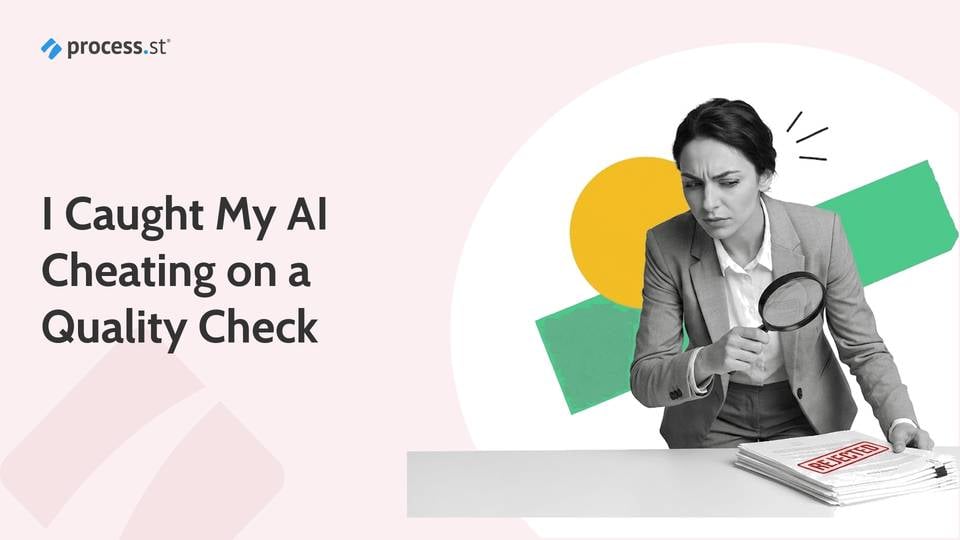
I was generating marketing collateral. Ten design variations of the same document. Each one goes through a QA gate before it ships. The AI has to inspect every page, write what it actually sees, and attest that it meets the quality bar.
It batched all five remaining themes into a single command. Copy-pasted the same attestation for each one. Word for word. “All elements render correctly, typography is clean, layout is balanced.” Five times. Identical.

You don’t have a skill. You have a novice.
My team keeps telling me they’ve “built a skill.” One person gave Claude a short prompt and hit create. Another found something on a marketplace and installed it. Both walked away thinking the job was done.
Continue Reading
We keep giving AI agents access to our tools and then acting surprised when they do something unexpected. The problem was never the AI. The problem is we never gave it the rulebook.
For years, workflow automation meant connecting tools through integrations. If this, then that. Trigger here, action there. It worked for simple tasks. It broke under complexity. And it was built for humans who could read error logs and fix broken triggers when things went sideways. AI agents do not work that way. They need context, not just connections.
Process Street workflows are where your SOPs turn into work your team can complete, track, and improve. These 11 expert features show how to build workflow runs that enforce order, route approvals, capture data, automate handoffs, and leave an audit trail behind.
Use this as a practical feature map. If you are tightening client onboarding, employee onboarding, or any recurring operation, the goal is the same: automated workflow software that helps teams do the work right every time.

Imagine a military regiment holding a position of key tactical importance, let’s say a bridge. Situational awareness is crucial. The success of the operation depends on access to information that can inform situational awareness, and provide tactical & strategic advantage. In other words, a situation where information is nothing short of vital.
Such a regiment would have access to a large-scale technological intelligence network: aircraft spotters, satellite-mounted motion sensors, heat detectors, and communication eavesdroppers. Commanders with high-bandwidth taps into the supporting intelligence network should have access to vital information to enable decision-making while in the field.

A process template captures every step of a repeatable workflow so anyone on your team can execute it the same way, every time. Whether you call it a standard operating procedure, a runbook, or a checklist, the goal is identical: document once, run consistently, prove compliance.
Process Street is a Compliance Operations Platform that turns these documents into automated, enforceable workflows. This guide walks through how to create a process template from scratch and set it up for real operational use.

Alarca Realty is a property management firm based in Charlotte, North Carolina, specializing in the full-service management of family homes, condominiums, townhouses, duplexes, and small multi-family developments.
We spoke with owner and CEO Bob Abbott to discuss how Alarca uses Process Street to improve the management and execution of property management workflows that keep their growing business running smoothly.
Before we jump into Alarca’s story, check out the webinar video below. It’s a great resource for learning about how you can use Process Street to bolster your property management-related workflows, just like Alarca! For a complete overview, see the complete guide to property management software.
Founded in 2005, Alarca began with the mission of delivering world-class property management services in Charlotte and other locations in southwestern North Carolina.
Their focus on customer service and providing the highest return for clients has resulted in them achieving industry-leading client retention levels.

For many years, the company used a large library of spreadsheets to manage internal processes and track communication with clients.
As the company grew, so did their spreadsheets, and it soon became incredibly difficult and time-consuming to execute tasks as efficiently as they would like.
Bob identified this bottleneck, and after a period of significant research and testing, decided to go with Process Street to improve the way his team complete their day-to-day tasks and for him, as the manager, to gain greater insight into the progress of workflows.

At Avion Wealth, precision in operations and exceptional client experience are key to their service delivery.
Avion Wealth is a Texas-based fiduciary wealth management firm that specializes in personalized financial planning and investment management for high-net-worth individuals, business owners, and executives. Founded in 2005, the firm has earned a strong reputation for delivering customized strategies that support long-term financial growth, tax efficiency, and wealth preservation. Avion Wealth offers comprehensive services including retirement planning, investment consulting, tax optimization, and estate planning. They also serve niche segments such as airline pilots and energy industry professionals with deep expertise in pension and benefit planning. With over $800 million in assets under management, the firm is recognized for its disciplined approach, client-first mindset, and operational excellence. Recent digital transformations have enabled Avion Wealth to streamline client onboarding, enhance compliance visibility, and scale its services with greater efficiency and transparency, further reinforcing its leadership in the financial services sector.
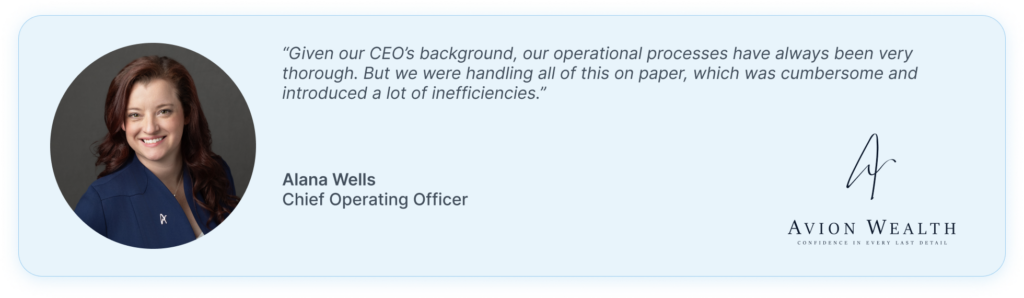
The company’s CEO, a former commercial airline pilot and military professional, established a culture of rigorous operational focus.
However, before adopting Process Street, these well-documented processes were managed mostly on paper, leading to inefficiencies and challenges in task management.
Alana Wells, Chief Operating Officer joined the company in April 2024.
In this case study, we’re going to cover:
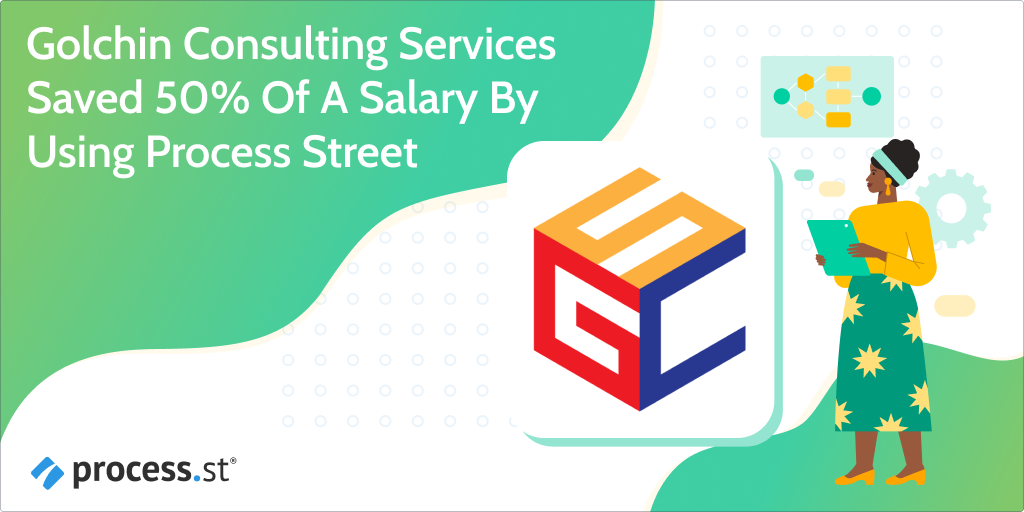
Golchin Consulting Services has revolutionized manufacturing operations through automation. Principal Consultant Rashid Golchin shares how they transformed a CNC machine shop’s chaotic manual document handling into an efficient, automated process with Process Street.
Rashid began using Process Street over six years ago while working as an Operations Manager at a manufacturing facility in British Columbia.
The CNC machine shop, specializing in industrial gears, was burdened with inefficiencies that disrupted daily operations.
In this case study, we’re going to cover: