






Mobile keyword ranking is the practice of tracking where an app appears for the searches people run in the Apple App Store and Google Play. It connects ASO keyword research, app-store listing quality, competitor monitoring, and paid search into one operating rhythm.
The app market is still crowded, but the work has changed. App Annie became data.ai in 2022, then Sensor Tower acquired data.ai in 2024. Apple Ads now gives keyword recommendations, search popularity, estimated installs, spend, average CPA, and impression-share signals. That means mobile keyword ranking is no longer just a list of keywords. It is a repeatable workflow for choosing, validating, defending, and improving app-store demand across organic ASO and paid search strategies.
These 12 tips cover the tooling and the way teams run ASO today. Use them to build a practical keyword ranking process for organic ASO and paid search.
- Mobile keyword ranking: What is App Store Optimization (ASO)?
- Mobile keyword ranking: App Store Optimization, and why it is important
- Mobile keyword ranking: Organic search strategy
- Mobile keyword ranking: Paid search
- Mobile keyword ranking: Organic vs paid search
- Mobile keyword ranking: Keyword defense
- Mobile keyword marketing: Platforms to understand your downloads and optimize target keywords
- Use Process Street to help you optimize your mobile keyword ranking
- Optimize your mobile keyword ranking today
Mobile keyword ranking: What is App Store Optimization (ASO)?
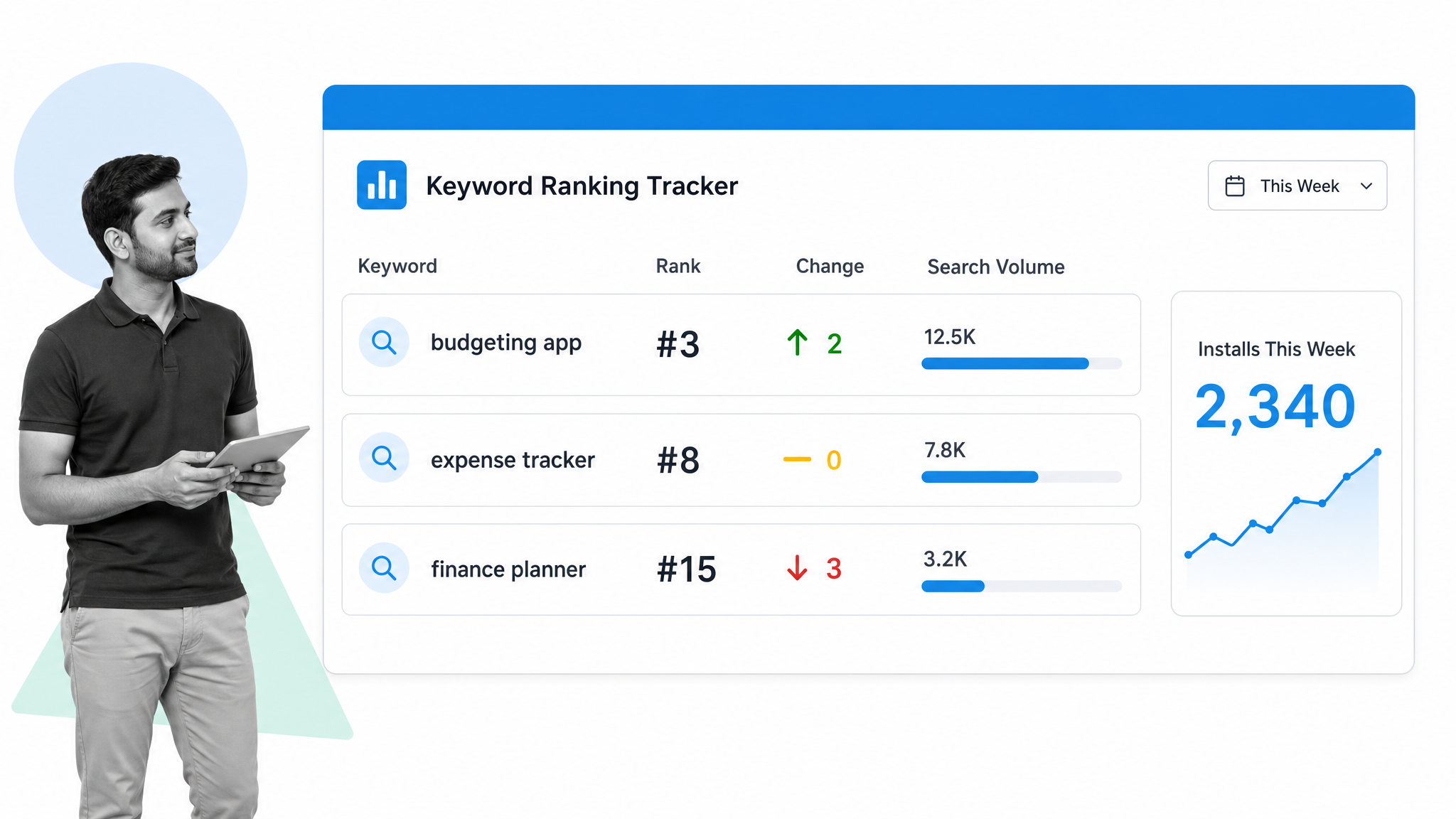
App Store Optimization, or ASO, is the work of improving how an app appears and converts inside app stores. A strong ASO program covers keyword targeting, title and subtitle choices, description copy, screenshots, reviews, ratings, localization, category fit, and conversion from search result to install.
Mobile keyword ranking sits inside that ASO system. It answers a direct question: when someone searches a target phrase, where does your app show up, and is that ranking producing downloads from the right users?
The first tip is simple: define mobile keyword ranking as a tracking process, not a one-time research task. Rankings move when competitors launch, paid ads change the search results page, reviews shift conversion, or app-store algorithms test different listings. Treat keyword ranking as an operating metric.
Mobile keyword ranking: App Store Optimization, and why it is important

ASO matters because app-store search is high intent. A user searching for a budgeting app, route planner, language tutor, or team checklist app is already describing the job they want done. If your listing is invisible for that search, you are not in the consideration set.
Some ASO advice still focuses on raw app counts. The better framing is quality and discoverability. Google reported major enforcement work across Google Play in 2025, including blocking policy-violating apps and banning bad developer accounts. Apple says the App Store reaches hundreds of millions of weekly visitors worldwide. The market is large, filtered, and competitive.
Tip two: judge ASO by the full search-to-install path. A ranking that gets impressions but no taps tells you the keyword or creative is weak. A paid search term that converts cheaply can become an organic keyword target. A keyword that ranks well but attracts the wrong users needs a different listing promise.
Mobile keyword ranking: Organic search strategy

A strong organic ASO workflow is tool-neutral. AppTweak, Sensor Tower, MobileAction, App Radar, ASO Suite, GrowASO, Apple Ads data, and Google Play Console all provide keyword intelligence. Choose based on your team’s scope and budget, or combine several for broader coverage.
Tip three: start with seed keywords from user language. Pull terms from reviews, support tickets, sales calls, competitor listings, paid search queries, and your own product positioning. For a mobile workflow product, that might include checklist app, workflow app, SOP app, inspection checklist, or team process app.
Tip four: mine competitors for keyword patterns. Competitor keyword tracking shows where a rival is winning, where they are vulnerable, and where a term may be too broad to chase without paid support.
Tip five: compare volume, ranking difficulty, and intent together. A high-volume keyword is not automatically worth chasing if it is too broad or dominated by stronger listings. A lower-volume keyword can be better if the searcher is closer to the app’s real use case.
Tip six: localize keyword research. Language, geography, category norms, and cultural phrasing change how people search. A keyword strategy for the U.S. App Store should not be copied blindly into other countries or languages.
Mobile keyword ranking: Paid search
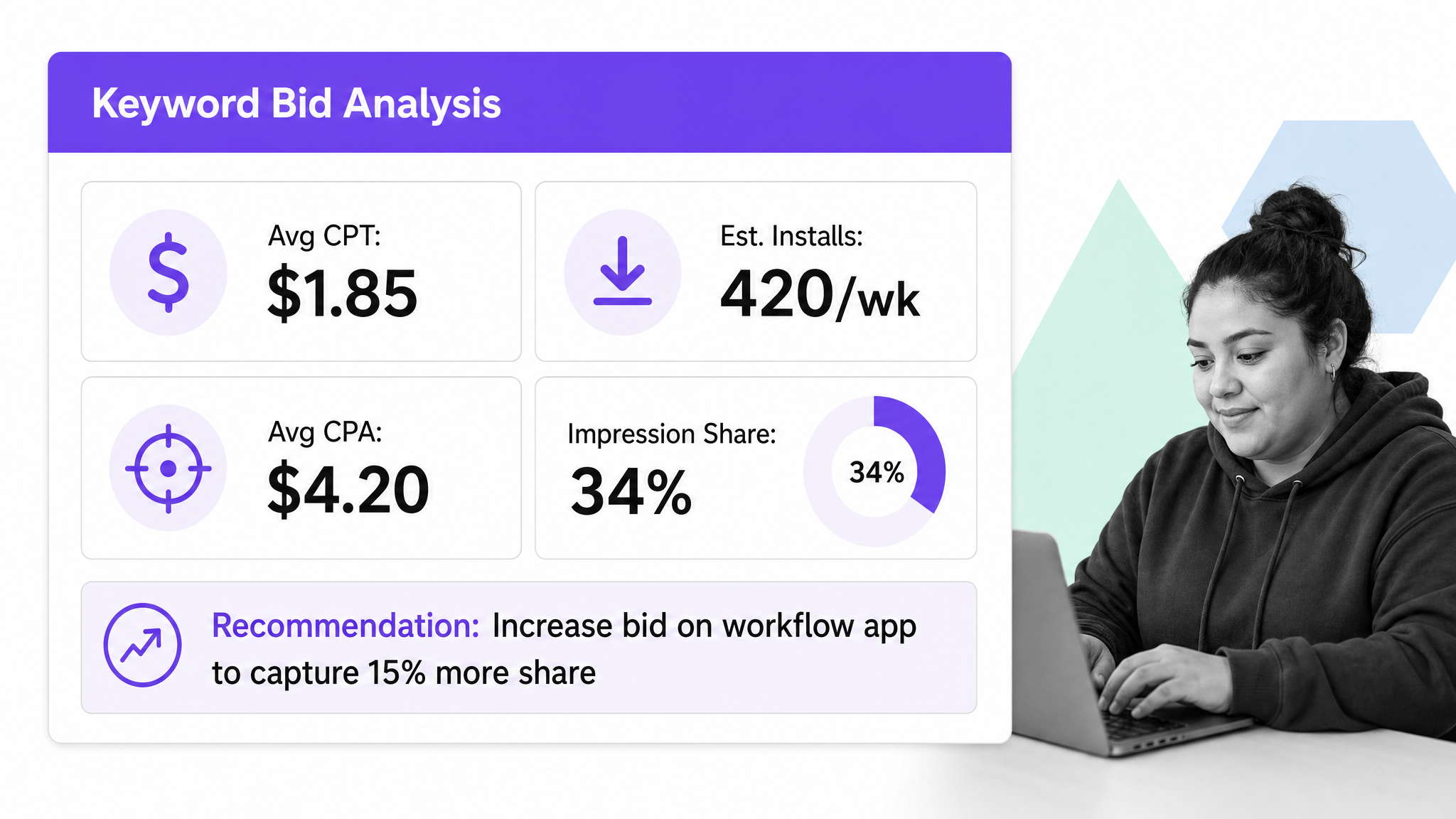
Paid search in the app-store context usually means Apple Ads search results campaigns and comparable paid acquisition programs. It can put your app in front of a target search, but it does not guarantee a durable top organic position. It gives you data faster.
Apple Ads recommendations can surface keyword ideas, recommended max CPT bids, estimated installs, estimated spend, average CPA, and search popularity. If a keyword matters to your brand, Apple also recommends monitoring impression share closely.
Tip seven: use paid search to validate keyword value before betting the whole ASO program on it. Paid data can show which keywords earn taps and installs, which are too expensive, and which competitor terms need a defensive response.
Tip eight: watch who appears on your keywords. If a competitor starts bidding on your brand or core category terms, your organic rank may look healthy while paid placements intercept demand above it.
Mobile keyword ranking: Organic vs paid search
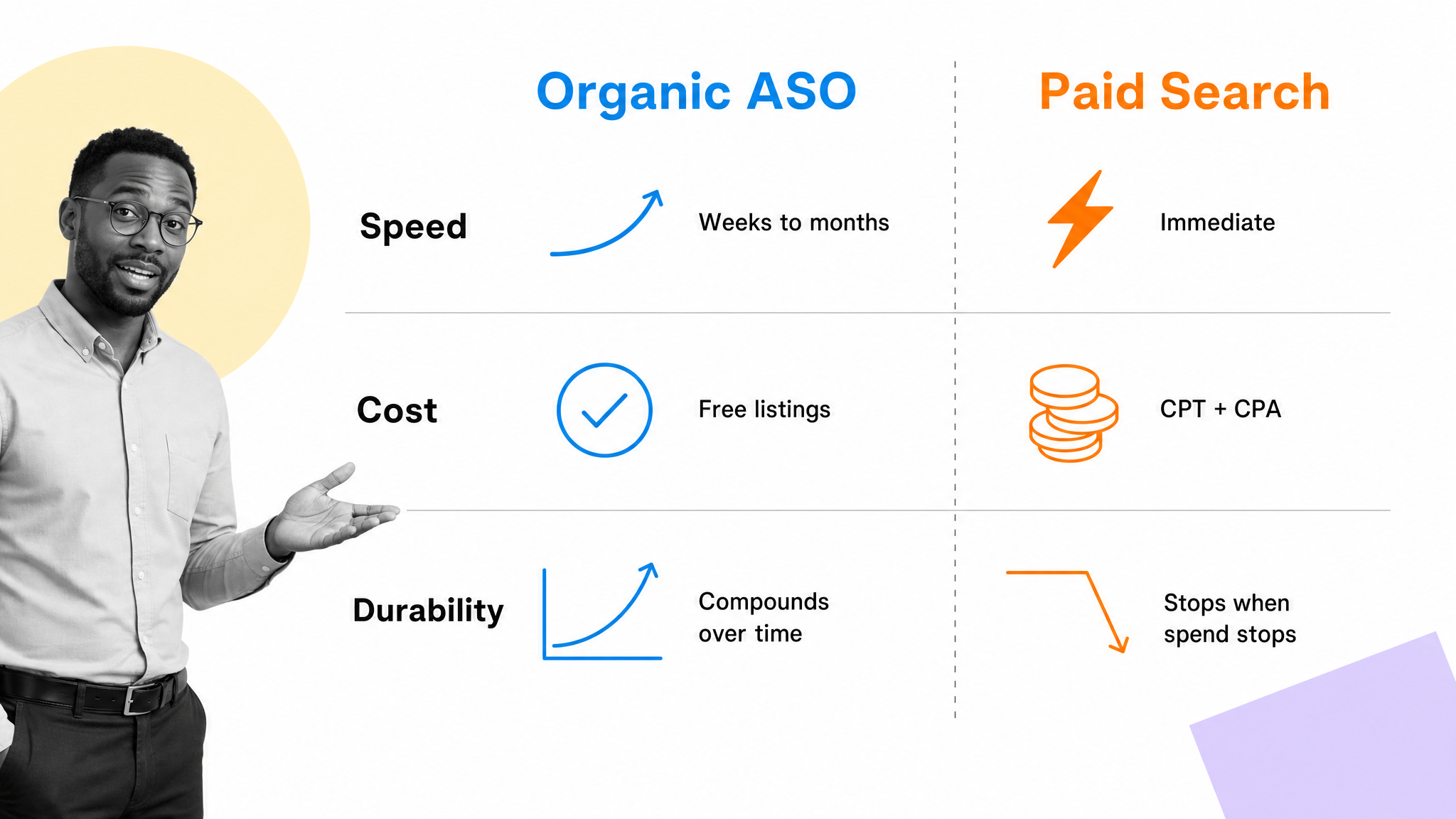
Organic and paid search are not rivals. They are feedback loops. Organic ranking tells you where the listing is earning relevance over time. Paid search tells you where immediate demand exists and what that demand costs.
Tip nine: use paid search to learn, then feed the learning back into ASO. Keywords that convert well in paid campaigns deserve stronger metadata, screenshots, onboarding language, and review prompts. Keywords that burn budget without installs should be removed or reframed.
Tip ten: do not let paid search hide organic weakness. A campaign can make a keyword look healthy while the underlying organic listing loses relevance. Track rank, paid placement, tap-through, install conversion, and cost together.
Mobile keyword ranking: Keyword defense

Keyword defense gives teams a practical way to decide which terms need action and which terms can be monitored. Assign every important keyword to one of four states:
- Safe: You rank well organically, competitors are not pressing hard, and paid defense is optional.
- Revealed: A keyword looks promising because paid tests or competitor movement exposed demand you had not prioritized.
- Threatened: You still rank, but competitors are bidding, improving listings, or gaining review strength.
- Critical: The keyword matters to acquisition and you are losing organic rank, paid share, or conversion at the same time.
Tip eleven: assign every important keyword to one of those four states. That turns ASO from a vague marketing activity into a weekly decision system.
Mobile keyword marketing: Platforms to understand your downloads and optimize target keywords
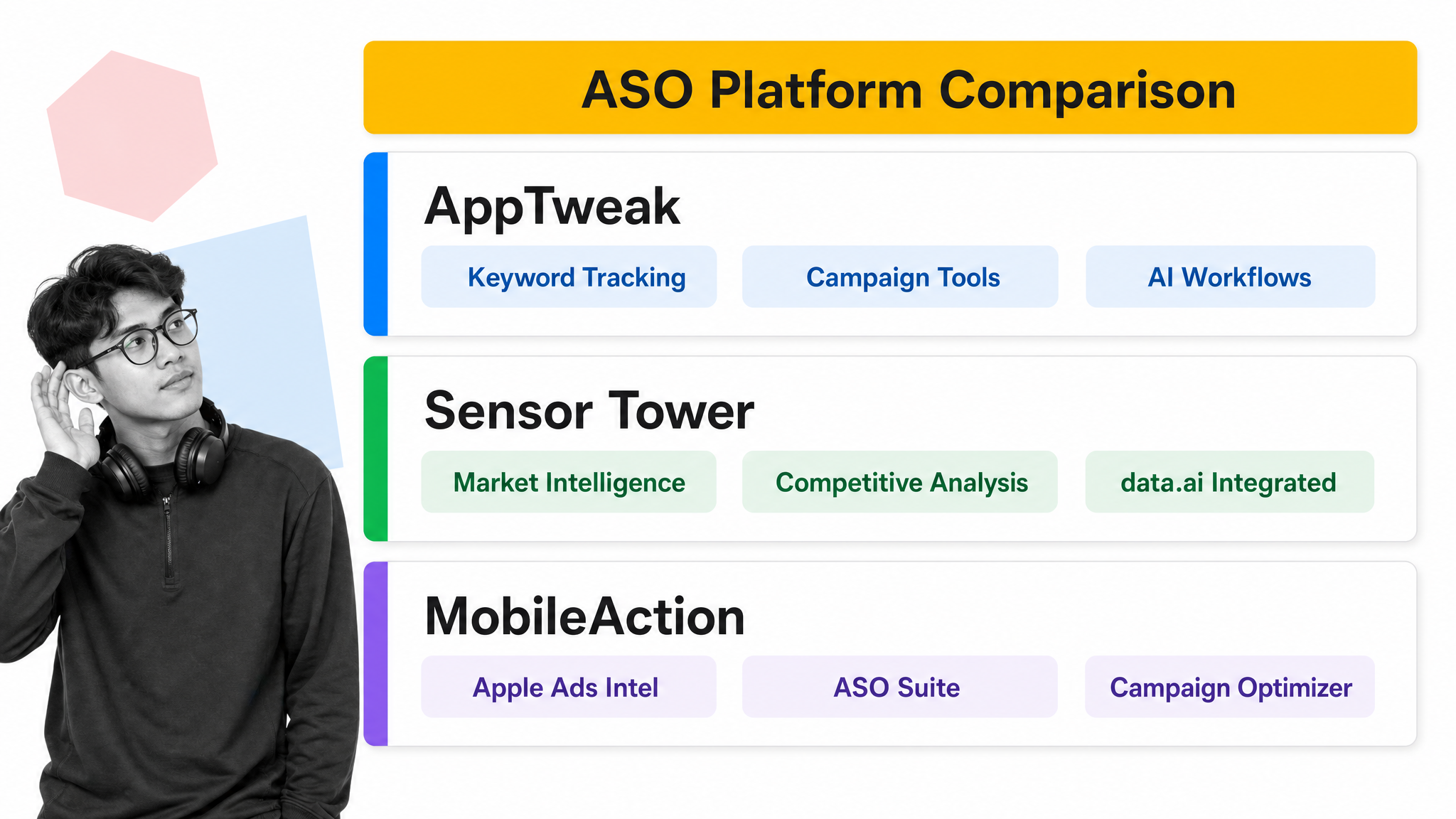
The ASO platform landscape has consolidated. App Annie became data.ai, and Sensor Tower acquired data.ai in 2024. Some smaller tools like SearchMan have faded. The platforms worth evaluating today are the ones that actively invest in keyword intelligence, competitive analysis, and Apple Ads integration.
Tip twelve: choose tools by the job you need them to do. A small app team may need affordable rank tracking and keyword discovery. A larger marketing team may need competitive intelligence, market estimates, paid-search monitoring, and reporting across countries.
- AppTweak: strong ASO intelligence, keyword tracking, campaign tools, market intelligence, APIs, and current AI-assisted workflows.
- Sensor Tower: a broad market-intelligence platform, stronger now that data.ai has joined Sensor Tower.
- MobileAction: active ASO and Apple Ads intelligence platform for app marketers.
- App Radar or ASO Suite: useful lighter-weight options for teams that want rank tracking and listing optimization without enterprise scope.
- GrowASO: an AI-native option worth evaluating for listing generation, keyword research, and ASO workflows.
Keep the shortlist small. A tool is only useful if someone owns the keyword review cadence, makes decisions from the data, and records what changed.
Use Process Street to help you optimize your mobile keyword ranking

Mobile keyword ranking works best when it is run as a repeatable process. That is where Process Street fits.
Process Street is a Compliance Operations Platform that brings Docs, Ops, and Cora together. Docs governs the procedure, Ops runs the recurring workflow, and Cora helps monitor, flag, and improve the process over time. For ASO, that means your keyword research, paid search checks, competitor review, approval steps, release notes, screenshots, and post-launch review do not live in scattered documents and Slack reminders.
A practical ASO workflow in Process Street can include tasks for keyword discovery, Apple Ads review, App Store and Google Play metadata updates, screenshot approvals, localization checks, and a final launch review. You can also connect the workflow to your broader workflow apps stack and document the process with process documentation software.
This App Annie webinar covers ASO fundamentals that still apply, though the tooling landscape has shifted since it was recorded.
You can start with the SEO checklist template below, then adapt the steps for ASO keyword tracking and app-store launch work.
Optimize your mobile keyword ranking today

Mobile keyword ranking is not won by choosing a few keywords once. It improves when the team reviews the right signals on a cadence and turns those signals into listing, paid-search, and workflow changes.
Use this operating loop:
- Capture user language from reviews, support, sales, and competitor listings.
- Build a seed keyword list for Apple App Store and Google Play.
- Check current rankings and competitor movement.
- Use Apple Ads or comparable paid data to validate demand.
- Prioritize high-intent terms, not just high-volume terms.
- Localize keyword sets by country and language.
- Map each important keyword to Safe, Revealed, Threatened, or Critical.
- Update metadata, screenshots, and app-store creative based on evidence.
- Document decisions so the next review does not restart from scratch.
- Run the same review cadence every release cycle.
When the process is documented and executed consistently, ASO becomes easier to defend. You know which keywords matter, why they matter, who owns the next action, and what changed after each release.