All posts in Business Operations

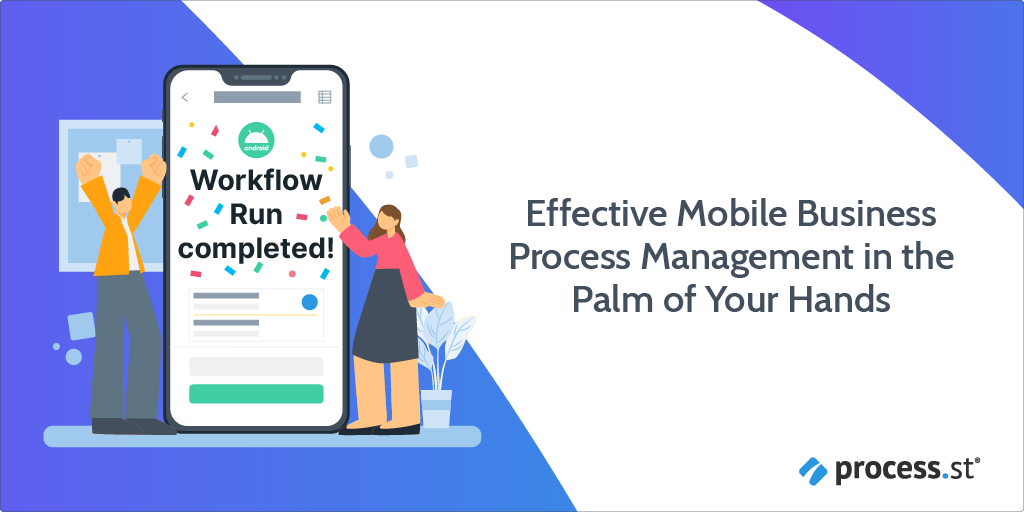
Mobile Business Process Management in the Palm of Your Hands

mobile business process management

Mobile Business Process Management (BPM) has become an essential aspect of the modern business world. With the increasing need for remote work and rapid decision-making, organizations require a more flexible and efficient way to manage their business processes. 

To address this need, we’ve made our leading BPM software available in the palm of your hands. Your Android phone or tablet can now access the same data inside of Process Street as your browser. But what does that really mean for you and your organization? 

Let’s get into it!

Continue Reading

How to Run a Security Audit: The Ultimate Guide (+ Free Templates)

Your Ultimate Guide on How to Run a Security Audit (+ Free Templates)

Readers, I’ll let you in on a little secret…

Between you and me, I was hacked; by my best friend no less! Thankfully, it was just an irritating prank, but it served to teach me a lesson.

Despite my grandiose beliefs that I knew everything I needed to know about all things digital, I hadn’t the faintest idea about how to spot a fraudulent message from a legitimate one. And this kind of threat is one of the biggest risks businesses face today.

In 2005, 157 data breaches were reported in the U.S., with 66.9 million records exposed. From 2005-2014 there was a 500% increase in data breach frequency.

That number almost doubled in 3 years to 1,579 reported breaches in 2017.

Although data breaches have since declined (1,506 issues were reported in 2019), IBM’s 2020 Data Breach report filed a 12% rise in data breach costs over 5 years, increasing to ~$3.92 million per incident.

The growing number of breaches and associated costs seems to be consequential of continuously changing hacking methods and an expanding number of entry points (that comes from digitization).

Security audits allow organizations to set up tougher walls of safety, as an adaptive defense against data breach threats.

With this in mind, Process Street created this article as your ultimate security audit guide, with access to our free security audit checklists and processes.

We’ll be covering:

Let’s get started!
Continue Reading

SOC 2 Compliance Made Easy (with Process Street & Drata)

soc 2 compliance faster easier than ever

SOC 2 has a reputation for being difficult and complex. You could argue that this is by design, since you need help from a small group of top-notch, pricey experts to be compliant. 

A kinder view is that it’s just how info security operates (there’s no one-size-fits-all fix). 

To set up the right protections, a company has to either create them according to the risks they face, or narrow down a huge list of possible controls, again, considering the risks. 

In a nutshell, SOC 2 goes with the first option: it sets broad criteria and lets each organization come up with controls to meet those criteria, based on their unique risks. Sounds reasonable, but it’s not exactly a walk in the park for those who aren’t experts.

That’s where both workflow automation and compliance automation software can come in handy.  

In this post I’ll introduce you to Drata and Process Street, two essential tools that, when used together, provide a complete solution to help you speed up and simplify your yearly SOC 2 compliance.

Continue Reading

The Ikigai Concept For Business: How to Find Your Business Purpose Fast

How to Find The Purpose of Your Business Through The Ikigai Concept Header

What is the ikigai concept for business?

Ikigai, which means “a reason for being”, is a Japanese word that has gently risen to the forefront of the business world, like a whale coming up to greet the dawn. It is a welcome wave of thoughtfulness and quiet in the face of a usually loud, blustering, profit-at-all-costs model.

The Ikigai concept beckons to us, asking us to consider the question: What do I get up for in the mornings? For most of us, the answer is not “money”.

Money, for most people, is a means to an end. If you ask people at the end of their lives what they wish they could have done differently, the answers are not usually “I wish I’d made more money”. They’re along the lines of “I wish I had stayed in touch with my friends”.

Heart matters, both in our personal lives and in business. It seems a bit short-sighted to assume otherwise or to see business as totally apart from our personal values. The industrial revolution saw people exchanging their labor for money and becoming increasingly alienated from the joys of pouring their hearts into their creative endeavors and trade. They became cogs in the wheel of the factory that is capitalism.

We still have a top-down structure in many work environments today, but some companies have begun to embrace a horizontal knowledge approach, where managers and employees are on the same level and treated as equals. The more we learn about what makes employees happy, hopefully, the more we will move towards those models, of which the Ikigai concept is a prime example.

While ikigai is generally applied to finding purpose in your personal life, this Process Street post will look at how the same 4 concepts can be applied to your business as well:

Make sure you’re sitting comfortably. Let’s begin.
Continue Reading

Best Marketing Automation Software: 10 Tools to Autopilot Marketing Emails

Marketing automation software

Marketing your product to a wide audience is a real challenge for many businesses. Acquisition costs can be high and effective optimization of approach requires bucketloads of data.

According to research from Aberdeen Group, users of marketing automation software are 17 times more likely to track all their data than those who don’t employ these platforms. This drives improvement and is one of the primary reasons that users of marketing automation decrease customer acquisition costs year on year at over twice the rate of their competition.

Modern marketing methods mean that multiple in-depth campaigns can be run without all the unnecessary administration and time-consuming efforts of the past.

There are many automation tools to choose from on the market and in this article we’ll run through 10 of the best, giving you a breakdown of what each offers.

Continue Reading

How to Write a Proposal and Get What You Want (Free Templates)


A proposal has a lot of different purposes, but there’s only one good way to write one: the way that pulls together all of the information in a concise and persuasive way and helps you get what you want … whether that’s a whole new software system, or just a tweak to your marketing strategy.

This Process Street article isn’t about a business proposal — also known as a quote — but instead about the document required when formally pitching an idea for action and execution by managers or department heads.

To explain how to write a proposal document and get what you want, we’ll go through the following:

Let’s get started.
Continue Reading

The Four-Day Workweek: Why It’s Here to Stay

Every few months, the idea of the four-day workweek starts trending. And it’s not just making the rounds on TikTok, Twitter, and Reddit. Big publications like Forbes and Time also frequently cover the topic.

As more and more countries introduce bills advocating for the 4-day workweek and as more and more studies show the benefits of it, the clearer it becomes that this is not going anywhere anytime soon.

But why is that? Is the four-day workweek as good as people are saying? Is it something companies need to start adopting?

In this post, we will discuss:

Continue Reading

How to Create a Weekly Tasks List (And Never Forget a Deadline Again)

When I started at Process Street, I was just a writer. I had the organizational skills of a child, and I was used to delivering a single piece of work at a time. As I was given more responsibilities, I started forgetting my regular tasks and working on whatever seemed important at that moment.

Since every task management system I’ve tried has quickly become crowded and unmanageable, I decided to create a Process Street checklist specifically for my recurring weekly tasks.

Now, I get a simple list of tasks in my Process Street inbox every week. As I work through them, I can track my weekly progress and use the checklist as a way to report my work to my manager. You can do the same, and it only takes about 10 minutes.

Here’s my checklist:

Continue Reading

How to Manage IT Tasks Effectively with Process Street (+Video Walkthroughs!)

manage IT tasks effectively

If you’re a Systems Administrator or performing any kind of IT managed service, your daily tasks are often repetitive, complicated, and easy to forget.

Especially if you’re new to the role, things can quickly become overwhelmingly difficult to track & execute effectively. New employees have a library of techniques specific to your setup to learn, and it’s almost impossible to manually track each task in a way that’s easily accessible.

That’s why IT managed service teams worldwide use Process Street to manage & automate their daily workflows, for processes like:

  • Network & server security audits
  • Reviewing audit logs
  • Performing daily backups
  • Penetration testing
  • VPN configuration
  • Firewall audits

In this Process Street article, we’ll show you some examples of how our customers manage their daily Systems Administrator & IT tasks.

You’ll learn everything from how to create workflows that adapt to your current situation to automatically assigning tasks to specific people based on their role in the team.
Continue Reading

Default to Action & Overcome the Toolbox Fallacy

toolbox-fallacy

“A good plan violently executed now is better than a perfect plan next week.” – George Patton

“Once I have X, I can do Y.”

This phrase is the defining characteristic of the toolbox fallacy: thinking you can’t do something until you have the right tool.

The toolbox fallacy is self-deception disguised as excuses or a lack of “tools”. The issue with these tools is that you believe that you need them and thus, can’t (or won’t) start a project without them.

“As soon as my Apple Watch arrives, I’ll start training for the 5K.”

The problem is when X arrives, do you crack on and get started with the Y? Often times, it’s too easy to continue down the slippery slope of toolbox logic.

“My Apple Watch arrived, but now I need a coaching app – which I am yet to have downloaded.”

So, how do you overcome the toolbox fallacy? Simple: You default to action. In other words, you get the ball rolling – whether you have all the tools you think you need or not.

The solution, in a sense, is to be more agile.

In this post I’ll be looking at how to overcome the toolbox fallacy by putting the systems in place to move fast, and with virtue. I’ll try to address:

  • How do you plan and structure clear action items, so you can move fast and be sure you’re making the right decisions?
  • How will you move fast without breaking things (by things I mean humans)?

And, to sum things up I’ll take a look at how we at Process Street use OKRs to decide when it is we should be moving fast vs when we should be slowing down.

To jump to a specific section click the appropriate links below:

Let’s start by unpacking the toolbox fallacy in more depth!
Continue Reading

Take control of your workflows today