The following is a guest post from Ryan Gould, Vice President of Strategy and Marketing Services at Elevation Marketing. An expert search, social and content marketer, Ryan leads Elevation Marketing’s digital strategy department, helping brands achieve their business goals, such as improving sales and market share, by developing integrated marketing strategies distinguished by research, storytelling, engagement and conversion.
Without software, you’d be hand-writing purchase orders, using a Rolodex for a CRM, and doing your newsletters via smoke signal.
Alright, maybe that last one is a little far-fetched, but there’s no denying that in the business world, technology is absolutely necessary and enables amazing things.
…But not everyone on your team gets enthusiastic about the prospect of learning a new tool. Even if that tool will help them improve productivity, do a better job, and escape the white-collar equivalent of hard manual labor.
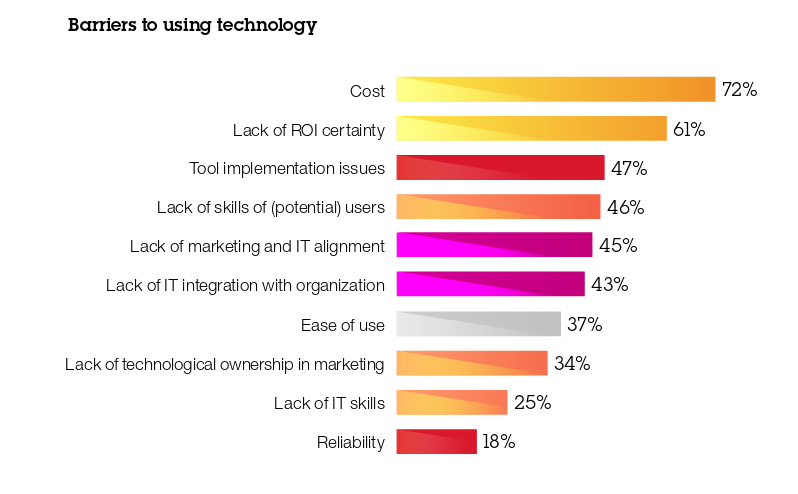
IBM research on the barriers to software adoption (Source)
Your goal when rolling out software is always the same: to help your business improve operations, boost efficiency, and enable sales. These days that means staying up to date on technological trends as well.
Deciding which tool is right for you will always hinge on fundamentals, like whether it can automate your vendor payments, purchase orders, employee onboarding, lead management, etc. However, there are other considerations, such as whether your solution integrates with cloud software and is responsive on mobile devices.
But, even after you’ve selected the solution perfect for your operation and your employees – after all the sales demos, comparison docs, and review reading – you’ll find it’s that the human element that trips you up.
The following is a guest post from Brett Farmiloe. Brett is the CEO of digital marketing company, Markitors, and advisor to career resource, Organizational Leadership Degrees. He is a regular contributor to Huffington Post and Forbes, and also enjoys tending his backyard vegetable patch.
Workplace structure.
What popped into your mind after reading those words? A large office building with hundreds of employees and multiple layers of management? Something gargantuan and sluggish?
That is certainly how I pictured the classic workplace structure, especially before starting my own company. Now I truly understand that all businesses, no matter how small, have a set structure of who reports to who – and for good reason. While it may sound unnecessarily methodical and plodding, it adds an element of organization to your organization.
Something I learned through years of trial and error was that organizational structures are a fluid beast – they need to evolve and grow as your company does.
Below are some of my tips for ensuring the success and longevity of your business, with lessons from Lego, Zappos, and my own company.
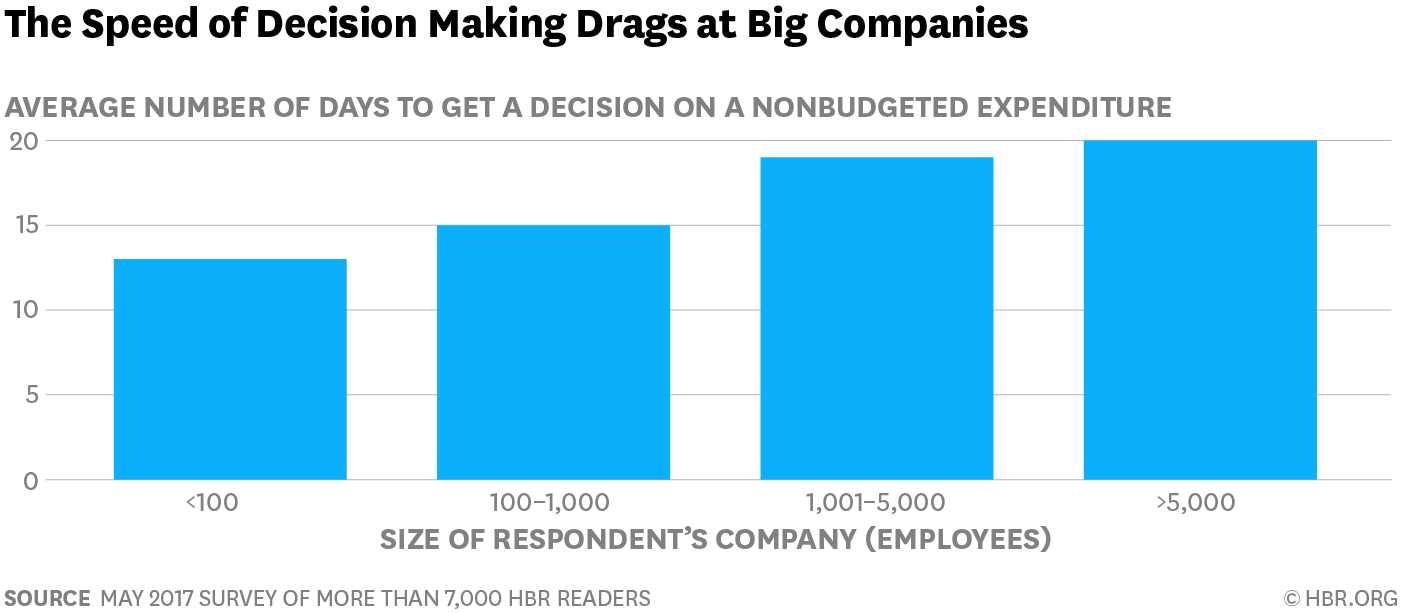
As you’ll have noticed when you phone call centers, visit the bank, or deal with the government in any capacity, bureaucracy can make organizations slow and frustrating to deal with.
Endless forms and complex layers of approval impact a company’s services along with the morale of its employees. It can leave organizations unable to adapt to new market pressures or external threats.
The UK Home Office, during the Windrush Scandal, ended up wrongly deporting many people who came to Britain after the Second World War from the Caribbean. It was exposed that these people were being wrongly deported yet deportations and other negative effects continued, as illustrated by The Guardian. The organization failed to respond adequately, and a scandal was born.
Despite all this, large organizations in our society – whether they’re governments or big business – aren’t just going to go away. Instead they need to find ways to adapt and improve while retaining the benefits which pushed them to develop complex bureaucratic structures in the first place.
The big question is: how do you manage operations within a bureaucratic organization so that it can run with the agility of a startup?
Pinch analysis is a difficult topic to talk about, as it both has widely applicable techniques which can reduce the need for external resources, but it’s traditionally very complicated and used in a limited business sector.
That’s why today I’ll be breaking down the topic and showing how the principles behind it can be used across any and all disciplines.
You don’t have to be a thermodynamics buff to understand this; it all comes down to analyzing what you have, what by-products your processes create, and whether you can use those by-products to your advantage.
By doing this, traditional pinch analysis is able to typically result in energy savings of 10-35% – that’s a third less energy you need to generate or import to carry out your processes.
No matter how foolproof you think your operations are, human error will always pose a threat. Heck, it’s already responsible for 52% of security and data breaches, was the root cause of a host of famoustragedies, and can strike at any time.
But what exactly is human error, and how can we limit its effects if it can’t be completely prevented?
To answer that question, we here at Process Street have broken it down for you. In this article, you’ll learn:
The four types of human error
How the different types of human error are caused
The single technique to combat each type in your business
It’s time to stop leaving your success open to random chances of failure.
Have you ever had a project which never seems to end? One which you either underestimated or kept adding tasks to as you went along?
That’s exactly what setting out your project scope will prevent.
By analyzing the elements of your projects before starting, you can set out the scope of the work in order to prevent extra work getting added (without adjusting the necessary resources) and avoid taking on projects too large for your team to handle.
Not to mention that the principles behind project scope can be applied elsewhere in your business too.
“I call this the Scopi-locks principle.
Don’t make your product too big, because no-one will adopt it. Don’t make your product too small, because it’s not worth adopting. You have to [get it] just right such that it’s worth poor people pulling it into their lives and, when they do, that they get some value out of it.” – Des Traynor (co-founder of Intercom) on product scope
Let’s get stuck right in with project scope by breaking down what it is, what you need to know before creating it, and how to use it in action.
The Ford Production System paved the way for most modern lean manufacturing, and the best physical embodiment of it was the Willow Run B-24 bomber production facility in WWII.
After intervention from Ford, Willow Run was able to go from producing one bomber per day to one per hour. That’s 24x their original output.
At the heart of the facility stood the “pacing clock”. This monitored what we now call takt time.
Takt time is the pulse of your operations – the rhythm and rate by which tasks and products are completed. By monitoring and setting guidelines for this single figure, Ford (and company) was able to build a facility which could produce the same as half of the entire German aircraft industry.
That’s why today we’ll be breaking down what takt time is, how to calculate it, and how it can be used in almost any system to reliably track your progress and provide an early warning system for any problems you encounter.
In a study of 400 businesses in the UK and US, global analyst firm IDC established that 23% of employees don’t understand a core part of their job. Combined with the potential damage that human error can cause, it’s easy to see why it’s important to make sure that your processes are being followed to the letter.
Still, nobody enjoys hearing the term “ensure compliance” when it comes to their team. It’s cold, impersonal, and conjures up images of school students being sent to detention or prisoners under strict watch, and if your team feels the same then their morale will quickly plummet.
Here at Process Street, we’re well versed in the problems with documenting, managing, and deploying your processes. That’s why this post will take care of those compliance problems by giving you some killer tips to make sure your team sticks to their methods without alienating them with harsh policies.
According to the American Management Association, one-quarter of workers seem to avoid responsibility on the job on average, and 21% of companies believe that the figure is as high as 30-50%. From these stats, it’s clear that low employee accountability is wasting company money on a massive scale.
At the same time, almost two thirds of employees believe their company does not have a strong culture. The link between these two factors is strong, argues management consultant and author Roger Connors. Connors blends The Wizard of Oz with now-influential writings on employee accountability in a series of best-selling leadership books including The Oz Principle and Change the Culture, Change the Game. In the latter, he says:
“Our experience proves that accountability, done the right way, produces greater transparency and openness, enhanced teamwork and trust, effective communication and dialogue, thorough execution and follow-through, sharper clarity, and a tighter focus on results. Accountability should be the strongest thread that runs through the complex fabric of any organization” — Roger Connors, Change the Culture, Change the Game
To paraphrase Connor, a business’ employee accountability depends on leaders creating a transparent culture where responsibility is clear, transparent, and owned. One way to bring clarity to the way your business operates is to use standardized processes and leverage technology that helps track activity, assign tasks, and facilitate hand-offs.
In this article, we’ll go through the links between processes, accountability and company culture, and give you tips on how to improve your business in those areas. But first, let’s look closely at the ties between accountability and culture.






 We always seem to be caught up in a never-ending mission to make our businesses better.