All posts by Vinay Patankar

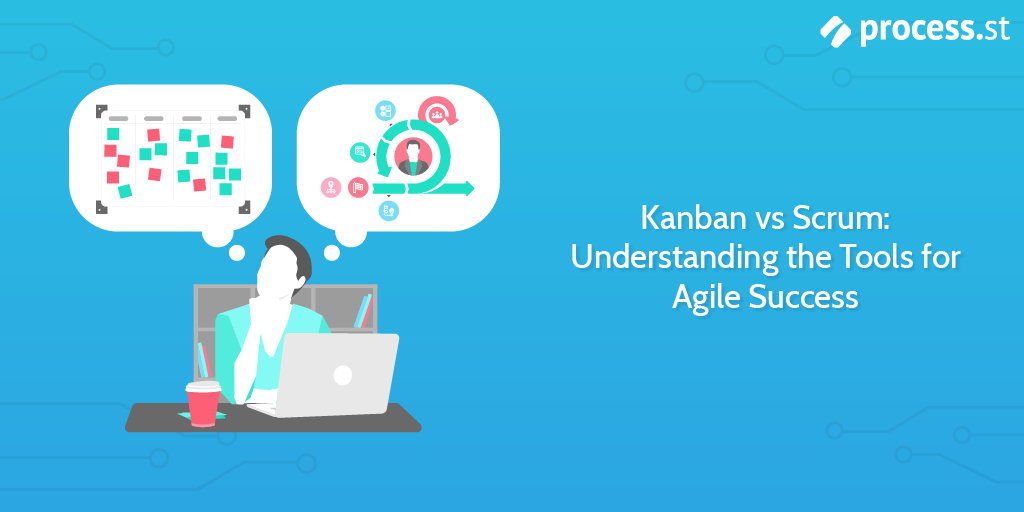
Kanban vs Scrum: Understanding the Tools for Agile Success

Kanban vs Scrum

You’ll often hear the question: “Which is better? Kanban or Scrum?” or variations of this eternal deathmatch between two of the most well-established agile methodologies.

People are wasting energy fighting over which methodology trumps another. If you’re an agile organization, you should be placing principle above practice.

It makes a lot of sense to ask questions like “why might I want to use Kanban over Scrum?”, or even “Kanban and Scrum” as opposed to “Kanban vs Scrum”. There are a lot of differences between the two, but fundamentally, they are both agile methodologies, and the principle behind why you might want to use both can be in alignment.

You may even find they can work well together, as part of a unified strategy referred to as Scrumban. You need to consider what approach will work best for your team.

My aim with this article is to approach the question of “Kanban vs Scrum” by clearly presenting both approaches in terms of when, how, and why you might choose to use either of them.

I’ll also talk about the capacity for overlapping Kanban and Scrum approaches, and how some additional tools like Process Street can factor into that equation.

Here’s a breakdown of how we’ll approach comparing “Kanban vs Scrum”:

Let’s start with a basic primer on what it means to be agile. Continue Reading
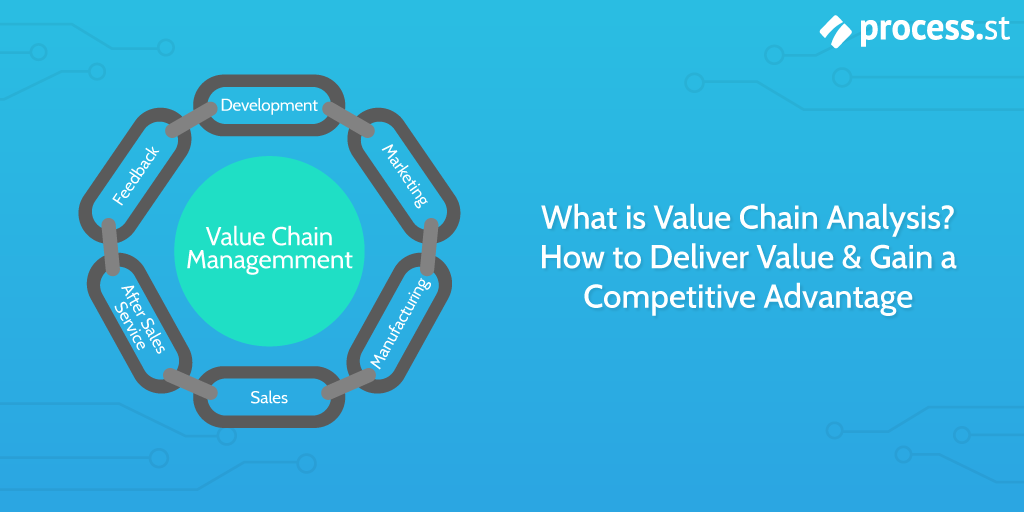
What is Value Chain Analysis? How to Deliver Value & Gain a Competitive Advantage

value chain analysis

How do you stand out against overwhelming competition? You need an edge; a value proposition isn’t enough on its own.

You need to make sure you’re out-competing the competition by keeping costs down and understanding the value you’re delivering to your customer. But how do you continuously improve your value offering while keeping costs down?

Enter the value chain.

A value chain is a model of looking at all of your business processes and figuring out how to gain a competitive advantage by focusing on developing maximum value in your product or service, while keeping your profit margins in the green at the same time.

Originally proposed by Harvard’s Michael Porter in his 1998 book Competitive Advantage, there’s a lot of ground to cover. Where do you start? What’s the process? What kind of tools exist to make the value chain analysis easier?

Well, if you’re looking for a clear, concise introduction to Michael Porter’s Value Chain model, you’ve come to the right place. Read on for a breakdown of:

By the end of this article, you should have a firm grasp on the value chain model, with a better idea of how to apply it to your own business. We’ll also investigate how to integrate BPM software like Process Street into the value chain.
Continue Reading

How to Unlock the Secret to Customer Success: Automation

customer success automationThis is a guest post from Shawn Mike. Shawn has been working with writing challenging clients for over five years. His educational background in the technical field and business studies has given him the edge to write on many topics. He occasionally writes blog articles for Dynamologic Solutions.

According to statistics, it is claimed that US organizations suffer a loss of $62 billion a year thanks to unsatisfactory customer service.

Customer service represents your secondary acquisition test, beyond actually getting that customer on board in the first place.

It’s very much a short-term game of conflict resolution, and your business depends mainly on how you deal with customer feedback and requests.

For maximum lifetime value, you need to consider how to synergize customer service with customer success.

It must be kept in mind that customers are the heart of every business and should be at the top of your priority list.

Satisfied customers help increase sales and build brand identity and reports claim that 77% of customers are estimated to recommend a brand or business to a friend depending on how good their experience with your product is.

Which is why focusing on keeping your customer base satisfied with great service and excellent products can go a long way in improving your sales.

Nowadays, consumers expect more than just a great product. They need you to guide them through the perfect experience. A better customer experience equals a greater lifetime value expectancy.

This article is all about figuring out the best way to analyze and improve customer experience by automating a lot of the manual work that can get in the way.

We’ll focus on:

Read on to learn more about how to optimize your customer success strategy. There’s even a free Ebook for you at the end of it!
Continue Reading

How to Automate Approvals: 20+ Free Approval Process Templates

Approvals are everywhere. If you’ve worked on any project involving any kind of deliverables, chances are you’re all-too-familiar with the approval process (or rejection process, depending).

Documents, prototypes, reports, mock-ups, wireframes, storyboards, and even more internally-facing elements like simple holiday leave requests. All of these represent different kinds of approval process, and approvals are an integral workflow element.

Approvals can also represent a major bottleneck.

Consider how you are currently approving work in your business. Perhaps you have a vague process involving emails, and if you’re particularly attentive you might be tracking it in a spreadsheet.

These methods are slow and prone to delays. You have no way of tracking anything reliably, you are more likely to miss approval windows, and information has to be sent manually between individuals.

What’s more, it’s quite difficult to improve this process without the proper system in place. You need to make sure you’ve got the right tools to optimize your approval process.

Process Street‘s approvals feature is the solution to this problem.

We created the approvals feature to make the process of approving work as fast and easy as possible.

With approvals, you can:

  • Get notified as soon as work is ready for approval
  • Approve (or reject) work with zero friction using a clear, streamlined interface
  • Approve on-the-go, from your phone’s email inbox
  • Synergize with many other Process Street features to optimize process efficiency
  • Save time and stay on top of your workflow

In this post, I have a trove of templates to showcase the approvals feature. All of the templates in this article are custom-built to make your life easier.

They also take advantage of Process Street‘s other powerful features like rich form fields, conditional logic, dynamic due dates, and role assignments.

So, read on for:

Read on to learn how to hit the ground running with the approvals feature.

Continue Reading

Secrets of the Cabal: Half-Life’s Organizational Management & Other Agile Tales

organizational management at valve corporation cabal process

From humble beginnings as a simple clone of the then-popular first-person shooter Quake, Half-Life would eventually become the first installment of one of the most successful video game series of all time.

Today, Valve Inc. is one of the most renowned, innovative, and successful game development companies worldwide, boasting one of the largest video game digital distribution service platforms on the planet, a range of pioneering virtual reality hardware and an impressive roster of instantly recognizable and widely-loved game titles.

Specifically, the development of the original Half-Life makes for an interesting case-study, and represents a model of innovative agile organizational management.

Half-Life is remembered as one of the best games of all time, and the intense environment in which it was created – where the Cabal process was born – is testament to that legacy.

Companies like Valve, Zappos, Semco, and even Google have come up with different models to enable the potential of their workers. These methods give power to the employees to pursue their own entrepreneurial pet projects.

Tesla’s innovation is equal part production process as it is the product; you need only look to the hulking Gigafactories to find evidence of this.

Similarly, Facebook’s success is not just in the service it offers users, but also how it was designed to scale to billions of users.

The process of organizational management is always an important factor in the outcome of these hugely successful products.

In this post I’ll be looking at democratic methods of organizational management, with a particular focus on Valve’s Cabal process. I’ll also mention a couple of other interesting examples of holocratic organizational management, and talk about our own internal structure at Process Street.

Here’s a quick breakdown of each section, if you want to jump ahead:

Continue Reading

What is ISO 9000? The Beginner’s Guide to Quality Management System Standards (Free ISO 9001 QMS Template)

What is ISO 9000? The Beginner's Guide to Quality Management System Standards (Free ISO 9001 QMS Template)

In 2018, Apple rolled out their brand new iPad Pro; top-of-the-line, cutting-edge, very slightly bent- wait, slightly bent?

Customers on social media and several on the MacRumors forums have discovered their iPad Pros exhibited this slight bend straight out of the box.

Of course, Apple’s response was that this was completely normal, and absolutely not a defect.

Despite the publicity Apple gives its “ultra precise” quality manufacturing process, more and more issues like these are appearing. The bendy iPad Pro is looking less like an exception, and more like an increasingly problematic trend.

Here’s a comprehensive quality breakdown (quite literally) of the iPad Pro in question:

It’s interesting to note that while Apple is bragging about premium materials such as the sapphire camera lens cover, tests like the scratch durability test done in the video above pose glaring questions to Apple’s quality standards.

Other quality management blunders from Apple’s recent track record include:

  • iPhone X: Major factory defect on phone screen making it unresponsive to touch;
  • iPhone XS/XS Max: A repeat of antennagate, except this one might be un-fixable with software;
  • Apple Watch: Batteries will swell and crack or detach the screen.
  • iPad Pro 2017: An older iPad model sold until November 2018 reportedly develops strange screen glitches;
  • MacBook Pro: Users have reported and Apple has admitted to serious defects (resulting in data loss and failure) with the solid-state drives inside 13-inch models, as well as severe performance issues with i9 CPUs and sound distortion at low volume;
  • Macbook/Macbook Pro: Defective keyboards in models from 2015 to 2017.
  • That’s a lot of issues for a company that continues to charge top dollar, push prices up, and boast a reputation as a pioneer in quality assurance.

    Obviously, and for whatever reason, there is a problem somewhere in Apple’s quality management process.

    Quality control and management is important to ensure the customer gets the value they deserve, and quality management standards like those defined by the ISO 9000 family exist to make quality management work better.

    Although Apple has received certification for ISO 27001 (an information security management standard), it doesn’t appear that they have any ISO 9000 certification for quality management. Who knows, if they had, perhaps they wouldn’t have so many QC issues?

    In this article, I’ll be looking at the ISO 9000 family of quality management standards, breaking down the basics and giving you a few free checklist templates to get you started with your own quality management system.

    Here’s exactly what I’ll be covering:

    Continue Reading

    How to Make Your Own Aptitude Test with Process Street (6 Free Templates)

    How to make your own aptitude test with process street

    Career aptitude tests are powerful tools for both employers and employees alike. They can be used to gain insight into personal tendencies and make informed responses to career and hiring decisions.

    Tests like these can differ in:

    • Purpose (i.e. for career placement, selection, counseling, or training)
    • What they measure (i.e. what they are designed to measure, be it personality type, skills, work approaches, values, or vocational interests)
    • What they predict (i.e. performance, quality of work, management potential, career success and satisfaction, your next job)
    • Format (online, paper form, in-person)
    • Standardization and rigor (how subjective or objective are the test results?)

    Some tests are highly structured, with definitive quantifiable outcomes; others are more flexible, and designed to be personally interpreted.

    This article will look at six different types of aptitude test, broadly defined, and run through the process of how you can build your own aptitude tests using Process Street.

    We’ll cover:

    Let’s get started. Continue Reading

    ISO 50001: The Ultimate Guide to Energy Management Systems (EnMS)

    What is ISO 50001 the ultimate guide to energy management systems (EnMS)

    If there was a list of the “Top Ten Problems” facing humanity in the next few decades, what do you think would be at the top?

    Well, it turns out Richard E. Smalley made such a list in 2003, and placed predictions about a looming global energy crisis at the top.

    His prediction focused on the problem of the amount of energy being consumed, against the amount of energy being produced (as well as available sources of energy production) alongside the projected boom of human population to around 8-10 billion by 2050.

    In recent years, there has been a resurgence of attention placed on the topic of energy efficiency and the relationship between energy consumption and climate change.

    It is an undeniable fact that our global climate is rising in temperature. The science is there to prove it; the United Nations Intergovernmental Panel on Climate Change (IPCC) and many other international organizations have acknowledged that recent years have been the hottest since records began.

    As a result, intense weather like heat waves, hurricanes, heavy rains, tropical storms, and rising sea levels all becoming more and more commonplace.

    Despite the rising tide of climate crisis, the demand for energy supply is at an all-time high. The global economy is insatiable in its demand for energy to sustain economic growth and development.

    How should organizations prepare themselves for the inevitable challenge of sustainable adaptation, and for ensuring they have the tools in place to facilitate the systematic energy management approach that will be the core of efforts to improve energy efficiency in the future.

    “Energy efficiency is the most promising means to reduce greenhouse gases in the short term,” – Yvo de Boer, Former Executive Secretary of the United Nations Framework Convention on Climate Change (UNFCCC).

    A systems-scale approach is necessary if organizations want to seriously engage with difficult problems facing sustainable business and adapt for the future of energy management.

    ISO 50001 is a standard designed to help organizations establish efficient and effective energy management systems (EnMS) and improve energy performance.

    Based on the principles of continuous improvement and popularized by the ISO 9001 and ISO 14001 management system standards, by implementing these standards companies stand to reduce energy efficiency costs, lower carbon dioxide emissions and prioritize the preservation and sustainable engagement with the environments in which they operate.

    This article will provide an introduction to the ISO 50001 standard, with a simple explanation and tips for getting started with an implementation of your own using Process Street.

    Thankfully, recent changes have made it easier than ever to implement ISO 50001 (and any ISO management system standard), so that will be a big focus of this article.

    Here’s a breakdown of what I’ll be covering here:

    Continue Reading

    The 10 Most Effective SEO Link Building Strategies of 2023

    Vinay Patankar September 26, 2019

    Link Building Strategies

    This is a guest post from Martha Jameson. As an educator at PhDKingdom.com and AcademicBrits.com, Martha found her calling as a writer, after pursuing web design and management. Her main goals are to share her experience, motivation and knowledge with her readers.

    Link building has been a contested subject in SEO circles, not least because of the amount of speculation that goes into figuring out what factors are most important for securing you a top SERP spot.

    Despite the controversy around Google’s search algorithm, a great deal of research has actually gone into figuring out what’s happening under the hood. At this point, we can be fairly sure that link building is a significant factor in the SEO of your website.

    In fact, it’s actually quite difficult to get your website ranking without the help of link building.

    SparkToro’s recent survey of over 1,500 professional SEOs placed the quality of linking sites and pages as the second most important factor, out of 26. That’s a big deal.

    Building links is all about linking your website to others, and theirs to yours. As you increase your links, you increase the ability for your readers to access more relevant data, thereby increasing your own website’s relevance.

    You’ve got to approach link building seriously in order to use it to your utmost advantage. Search engines will crawl through each page of your website in search of this information.

    When you do this right, you can help boost your website rankings and help more readers find and access your content.

    Here are 10 of the most effective SEO link building tips of 2019:

    Continue Reading

    What is Fake Agile? Understanding the Dark Side of Agile and How to Avoid It

    fake agile

    Agile is a buzzword. These days, everyone is “doing agile”. Or so they say.

    Despite over 90% of senior executives stating agile adoption as a top priority, less than 10% actually consider their firm to be performing with a high level of agility.

    As much as people love to wear the badge of agile on their sleeve, there is a great deal of confusion swelling in the dark chasm between the aspiration of agile implementation and reality.

    So what is agile?

    It’s basically a philosophy of software development that prioritizes iterative development of working software and solutions through cross-collaboration and self-organizing teams.

    It’s also an umbrella term for a bunch of development frameworks, but agile doesn’t simply mean kanban or scrum.

    Some of the confusion arises when teams equate the agile approach to using an “Agile framework” (usually capitalized).

    Frameworks like these are attractive because they’re sold as simplified solutions to difficult project and process management problems.

    Sure, these frameworks can be an important part of an agile implementation, but they need more. They need a firm foundation to stand upon.

    It’s not enough to simply go through the motions and expect an agile approach to “just work”, especially when transitioning from a more rigid and traditional framework like waterfall.

    In order to drive agile success, teams need to adopt agile philosophy. They need to change the way they think about work ownership, management, and their relationship and duty to customers.

    Without this vital force, frameworks like scrum and kanban fall flat.

    In this article I’ll investigate what it is that separates true agile from the “fake” agile that is often the differentiator between success and failure of a development team. Here’s a quick overview:

    Continue Reading

    Take control of your workflows today