





A Gemba Walk is a structured visit to the place where work happens. Leaders observe the real process, ask respectful questions, learn from the people doing the work, and identify improvements grounded in evidence rather than assumptions.
You have heard of moonwalking. A Gemba Walk moves in the opposite spirit: step into the work, slow down long enough to see it clearly, then strive forward with the people closest to the process. This guide covers the meaning, purpose, questions, practical steps, and follow-up that make the practice useful.
- What is a Gemba Walk?
- Where Gemba Walks come from
- The three elements of a Gemba Walk
- Benefits of Gemba Walks
- Turning observations into process improvements
- Gemba Walk FAQs
What is a Gemba Walk?
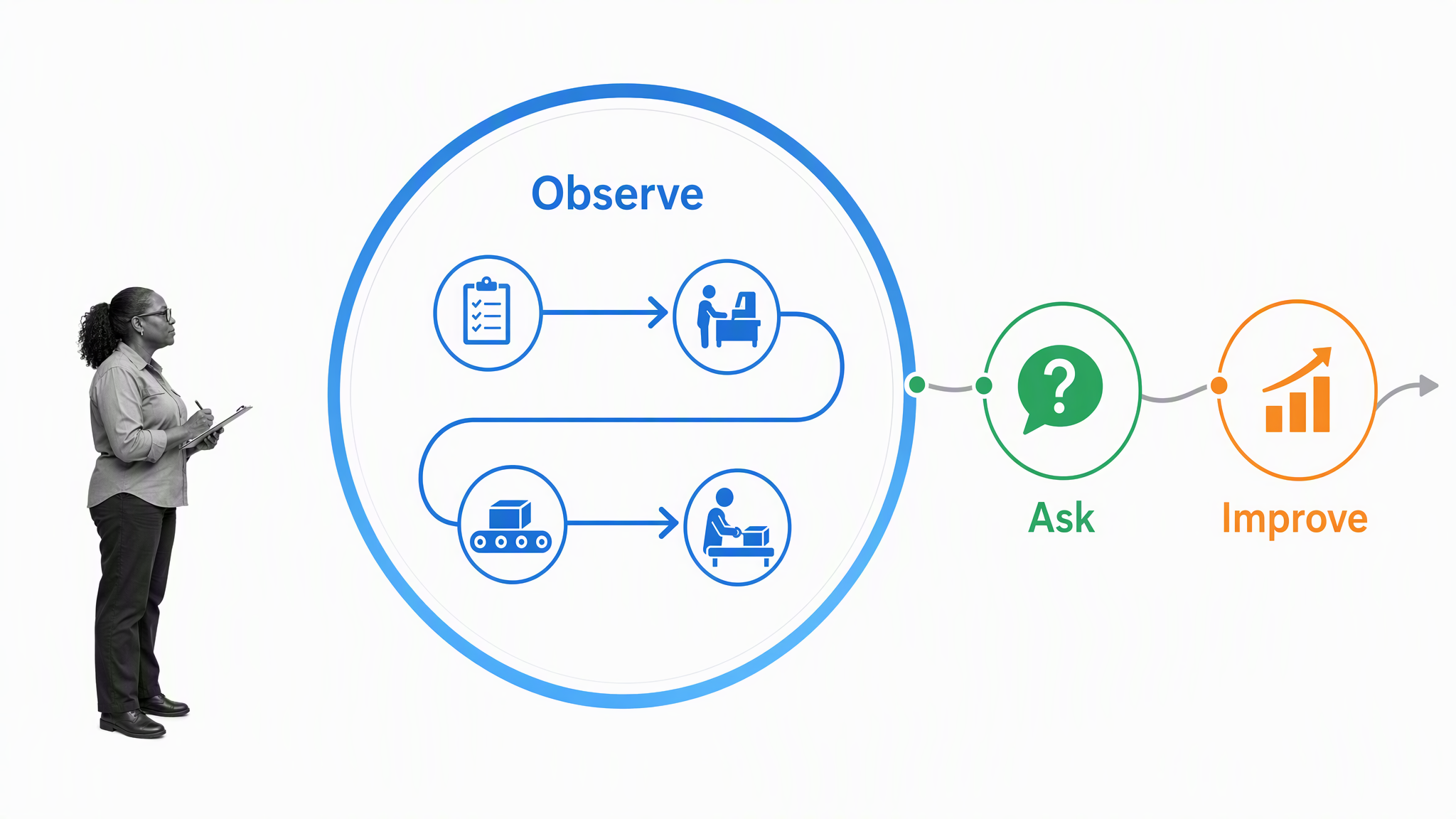
The Japanese word gemba means the actual place. In management practice, it is the place where value is created and where the process can be observed directly. A Gemba Walk is therefore not a conference-room review, a dashboard check, or a surprise inspection. It is a deliberate visit to understand how work really moves.
The Lean Enterprise Institute definition of a Gemba Walk emphasizes direct observation, questions, and respect. The purpose is learning. Leaders compare the intended process with actual conditions, listen to the people doing the work, and collect evidence before discussing changes.
A warehouse Gemba Walk might follow receiving, put-away, picking, packing, and dispatch. A leader can observe where items wait, which instructions are unclear, how often people search for equipment, and which handoffs create risk. The goal is not to catch an employee doing something wrong. It is to understand what the system makes easy, difficult, visible, or invisible.
The same idea applies outside a factory. For a marketing team, the gemba may be the workflow where a brief becomes a campaign: intake, research, drafting, review, approval, publishing, and measurement. Direct observation can reveal missing inputs, approval loops, unclear ownership, and rework that a high-level status report hides.
This warehouse safety checklist is one example of a repeatable observation aid. A checklist supports attention and evidence collection, but it does not replace conversation or curiosity.
What is lean management?
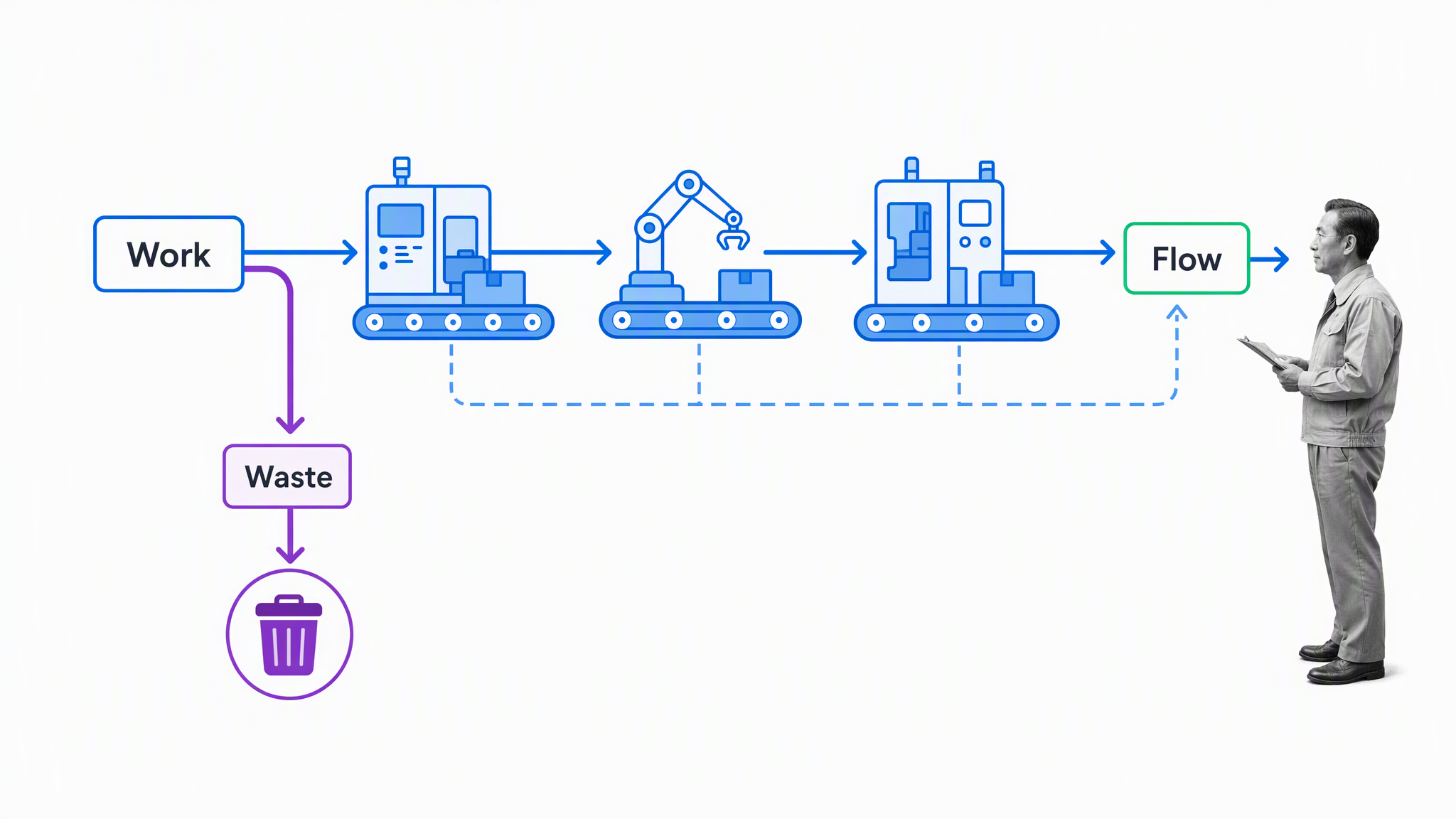
Lean management is a way of improving value and flow while reducing waste. Waste can include waiting, unnecessary motion, defects, excess work in progress, overprocessing, and knowledge that never reaches the decision-maker. A Gemba Walk supports lean practice because it brings the learner to the process rather than asking the process to fit a distant explanation.
Observation alone is not enough. A useful walk connects what was seen to a clear problem statement, a cause that can be tested, an owner, and a follow-up date. Without that discipline, even a thoughtful conversation can dissolve into an unprioritized suggestion list.
The origin of Gemba Walks
Gemba Walks are rooted in Japanese management practice and the development of the Toyota Production System. The practice is closely associated with Taiichi Ohno, but it is more accurate to describe it as part of a broader Toyota and lean tradition than to claim that one person invented the walk.
Toyota’s production-system history describes the long development of just-in-time production and jidoka. Both depend on making the condition of work visible. Toyota also treats Genchi Genbutsu, going to the source to find facts, as a foundational way to understand problems.
A well-known lean formulation is “go see, ask why, show respect,” attributed by the Lean Enterprise Institute to Toyota leader Fujio Cho. The sequence matters. First see the process. Then ask questions that uncover how it works and why conditions exist. Throughout, respect the expertise and dignity of the people who perform the work.
This history also explains why a Gemba Walk is different from management by wandering around. It has a learning purpose, a defined scope, and a connection to improvement. The leader is not there to perform authority. The leader is there to test assumptions against reality.
The 3 elements of a Gemba Walk
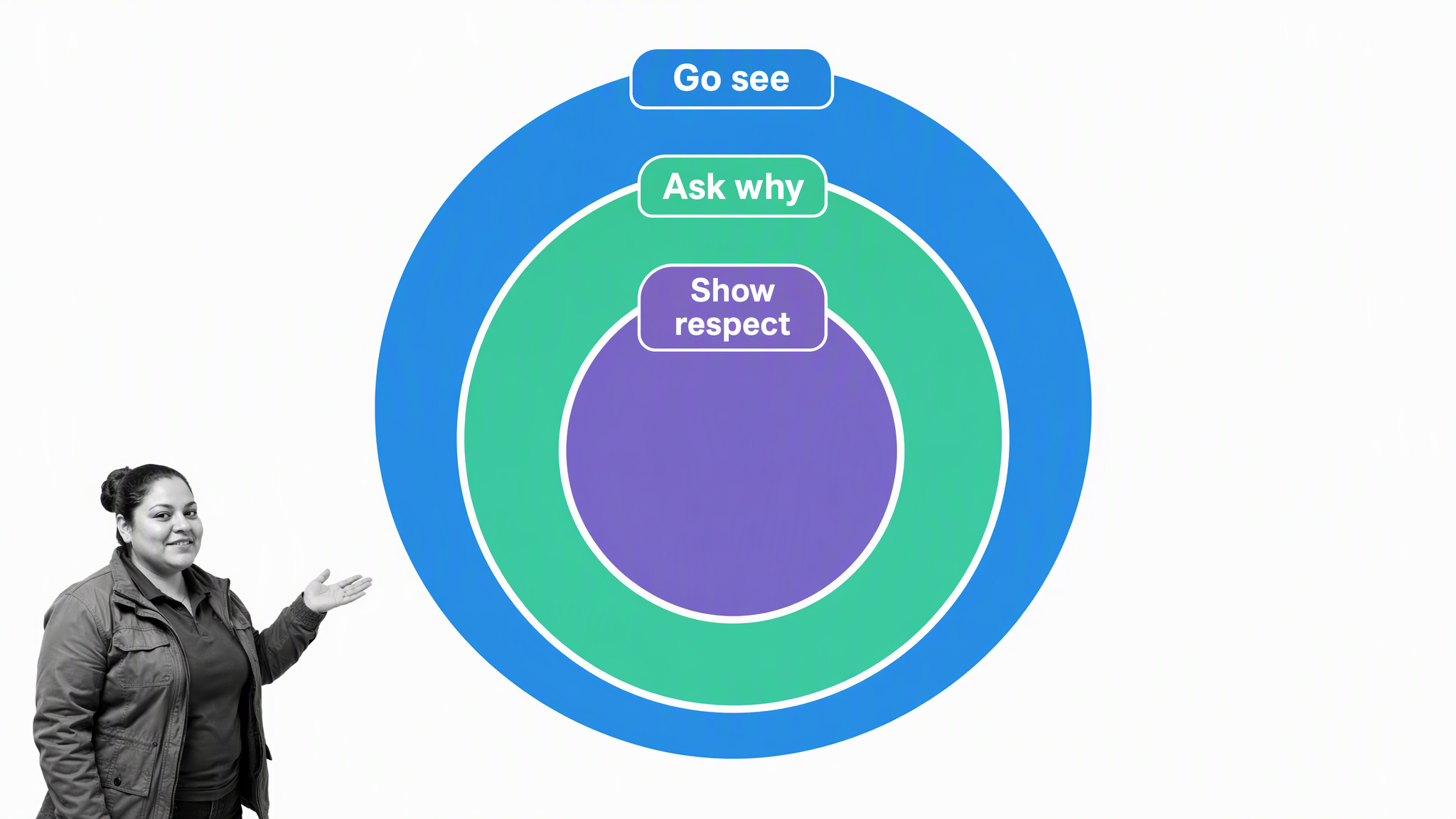
The three elements provide a simple standard for preparing, conducting, and following up on a walk. They also protect the practice from becoming a policing exercise.
Go see
Choose a process, value stream, or problem rather than trying to inspect everything. Review the expected workflow and any relevant measures before the walk, then observe actual work from beginning to end. Look for queues, workarounds, unclear criteria, repeated handoffs, missing information, safety concerns, and differences between the documented process and the real one.
Stay long enough to understand normal conditions. One snapshot may capture an exception. When possible, compare different shifts, roles, locations, or cases and ask what evidence would confirm that a pattern is real.
Ask why
Ask open questions before proposing a solution. Useful Gemba Walk questions include:
- What should happen at this step, and what happens most often?
- Where does work wait, repeat, or return to an earlier step?
- What information, tool, or approval is hardest to obtain?
- How do you know this step is complete and correct?
- What workaround do experienced people use, and why is it needed?
- If one small change were tested first, which change would help most?
The 5 Whys can help move from a symptom toward a cause, but five is a guide rather than a quota. Stop when evidence supports an actionable cause. Do not force a neat chain when several causes interact.
Show respect
Respect means listening without blame, explaining why the walk is happening, and giving people room to describe the work in their own terms. It also means closing the loop. If someone raises a hazard, constraint, or improvement idea, record it, assign a response, and report what happened next.
Lean guidance warns against turning Gemba Walks into policing. A leader who arrives with a hidden verdict will get guarded answers. A leader who is curious, specific, and accountable for follow-up is more likely to learn how the system actually behaves.
A practical Gemba Walk checklist
- Define the purpose. Select one process, question, risk, or customer outcome.
- Prepare. Review the documented method, current measures, known concerns, and the people who should be present.
- Set expectations. Tell the team the walk is for learning and improvement, not individual performance scoring.
- Observe the flow. Follow work, information, and decisions through the real sequence.
- Ask and listen. Use open questions and seek examples or evidence.
- Separate fact from interpretation. Record what was observed before deciding why it happened.
- Prioritize. Choose a small number of findings based on risk, impact, and feasibility.
- Assign follow-up. Give each action an owner, due date, evidence requirement, and review point.
- Return. Revisit the gemba to verify whether the change improved the real process.
How the elements change across different workplaces
Depending on what industry a business is in, the place where it conducts a Gemba Walk will be different, but the elements involved will not change. In a warehouse, an employee physically walks around the space to analyze how people are going about their processes. For instance, the routes forklifts take when moving items could be improved, or the location of stock could cause unnecessary motion. In an office, the walker may follow information rather than a vehicle.
For a marketing agency, the walk could take the form of noticing how the team is completing marketing tasks, whether they are following documented marketing processes, and whether their methods improve or regress the established process. The same approach works for remote teams when the walker follows a request through the systems, meetings, approvals, and handoffs where the work gets done.
The first element is to go to the gemba, the location where important work happens. The walker moves through the gemba with eyes peeled for how the process is being done. The second element, ask why, is about gaining insight and hearing what workers have to say rather than talking at them. The third element, show respect, is more of a mantra: walkers are not there to judge or tell people what they are doing wrong as a boss would. They are there to observe, notice, and learn before changes are made.
Although the word gemba is used in a myriad of different contexts in Japan, the western management world knows it best in relation to continuous improvement. Detectives may refer to the scene of a crime as the gemba because it is the actual place. In lean management, that same language points leaders to the front lines where crucial work happens and problems related to the process can be noticed and tackled.
The benefits of Gemba Walks and lean management
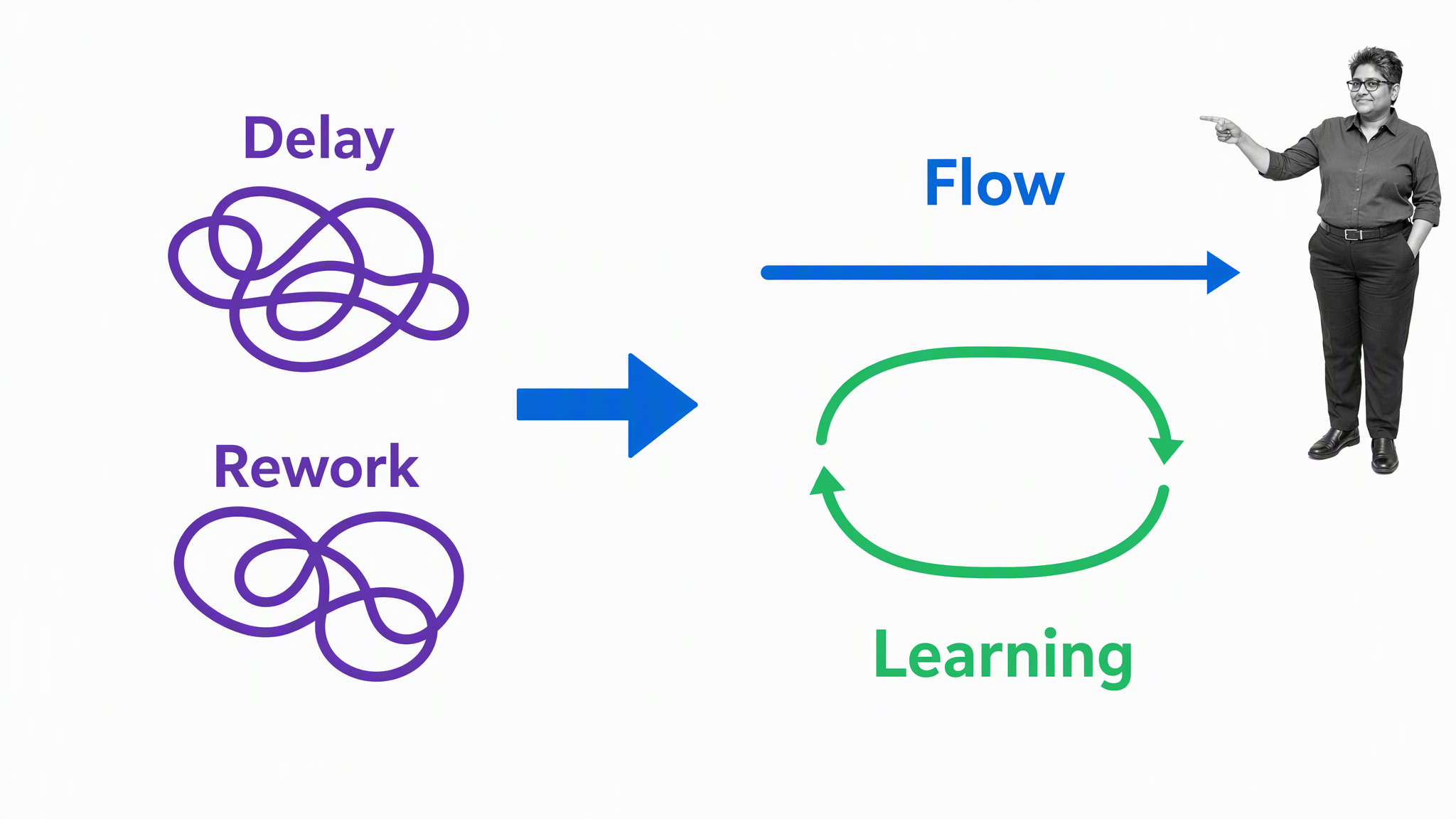
A Gemba Walk creates a shared view of the process. That sounds simple, but it addresses a common operational problem: different roles often hold different fragments of the truth. Direct observation combines those fragments with the visible condition of the work.
- Better problem definition: Teams can describe a specific condition instead of debating an abstract complaint.
- Faster learning: Questions at the point of work expose missing context, workarounds, and dependencies.
- Stronger employee involvement: The people closest to the process contribute evidence and ideas rather than receiving a remote diagnosis.
- Safer and more reliable work: Hazards, unclear controls, and inconsistent handoffs become easier to see and address.
- More useful process documentation: Differences between the designed and actual process show where instructions or controls need attention.
- Continuous improvement habits: Regular observation, action, and review turn improvement into a managed routine.
Of the benefits that Gemba Walking brings, process optimization is the star of the show. Seeing the sequence in person helps a team complete recurring work in smarter ways, remove avoidable steps, and compare the next iteration with the one that came before. Process improvement and reducing wasteful actions go hand in hand: a change is useful only when it improves value, flow, quality, safety, or learning.
Regular walks can also minimize resistance to change. Employees are less likely to see improvement as a remote management program when they help explain current conditions and evaluate possible changes. That involvement supports an agile mindset while keeping the people affected by a decision inside the feedback loop.
Another benefit is clarity from taking a step back. Operational work can feel like a relentless race to keep pushing forward, especially when targets are under pressure. Pausing to observe can expose the core procedures that are holding a business back. With that clarity, leaders can focus on necessary changes instead of asking people to work faster inside a flawed system.
A moderate understanding of Gemba and a useful checklist can help a new walker begin, but effective practice still requires judgment. The walker needs knowledgeable eyes, preparation, respectful listening, and the discipline to test assumptions. An external auditor may support a formal assessment, but the people who operate and lead the process must still participate because they carry the context needed for improvement.
Lean production is a methodology for creating maximum value by optimizing resources. It aims to ensure that processes and procedures are not wasteful, but it does not declare that every pause or buffer is automatically bad. In practical terms, waste or muda is activity that does not add value and is not required for safety, learning, quality, or control. The primary goal is to eliminate unnecessary waste while protecting the conditions the process actually needs.
This is also why Gemba Walks should not be reduced to a pair of knowledgeable eyes and a checklist. The walk itself may be short, but the full practice consists of preparation, observation, discussion, analysis, ownership, and a return visit. A checklist helps the walker complete recurring tasks correctly and capture consistent evidence. Judgment is still required to separate an isolated event from a system condition.
Regular Gemba Walks can keep procedures from stagnating because they create repeated opportunities to notice whether the documented method matches reality. That does not mean processes are always being optimized, tweaked, and altered for the sake of activity. Changes should be made only when evidence suggests a better way, and the result should be checked so employees do not become confused or revert to an inefficient process.
An effective Gemba Walk can help both remote and physical businesses continuously improve, but the aforementioned benefits barely scratch the surface. The practice allows employees to ask questions across roles, account for additional context, and collaborate on changes that can increase reliability. It also ensures that improvement is not done blindly. A finding is carried forward only after the people involved understand what was observed, what has already been tried, and what success should look like.
For full transparency, Gemba Walking is not automatically conducive to improvement. A poorly planned walk can feel like an executive inspection and can even reinforce the wrong conclusion. A useful walk is an evaluative learning process, not a verdict. It should build a shared view, identify holes in the current method, and create an additional feedback route so changes can be tested, measured, and either adopted or reconsidered.
The method works in knowledge work too. A finance, HR, support, or marketing team can observe how requests enter a queue, how decisions are made, and where evidence is lost. Lean Enterprise Institute examples show that “go see” can mean following information and decisions, not only walking a production floor.
The limits are just as important. A Gemba Walk does not prove a root cause by itself, replace a safety or compliance audit, or justify immediate changes based on one observation. Use it to form better questions, then validate important findings with data, interviews, experiments, or formal analysis.
For methods that complement observation, this guide to quality management tools covers approaches for organizing causes, prioritizing risks, and testing improvements.
Turn Gemba observations into process improvements with Process Street
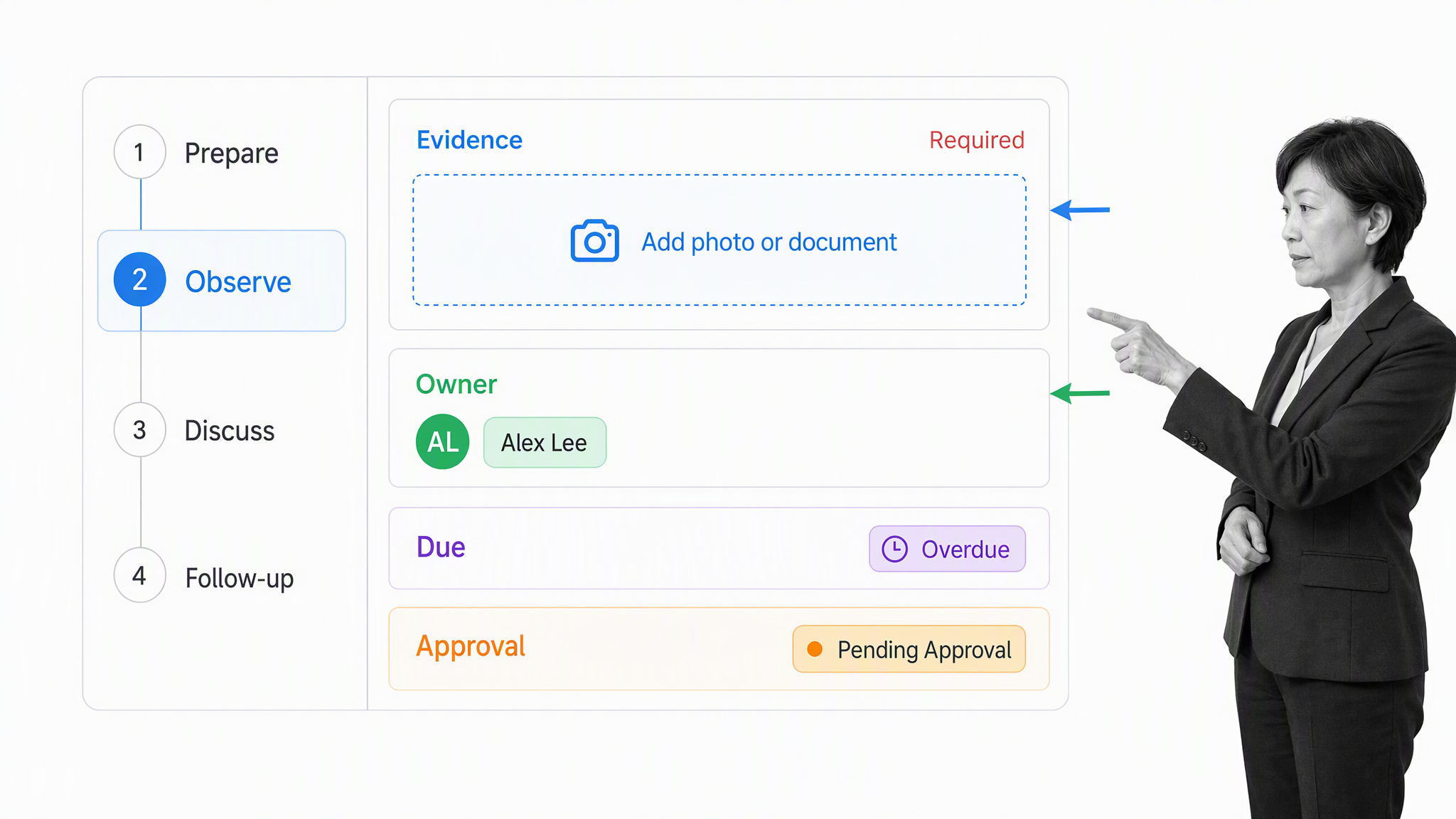
Process Street is a Compliance Operations Platform that brings Docs and Ops capability areas together with built-in AI. Teams can keep approved guidance in Docs, run repeatable Gemba and corrective-action workflows in Ops, and use built-in AI to work with information inside the process while ownership and control remain visible.
A governed Gemba workflow can prompt the walker to define the purpose, identify the area and participants, capture observations, attach evidence, distinguish facts from interpretations, and select findings for review. Required fields make important evidence harder to skip, while assignments and due dates make responsibility explicit.
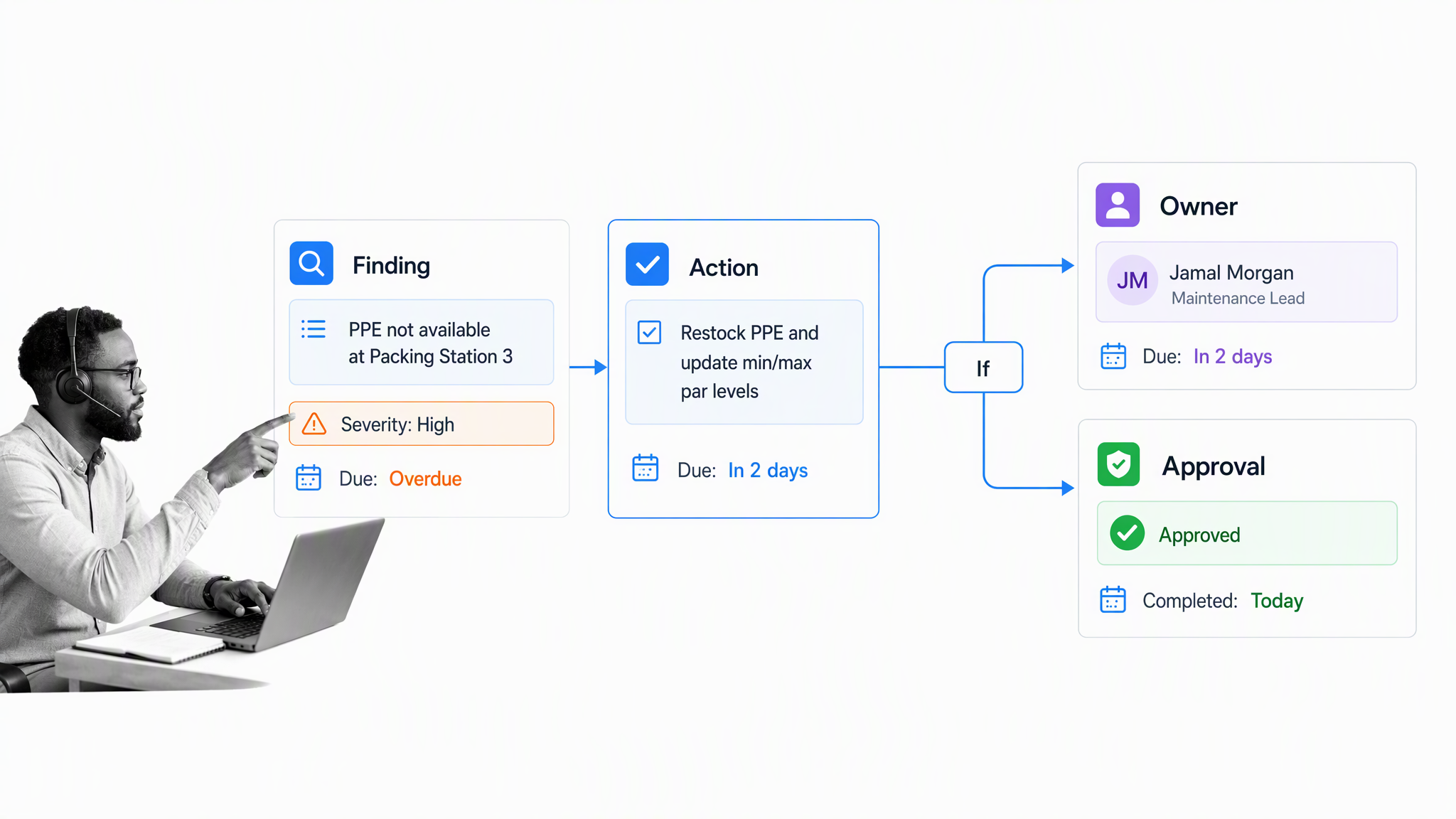
Conditional paths can route a safety concern, quality defect, policy exception, or improvement suggestion to the right owner. Approvals can document the decision to accept, reject, or revise an action. The workflow then retains the finding, decision, owner, timing, and completion evidence in one reviewable record.
Docs and Ops serve different parts of the same system. Docs holds the current Gemba standard, question guide, escalation rules, and examples. Ops applies that knowledge to live work through tasks, forms, assignments, approvals, and conditional logic. Built-in AI can help summarize observations or organize evidence, but the workflow still shows who reviews and owns the decision.
Teams can document workflows, core business processes, and integral procedures in Docs, then run the work through Ops. Useful controls include stop tasks, dynamic due dates, conditional logic, task permissions, task assignments, role assignments, embed widgets, webhooks, and approvals. Select the controls that clarify responsibility or reduce risk rather than adding automation for its own sake.
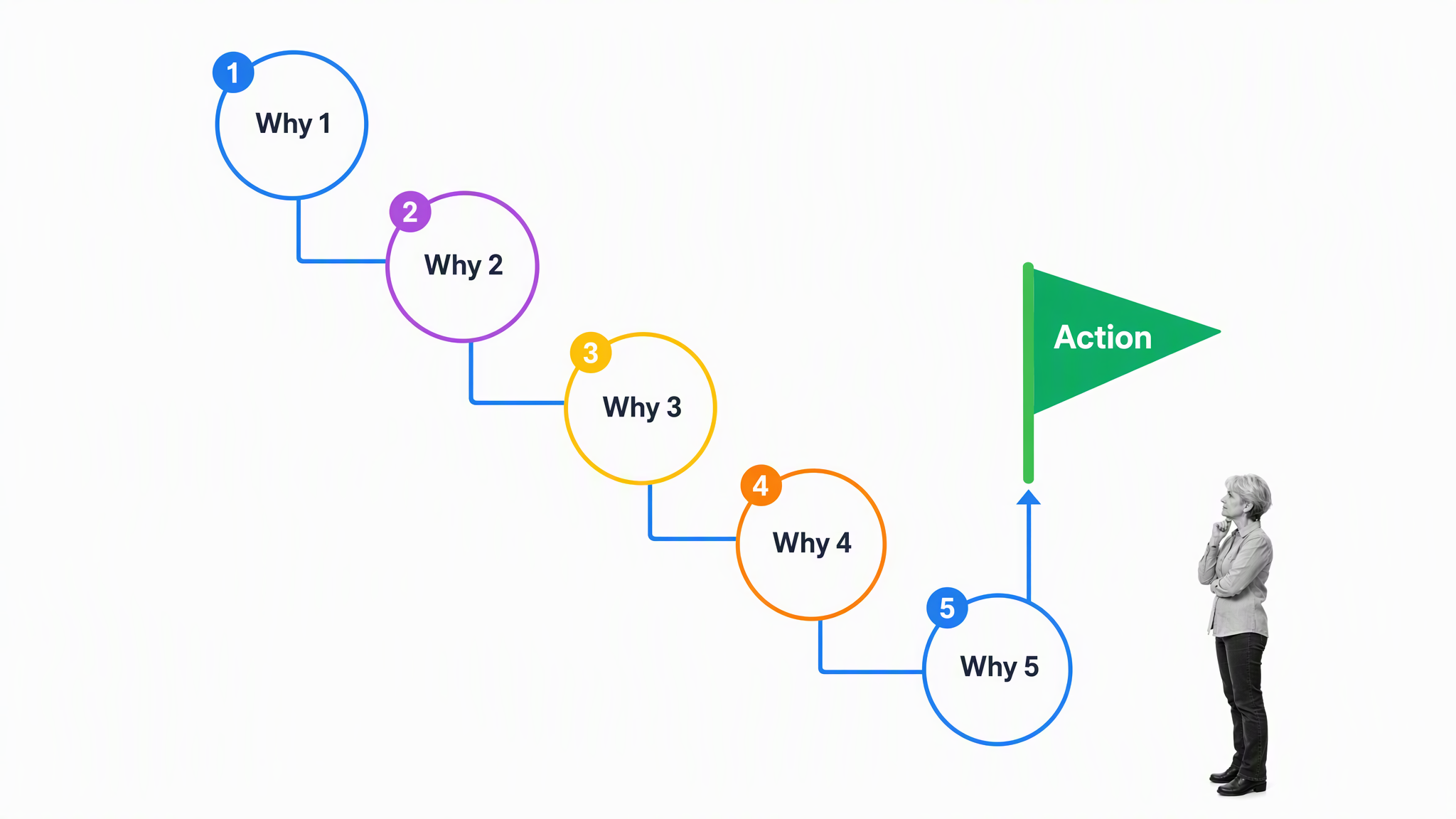
For deeper investigation, link a finding to a 5 Whys or other root-cause workflow. The result should end with an owned corrective action, not simply a diagram. Define what will change, who will make the change, what evidence will show completion, and when the team will return to verify the outcome at the gemba.
Helpful resources include guides to process improvement, continuous improvement, business process management, and knowledge management. Each supports the same essential discipline: understand current work, design a better method, and verify that the change works in practice.
The Process Street template library also provides structured starting points for methods that often follow a Gemba Walk, including FMEA, VRIO analysis, SWOT analysis, 5 Whys, and SMART goal setting. Adapt a template to the risk, evidence, roles, and review cycle of the actual process.
More resources for making process improvements
Gemba Walking is one part of a broader improvement system. These related guides cover implementation, optimization, lean methods, quality, and error reduction:
- Implementing processes
- Process improvement
- Continuous improvement
- Business process optimization
- Kaizen
- Six Sigma principles
- PDCA
- Lean manufacturing principles
- Muda and the seven wastes
- DMAIC
Explore Process Street pricing and start a free trial.