



All posts by Benjamin Brandall

How to Calculate NPS with the Perfect Customer Happiness Survey

Calculate NPS

Customer Happiness is a metric unlike any other.

It’s not founded on principles of revenue, bounce rate or any other traditionally mathematical ideas.

Customer Happiness is based on emotions, not data. And while these emotions can be formulated as data, one of the first steps is to work out how.

In this blog post series we’ve already covered the definition of customer success, why customer success is important and churn for SaaS companies.

Have you ever received this email?

Chances are, you’ve got an email at some point that looks like this:

Microsoft NPS survey

The outcome of this question is used to formulate your Net Promoter Score (NPS), one of the metrics that measures the health of your company and the effectiveness of your Customer Success strategy.

Some companies will ask for your response on a scale of 1-10, some in a series of phrases like the Microsoft example above. I’ve even seen 🙂 and 🙁 as options.

How do these responses translate to a solid representation of customer happiness?

Continue Reading

What is Churn? An Introduction for SaaS Companies

What is Churn

Churn is the enemy.

Churn is the sickness that will kill your SaaS company.

Redpoint VC Tomasz Tunguz showed us just how damaging churn is to the MRR of SaaS companies and how an adjustment of just 5% can make a massive impact.

Churn is the rate your customers are cancelling their subscriptions to your product.

One of the key outcomes of any customer success strategy is to reduce churn by helping disenfranchised customers continue to get value from what you’re offering them.

The pricing model of SaaS lends itself well to being extremely profitable. But as David Skok says in his post about achieving negative churn, there are massive risks.

The nature of subscriptions mean that your customers are paying you regularly which brings in recurring revenue, but also puts you in a precarious position.

Every time your customers get the bill for your product through on their statement, they’re asking the question: This month, did this product save me more money than it cost me?

Over the past two weeks, I’ve answered two questions: What is Customer Success? And Why is Customer Success Important? Today I’m going to answer the question ‘What is churn?’. It all boils down to one thing. Customer success teams and strategies are in place to stop customers cancelling.

They exist to reduce churn.

Let’s look at this in more detail.

Continue Reading

Why is Customer Success Important? A Guide for SaaS Companies

Why is customer success Important SaaS

Last week I kicked off a new series of blog posts about customer success for SaaS companies by answering the question ‘what is customer success?‘. This week, we’re going deeper and examining why it’s important for SaaS companies.

Tomasz Tunguz, venture capitalist at Redpoint, says customer success is ‘equal in importance to sales and marketing and engineering and product within SaaS companies‘. But why? Technically, it didn’t exist 10 years ago, so why do we need it?

We need it because products are developing faster than our capacity to understand them, we need it because competition in the SaaS world is harsh and we need it in place to reduce churn and keep users sticking around for the long haul.

Let’s take a closer look at these points.

As a free bonus, check out our podcast episode talking about customer success.

Customer Success connects promise to reality

Here’s a theoretical situation to explain.

Pretend I just signed up for an analytics product because I know I need to start tracking user activity in my mobile app. The landing page copy told me that’s what I can do with the app, so I bought it. I go in, and within 2 minutes I’m confused and wondering exactly how I can load it up with my app’s data or set conversion goals.

In an ideal world, the platform’s customer success manager should have been on the phone to me the same day of purchase, guiding me through the steps to get it set up and teaching me everything I need to know.

Salesforce Customer Success

Analytics platforms and CRMs are just two examples of complex products that can be configured in numerous different ways — for these products, a user guide or support ticket system isn’t always the best thing to offer.

You don’t want your customer having to work harder to get what was promised by the sales team because your product should be easy to implement for all customers and deliver value from day one.

Your product’s initial setup, or even basic use, won’t be obvious to everyone. Not to mention how businesses grow and their needs change over time — every time the monthly bill for your product comes through, the customer is questioning whether they really need it.
Continue Reading

What is Customer Success? An Introduction for SaaS Companies

What is Customer Success

When you sell a coat or a bar of chocolate, customer success isn’t necessary.

Those are simple, self-explanatory products that everyone knows how to use.

Even with things like a new vacuum cleaner, customer success isn’t required. A user manual and a hotline is as far as most things go.

With your SaaS product, however, it’s not going to be so easy. Complex analytics platforms, SEO tools, and landing page creators can be set up and used in a variety of ways, solving different problems for customers from marketing agencies, e-commerce stores, factories, and farms.

For software companies, the golden days of unbreakable contracts and technical lock-ins are gone. The industry has diversified, and there are a lot of companies your customers could be choosing over yours, with more attractive branding, master salespeople or better customer success.

When your product needs follow-up and guidance to ensure the customer gets full value, that’s when customer success becomes a must-have.

This is because a customer who speaks to your sales team or reads your landing page is sold on the benefits, not the features.

The customer knows your product can solve their problem, but not exactly how to get that value.

(Click here to skip ahead and get a full high-touch customer onboarding process for SaaS companies)
Continue Reading

From Marx to Microsoft: The Origins of Flat Design and How It Was Almost Ruined

flat design

Help me. I’m on a laptop running Windows 8 right now.

Like many others, I hate it and think it’s the worst operating system since the not-so-distant Vista.

If I didn’t have to use it, I might be able to appreciate for a second that Microsoft made a bold design decision that actually ended up being influential.

Microsoft’s Metro design language was one of the first instances of flat design in technology and it came in the least likely form: a terrible mp3 player nobody bought apart from this one kid at my school. The short-lived Zune.
Continue Reading

Do you need to get an MBA? My dad didn’t, and neither do you

Benjamin Brandall November 3, 2015

get an mba

College education has been called the largest scam in US history. The cost of one year of college tuition in the US has risen by 160% in the last 10 years and looks set to increase 5% year on year.

Despite the huge price hikes, doesn’t having a college education make you a vastly more attractive candidate?

Not really.

A 2014 survey of nearly 3,000 job seekers and HR professionals found that 64% of hiring managers said they would “consider a candidate who hadn’t gone to a day of college”. In fact, business jobs like sales manager and operations manager don’t need a degree at all, despite paying an average salary of over $90,000.

Experience is more important than education

While degrees do still matter to 46% of hiring managers, one of the most important factors when choosing a candidate is experience. A few decades back when the corporate structure might have been a little more loose, executive positions were widely available to low-level employees.

My dad started out working in the factory for a coffee corporation in the early 1980s. Over the years, he climbed the ranks towards becoming the top salesman in the region up to what would now be called the customer success manager.

Did he have a college degree? No, actually. He left school at 16, joined the Air Force and lived in Cyprus throughout the 1970s. This example is probably a case of being in the right place at the right time, and nowadays it’s rare to be promoted from the factory to the golf course with clients, especially in a big company. However, the same thing can happen now, just not in the corporate space…

Continue Reading

These 5 Data-Driven Reasons Decisively Prove the Benefits of Blogging

Untitled design (10)

In light of a recent study from IZEA commissioned by Halverson Group which revealed that the lifespan of a blog post is 24 times longer than first thought, it’s time to re-evaluate the other reasons why not blogging is a mistake in the current marketing climate.

Contradictory data floods businesses daily. It’s understandable some need hard facts to justify the investment in a blog. That’s just good business sense. Yet, researchers bury vital statistics in 60-page white papers which don’t always reach the audiences that need them.

Thanks to several new studies, the benefits of blogging are out in the open.

Here’s a compilation of recent findings showing the contrasting success of companies that blog versus those that don’t.

Continue Reading

My Content Creation Process: How to Write More in Less Time

content creation process

How often do you manage to read everything you save for later? I mean email, bookmarks, PDFs… everything.

When I first started working as a Process Street content writer, I had to improve my content creation process instantly or start falling behind deadlines.

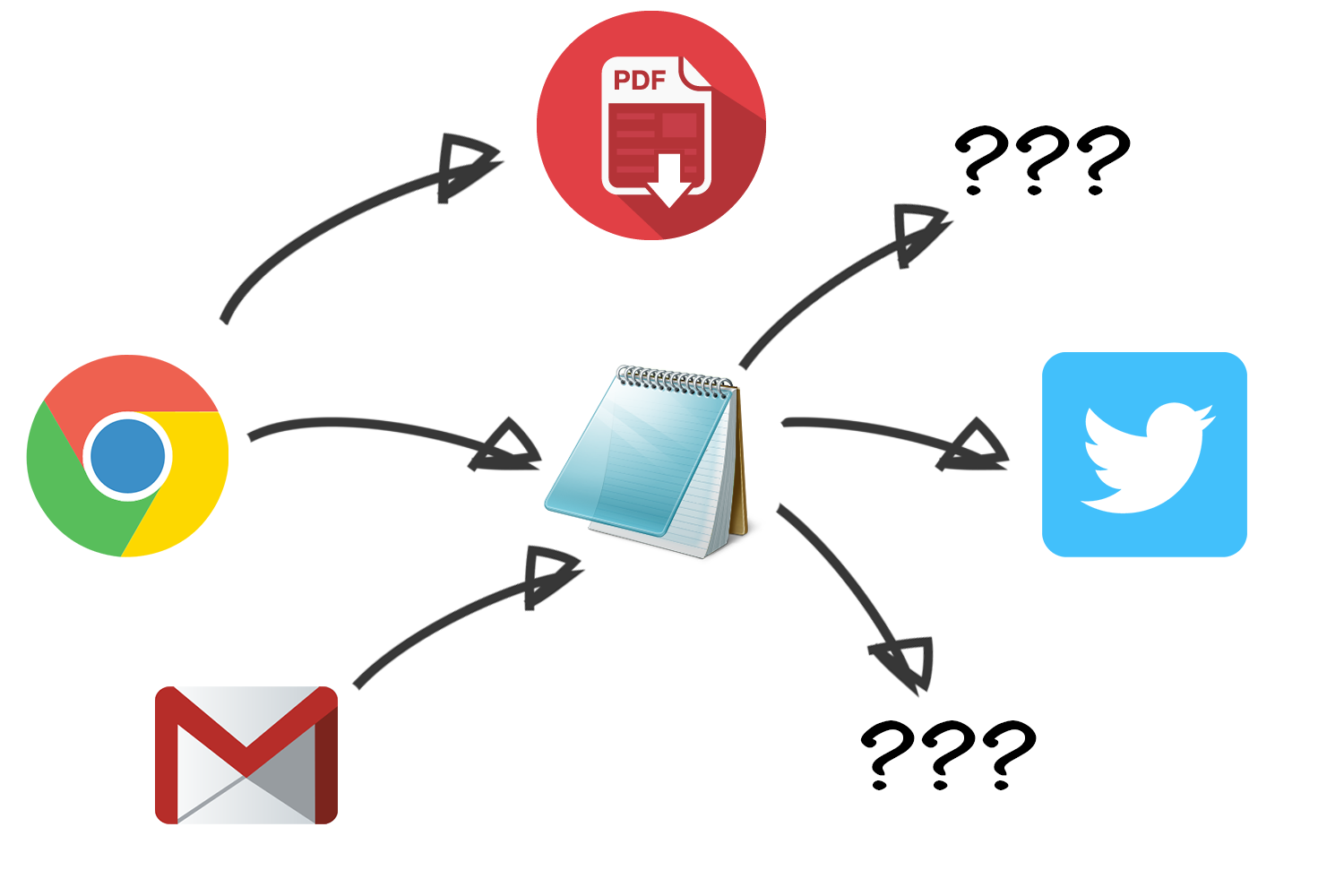
I don’t want to remember how slow and disorganized I used to be before Pocket. It’s only been a few months, but I’ve already repressed memories of my sluggish content creation process. For the purposes of this post, I racked my brain and dredged up the process for you all to laugh at. Here’s what it looked like:
bad content creation process

My day-to-day tasks include research, reading, writing, and keeping our social platforms updated with fresh, relevant content. As far as research goes, I lost most of it or had no way of organizing it properly. PDFs got lost in my overflowing and overlooked Downloads folder, and anything pasted from Gmail to Notepad wasn’t worth looking at because of the formatting issues.

If I wasn’t using a combination of Twitter, Pocket, Evernote and Trello for content creation, I might as well be shoving a load of links into Untitled.txt and forgetting about them forever.

Here’s how I make sense of the research process I go through when creating new content for the Process Street blog.
Continue Reading

You Need a Way to Manage Core Business Processes — Here’s What to Do

core business processes

The Problem Small Businesses Don’t Want to Admit

Every small business owner is an entrepreneur and a technician, but not everyone’s a manager.

Most people start a small business after working a job that involves ‘making’. Programming, graphic design, SEO, you name it – small business owners usually get their idea when they realize that they could be doing the same thing as they’re doing now and getting rid of their boss.

Motivated by the mythical entrepreneurial drive and true technical experts in their field, founders don’t realize that they can’t just get rid of the boss — they have to be the boss.

Being the boss involves management of time, people and money. While this can be possible if it’s your only responsibility, on top of everything else it will be overwhelming.

Unfortunately, in starting a small business, suddenly you have a boss again – your customers, the amount of hours in the day and your revenue.

This idea, from Michael E. Gerber‘s The E-Myth is key to understanding why small businesses face the problems they do, especially when growing fast.

Don’t worry: that’s where productivity tools come in.

Continue Reading

How Microsoft’s Secret User Onboarding Process Fooled Us All

user onboarding process

What happens if you make software too difficult to use? Probably the same thing that happens if you never made it at all — no one uses it.

It’s easy to get users to adapt to familiar concepts like drag-and-drop, but what if you made something totally new? You need a creative user onboarding process, like the one Microsoft used back in 1992 and the others I’m going to look at in this post.

The Software User Onboarding Process

I already talked about concierge onboarding, so this time I’m going to look at the total opposite — a style known as low-touch user onboarding. It’s not always possible to work with every customer, especially if you’re distributing software on a massive scale like Microsoft Windows, so writing onboarding into your product is a necessity.

James Hunt‘s excellent article on Mental Floss reveals the true purpose of Minesweeper, Microsoft SolitaireFreeCell and Hearts: a gamified way to teach users concepts vital to success using Windows 3.1.

Let’s take a look at exactly how they did it.
Continue Reading

Take control of your workflows today