



All posts in Human Resources

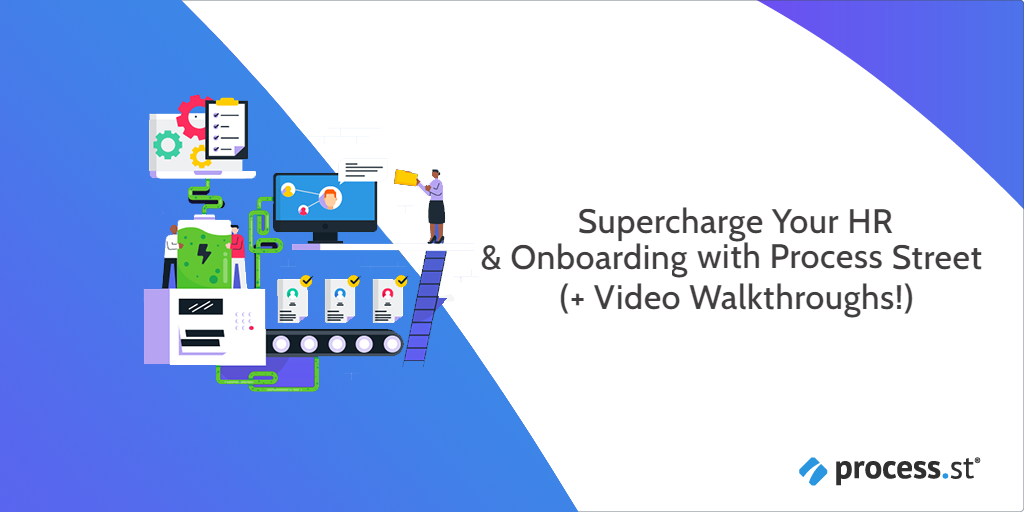
Supercharge Your HR & Onboarding with Process Street (+ Video Walkthroughs!)

hr-onboarding-process-walkthrough

For HR managers in charge of onboarding new employees, daily tasks can quickly become difficult to track and overcomplicated.

Consider: 4 new hires starting this week, alongside about a dozen others that started in the past few months, and a handful that are wrapping up their first year any day now; it’s clear how HR departments can struggle to stay on top of things without stress or confusion.

That’s why human resources departments worldwide use Process Street to streamline and automate their daily HR work tasks, for processes like:

In this article, we’ll show you how our customers manage their daily HR tasks using Process Street.

You can see exactly how it’s done, with supporting screenshots and video walkthroughs.
Continue Reading

The Impact of GHRM on Employee Retention and Well-Being

Greening HR The Impact of GHRM on Employee Retention and Well-Being

We’re all doing our part to be more eco-friendly, but let’s not beat around the bush: At the end of the day, even saving the environment needs to have an ROI. The primary function of a business is to generate revenue, after all; if your company doesn’t have revenue, your Green initiatives are kind of a moot point.

Corporate sustainability is not a new idea. While the term “greenwashing” didn’t come into use until the ’80s, and “business sustainability” until John Elkington’s 1994 paper for California Management Review, the concept behind both dates all the way back to the ’60s and Westinghouse’s “clean and safe” nuclear power plants.

It’s been around a while, in other words, so let’s look at some recent numbers.

85% of S&P 500 index file regular sustainability reports. Over 80% of investors factor ESG (environment, social, and governance) data into their decision-making. At the start of 2016, $22.89 trillion in assets (26% of all managed assets) were the result of sustainable investments – a nearly 5% increase since 2012. By 2020, sustainable assets under management $35.3 trillion (36% of managed assets).

“Going Green” isn’t just about paperless memos and reduced carbon footprints, though. It’s only through the commitment, performance, and efforts of your employees that you can effectively adopt environmentally aware practices. This requires a complete shift in your business’s values and cultures – a shift that is only possible if backed by your employees.

For your employees to adopt pro-environmental behaviors (PEB), you need to have established human resource practices that encourage them. You need, in other words, to “Green” your HR management, or as it has been creatively termed, Green HR management (GHRM).

As I’ll show you in this Process Street post, not only does GHRM create more environmentally aware employees, but environmentally aware employees are more engaged at work and have higher job satisfaction.

Here’s the rundown:

Let’s get started!
Continue Reading

Why Excel Sucks for Employee Onboarding (You Could be Losing Millions)

Why Excel Sucks as Employee Onboarding Software-04 (1)

Employees in a well-structured onboarding program are 69% more likely to remain at the company after 3 years.” – Society for Human Resource Management (SHRM), 2010 Employee Benefits

1 out of 25 employees leave their new job due to substandard onboarding experiences.

In contrast, a good employee onboarding program can boost employee retention by 69% after 3 years.

Process Street is dedicated to helping our users improve their business operations, and employee onboarding is a prime focus area. On this, we’re surprised to learn that some of our customers have been using Excel for employee onboarding.

According to Harvard Business Review, companies – on average – lose 23% of their new hires after one year. A more thoughtful approach to employee onboarding can dramatically improve this statistic for your organization; and for that, we say, get off Excel.

“…a lot of B2B productivity products are competing with Excel sheets and other products that are totally not built for the specific problem they solve.” – Bram Kanstein, Tech Out Loud, The Product Before the Business by Bram Kanstein

In this Process Street article, you’ll learn why Excel sucks for employee onboarding, and why workflow management solutions offer better onboarding solutions.

Click on the relevant subheader to jump to your section of choice, alternatively scroll down to read all we have to say.

Let’s jump to it!
Continue Reading

Human Capital Theory: Still Relevant or Woefully Outdated for Our Knowledge Economy?

Human Capital Theory Still Relevant or Woefully Outdated for Our Knowledge Economy

“Our human capital stock is ready to go back to work.” – Kevin Hassett

In May 2020, White House advisor Kevin Hassett drew public ire by referring to the American workforce as “human capital stock.” US Representative Alexandria Ocasio-Cortez asserted the term was not only outdated but inherently racist.

This raised a very important question for employers: How do you measure the output of your employees without treating them like cattle?

In addition to questions about the potential for dehumanizing employees, contemporary theorists question whether or not human capital theory – a product of the mid-20th century manufacturing economy – still has a place in our 21st-century knowledge economy.

In a knowledge economy, an employee’s output is intellectual rather than physical. Human capital theory originated during what is considered a manufacturing economy. As a result, it’s optimized for measuring physical output.

At a clothespin factory, a worker’s productivity is judged by how many pins they produce a day. There’s an established length of time it should take to make a faultless pin. That pin is an example of physical output. At the end of the day, you can count that worker’s pins and have a fairly good idea of their productivity.

A knowledge worker, however, doesn’t produce physical output; a knowledge worker produces intellectual output. I’ll go into this in more detail further on, but – in terms of human capital theory – the question is: how do you know how many “pins” a knowledge worker makes per day?

Obviously, knowledge workers are still given a wage, generally factored according to their value to the company (experience, education, etc.); in other words, using the principles of human capital theory.

But is this an accurate reflection of that employee’s worth? Are knowledge workers being undervalued because their productivity isn’t linked to the number of hours they work? Should intellectual and physical output still be measured on the same scale? Can they be weighed by the same scale?

More to the point, if human capital theory has outlived its usefulness, what language should we be using to describe an employee’s value? Is it fair to consider employees part of a company’s assets?

In this Process Street post, I aim to investigate these questions and explore ways in which the 21st-century employer can assess employees in terms of company value without objectifying the individual contributions.

Let’s delve deeper.
Continue Reading

How to Combat Zoom Fatigue: Synchronous vs. Asynchronous Communication

How to Combat Zoom Fatigue Synchronous vs Asynchronous CommunicationIt’s 4 p.m. and you’ve got a welcome call with your newest team member. Ideally, you’d feel full of life, ready to welcome her with enthusiasm and get her excited about the weeks to come.

Problem is, this is your 6th video call of the day and you’re overrun with Zoom fatigue.

You’ve been turned “on” (not in a good way) for the last 7 hours and are severely lacking in enthusiasm, let alone excitement.

The worst thing is, the majority of those meetings were unnecessary, everything covered in them could’ve been communicated asynchronously.

Simply put, asynchronous communication involves communicating remotely without expecting an immediate response. This can be done via iMessage, pre-recorded video/audio, making suggestions to an existing project (think: Google Docs/Sheets, Github, Jira).

The challenge is knowing, when and how to use synchronous vs. asynchronous communication methods. Fortunately, this post is here to teach you just that so you can avoid Zoom fatigue and stop being real-time, all the time. Feel free to skip to a specific section of the post using the links below.

Let’s get started!
Continue Reading

When You Need an HR Team and How to Build One Effectively

When You Need an HR Team and How to Build One Effectively

It’s 4:55 on a sunny Friday afternoon. You have a whole weekend of relaxing in the backyard planned. Maybe you’ll have friends over for a barbecue, or finally finish that crime thriller you started last year and forgot about. There’s always that super-extended director’s cut of a film from four years ago that just came out.

You’re blissfully contemplating all your stress-free options when your line manager pops their head in and cheerily says, “HR wants to see you first thing Monday morning. Have a great weekend!”

It's all fun and games until someone calls HR
(Source)

The truth is, the role of HR teams – and even the name – has evolved quite a bit over the years, though its reputation hasn’t been quite so quick to keep up. People Teams, as all the start-ups are calling it these days, still have a vital role to play in the structure and organization of a company, though.

So, when is it time to create a super team-up for your start-up? More importantly, how do you do it?

I sat down with Process Street’s own VP of People, Jay Hanlon, to talk:

Come on in and have a seat!
Continue Reading

Speed Up HR Tasks with Process Street’s New Slack App

hr tasks
How many different tabs do you have open on your computer or laptop, right now?

I bet it’s a lot.

Let me guess. You’ve probably got one open for your emails, one for your social media, one for Slack, and another for Process Street?

And, maybe you’ve also got tabs open for your HR management system, your recruitment software, your reporting platform, your payroll service, your employee engagement tool, and…well, the list could go on and on and on.

Am I right?

But, this makes finding the tab you need when you need it virtually impossible, it slows your computer…right…down, and even the simplest HR tasks can end-up taking twice as long.

Too many tabs, in almost any web browser, will lead to overtaxed computer memory, a reduction in battery life, and, for sure, a cluttered browser workspace.” – Forbes, Too Many Tabs Open: Save Your PC Or Mac From Overheating

What if there was a way to speed up your HR tasks? What if you could get all your task notifications and updates in one, central place instead of several? What if you could improve communication with your team and spend less time waiting or chasing for updates and more time on the things that matter?

Interested?

Allow me to introduce you to our newest feature, built for Slack lovers: The Process Street Slack App. Just click the button below to add it to your Slack!

HR tasks

Read on to discover how the Process Street Slack App can speed up your HR tasks as we whizz through the following:

Let’s get cracking. ️
Continue Reading

How to Use Technology to Overcome Workplace Anxiety-Related Productivity Issues

How to Use Technology to Overcome Anxiety-Related Productivity Issues

This is a guest post by Hazel Bennett, a freelance writer and blogger. She has a degree in communications and lives in Northeastern Ohio. Hazel loves writing about numerous topics and showcasing her expertise with words. Follow Hazel on Twitter.

Those with anxiety know what a struggle it can be to get through each workday. Stress, nervousness, and negative thoughts can wear a person down. As the effects of anxiety begin to take over, workers can lose the focus and motivation necessary to get the job done, leading to productivity and morale problems.

The combination of a high-stress work environment and mental health challenges can result in less-than-satisfactory work performances and unhappy employees. If you’re looking for solutions to keep your company working smoothly and your staff healthy and well, this Process Street post has you covered.

Read on for information about anxiety and how to overcome it with the help of productivity-enhancing technology:

Let’s take a look!
Continue Reading

Reduce Employee Turnover by 63% Using Employee Acknowledgment

Employee Acknowledgment

This is a guest post by Katerina Mery, a marketing specialist at Fond. Fond is a rewards and recognition company dedicated to building places where employees love to work. Mery authors articles about how to leverage recognition programs to drive company success.

Think back to the last time a colleague acknowledged you for a job well done.

How did you feel?

Did the experience have an impact on your behavior moving forward? Did the exchange affect your relationship with the person thanking you? What about your relationship with the company in general?

63% of employees who are acknowledged for the work they do are unlikely to look for a new job. Expressing gratitude at work takes relatively little effort, but it can create an incredibly memorable professional experience. Knowing that you did a good job is one thing, having a colleague call out your great work takes the experience to another level.

Business objectives can sometimes feel at odds with an enjoyable employee experience. Employee acknowledgment, however, is a practice that effortlessly supports both.

From this Process Street article, you’ll learn how employee acknowledgment simultaneously caters to your organization’s business objectives. You’ll also learn how to meet the emotional needs of your employees using fantastic positive feedback loops that generate continual improvements across the board.

We say employee acknowledgment is a smart initiative a company can adopt – but before you take our word for it, allow us to explain why.

Click on the relevant subheader below to jump to your section of choice, alternatively scroll down to read all we have to say.

Let’s jump to it!
Continue Reading

Workforce Planning Essentials for the Remote-Savvy HR Manager

Workforce Planning Essentials for the Remote-Savvy HR Manager

There are plenty of great quotes from inspirational leaders that perfectly sum up the importance of workforce planning, but in my mind, none of them quite capture it like this one:

“Making a plan without the right tools is like making spaghetti without a pot.” – Kris Hughes, Content Strategy Consultant

You are absolutely not going to be making any spaghetti without a pot, or at least a pot-like vessel that will hold boiling water in a way so as not to burn the crap out of your hands in the process. When it comes to workforce planning, the spaghetti is your business and the pot…

Okay. I took the simile too far. You get the picture: if your business doesn’t have the right people in the right place, you got nothing.

Think beyond that: if the right people don’t stay or aren’t being utilized properly, you still don’t have a pot to… make spaghetti in.

There is a lot out there about workforce planning, and by a lot I mean, a frickin lot. It’s my job to do research and even I got a little dizzy trying to sort through all the different takes on what is or isn’t or could be/might be the best way to manage your workforce.

This post aims to simplify all that. I’ll cover the foundations of workforce planning, specific considerations for remote work, and examine some common methods for finding the right approach for your organization.

This Process Street post is designed so you can jump straight to the info you need to know, so feel free to skip ahead.

Let’s get planning!
Continue Reading

Take control of your workflows today