





Coronavirus workplace processes turn health guidance into assigned, repeatable action. This collection includes eight free COVID-19 checklists informed by the World Health Organization, the Centers for Disease Control and Prevention, Alberta Health Services, the New York State Department of Health, and the Construction Leadership Council.
Several source documents were written during the 2020 emergency phase, so treat these workflows as adaptable starting points rather than current medical or legal instructions. Validate every control against current public-health guidance, employment law, local rules, and the risks of your workplace before use.
The templates range from straightforward cleaning routines to branching assessment and response workflows. Together they provide a practical base for a pandemic preparedness plan for businesses, especially when each control has an owner, evidence requirement, escalation path, and review date. That structure also makes the plan easier to test in exercises, improve after an incident, and hand over when responsibilities change.
Each process template is embedded below with a description and a link to its source context. The set covers households and families, onsite personnel, construction sites, essential shops and retail outlets, essential workers, ships and ports, and an office response to a positive COVID-19 employee.
Current workplace guidance covers COVID-19 alongside influenza, RSV, and other respiratory infections. The CDC and NIOSH recommend assessing job-specific risk and using measures such as ventilation, hygiene, staying home when sick, vaccination, cleaning, and workplace flexibility as appropriate. See the CDC and NIOSH workplace respiratory infection resources for current context.
- Coronavirus template quick-links
- How to use these coronavirus workplace templates
- 8 COVID-19 procedure templates
- How to use Process Street for workplace preparedness and continuity
Coronavirus template quick-links
Open any template below to review it, adapt the controls, and assign the work:
- CDC Cleaning/Disinfection Checklist for Households and Housekeeping
- CDC COVID-19 Checklist for Individuals and Families
- CDC COVID-19 Daily Office Safety/Health Checklist for Onsite Personnel
- Construction Leadership Council Site Operating Procedures for Coronavirus Management in Construction
- Department of Health Cleaning/Disinfection Checklist for Essential Shops and Retail Outlets
- ECC/Alberta Health Services COVID-19 Pre-Screen Procedures for Essential Personnel
- WHO Crisis Assessment on Board a Ship
- WHO Office Response Procedures for Positive COVID-19 Employee
How to use these coronavirus workplace templates
Start by opening the template and adding it to your Process Street organization. Review every task against the latest authority guidance, then replace source-era thresholds, contact details, and decision rules before the workflow is used.
- Adapt the workflow to the risks, roles, facilities, and legal requirements of your organization.
- Run the workflow whenever the procedure is triggered so the team follows the same approved sequence.
- Use form fields to capture symptoms, locations, decisions, evidence, and follow-up information that is appropriate and lawful to collect.
- Assign owners, approvals, due dates, and escalation logic so an exception reaches the right person.
- Connect Process Street to the systems where the outcome needs to be recorded or acted on, while keeping sensitive health data access tightly controlled.
Keep the source, effective date, owner, and next review date inside the workflow. When guidance changes, update the controlled workflow before the next run instead of relying on printed copies or personal memory. The Process Street Help Center explains current configuration options.
Process Street workflows can use conditional logic to support different outcomes, role assignments to route tasks, approvals to hold a decision for review, dynamic due dates to control timing, and webhooks or other integrations to store or use approved data in another system.
You can edit these process templates to adapt them to the specific needs of your organization. When you need to follow a procedure, run the template as a checklist, add form fields throughout the workflow to gather information, and connect the account with other platforms to automatically store or use approved data.
8 COVID-19 procedure templates
The eight workflows below preserve the operational structure of their source-era guidance. Seven require current-policy review before use. The WHO ship assessment is broader than COVID-19 and remains a durable all-hazards model.
CDC Cleaning/Disinfection Checklist for Households and Housekeeping
This cleaning and disinfection workflow was built from the CDC’s early COVID-19 household recommendations. It remains useful as a customizable housekeeping process, but its controls should be checked against current guidance before use.
Current CDC guidance says routine cleaning with soap and water is enough in most situations, while disinfection is most relevant when someone is sick or has recently been present. Use the workflow to assign owners, document products and contact times, and retain evidence that the work was completed.
A strong implementation separates routine cleaning from event-triggered disinfection, identifies approved products for each surface, and requires the person completing the task to record exceptions before the area is released.
Sources: Current CDC cleaning and disinfecting guidance.
Open and customize the template.
CDC COVID-19 Checklist for Individuals and Families
This checklist was built from the CDC’s 2020 household-readiness material. It helps employees and families think through communication, supplies, care responsibilities, and what to do when someone becomes ill.
Treat it as a planning template, not a current clinical protocol. Replace its fixed assumptions with the latest local rules and current CDC respiratory-virus prevention guidance before assigning it to anyone.
For an employer, the value is continuity beyond the facility. Employees can plan care, communication, and household responsibilities before an illness creates an avoidable staffing or service disruption.
Sources: Current CDC respiratory virus prevention guidance.
Open and customize the template.
CDC COVID-19 Daily Office Safety/Health Checklist for Onsite Personnel
Daily symptom screens were common during the emergency phase of COVID-19. This workflow shows how an organization can collect a consistent self-assessment before onsite work and route an exception to the right owner.
Do not run its original screening logic unchanged. Adapt it to current public-health guidance, employment law, privacy requirements, and the risks of the specific workplace. Current CDC guidance focuses on staying home while sick, returning after symptoms improve and fever has been absent for at least 24 hours without medication, then taking added precautions for five days.
Keep the decision logic owned by HR, safety, and legal leaders rather than asking individual supervisors to improvise. Access to any health information should be limited to people with a legitimate need.
Sources: Current CDC precautions when sick.
Open and customize the template.
Construction Leadership Council Site Operating Procedures for Coronavirus Management in Construction
This workflow was built from version 4 of the Construction Leadership Council’s Site Operating Procedures. It demonstrates how a construction business can turn site rules into assigned, repeatable checks across access, welfare facilities, travel, cleaning, and work planning.
The Council withdrew these procedures as current guidance on April 1, 2022 and retains them only as a reference document. Use the workflow structure, but replace its controls with current national, local, client, and site-specific requirements.
The site-specific pattern is still valuable: translate each control into a check that can be completed by a named role, verified by a supervisor, and revised when project conditions change.
Sources: CLC status and reference notice.
Open and customize the template.
Department of Health Cleaning/Disinfection Checklist for Essential Shops and Retail Outlets
This checklist was built from New York State Department of Health guidance issued on March 16, 2020 for essential retail locations. It covers supplies, high-touch surfaces, cleaning responsibilities, and records of completed work.
The source is a useful record of the original control set, not a substitute for current guidance. Adapt cleaning frequency and disinfection steps to the workplace risk, the product label, and current CDC facility recommendations.
Retail teams can use the workflow to define high-touch zones, avoid duplicated work between shifts, document supply shortages, and escalate a condition that makes the planned control impossible to complete.
Sources: Original NYSDOH retail cleaning guidance; Current CDC facility cleaning guidance.
Open and customize the template.
ECC/Alberta Health Services COVID-19 Pre-Screen Procedures for Essential Personnel
This pre-screen workflow was built for Alberta’s 2020 emergency response. Its main operational value is the routing pattern: collect a self-assessment, apply policy logic, document the outcome, and escalate an exception before a shift begins.
The original source protocol is no longer available and its fixed travel, exposure, and return-to-work rules are not current. Replace those questions and thresholds with current local policy, protect employee privacy, and use present-day public-health guidance.
The same routing design can support a broader respiratory-illness policy: capture only necessary information, apply the approved rule, notify the designated owner, and record the operational response without exposing private details.
Sources: Current CDC and NIOSH workplace respiratory infection resources.
Open and customize the template.
WHO Crisis Assessment on Board a Ship
This WHO crisis-assessment workflow supports planning and response to public-health events on ships and in ports. It is not limited to COVID-19. The process can be used for events caused by biological, chemical, or radiological agents.
The workflow covers event identification, verification, risk assessment, and response. That all-hazards structure makes it the most durable template in this collection and a useful model for any operation that needs clear escalation under uncertainty.
Its sequence also transfers well to other constrained environments. First establish whether an event is credible, then assess consequence and urgency, identify available controls, coordinate authorities, and document the final disposition.
Sources: WHO handbook for public-health events on board ships.
Open and customize the template.
WHO Office Response Procedures for Positive COVID-19 Employee
This office-response workflow was built from WHO workplace material published in March 2020. It shows how to organize a positive-case response, assign communications, record actions, and coordinate workplace controls.
Its original meeting, travel, distancing, and return-to-work assumptions are source-era guidance. Adapt the workflow to current local requirements, the risk profile of the workplace, and current respiratory-illness recommendations before use.
A current positive-case process should define who makes each decision, how confidentiality is protected, which facilities or equipment need attention, what business operations are affected, and when the response can close.
Sources: WHO COVID-19 at work resources; Current CDC and NIOSH workplace respiratory infection resources.
Open and customize the template.
How to use Process Street for workplace preparedness and continuity
Disruption raises cognitive load. A clear process reduces the number of decisions people must make under pressure, prevents missed handoffs, and creates a record of what happened. That matters for a positive case, a facility closure, a supplier interruption, or any event covered by a broader business continuity plan.
When stress levels are high, having a clear, easy-to-follow process with a clean, intuitive interface helps offload mental energy and reduce human error. Automating tedious manual tasks can also save time, while process adherence, flexibility, workflow agility, collaboration, and automation make recurring procedures more robust.
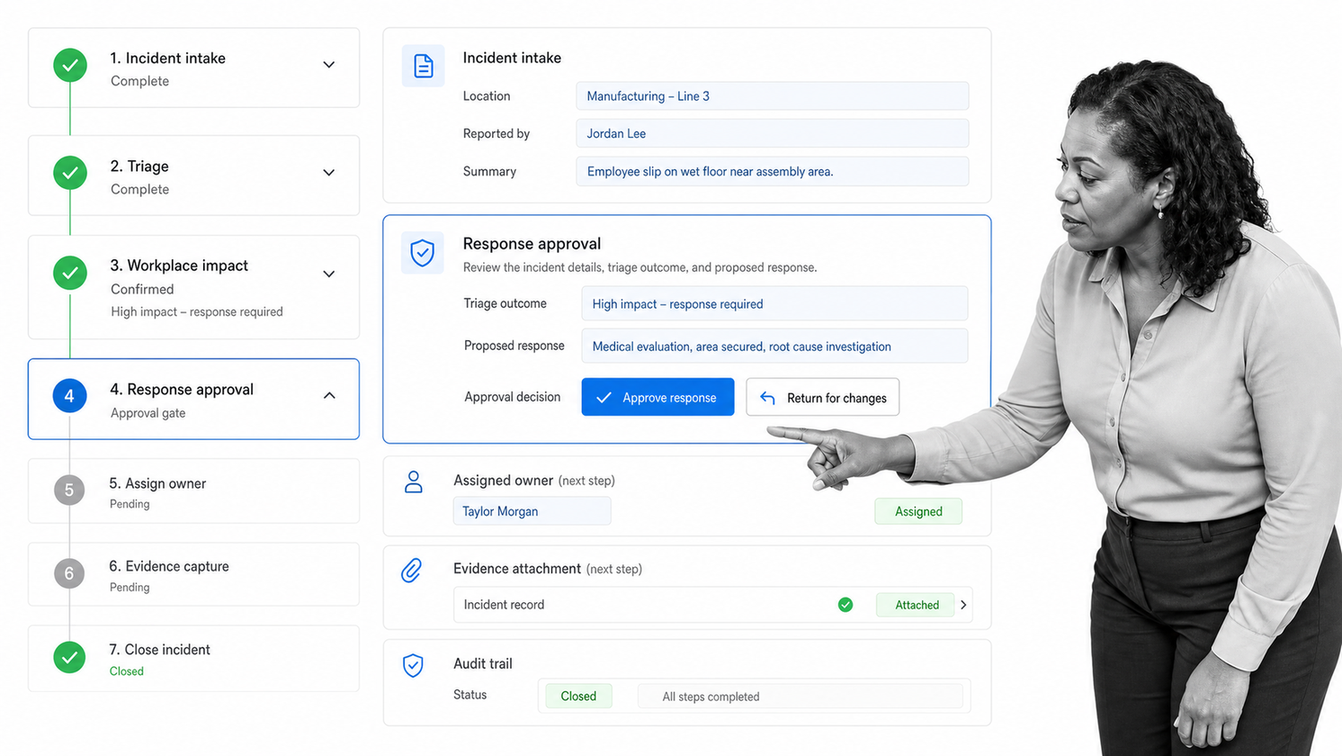
Process Street is a single Compliance Operations Platform with Docs and Ops capability areas plus built-in AI. Teams can govern the approved procedure, run the operational workflow, assign owners, route approvals and exceptions, capture evidence, and maintain an audit-ready history in one system.
Built-in AI can help turn source material into a draft workflow, summarize incident evidence, identify missing information, and support continuous improvement. People remain responsible for medical judgment, legal review, privacy, and final approval. The workflow enforces the approved process while keeping those decisions visible.
A practical preparedness workflow moves through detection, triage, decision, communication, action, evidence capture, and review. Give every stage a clear owner and completion condition. Review the workflow when public-health guidance, regulations, facilities, or business dependencies change.
The same operating model supports employee and client onboarding, continuous improvement, business process management and automation, risk management, ISO programs, and standard operating procedures. The subject changes, but the control pattern stays consistent: assign the work, enforce the sequence, capture the evidence, and improve the process when conditions change to achieve a stronger operational result.