






Guest post by Romi Catauta at Toptal.
Developer onboarding is the structured process of giving a new software engineer the access, environment, technical context, relationships, and feedback they need to make a safe first contribution and grow into the role.
For a remote developer, that process has to work without relying on overheard conversations or a colleague sitting nearby. A strong plan starts before day one, continues through the first pull request, and builds toward independent ownership over the first 30, 60, and 90 days.
This guide explains the tradeoffs in hiring remote developers and provides 11 developer onboarding best practices in two stages: four practices for hiring well and seven for integrating the new developer into the team.
In this article:
- What is developer onboarding?
- Hiring remote developers
- The 11-tip developer onboarding process
- How to retain developer talent
What is developer onboarding?
Developer onboarding is more specific than general employee orientation. It includes the normal company introduction, but it also covers repository permissions, development-environment setup, architecture, coding standards, security controls, testing, CI/CD, incident expectations, and the path to a first production change.
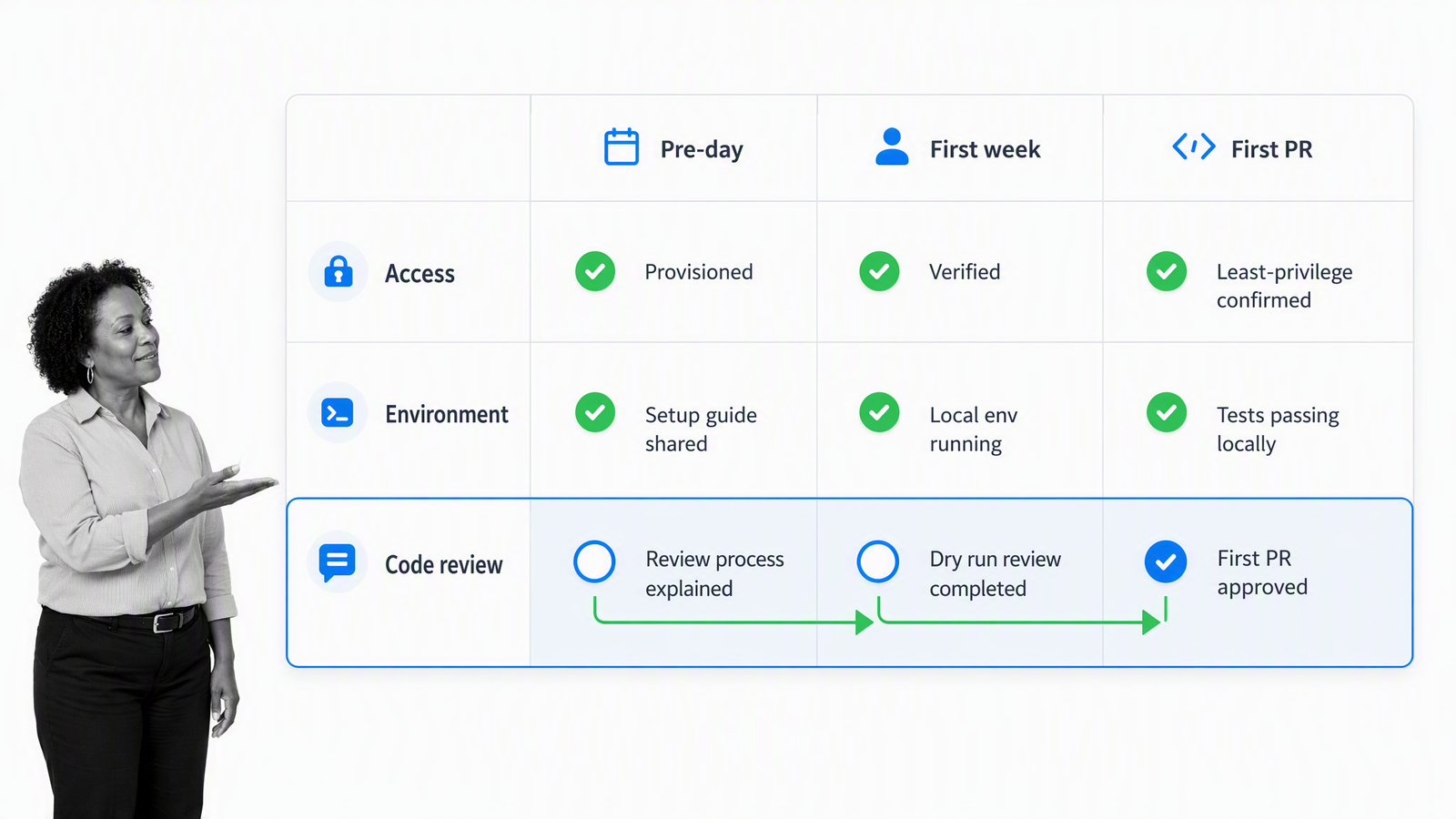
The goal is not to make a new engineer memorize the codebase. It is to create a sequence of supported, verifiable milestones. By the end of the first week, the developer should know where the source of truth lives, how to ask for help, how work moves from issue to deployment, and which actions require review or approval.
A useful plan has three horizons. Pre-day work provisions hardware, accounts, and role-based access. First-week work establishes relationships, product context, local setup, and a low-risk task. First-contribution work guides the developer through review, testing, deployment, and feedback. A 30-60-90 day plan can then move from learning to contribution and finally to ownership.
Developer onboarding challenges
The first challenge is hidden dependency. A missing repository permission, expired setup guide, unavailable test credential, or unclear owner can stop progress for hours. Remote work makes those gaps harder to resolve because the new hire cannot simply look around for the right person.
The second challenge is context. Engineers need to understand why the system is shaped as it is, where risk sits, which tradeoffs the team has accepted, and how decisions are recorded. A code tour without product and customer context explains the machinery but not the purpose.
The third challenge is psychological safety. New developers need a predictable way to ask questions and receive feedback. If every question feels like an interruption, they may guess, wait, or make a risky change. An onboarding buddy, recurring check-ins, and written communication norms reduce that uncertainty.
The final challenge is measurement. “Access granted” is not the same as “ready to contribute.” Track observable milestones such as environment running, tests passing locally, first review completed, first pull request merged, and the developer’s own confidence in finding information.
Documentation drift is another source of delay. Setup instructions may describe a dependency that has changed, an architecture diagram may omit a service, or an access request may point to someone who no longer owns the system. Treat the new hire’s experience as a controlled test of the onboarding path. Record every unexpected wait, unclear instruction, and manual workaround, then assign the correction to an owner.
Hiring remote developers and building the right conditions
Remote hiring gives employers access to a wider talent pool and gives developers more flexibility over where they work. It can also extend coverage across time zones and reduce relocation constraints. Those benefits depend on deliberate communication and a hiring process that evaluates job-related evidence consistently.
How remote work can benefit employers
A distributed search is not limited to candidates who can commute to one office. Teams can hire for scarce skills, serve customers across regions, and build working patterns around outcomes rather than attendance. Developers may also gain the quiet focus and schedule flexibility that deep technical work often needs.
The wider pool only helps if the role is clear. State the employment location, working-hour overlap, expected communication pattern, compensation range where required, security constraints, and whether travel is part of the job. Ambiguity at the job-description stage becomes friction after hiring.
The drawbacks of hiring remote developers
Remote hiring creates risks that an office interview can hide rather than eliminate. Time-zone gaps may slow decisions. Unstructured interviews can reward confidence over evidence. Take-home exercises can demand too much unpaid time. Security teams may need extra controls for devices, credentials, and data access.
The answer is not surveillance or a longer interview loop. Use a consistent rubric, explain the role’s real constraints, provide an accessible interview process, and assess the smallest amount of evidence needed to make a sound decision. Decide in advance how candidates may use AI tools, documentation, and search during a work sample. Modern development uses those tools, so the useful signal is how a candidate reasons, verifies, explains, and improves the result.
Keeping evaluation fair and reliable
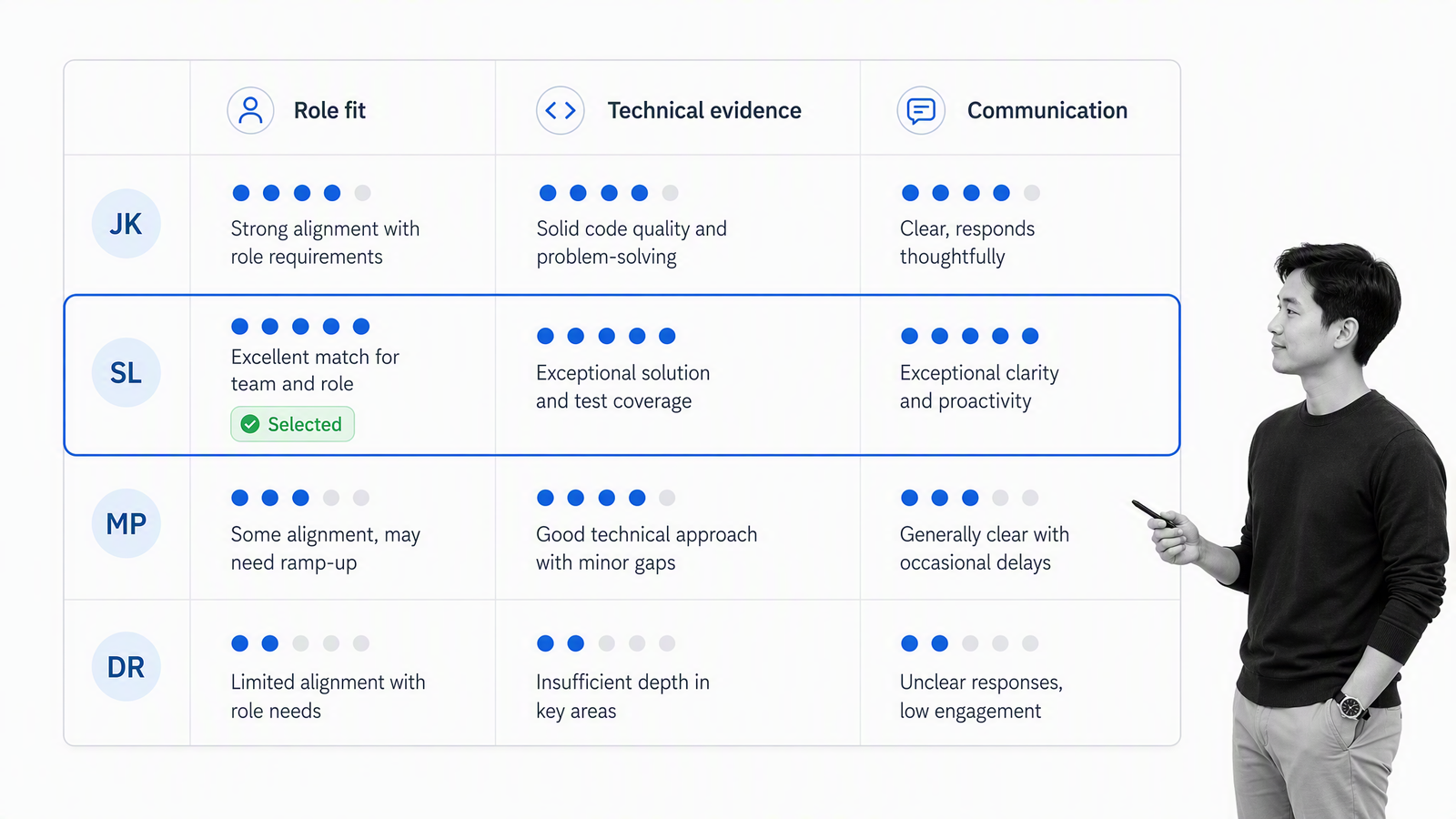
Build the process around role fit, technical evidence, and communication. Ask the same core questions, score against the same criteria, and record the evidence behind each decision. If a coding exercise is needed, make it representative, time-bounded, and proportionate. Review it together so the candidate can explain tradeoffs and respond to feedback.
Security belongs in the operating design. Confirm identity and employment eligibility through the appropriate process, use managed devices where the role requires them, provision least-privilege access, separate production from development environments, and define how credentials and confidential data are handled. References and portfolios can support a hiring decision, but they do not replace technical access controls.
Remote recruitment also needs a humane cadence. Tell candidates when they will hear from you, keep the number of interviewers proportionate, and avoid scheduling that repeatedly penalizes one time zone. If the process changes, explain why. Reliability during hiring is evidence of how the organization will communicate after the employee joins.
The remote developer onboarding journey with 11 tips
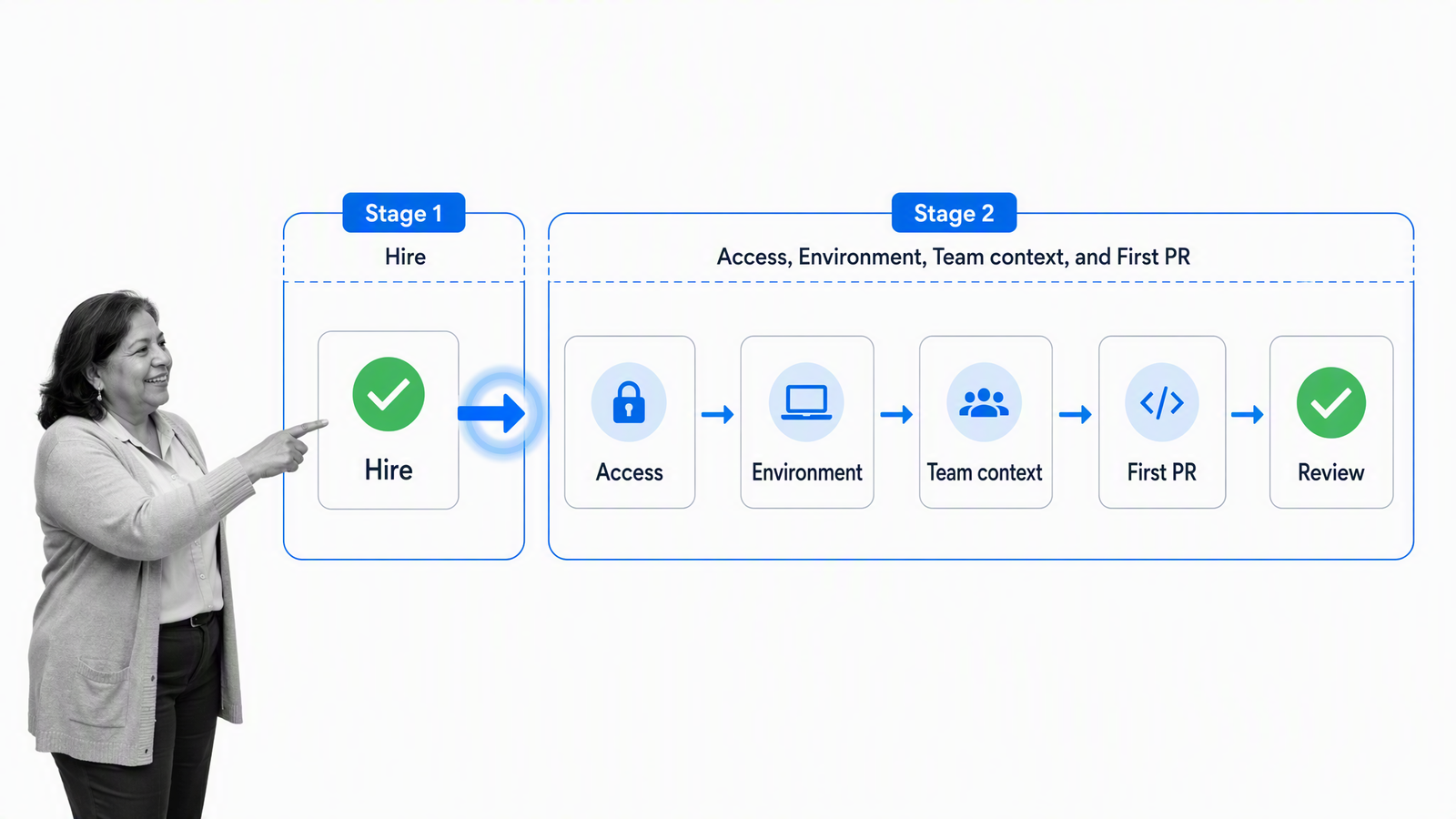
I treat developer onboarding as two connected stages. Stage 1 makes sure the role is defined and the candidate is assessed fairly. Stage 2 begins once the offer is accepted and prepares the employee to work safely, understand the team, and make a meaningful contribution.
Stage one, hiring for the role
Good onboarding cannot repair a role that was never clear. These first four practices create the conditions for a strong match and a credible handoff into the team.
1. Create an attractive, accurate job description
Describe the outcomes the developer will own, the systems they will work with, the level of autonomy expected, and how success will be measured. Separate essential capabilities from preferences. Avoid a shopping list of every technology the team has ever used.
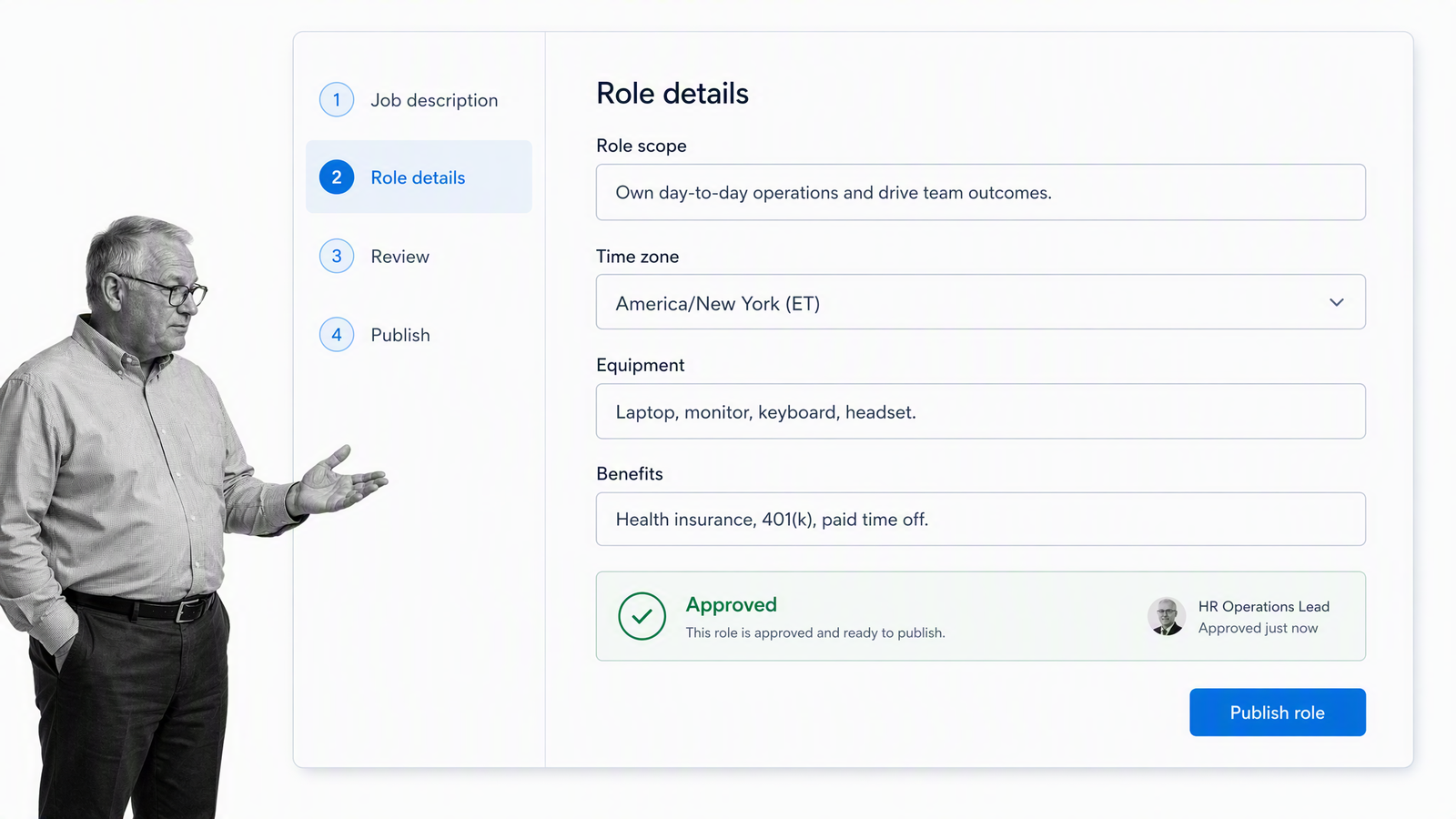
Include remote-work details that affect the decision: location restrictions, time-zone overlap, equipment, on-call expectations, communication cadence, and travel. A candidate should be able to decide whether the role fits before investing hours in interviews.
Use the Job Description Template to route the role through review before publishing it.
2. Use a structured application and screening rubric
Collect only information that helps evaluate the role. A short, role-relevant written prompt can reveal how a candidate frames a problem or communicates asynchronously. Use a rubric to distinguish must-have evidence from learnable gaps, and document why a candidate advances or stops.
Keep accessibility in mind. Offer reasonable adjustments, publish the interview format, and do not treat accent, camera quality, or familiarity with an interviewer’s preferred style as a proxy for technical ability.
3. Use a realistic, bounded technical exercise
Choose an exercise that resembles the work without copying a live company problem or asking for free labor. State the expected time, evaluation criteria, permitted tools, and submission format. A small debugging task, code review, or design discussion can produce better evidence than a large take-home project.
Review the work in conversation. Ask what the candidate would change with more time, how they tested assumptions, where they used AI assistance, and how they would monitor the change in production. The explanation is often more informative than a perfectly polished answer.
4. Run an interview candidates can prepare for
Send the agenda, participants, duration, and video-call link in advance. Test the meeting link, provide a fallback channel, and avoid unnecessary back-to-back sessions. The interview should cover the role, technical evidence, collaboration, feedback, and the candidate’s questions.
Close the loop quickly. Record the decision against the rubric, give the candidate a clear timeline, and transfer the role expectations, interview evidence, and agreed accommodations to the onboarding owner. That handoff prevents a new employee from repeating information the company already collected.
The handoff should also capture promises made during the process. If the hiring manager discussed a particular project, mentoring arrangement, equipment need, or working schedule, make it visible to the people preparing onboarding. A mismatch between the interview story and the first week damages trust before the developer has a chance to contribute.
Stage two, joining the team and its work
The offer is accepted and the equipment is on its way. It is tempting to think the hard part is over. But it’s not. The next seven practices turn a successful hire into a developer who can contribute with confidence.
5. Prepare hardware, identity, and least-privilege access
Start before day one. Assign an owner for the computer, identity account, password manager, source control, issue tracker, communication tools, development environment, staging access, CI/CD visibility, documentation, and any required security training. Every item needs a due date and an escalation path.
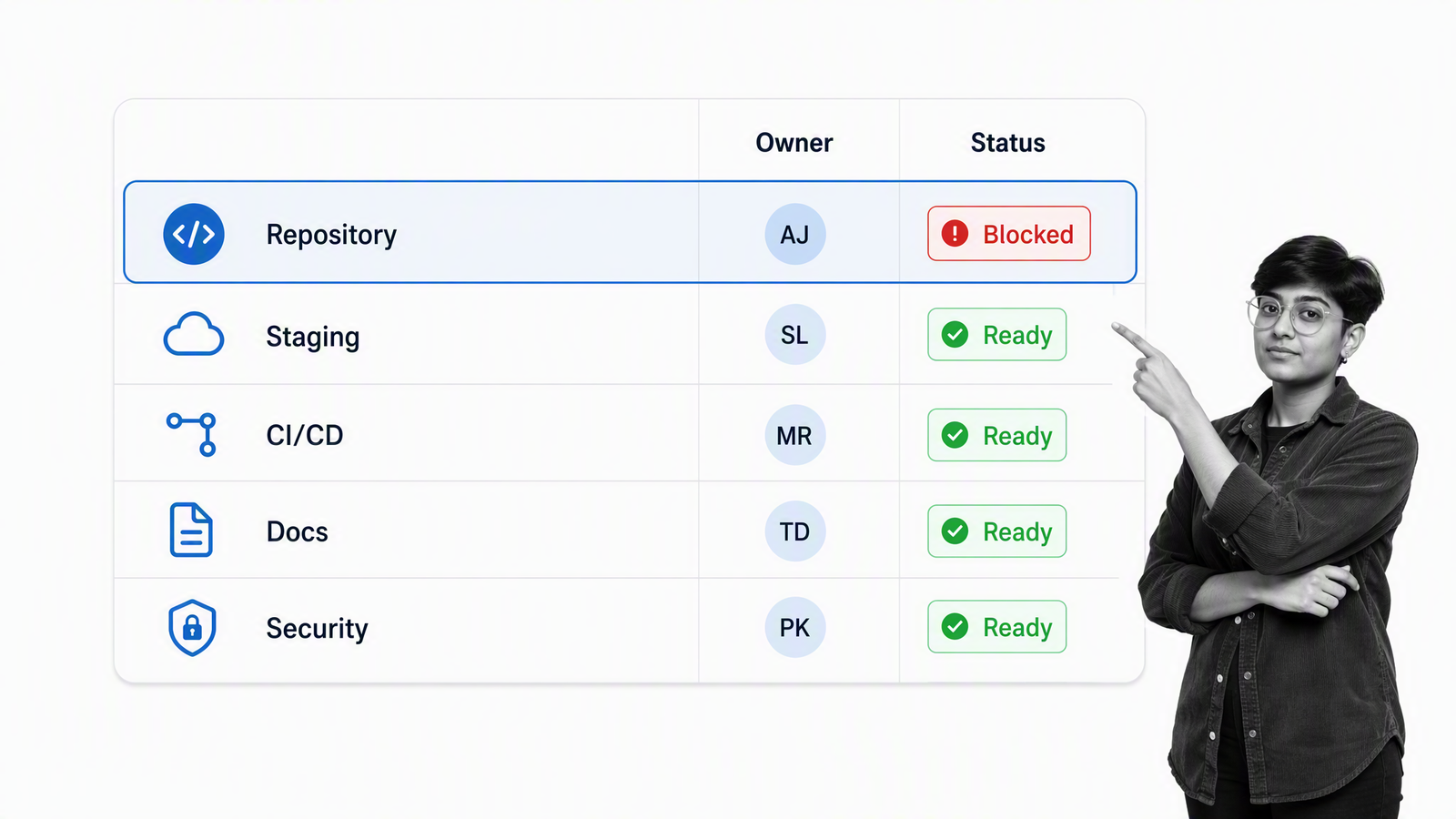
Do not grant broad production access simply to avoid delay. Use role-based access and expand it when the work requires it. Confirm that the new developer can authenticate, clone the right repository, build the application, run tests locally, and reach the support channel before their first scheduled pairing session.
Provisioning should end with verification, not a set of sent invitations. Ask the owner to confirm the account works and the developer to confirm the intended task is possible. For sensitive systems, record the approver, business justification, access level, and review date. That creates a clean starting point for later access certification and offboarding.
6. Give them one navigable source of truth
A welcome message should link to the onboarding plan, team directory, architecture overview, glossary, coding standards, branching strategy, review expectations, release process, incident guide, security rules, and the current product roadmap. Name an owner for each document so the new hire knows where to report gaps.
Write instructions for the reader who has no local context. Include expected output and common failure points, not just commands. When a new developer finds a missing step, invite them to improve the guide after the fix is verified. That turns onboarding into a maintenance loop rather than a static packet.
7. Connect product context to the codebase
Begin with the customer problem, key workflows, risk boundaries, and the systems that support them. Then walk through the architecture at a level that explains services, data flow, dependencies, observability, and deployment. Save an exhaustive module tour for the moment it becomes useful.
Pair each technical area with a person who can explain its history and current constraints. Record important decisions in writing. A developer should understand not only what the system does, but also which behavior must not change without review.
8. Assign an onboarding buddy and predictable check-ins
The manager remains accountable for outcomes, while the buddy provides fast, low-stakes help with team habits and everyday questions. Define what the buddy is responsible for and reserve time for the work. A name in a welcome email is not a buddy program.
Use short daily check-ins during the first week, then reduce the cadence as confidence grows. Ask what is blocked, what is unclear, which assumption may be wrong, and whether the plan is moving too quickly or too slowly. Remote developers need scheduled space for questions that would otherwise surface informally.
9. Design a safe first contribution
The first task should be meaningful enough to show the delivery path but small enough to complete with support. Good candidates include a test improvement, documentation fix tied to code, small defect, observability enhancement, or low-risk product change.
Before coding begins, explain the issue, acceptance criteria, reviewer, test approach, deployment path, and rollback expectation. Schedule a dry-run code review if needed. The milestone is not raw speed. It is completing the loop from understanding through review and learning how the team responds to uncertainty.
Feedback on that first contribution should be direct and kind. Separate team conventions from correctness, explain the reason behind requested changes, and identify what the developer did well. If a review uncovers a missing standard, improve the shared documentation instead of leaving the lesson inside one pull-request thread.
10. Make remote communication explicit
Explain which channel is used for urgent incidents, durable decisions, project updates, questions, and social conversation. Define response-time expectations and when a synchronous call is justified. Use shared documents and recorded decisions so people in other time zones are not excluded.
Good async work is not silence. It means communicating state, risks, and decisions clearly enough that another person can continue. Encourage the new developer to summarize what they tried, what happened, and what they need when asking for help.
11. Build a 30-60-90 day path to ownership
During the first 30 days, focus on environment, relationships, product context, and supported contributions. By 60 days, the developer should handle a normal work item with less guidance, participate in review, and improve one piece of team documentation. By 90 days, they should own a bounded area or recurring responsibility with clear support.
Review progress using outcomes and evidence, not online presence. Ask the developer to assess the onboarding process itself. Track time to environment readiness, time to first review, time to first merged pull request, unresolved access blockers, and confidence. These signals show where the system needs repair without turning onboarding into surveillance.
Managers should calibrate the plan to role level and system complexity. A senior engineer may reach a first contribution quickly but need more time to understand organizational dependencies. A junior developer may need tighter pairing while becoming productive in a smaller area. The milestones can remain consistent even when the support and timing differ.
Incorporate developer onboarding best practices to retain top talent
Developer onboarding works when the hiring promise matches the employee’s daily experience. Clear expectations, secure access, useful documentation, supportive relationships, and early feedback help a new engineer move from uncertainty to contribution.
The same system supports retention. Keep career expectations visible, recognize good technical judgment, provide room to learn, and connect the developer’s work to customer and business outcomes. Belonging is built through repeated inclusion in decisions and relationships, not a single welcome call.
Process Street is a single Compliance Operations Platform with Docs and Ops capability areas plus built-in AI. Docs keeps onboarding standards and technical guidance governed. Ops turns those standards into assigned workflows with due dates, approvals, evidence, and an audit trail. Teams can use the same operating model for remote onboarding, access reviews, training, and role-specific ramp plans.
The practical test is simple: can a new developer find the right information, get the right access, understand the reason behind the work, and complete a safe first contribution without relying on luck? If the answer is yes, onboarding is doing its job.