





A self-care plan is a practical routine for protecting your physical, emotional, social, and financial wellbeing. The idea behind “health is wealth” becomes useful when good intentions turn into specific actions you can schedule, complete, and review.
This guide explains how to create a self-care plan and gives you 22 free Process Street templates and checklists for daily habits, planning, exercise, meals, work, finances, goals, travel, reflection, and rest.
Start with the Daily Self-Care Checklist or Annual Self-Care Planner, then choose the resources that match your current needs. A self-care plan can support healthy routines, but it does not replace medical or mental-health care.
- What a self-care plan is and how to build one
- 22 free self-care checklists
- How to make the plan repeatable
What a self-care plan is and why it is important
The World Health Organization defines self-care as the ability of individuals, families, and communities to promote and maintain health, prevent disease, and cope with illness, with or without support from a health worker. A self-care plan turns that broad idea into a personal guide you can use in ordinary life.
A useful plan is specific enough to act on and flexible enough to change. It identifies the parts of life that need attention, names realistic actions, and sets a rhythm for reviewing what helps. For one person, that may mean protecting sleep and movement. For another, it may mean budgeting, reconnecting with friends, setting work boundaries, or asking for support.
The goal is not to optimize every part of life at once. The goal is to notice what you need, choose a small number of actions you can sustain, and revise the plan as your circumstances change.
Self-care plan benefits
A written plan reduces the distance between knowing and doing. It gives you a place to decide in advance what matters, when an action will happen, and what support you may need. That can make healthy choices easier to remember when work is busy or energy is low.
- Clearer priorities: A plan helps you distinguish restorative actions from obligations that overextend you.
- More consistent routines: Small scheduled actions are easier to repeat than vague goals.
- Earlier warning signals: Regular check-ins help you notice changes in sleep, stress, mood, connection, or workload.
- Better boundaries: Current APA guidance on work stress recommends tracking stressors, developing healthy responses, setting boundaries, and taking time to recover.
- Stronger support: A plan can name the people, services, and professional resources you will contact when self-guided steps are not enough.
These are supports, not guarantees. Self-care does not make harmful working conditions harmless, and employers should not use individual wellness activities as a substitute for healthy job design. NIOSH workplace guidance emphasizes that supportive cultures and working conditions matter alongside personal resources.
The self-care wheel for wellbeing support
One useful model is an eight-dimension wellness wheel. It looks at physical, social, emotional, intellectual, vocational, environmental, financial, and spiritual wellbeing. The categories overlap, and the right balance is personal. Financial strain can affect sleep. Poor work boundaries can reduce time for relationships. Social connection can make it easier to cope with stress.
- Physical: sleep, movement, nutrition, routine care, and recovery.
- Social: supportive relationships, community, and a sense of belonging.
- Emotional: recognizing feelings, coping with stress, and knowing when to ask for help.
- Intellectual: curiosity, learning, creativity, and mental stimulation.
- Vocational: meaningful work, sustainable demands, and boundaries between work and nonwork time.
- Environmental: spaces that feel safe, functional, and supportive.
- Financial: awareness, planning, and habits that reduce avoidable uncertainty.
- Spiritual: values, meaning, reflection, or practices that connect you with something larger than daily tasks.
You do not need equal scores in every dimension. Use the wheel to spot the one or two areas where a small change would make the biggest difference now.
Creating a self-care plan that is personal to you
Build a plan you can actually follow:
- Take stock. Note what is working, what feels depleted, and which situations repeatedly create stress.
- Choose one or two priorities. Avoid turning self-care into another impossible project.
- Write concrete actions. Replace “sleep more” with a specific bedtime routine, or “see friends” with a scheduled weekly check-in.
- Set a rhythm. Decide which actions are daily, weekly, monthly, or triggered by a warning sign.
- Name support. Record who you can contact, including friends, colleagues, an employee assistance program, or a qualified health professional.
- Review and adjust. Keep what helps, change what does not, and reassess after major changes in work, health, or family life.
Start small. Guidance from NIMH recommends practical habits such as regular activity, healthy meals, sleep, relaxing activities, setting priorities, and staying connected. If severe or distressing symptoms last two weeks or more, seek help from a qualified professional.
How to use a self-care plan in real life
Treat the plan as a working document rather than a test of discipline. Put the actions where you already look: a recurring checklist, calendar, or weekly review. Give each action a clear trigger. For example, take a ten-minute walk after lunch, prepare tomorrow’s breakfast after dinner, or call a friend on Sunday afternoon. A trigger makes the next step easier to remember and easier to evaluate.
Plan for low-energy days as well as ideal ones. A useful action can have a minimum version and a fuller version. Five minutes of stretching may be the minimum version of a workout; sending one message may be the minimum version of social connection. The smaller option keeps the routine available without turning self-care into another source of guilt.
- Daily check: What do I need today, and what is one action I can complete?
- Weekly review: Which actions helped, which were difficult, and what got in the way?
- Monthly reset: Which wellbeing dimension needs more attention now?
- Support trigger: What sign tells me to contact a friend, manager, employee assistance program, clinician, or crisis service?
Review the evidence from your own experience. If an action repeatedly fails, change the action, timing, or environment instead of simply demanding more willpower. If a routine consistently restores energy, protects sleep, improves connection, or reduces avoidable stress, make it easier to repeat. Major changes such as a new role, health condition, caregiving responsibility, move, or financial pressure are good reasons to rebuild the plan.
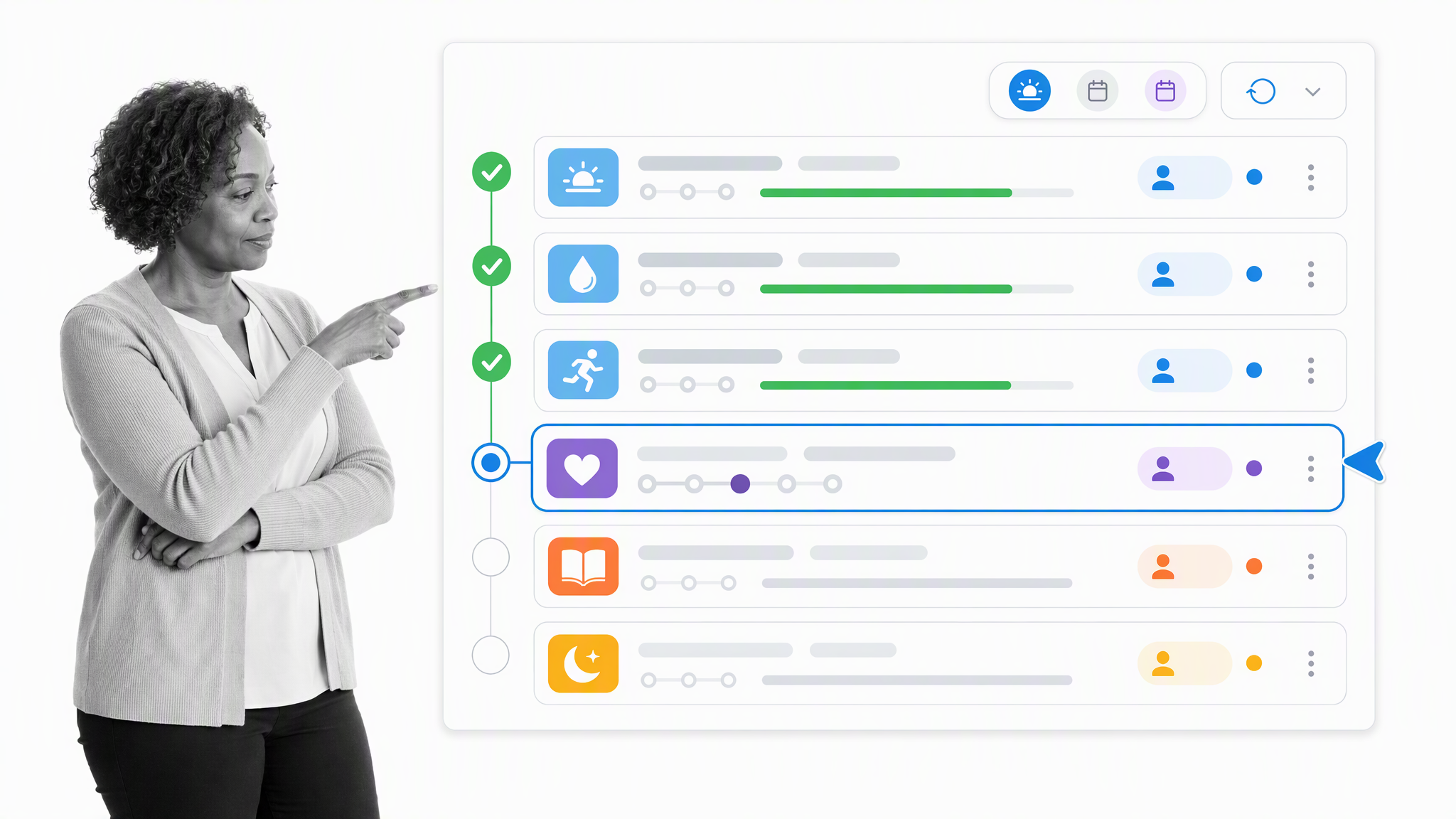
Process Street can turn the plan into a recurring workflow with adjustable steps, due dates, assignments, approvals, and review points. You can begin with one of the templates below, adapt it to your needs, run it, and change the next version based on what you learn.
22 free self-care checklists
So far we have discussed the 8 dimensions of wellness. We have highlighted the benefits that come from developing a self-care plan. Here are 22 free self-care checklists, all uniquely designed to help you improve your wellbeing.
Daily Self-Care Checklist for everyday wellbeing
Run our Self-Care Checklist to look after your mind and body daily. This checklist is short and simple, meaning you can jump in and out of it on a daily basis, encouraging the adoption of healthy lifestyle habits in your day.
Our Self-Care Checklist has been designed to work in tandem with our Annual Self-Care Planner, our Morning Routine Checklist, and our Evening Routine Checklist.
Click here to access our Daily Self-Care Checklist!
Annual Self-Care Planner
Use our Annual Self-Care Planner throughout the year to incorporate good habits into your lifestyle for increased happiness, wellness, productivity, and to help you attain your goals.
Our Annual Self-Care Planner has been designed to work together with our Morning Routine Checklist, Evening Routine Checklist and our Daily Self-Care Checklist.
Click here to access our Annual Self-Care Planner!
Morning Routine Checklist for a steady start
Our Morning Routine Checklist can be run in as little as 6 minutes, creating a quick, perfect start to your day. Begin your morning practicing gratitude, meditation, and exercise to stimulate the production of feel-good hormones, setting your day rolling on the right foot.
Again our Morning Routine Checklist has been created to be used in tandem with our Self-Care Planner, our Self-Care Checklist, and our Evening Routine Checklist.
Click here to access our Morning Routine Checklist!
Evening Routine Checklist for winding down
Our Evening Routine Checklist can be run in as little as 7 minutes, creating a quick and perfect end to your day. Use this checklist to incorporate relaxing habits to fuel a great night’s sleep, so you can wake up feeling refreshed and rejuvenated.
Our Evening Routine Checklist is to be used along with our Daily Self-Care Checklist, Morning Routine Checklist, and our Annual Self-Care Planner.
Click here to access our Evening Routine Checklist!
The Tony Robbins morning routine in practice
Adopt a morning routine like Tony Robbins. Author, public speaker, life coach, and philanthropist, Tony Robbins is a busy man. Yet he still makes time to incorporate good, healthy habits into his life.
Start your day with a nutritious breakfast, a workout, and morning meditation to get your body and mind in an optimal state to start your day.
Click here to access our Tony Robbins: Morning Routine checklist!
Achieving a Work-Life Balance Checklist for healthier boundaries
26% of work is completed outside normal working hours. This isn’t conducive to a healthy work-life balance. Use this Achieving Work-Life Balance Checklist when you want to equilibrate your working obligations and your personal lifestyle needs.
Click here to access our Work-Life Balance Checklist!
Backpacking Checklist for confident preparation
A dimension of self-care is about having fun and incorporating more adventure into your life. Use our Backpacking Checklist to prepare a backpacking escapade to last from a few weeks to a few months.
Click here to access our Backpacking Checklist!
Camping Checklist for a restorative break
Camping is an excellent way to get out into nature, spend time with friends and family, exercise, and have an adventure. If you are going camping for a few days or even a few weeks, you need to make sure you have the right equipment with you. Use this Camping Checklist as you plan your next camping trip.
Click here to access our Camping Checklist!
Travel Checklist for lower-stress planning
Run through our Travel Checklist whenever you’re planning to travel somewhere. Travel is an important part of self-care, broadening your mind, creating a source of adventure, and can also be wonderfully relaxing.
Click here to access our Travel Checklist!
Big Personality Test (Structure Template)
Self-care is about self-reflection, to understand yourself, your wants, and your needs. Use this Big Five Personality Test (Structure Template) to build your own Big Five Personality Test (Structure Template) in Process Street. By understanding yourself and your personality better, you can create good habits and goals based on this.
Click here to access our Big Five Personality Test (Structure Template)!
DISC Assessment (Structure Template)
Our DISC Assessment (Structure Template) is a personal assessment tool used to improve work productivity, teamwork, leadership, sales, and communication. DISC assessments are designed to measure your personality and behavioral style based on the following measures:
- Dominance: Direct, strong-willed and forceful,
- Influence: Sociable, talkative and lively,
- Steadiness: Gentle, accommodating and soft-hearted,
- Conscientiousness: Private, analytical, and logical.
Your DISC assessment results are then used to adjust your career goals.
Click here to access our DISC Assessment (Structure Template)!
Budget Template for financial awareness
Being on top of your finances is an important part of self-care, to manage your spending so that you save for what’s important. Use our Budget Template to help you identify your monthly spending targets, to be used in conjunction with our Daily Budget Template given below.
Click here to access our Budget Template!
Daily Budget Template for everyday decisions
Our Daily Budget Template is designed to be used alongside our Budget Template. This template allows you to monitor your daily spending and takes no time at all to complete.
Click here to access our Daily Budget Template!
Daily Routine Checklist for sustainable habits
Run through our Daily Routine Checklist every day to stick to your targets and get the most out of each day. By sticking to a daily routine checklist you can vastly increase your productivity whilst finding the time to do things you love and see the people most important to you.
Click here to access our Daily Routine Checklist!
Daily Schedule Template for realistic priorities
Plan your day in advance using our Daily Schedule Template. At the end of each day, you can click on the run link to begin the next day’s checklist. In an allocated half an hour, you can decide and fill in the tasks for the next day in a new checklist. Using this checklist will help you realize your goals and set healthy habits.
Click here to access our Daily Schedule Template!
Fitness Planner
Our Fitness Planner checklist can be run weekly to plan and execute your fitness routine. The benefits of exercise for wellbeing and as part of your self-care journey have long been acknowledged. In our Fitness Planner, you’ll find a sample weekly workout routine covering a 3-days-on-1-day-off schedule.
Click here to access our Fitness Planner checklist!
Lisa A. Romano: Overcoming Negative Self-Talk
We all face the struggles of negative self-talk on a daily basis. Negative thoughts are inescapable, and so we must recognize them and rather than trying to escape them, direct our efforts to acknowledge them for what they are – just thoughts.
Lisa A. Romano is a life coach and a bestselling author specializing in helping people take control of their lives, and re-frame their thought processes to be positive, optimistic, and self-fulfilling. Use our Lisa A. Romano: Overcoming Negative Self-Talk checklist to manage your negative emotions proactively.
Click here to access our Lisa A. Romano: Overcoming Negative Self-Talk checklist!
Self-Evaluation Performance Review Template for reflection
Launch our Self-Evaluation Performance Review Template whenever your manager asks you to complete a self-evaluation performance review. By running through this checklist, you can track your career performance, and assess your current vocational goals and wellness against set targets.
Click here to access our Self-Evaluation Performance Review Template!
SMART Goal Setting Checklist for practical progress
Self-care is about sticking to new, healthier habits with the aim of achieving your goals. Use our SMART Goal Setting Checklist to implement the SMART method for setting achievable goals, covering all bases, and leaving no room for misunderstanding.
Click here to access our SMART Goal Setting Checklist!
Weekly Meal Planner
Eating healthy is vital to look after your physical health. Use our Weekly Meal Planner checklist to plan your weekly diet and stick to it. Live a healthy eating lifestyle and save money. It is a win-win situation.
Click here to access our Weekly Meal Planner checklist!
Work Anxiety Resolution Checklist for identifying next steps
APA research reports that many workers regularly feel tense or stressed during the workday, and some experience anxiety at work. Stress at work can easily lead to work anxiety – a type of anxiety that is fueled by thoughts or actions related to work. Run our Work Anxiety Resolution Checklist to tackle work-related anxiety, to feel better, and to enhance life quality.
Click here to access our Work Anxiety Resolution Checklist!
KonMari Checklist for resetting your space
Use this KonMari Checklist to implement the KonMari Method for decluttering your home of unnecessary belongings efficiently and effectively. Tidying can be one small way to reset your environment and reduce immediate friction. Current CDC emotional-wellbeing guidance includes manageable actions that help people regain a sense of control.
Click here to access The KonMari Checklist!
Use Process Street to make self-care repeatable
A self-care plan works best when it is easy to revisit. Choose the Daily Self-Care Checklist for a lightweight routine or the Annual Self-Care Planner for a broader review, then customize the steps around your real schedule and support system.

Process Street is a single Compliance Operations Platform with Docs and Ops capability areas plus built-in AI. You can document guidance, turn it into a recurring workflow, assign responsibilities where a team is involved, automate reminders and handoffs, and keep a record of what was completed. Process Street has 5,000+ integrations.
For a reusable routine, explore the checklist maker guide. Related resources include the EAP program guide, burnout guide, and HR best practices.
What should a self-care plan include?
Include the areas of wellbeing that matter to you, a small set of specific actions, a realistic schedule, warning signs to watch, and the people or professional resources you can contact for support.
How do you make a self-care plan realistic?
Start with one or two priorities and make each action small enough to repeat. Put actions on a calendar or recurring checklist, review progress, and remove steps that create pressure without helping.
How often should you review a self-care plan?
A short weekly check-in works for daily habits. Use a deeper monthly or quarterly review for broader goals, and revisit the plan after a major change in work, health, relationships, or living situation.
Is a self-care plan a substitute for professional care?
No. A self-care plan can support everyday wellbeing, but it does not replace medical care, mental-health treatment, crisis support, or changes to unsafe working conditions.