All posts by Molly Stovold

Business Plan vs. Business Proposal: Everything You Need to Know

Business strategist comparing the paths of a business plan and a business proposal

Guest post by Revv’s Seema, originally a Product Expert at Revv, whose document automation and eSignature technology was later acquired by LegalZoom. She believes in the power of words and storytelling, and she writes here from her own experience explaining the difference between closely related business terms.

A business plan is the company-wide roadmap for how a business will operate, grow, and fund its goals. A business proposal is a tailored offer designed to win a specific client, project, or opportunity. You may use both, but they serve different readers and decisions.

Continue Reading

How to Ship in 8 Weeks or Less (via Cross-Functional Teams)

How to Ship in 8 Weeks or Less (via Cross-Functional Teams)

Bored of Scrum and Kanban? Thinking about making the move to Shape Up?

This post is here to get you clued up on what the development methodology Shape Up looks like in practice. I’ll be giving you a sneak-peak into what we do here at Process Street as our EPD team shares their secrets. Learn how Shape Up facilitates the smooth running of a cross-functional team.

For those of you who are unfamiliar with Shape Up, or if you’re interested in the Design part of the E-P- “D = design” team,or maybe, you’d like to get your hands on 3 Shape Up workflows to plug straight into your team, check out the following posts:

In this post I speak to Process Street’s Product Lead, Michael, and our Full Stack Engineer Herbie. We talk about all things Shape Up and discuss how the methodology facilitates the success of a cross-functional team.

Let’s get started!
Continue Reading

Level Up Your Favorite Work Apps With Automations

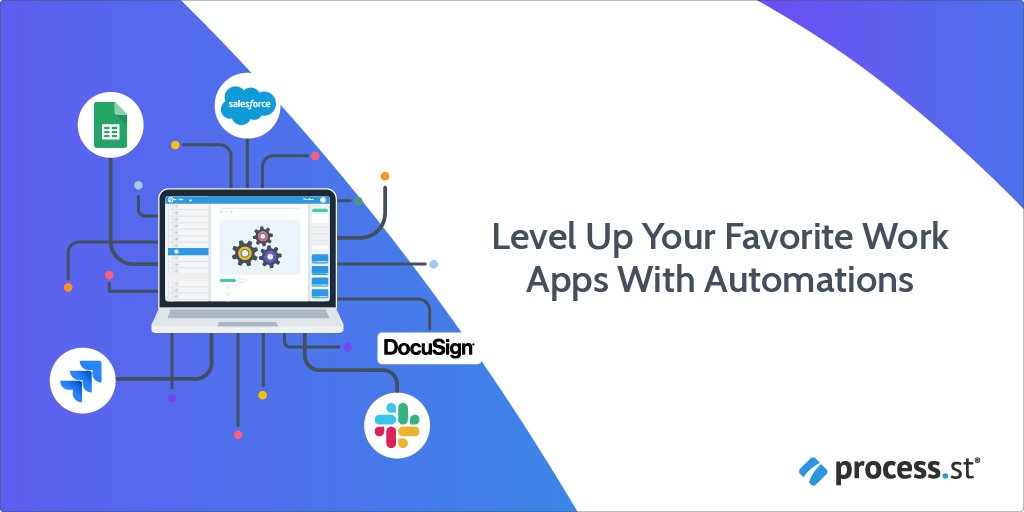
Level Up Your Favorite Work Apps With AutomationsToday, we’re excited to announce Automations, a new set of direct integrations helping you create and run custom processes using built-in functionality from some of the world’s most popular software tools.
Anyone who’s ever updated an opportunity in Salesforce or created an issue in Jira knows the power of those applications. It can feel like a world of endless possibilities right at your fingertips. It’s what we love about these tools, and why teams like us use them every day.

But sometimes, instead of endless possibilities, you need a specific set of tasks done quickly and correctly. You need a process. That’s what we’ve helped thousands of companies with, and that’s why we’re so excited to announce our newest feature, Automations.

Automations brings your critical apps together to drive your team’s most important processes. Powering Automations is a new set of native integrations with:

Continue Reading

Femtech & Wellness Apps: How to Find Product-Market Fit in a Pandemic

femtech-wellness-apps

“In the midst of every crisis lies great opportunity.” – A. Einstein

I’ll refrain from attempting to mask something as devastating as the coronavirus with a silver lining. Nonetheless, there’s no denying that while the world goes bust there is one industry that continues to boom: Tech.

Since the first half of 2020, health and fitness app downloads have soared, growing by a whopping 46% worldwide.

What has been the pandemic’s influence on the femtech and wellness app industries? In this Process Street post, I feature an interview with Hélène Guillaume, founder of a femtech platform (Wild.AI), and Reeva Misra, the founder of a wellness app (Walking on Earth).

Wild.AI is a fitness platform that empowers female athletes by providing AI-powered personal trainers that adapt to the user’s needs. Walking on Earth is a wellness app and platform that offers every user access to personalized coaches and treatment plans.

Let’s get started.
Continue Reading

How to Combat Zoom Fatigue: Synchronous vs. Asynchronous Communication

How to Combat Zoom Fatigue Synchronous vs Asynchronous CommunicationIt’s 4 p.m. and you’ve got a welcome call with your newest team member. Ideally, you’d feel full of life, ready to welcome her with enthusiasm and get her excited about the weeks to come.
Problem is, this is your 6th video call of the day and you’re overrun with Zoom fatigue.

You’ve been turned “on” (not in a good way) for the last 7 hours and are severely lacking in enthusiasm, let alone excitement.

The worst thing is, the majority of those meetings were unnecessary, everything covered in them could’ve been communicated asynchronously.

Simply put, asynchronous communication involves communicating remotely without expecting an immediate response. This can be done via iMessage, pre-recorded video/audio, making suggestions to an existing project (think: Google Docs/Sheets, Github, Jira).

The challenge is knowing, when and how to use synchronous vs. asynchronous communication methods. Fortunately, this post is here to teach you just that so you can avoid Zoom fatigue and stop being real-time, all the time. Feel free to skip to a specific section of the post using the links below.

Let’s get started!
Continue Reading

Ditch Scrum! 3 Shape Up Processes & Checklists to 5x Your Dev Cycle

Shape-Up-processes
We’ve cut our development cycle by 70% since making the move to Shape Up.

This alternative development method is a breath of fresh air from all things Scrum, Agile, Kanban, Scrumban, Fake Agile, Bad Agile… you get my drift.

What started off as Basecamp‘s internal approach to developing and shipping software at lightning speed, has become a clearly written (and illustrated), freely contributed, and easily accessible e-book: Shape Up: Stop Running in Circles and Ship Work that Matters.

Although I sincerely recommend you read the book, this post is here to save you from studying the 143 pages of text by providing you with three nifty checklist templates. The checklists take you through the Shape Up process and its 3 key phases: Shaping, betting, and building.

In this post, I’ll briefly touch on the fundamental concepts of Shape Up’s approach. I’ll also introduce each of the phases and their corresponding checklist.

Let’s get shaping!
Continue Reading

The Minimum Virtuous Product: Is the Move Fast & Break Things Era Behind Us?

Minimum Virtuous ProductIf you’re moving fast and breaking things, at what point in time do you realize things are broken?

When there is public uproar against your product? Such as the Amazon case in 2019 involving job listings for the role of “union buster” (someone who reports on fellow employees seeking fair labor practices).

Or, when regulators come down on you like a ton of bricks? As was (and continues to be) experienced by Airbnb whose platform has been home to grotesque racial discrimination.

Allow me to introduce the topic of this blog post: The minimum virtuous product (MVP).

It seems the concept behind the traditional minimal viable product (MVP) which prioritizes quick launches and basic feature sets has been replaced by something a little more virtuous. The new MVP, minimum virtuous product, encourages companies to focus on diversity and transparency by building morally sound design principles, from the start.

This post will take a look at what this change in acronym has to do with the way companies grow and scale; along with an eight-question framework that will help start-ups assess the social impact of their products; and finally, it will cover what moving with virtue could mean for future startups.

To skip to a specific section of the post click on the appropriate link below:

Alternatively, just keep scrolling to read the whole post.
Continue Reading

How to Build a Successful Go-to-Market Strategy

go-to-market strategy

A go-to-market (GTM) strategy is the way in which a company brings a product or service to market.

No matter how good your idea is, you need a go-to-market strategy.

Why?

Because statistically speaking, your business is more likely to fail than succeed.

In fact, if you’re a startup, your chance of failure is a dreary 90%. That’s not to say that your idea isn’t a brilliant one, or that you haven’t got what it takes to bring it to market.

Startups fail for different reasons. Perhaps the market is already awash with companies offering the same solution as yours, or the market isn’t mature enough to welcome your product. Or, maybe the cost of developing and launching your product is so steep that it’s unprofitable.

If successful, a go-to-market strategy will be your salvation and prevent you from failure. The question is, how do you develop a winning strategy? Which factors should you consider?

I asked our VP of Marketing Bryan Sise these very questions. Through the course of his career at companies like Twilio, SendGrid, Twitter, Dynamic Signal, and now Process Street, Bryan has noticed what contributes to GTM success.

In this post I’ll share with you what he has to say. I’ll cover what a go-to-market strategy is, types of go-to-market strategies, the key steps to building a successful go-to-market strategy, and what GTM strategies we use here at Process Street.

Let’s get strategizing.
Continue Reading

Set Up a Home Workspace That Inspires Productivity

home workspaceNouman provides ghostwriting and copywriting services. His educational background in the technical field and business studies helps him in tackling topics ranging from career and business productivity to web development and digital marketing. He occasionally writes articles for carpet cleaning.

Working from home has become the new normal. However, it can be difficult to ensure productivity when you work at home.

Although the concept of a traditional office is no more, we all require a dedicated workspace to get things done.

If you are having trouble staying productive while working from home, then chances are that you need to set up a home workspace that inspires productivity. Not many people realize just how important it is to have a dedicated workspace.

According to data, workspace design plays a huge role in our productivity levels.

The question is: How can you design your workspace in such a way that boosts creativity, connection, and productivity? Fortunately, this Process Street blog post is here to help. There is no need to worry as this guide will provide you with all the information you need to feel motivated to work.

When you decide to work remotely, you need to understand that it comes with a fair share of complications. The main of which involves setting up your home workspace to ensure maximum productivity. Fortunately for you, this article is here to help you get started.

Let’s jump right in!
Continue Reading

Make Magic & Embody Cross-Departmental Collaboration

Cross-Departmental CollaborationThis is a guest post written by Kashyap Trivedi. Kashyap is a Project Manager, working with an awesome team at Launch Space. He helps SaaS companies conquer the SERPs with Expert Outreach. When he is not working, you’ll find him playing Table Tennis or Meditating.

The Sales, Marketing, and Support teams form the three significant points of a business’ interactions with customers. Because of this, they must work together to create a seamless transition for the customers that are moving from one stage of the buying process to another.

When all three teams work together in sync, they can easily help each other to reach organizational goals quickly. This article will show you how these three teams can work together and how your business can benefit from it. To jump to a specific section of the post click the appropriate link below.

Let’s start with Sales.
Continue Reading

Take control of your workflows today