Subscribe to the Process Street blog

Get tips and apps to hack your business straight to your inbox.

How to Organize a Content Marketing Workflow for Your Team

The following is a guest post from Gloria Kopp, a digital marketer and a business consultant from Manville city. She works as a content manager at Paper Fellows and is a regular contributor to such websites as Engadget, Academized, and Huffington Post.

A well-planned workflow is crucial to keeping your content marketing efforts on track and ensuring that you meet your goals.  You may often find that you are receiving content late from your team, that it’s not up to scratch, has been rushed, or just never materializes. The tips in this article should help you to get back onto the straight and narrow.

Before you or your team get stuck into creating more content, make sure that you’ve read through the following points to keep your projects flowing productively.


Continue Reading

Get our posts & product updates earlier by simply subscribing

The Complete Guide to Asynchronous Communication in Remote Teams

I’m writing this blog post to solve a very specific problem.

During one of our regular marketing meetings, Vinay assigned me this post and said he wants it to be written so he can link it to everyone who messages him just “hey Vinay” on Slack and waits for a response before saying anything else.

Like many managers in remote teams, Vinay’s sick of our tendencies to under-communicate. Just saying “hey Vinay” and hoping to get a synchronous chat going is a waste of time, especially if there are time zone differences, or if general busy-ness prevents a polite, fully-fledged chat.

And so, in the spirit of that real example, this article will solve the problem of communication in remote teams.

Continue Reading

Processes, Policies and Procedures: Important Distinctions to Systemize Your Business

Processes_Policies_and_Procedures-_The_important_distinctions_to_systemize_your_businessCommunicating the right things at the right times is vital in all walks of life.
Within a complex business with multiple moving parts, the value of this communication is high and the effects of poor communication are potentially catastrophic.

As Professor Allen Webster puts it:

Without communication and the team effort it permits, the successful completion of any important project can be jeopardized.

There are two elements of communication here to be addressed:

  1. How effectively we are understanding key concepts and terms
  2. How effectively we are utilizing and communicating those concepts and their effects to our teams

The three concepts we’re going to tackle specifically in this article are processes, policies and procedures.

What are the differences between them? How do we effectively utilize each? How do we, at Process Street, utilize these concepts within our organizational structure?

Continue Reading

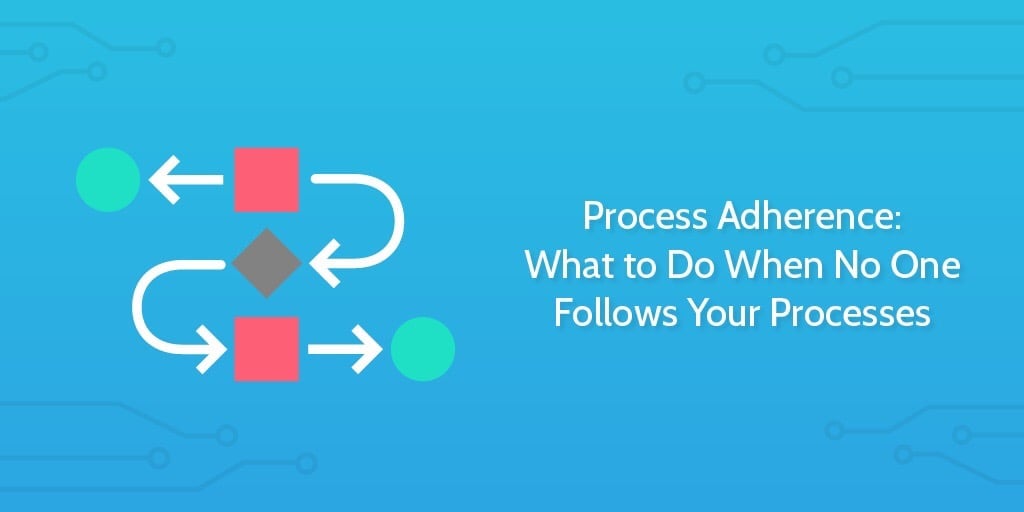
Process Adherence: What to Do When No One Follows Your Processes

Process AdherenceProcesses aren’t just a set of documents and rules that help your business run efficiently and reduce human error…


They’re also something that needs to be part of your company culture. Process adherence is the culture side of systemization, and that makes it one of those hard to grasp concepts without many solid rules.

The culture of processes — instead of the act of writing and optimizing them — is something we’ve been meaning to cover for a while because we know it’s a big problem for our users.

Incidentally, we got an insightful comment on our article about creating an operations manual from MamaRed Knight. She outlined an age-old problem with process adherence:

“[Process adherence] is something I’ve been dealing with since I started formally creating documentation in ’83. It really must start at the top level where they don’t answer questions, they ask if it is “in the manual” and it ripples down.

It does take time because, frankly, a very teensy tiny percentage of people want to look something up… 98% want to ask someone and be done with it.”

In this quote, she highlights two main issues:

  • Employees don’t want to look up processes
  • Procedures are passed on informally by hearsay

In this post, I’m going to explain why processes fail because of human nature, and then unpack each reason with an explanation of how you can improve process adherence in each area.

Continue Reading

Workflow Analysis: Apple’s Secret Ingredient to Success

workflow analysis - header

Apple is well-known for being innovative and immensely successful, to the point where the company is worth $750 billion (and counting). However, without a healthy dose of workflow analysis they would’ve crumbled under their own business model back in the late 1980s.

“We could no longer afford the limitations that went with our product development processes… The lack of a formal new product development process led to confusion, wasted time, and often caused project teams to ‘re-create the wheel’” – Jackie Streeter (then VP of Engineering at Apple), Apple Rethinks Core Process: Improves Cycle Time

workflow analysis - apple

The simple truth is that any company (no matter the size or success) needs to regularly review its workflows and processes in order to keep them up to date and efficient. Tasks should be updated, improved, and automated where possible to save time and money, but without using the best workflow management software around to analyze and improve your business practices, your entire business model itself can prevent your success.

Continue Reading

How Hatch Canada Uses Process Street to Handle its Growth

Education operations leader carrying a model of connected Hatch Canada learning centers

Hatch Canada uses Process Street to handle its growth by standardizing recruiting, onboarding, and multi-location operations. In one peak summer, the team ran 400 recruitment workflows from the same template.

In this customer story, CEO Peter Kuperman explains how repeatable processes helped the team see where every candidate stood, make decisions faster, and maintain consistent work across geographically distributed locations.

Continue Reading

Why Are Monopolies Bad? An Analysis of 6 Rise-and-Fall Companies

Why are monopolies bad?When I think of monopoly I think of a mustachioed man with a nice hat and a highland terrier.

I also think of family arguments and Christmas flashbacks; Monopole mon amour, directed by Resnais…

Yet, those aren’t the only monopoly connotations you should be worried about. The New York Times recently reported that a whopping 77% of mobile social traffic is owned by Facebook, 74% of the ebook market is Amazon, and Google owns 88% percent of the search advertising market.

They aren’t the only monopolies around and they’re only in specific sectors. A report from eMarketer showed that in 2016 Facebook and Google collectively accounted for 57% of all mobile advertising – and that figure is rising. Maybe it’s not a monopoly at all, but a duopoly?

Market position isn’t static, it’s dynamic. Monopolies form and fade, doing so in response to specific factors and environments.

In this article, we’ll look at the rise and fall of some monopolistic scenarios and try to learn a little about how this current dominance may look moving forward.

Continue Reading

How to Create Viral Marketing: 6 Lessons From 10,879 Articles

viral marketing header

Everyone wants to be the next Dollar Shave Club ad. Aside from being a fantastic and effective ad, it’s a perfect example of viral marketing, with almost 24.5 million views and counting.

Unfortunately, most of us can barely agree on what classes as “viral” content, let alone create it at will with a set marketing process. Worse still, much of the existing research on viral marketing ignores one key factor; how big your audience is. That’s like gambling without even knowing how much you’re betting – the theory is solid, but you can’t expect to succeed without knowing more.

So, in an attempt to pin down how a less-established site can produce viral content, I analyzed 10,879 of the most shared articles from last year. Stick around to find out:

  • How much your existing audience affects your viral marketing chances
  • Which social media platform is best to focus on
  • How long your content should be (and how much it matters)
  • The link between viral sharing and traffic
  • Why spam tactics work, but are a terrible idea
  • How to give your content the best chance of going viral (without needing your own audience)

Let’s get started.

Continue Reading

How to Create the Organizational Chart You Know Your Business Needs

Is your team confused about responsibility, hierarchy, or who reports to who?

Do you have a clear idea of where there’s room to give a promotion, or which department could do with more hires?

You need to make an organizational chart for your business, no matter what size your company is because it ensures your company can scale consistently with a clear view of its structure. It’s just as important as solid processes because it’s the single source of truth for the architecture of your business.

In this article, I’m going to show you how to create organizational charts using simple free tools, or powerful paid alternatives.

You’ll learn:

  • The definition and components of an organizational chart
  • The hidden benefits of organizational charts, and why they’re not just a formality
  • Creating a cloud-based organizational chart in Google Sheets that you can automate
  • How to use templates to create a simple org chart in Word, PowerPoint, Excel, and dedicated diagram tools
  • How to use different types of charts for alternative organizational structures, like matrix and flat

Continue Reading

How iQ Food Co Use Process Street to Manage Their Operations

Restaurant operations leader guiding an organized commercial prep-line cart

iQ Food Co used Process Street to document recurring restaurant operations, standardize work across locations, train employees more efficiently, and reduce mistakes in payroll onboarding. The Toronto-based restaurant company turned knowledge that had lived in one leader’s head into repeatable procedures that other people could follow.

In 2017, we spoke with then-COO Arthur Bekerman about how the team used Process Street while its network of locations was growing. His account shows why restaurant standard operating procedures matter: growth becomes easier to manage when teams can find the right process, follow it consistently, and confirm that every required step is complete.

Continue Reading

Take control of your workflows today

Choose which optional cookies to allow. You can change or withdraw consent here at any time.