All posts in Business Operations

5 Continuous Improvement Tools for Process Success

ALT: 5 Continuous Improvement Tools for Process Success

Continuous improvement tools are essential.

They’re a means of increasing productivity while eliminating errors. And they’re closely associated with lean manufacturing, particularly in streamlining processes. Every process should be continuously improved, especially in a world where checking email alone costs us 1000 hours every year.

I once used a continuous improvement tool to transform my skill level in meditation. I was amazed at how quickly a process could be made leaner and more agile. If your organization has been wondering which continuous improvement tool to use, Process Street has written this guide with you in mind.

Here’s how to transform your process for success with continuous improvement tools:

Continue Reading

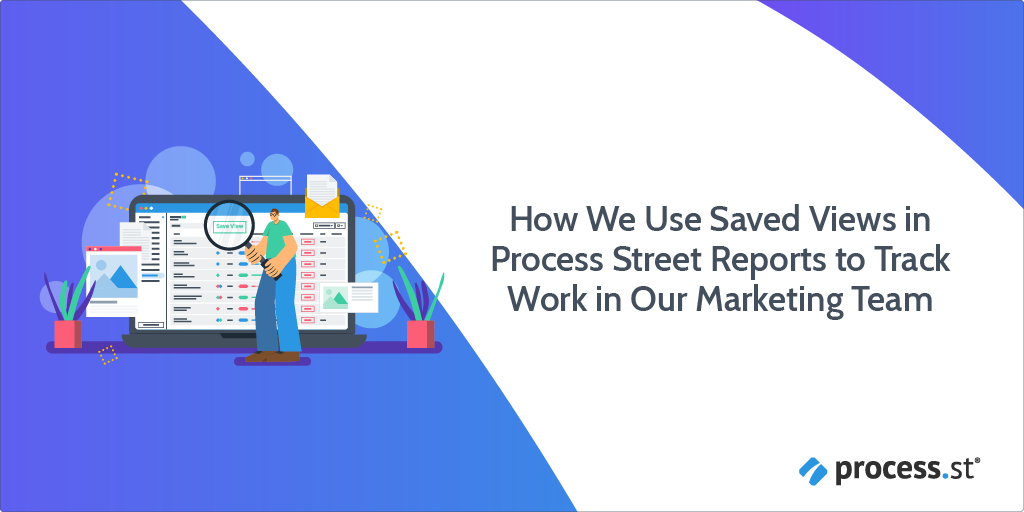
How We Use Saved Views in Process Street Reports to Track Work in Our Marketing Team

marketing team work tracking reports

According to ITSMA and Vision Edge Marketing, 74% of marketers don’t keep track of their efforts. This is problematic as it means marketing teams aren’t able to report on how their efforts impact the business as a whole.

At Process Street, we make sure our marketing operations are documented, tracked, and easy to understand, so we can stay on top of our marketing OKRs and ensure they align with top-level company goals. To do this, we utilize Process Street‘s saved view feature.

The saved view gives a summary of workflow data. You can customize these views and present the data to suit your needs. For our marketing team, this means work is tracked and can be easily correlated with internal OKRs. Saved views have helped our marketers gather data, detect patterns, and keep their work on track.

We’ll be covering:

Let’s get started!
Continue Reading

5 Continuous Improvement Steps for Process Optimization

Continuous improvement without data collection is like driving cross country without signs or a map. 

Data collection is vital to making improvements because without it there’s no real proof of any problem existing to begin with. 

Why are you making improvements? Is it really a problem, or are you just distorted by frustration in the moment? 

Yes, your frustration can give you clues as to what the root problem is, but relying on your feelings alone won’t give you accurate results in the long run.

That’s where data collection can help. Our Analytics feature can be used to paint an objective, unbiased picture of the current state of any given process and help highlight potential areas that could be improved upon. 

So, let’s start by walking through our 5 continuous improvement steps for process optimization:

Continue Reading

How to Write an Effective Policy & Procedure Template

How to Write an Effective Policy and Procedure Template

Let’s get straight to the point – you’re probably searching for a policy and procedure template you can use.

Moreover, if you want an actionable policy and procedure template, you can find two hand-crafted examples below. One is a blueprint you can use to build your own, and the other is a filled-out example of the first, using a fictional company called Brightstar Marketing.

In fact, both can be easily edited and updated by you inside Process Street.

Continue Reading

Writing Standard Operating Procedures: The Ultimate Guide (+ 20 Free Templates)

Whether starting a business or trying to improve an existing one, you have to understand how things will get done. Writing standard operating procedures can seem complicated on the surface, but with some thought, the process can be easy.

Start by answering the following questions: What tasks do you need to do? Who needs to do them? What are the best ways to approach these tasks?

This will be your first step toward systemizing your business. Consequently, creating processes and workflows will define how your day-to-day activities function.

One popular approach is the creation of SOPs (standard operating procedures). But what exactly are SOPs?

Read through these sections to get clued up:

Continue Reading

How to Prioritize Tasks and Do Only The Work That Matters

how to prioritize tasks

You’ve got a ton of work to do right now. Your to-do list is an unstructured mess of action items, and you’ve only got a faint idea how to prioritize tasks.

Luckily, there are a few (almost automatic) ways to quickly get your to-do list prioritized without much effort. In fact, you can apply one of these methods within 5 minutes and know exactly what to do next. There have been a number of methods over the years, and all have their own quirks and considerations. Which is right for you?

In previous chapters of my task management guide, I’ve taken you all the way through from writing, organizing, and planning your to-do list. Check those out if you haven’t already.

Now, I’m going to take you through a few of the ways I prioritize my tasks as a content writer for Process Street.

Let’s get prioritizing!
Continue Reading

How Revenue Operations Can Support & Increase Sales Growth

Amy Dawson is a freelance copywriter specializing in content creation and PR strategies. With a background in recruitment, Amy has spent many years writing about how to make the most of your job hunt, from finding out where to search for your dream job, to preparing for your interview and understanding what to expect from your employer.

For many years, businesses have seen better sales & business performance as a result of dedicated departmental operations managers: Sales operations, marketing operations, customer operations, systems operations, they all work to improve the operational efficiency of their teams.

However, this kind of vertical organization can make it difficult to figure out how sales, marketing and customer success can work together optimally.

Siloing operational knowledge like this often leads to inefficiencies and reduced performance.

That’s where the role of revenue operations (also referred to as RevOps) comes in: Their goal is to increase efficiencies and ensure that each strand is working together harmoniously.

In this Process Street post, we’ll be covering:

The 5 Project Management Steps To Run Every Project Perfectly

project management stepsProject management is the key to sticking to your budget and deadline, whilst keeping the most important tasks at the forefront of your company.

Without it, you leave the future of your business at the mercy of your teams and employees (which, in case you weren’t aware, is not a good business model).

For such an important process, the project management steps are a little muddy, with sources citing differing numbers of steps, timelines, etc.

Then again, it’s a massive topic with a huge margin for error; how the hell do you convey these steps when the project could be anything from “get winter clothes in stock” to “grow to $220,000 monthly recurring revenue”?

Well, we here at Process Street hate making things complicated, so we’ve simplified the project management steps of any and every undertaking to five easy stages:

If you’re looking to structure your next big push, or you just want to set and track realistic deadlines, then this is the process for you. Then again, feel free to skip ahead to any particular step you’re after.
Continue Reading

50 Google Docs Templates for Business Success (With 60+ Process Checklists)

50 Google Docs TemplatesIt’s 9:00 am. I grab my morning coffee, boot-up my laptop, and join the 1 billion others logging into Google Drive today.

I go straight to my Google Docs templates folder. As a content writer for Process Street, these templates include planning templates, review templates, and templates designed to record my research.

Suffice to say, my Google Docs templates are the backbone of my content creation process.

As a content writer for Process Street, I’ve built up an extremely efficient writing process that combines the convenience of Google Doc templates (via Google Drive), the clarity and reliability of Process Street workflows and Pages.

By merging Process Street and Google Drive into a simple, repeatable process for content creation, I know I can work productively and consistently meet my deadlines.

For me, Process Street + Google Drive = Success.

That’s why in this article, I’ll show you how you can recreate my process and build your own streamlined automations. I’ll be covering:

Let’s get started!
Continue Reading

Workflow Meaning & Examples: A Simple Guide to Getting Started

what is a workflow

If you look at the Wikipedia definition of a workflow, you’re probably going to get confused as I did:

“A workflow consists of an orchestrated and repeatable pattern of business activity enabled by the systematic organization of resources into processes that transform materials, provide services, or process information It can be depicted as a sequence of operations, declared as work of a person or group, an organization of staff, or one or more simple or complex mechanisms.”

Let’s put this simply…

Workflows are the way people get work done, and can be illustrated as series of steps that need to be completed sequentially in a diagram or checklist.

Think of it literally as work flowing from one stage to the next, whether that’s through a colleague, tool, or another process. You can execute a full workflow alone (like writing, editing and publishing a blog post), or it can involve multiple people (like invoicing a client).

In this Process Street article, we’ll be looking at:

Continue Reading

Take control of your workflows today