All posts in ISO

AS9100: The Quality Management System that Changed Aerospace

Aerospace quality engineer inspecting a cutaway turbofan engine

AS9100 is the internationally recognized quality management system standard for aviation, space, and defense organizations. The current published edition is AS9100 Rev D, aligned with IAQG 9100:2016 and built on ISO 9001:2015. It keeps ISO 9001’s quality management foundation and adds aerospace controls for product safety, operational risk, configuration management, supplier oversight, counterfeit-part prevention, and traceability.

Those controls are one part of a much larger safety system that also includes engineering, regulation, maintenance, training, and accident investigation. The results are striking: IATA recorded 51 accidents across 38.7 million flights in 2025, while an MIT analysis estimated one fatality per 13.7 million passenger boardings from 2018 through 2022. AS9100 matters because it makes disciplined quality work repeatable across a complex global supply chain.

Continue Reading

AS9100D: 6 Free Aerospace QMS Templates to Get Started

Aerospace quality engineer inspecting a riveted aircraft fuselage test article for AS9100D quality management

During a routine cryogenic proof test on February 28, 2020, SpaceX’s Starship SN1 prototype suffered a catastrophic failure. Elon Musk attributed the failure to bad welding near the puck designed to bear the engine thrust load. Starship SN3 later collapsed during pressure testing because of test-configuration mistakes.

Controlled testing is designed to expose weaknesses before an operational system depends on them. The lesson is not that failure is acceptable, but that disciplined processes must turn test evidence and nonconformities into corrective action. That is the role of AS9100D: an aerospace quality management system standard for controlling work, managing risk, learning from problems, and improving performance. This guide explains the standard, its relationship to ISO 9001, and six free templates that can support implementation and internal audits.

Continue Reading

Agile ISO: How to Combine Compliance with Rapid Process Improvement

A quality and compliance lead reading a precision dial gauge, illustrating how to combine ISO 9001 compliance with agile, rapid process improvement.

ISO compliance used to mean thick binders and a slow, painful process for changing how any task was done. The 2015 revision of ISO 9001 quietly changed that. It gave organizations far more freedom over how much they document and how they store it, which opens the door to software, rapid iteration, and work instructions built from the bottom up rather than dictated from the top down.

Agile ISO is our name for how you combine compliance with the rapid process improvement of a startup. It keeps the rigor and auditability that ISO 9001 demands while letting you build, run, and improve processes at speed. This guide explains what ISO is, what ISO 9000 and ISO 9001 actually ask for, why the current standard is agile friendly, and how to put Agile ISO into practice.

Continue Reading

7 SOP Examples: Essential Templates to Make SOPs Simple

Header image: SOP Examples

Standard operating procedure (SOP) examples are useful when they show more than a static document. A good SOP example shows who owns each step, what order the work follows, where approvals happen, and how the team proves the process was completed.

The seven SOP examples below are runnable Process Street templates you can copy and adapt. They cover strict step-by-step execution, collaborative handoffs, flexible daily work, conditional branching, a feature-rich master SOP, a simple starter SOP, and an ISO-oriented quality management structure.

Continue Reading

6 Checklists for Meticulous Evaluation of FSSC 22000 Compliance

FSSC 22000 meticulous evaluation header image

FSSC 22000 checklists help food safety teams turn certification requirements into repeatable audit work. The standard is built for organizations that need a food safety management system (FSMS) recognized by the Global Food Safety Initiative (GFSI), with documented controls for hazards, prerequisite programs, internal audits, corrective action, and continual improvement.

This guide gives you six practical FSSC 22000 checklist templates and explains where each one fits. It also reflects the current scheme transition: FSSC 22000 Version 7 was published in May 2026, Version 6 audits are allowed until April 30, 2027, and Version 7 upgrade audits run from May 1, 2027 through April 30, 2028.

Continue Reading

ISO 27001: The Secure Standard for Implementing & Auditing Your ISMS

iso 27001 2013

In this article, we’ll take a look at the foremost standard for information security management – ISO 27001:2013, and investigate some best practices for implementing and auditing your own ISMS.

Here is a summary of what we’ll cover in this Process Street article:

If you just want the free checklist for implementing and auditing your ISMS, you can grab that here. Otherwise, read on!
Continue Reading

EQMS: How It Will Improve Your Business (+ the Top 8 Solutions)

EQMS

Would you eat a McDonalds Big Mac that was out-of-date, had been dropped on the floor, and made with a stranger’s bare hands?

No! Me neither.

Unfortunately, that’s what thousands of people in China, unknowingly, did.

Back in 2015, the Chinese meat suppliers for McDonald’s were secretly filmed and caught:

Handling meat and chicken with their bare hands, taking meat that had fallen on the floor and adding it back on to the production line…and forging production dates on beef patties.” – ET2C, Lessons on the Importance of Quality Control Checks

Around 4,300 McDonalds beef patties were tested and found to be out-of-date and contaminated with bacteria.

As a result, over 2,000 McDonald’s outlets across Asia were dramatically affected. The reputation of McDonald’s and their meat supplier was irreversibly damaged, and McDonald’s saw a 7.3% drop in sales.

McDonald’s was definitely not ‘lovin it’.

If only they’d used Enterprise Quality Management Software (EQMS) to regulate their supplier’s meat handling processes and control the quality of the produce they were delivering.

Companies who use EQMS to manage quality, experience fewer product quality issues (less than 1%), and improve their productivity by 20%.

Keen to find out more? Join me in this Process Street post as we run through the following:

Let’s make our way through the golden arches and get started!
Continue Reading

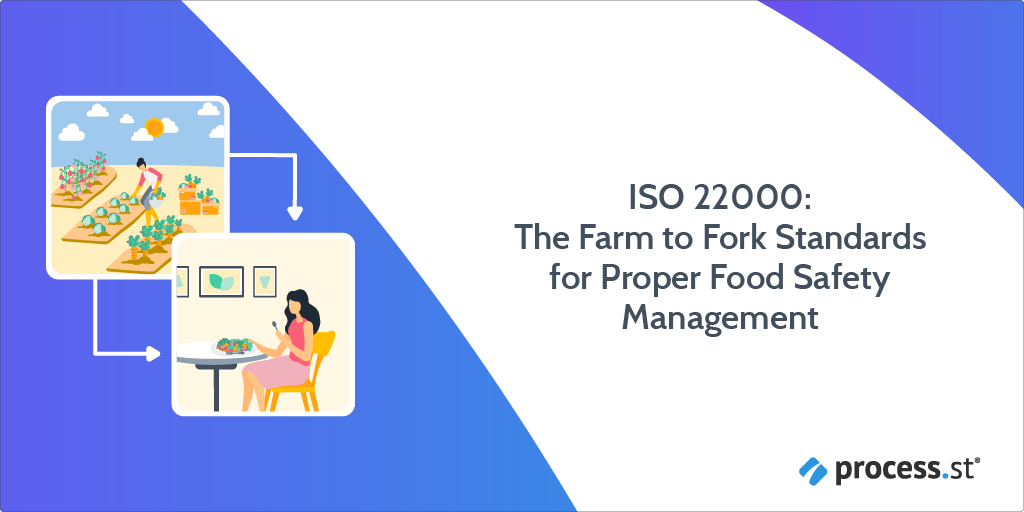
ISO 22000: The Farm to Fork Standards for Proper Food Safety Management

ISO 22000

I didn’t expect to get ill the last time I ordered food via UberEats.

Was it because of the rib eye steak? How the cook prepared it? Or how the steak was transported to the restaurant from the producer?

I don’t know.

What I do know, though, is that the CDC estimates 48 million people each year get sick from foodborne illness.

No matter your role in the food supply chain – whether you’re a primary producer, a storage operator, or a subcontractor to a food outlet – a food safety management system is necessary. Otherwise, you’re exposing people to illnesses that could potentially be life-threatening. Even if the illness is fleeting, the long-term result of a consumer’s sickness will result in your brand being tarnished.

Luckily, ISO 22000 can help you create and sustain a solid food safety management system.

In this post, I’ll discuss what ISO 22000 is in more detail, its requirements, its benefits, and why food safety management systems are just so important. Plus, I’ll explain how Process Street can help you gain ISO 22000 certification!

Read through the following sections to get clued up:

Hungry to learn more?

It’s time to dig in!

Continue Reading

Ultimate SOP Guide: Standard Operating Procedures Made Easy (Free Templates!)

sop templates

SOPs (often pronounced S-O-P) are basically just another way to think about processes. Specifically, with a focus on formally defining the best way of doing something.

In business terms, that means saving time and money by building a clear, concise set of instructions for all of your internal processes. Policies (or standards) are important too; SOPs are kind of like a hybrid of policy and procedure.

Traditionally, SOPs were useful in principle, but often suffered from being difficult to maintain and crucially, hard to enforce. What good is an SOP if it lives its life sat on a dusty stack of paper forms? Your SOPs should be actionable, and that’s where BPM software like Process Street comes in.

If you understand how to build, maintain, and optimize SOPs with software, you can supercharge your standard operating procedures.

In this article, we want to give you everything you will ever need to know about SOPs, including:

Each section will be as concise as possible, with links out to further reading wherever appropriate. Let’s start with the basics.
Continue Reading

ISO: Everything You Need to Know (Ultimate Guide + Free Templates)

isoISO means standards. A standard is just a set of requirements, decided by experts, for doing something specific.

A lot of standards exist under the banner of ISO, for all sorts of things, from quality management, to environmental and social responsibility guidelines, to how to design medical devices.

They’re useful because they help you to write good processes; how to structure, organize, implement, and improve on them.

At the heart of ISO is the principle of systematizing your approach to process management in your company – simple as that! You might be scared of ISO, but there’s really no need to be intimidated. What’s more, recent changes have made it easier than ever to get started with ISO standards.

In this Process Street article, we’ll look at everything ISO, including (but not limited to):

Let’s start with the basics. What exactly is ISO?
Continue Reading

Take control of your workflows today