





Bread. Beer. Bacon. No matter what tasty food product your organization is creating, or helping to create, a robust food safety management system is essential. FSSC 22000 gives food organizations a certifiable system built around ISO 22000, sector-specific prerequisite programs, and additional scheme requirements.
Without a strong food safety management system, food can be exposed to risks and hazards that threaten consumers, trade opportunities, and the organization itself. The scheme turns food safety policy into connected work that can be implemented, audited, improved, and trusted across the supply chain.
This guide explains what FSSC 22000 covers, how it differs from ISO 22000, why Global Food Safety Initiative recognition matters, and how to build an evidence-ready management system. It also reflects the current transition from Scheme Version 6 to Version 7.
In this article:
- What is FSSC 22000?
- FSSC 22000 vs ISO 22000
- What GFSI recognition means
- Benefits of certification
- Managing FSSC 22000 with Process Street
FSSC 22000 explained
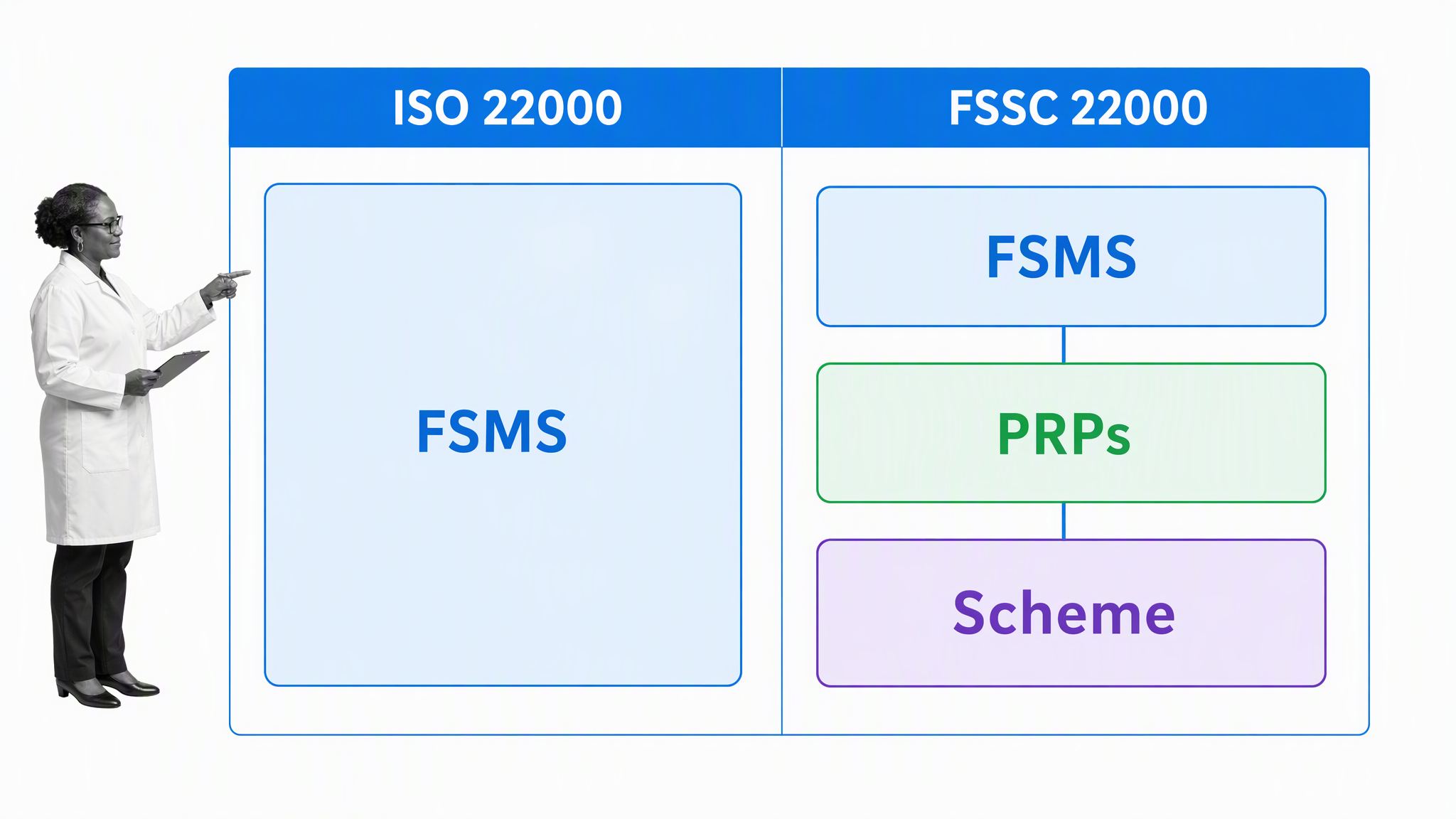
FSSC stands for Food Safety System Certification. The FSSC 22000 Scheme is owned by the Foundation FSSC and provides a certification model for organizations in the food supply chain. Its requirements combine three layers: ISO 22000, the applicable sector prerequisite program specification, and FSSC additional requirements.
ISO 22000 supplies the management-system foundation. It requires an organization to understand its context, establish leadership and accountability, plan for risks and opportunities, provide resources, control operations, evaluate performance, and improve the system. Within operations, the standard integrates hazard analysis and the principles of HACCP so food safety risks are identified and controlled.
Prerequisite programs, usually shortened to PRPs, establish the basic environmental and operating conditions required for safe production. Depending on the organization and scope, they can cover premises, utilities, cleaning, pest control, personnel hygiene, storage, transport, equipment suitability, allergen controls, and other foundational practices. The applicable PRP specification varies by food-chain category.
FSSC then adds scheme-specific requirements. These requirements address topics such as food defense, food fraud mitigation, allergen management, environmental monitoring, quality control, equipment management, food loss and waste, communication, and a food safety and quality culture. The exact set depends on the organization and the current scheme version, so implementation should always be checked against the official Scheme documents and the certification scope.
Depending on scope and food-chain category, the control map can include management of services, supervision of personnel, management of supplied materials, management of natural resources for animal production, food defense, food fraud prevention, formulation of products for relevant pet-food categories, management of allergens, product labelling, environmental monitoring, and rules for logo use. These are not a substitute for the Scheme documents, but they show why the framework reaches beyond a single hazard-analysis plan.
Achieving certification shows suppliers, buyers, and other interested parties that the food safety management system has been assessed against defined requirements for the safe supply of food and drinks. An organization cannot simply claim certification for itself. A licensed third-party certification body assesses the organization’s processes and systems, and ongoing audits confirm that the certified system continues to meet the Scheme requirements.
FSSC 22000 is a company-level framework and certification created by the Foundation FSSC. A business can’t claim to be FSSC 22000 certified themselves. A licensed third-party has to come in and assess whether the business’ processes and systems are following FSSC 22000 rules. To boot, certification isn’t a one-off: businesses are re-audited regularly, annually in many audit cycles, to ensure they’re remaining compliant.
What is a food safety management system?
A food safety management system, or FSMS, is the coordinated set of policies, responsibilities, processes, controls, records, and improvement activities used to manage food safety. It connects strategic commitments with day-to-day execution. A hazard-control plan may explain what must be controlled, but the broader FSMS also determines who owns the control, how competence is established, what evidence is captured, how exceptions are escalated, and how management reviews performance.
If you are not sure what a food safety management system means precisely, or what it consists of, think of the FSMS as the complete collection of safety processes that make sure food and drinks are safe for consumption. FSSC 22000 certification is not the system itself. It is the independent assessment of whether the overall food safety system meets the applicable certification requirements.
As a plain-language shorthand, basically think of the food safety management system as a myriad of safety processes and FSSC 22000 certification as an independent stamp of approval for the overall food safety system.
That distinction matters during an audit. A procedure alone does not show that a control is effective. Auditors need evidence that the organization follows the procedure, monitors results, responds to deviations, investigates causes, completes corrective action, and learns from trends. The management system makes those relationships visible.
Scope is another foundational decision. A certificate applies to the sites, activities, products, processes, and food-chain categories described on it. Central functions may support the system, but each site still needs clear operational control. When products, lines, warehouses, outsourced processes, or site boundaries change, the organization should assess the effect on hazards, PRPs, documented information, competence, and certification scope before the change becomes routine.
The current implementation context is also important. Foundation FSSC published Scheme Version 7 on May 1, 2026. Version 6 audits can continue through April 30, 2027. Version 7 upgrade audits are scheduled from May 1, 2027 through April 30, 2028. Version 6 is currently GFSI-recognized, while Version 7 is undergoing the GFSI benchmarking process. Organizations should plan the transition with their licensed certification body and use the published transition requirements rather than assuming a certificate changes automatically.
FSSC 22000 vs ISO 22000
ISO 22000:2018 specifies requirements for a food safety management system. It is the central management-system standard used inside the FSSC 22000 Scheme, but the two are not interchangeable. ISO 22000 certification shows conformity with that standard. FSSC 22000 certification shows conformity with ISO 22000 plus the applicable PRP specification and the FSSC additional requirements.
A practical way to picture the relationship is as a stack. ISO 22000 defines the FSMS framework and operational food-safety planning. PRP specifications add detailed baseline conditions for a particular part of the food chain. FSSC additional requirements address scheme priorities and GFSI benchmarking expectations. Certification bodies then audit the complete combination against the organization’s declared scope.
ISO 22000 can therefore be the right choice when an organization needs an internationally recognized FSMS standard but does not require a GFSI-recognized certification program. FSSC 22000 may be the stronger fit when customers, retailers, brand owners, or supply-chain partners expect a GFSI-recognized certificate, or when the added scheme controls match the organization’s risk and market needs.
FSSC 22000 and ISO 22000 have substantial similarities and overlap because FSSC follows the ISO 22000 requirements as its management-system core. The additional requirements and applicable PRP specification make the FSSC certification more extensive. In short: ISO 22000 provides the broad FSMS foundation, while FSSC 22000 combines that foundation with food-sector prerequisites and additional scheme controls.
For a concise summary of the difference:
- FSSC 22000 is based on ISO 22000 and follows the majority of its management-system requirements.
- FSSC 22000 contains additional requirements and sector prerequisite programs for food safety.
- ISO 22000 is a certifiable standard, but it is not itself a GFSI-recognized certification program.
- FSSC 22000 Version 6 is GFSI recognized; Version 7 is undergoing GFSI benchmarking.
Organizations that have already done research will often see ISO 22000 mentioned alongside FSSC 22000. That is because one sits inside the other. ISO 22000 provides requirements in the eyes of the International Organization for Standardization. FSSC 22000 is based on that already-established ISO foundation, then adds the sector detail needed for its certification program and GFSI benchmarking.
ISO 22000 can be a strong beginning step for deploying a food safety management system. Its broad scope is valuable, but that broadness means ISO 22000 is not itself a GFSI-benchmarked certification program. FSSC 22000 contains additional requirements so it can be recognized by food-focused groups under the GFSI model. That makes the FSSC framework more rigid in scope, which is a positive when those additional controls match the organization’s needs.
Neither option should be chosen as a branding exercise. Start with customer and regulatory obligations, product and process risk, supply-chain position, geographic markets, and the certification scope. Then confirm eligibility with a licensed certification body. FSSC publishes a clear overview of the certification process, including the preparation, audit, certification, and surveillance cycle.
The certification journey normally includes a readiness phase, an initial audit, correction of any nonconformities, a certification decision, surveillance audits, and recertification. A stage-one assessment examines readiness and system design; stage two tests implementation and effectiveness. Exact arrangements depend on the scheme and certification body, but evidence should be available from normal operations rather than assembled only for the audit.
A certified organization is re-audited regularly, with the audit program designed to ensure it remains compliant throughout the certification cycle. Preparation therefore means more than passing a one-off assessment. The organization needs an audit schedule, competent internal auditors, retained records, prompt correction of findings, and management attention to recurring weaknesses.
Use structured audits to test the system
Internal audits help teams test whether the management system conforms to planned arrangements and works in practice. The template below is framed around ISO 9001, but its audit structure is useful for planning scope, collecting objective evidence, recording findings, and following corrective actions. Adapt every clause and question to the applicable FSSC 22000 Scheme documents and your organization’s food-chain category.
The goal is not to produce more audit paperwork. It is to make findings actionable. Every nonconformity should connect to an owner, containment where needed, root cause analysis, corrective action, due dates, effectiveness verification, and retained evidence.
The value of GFSI-recognized certification
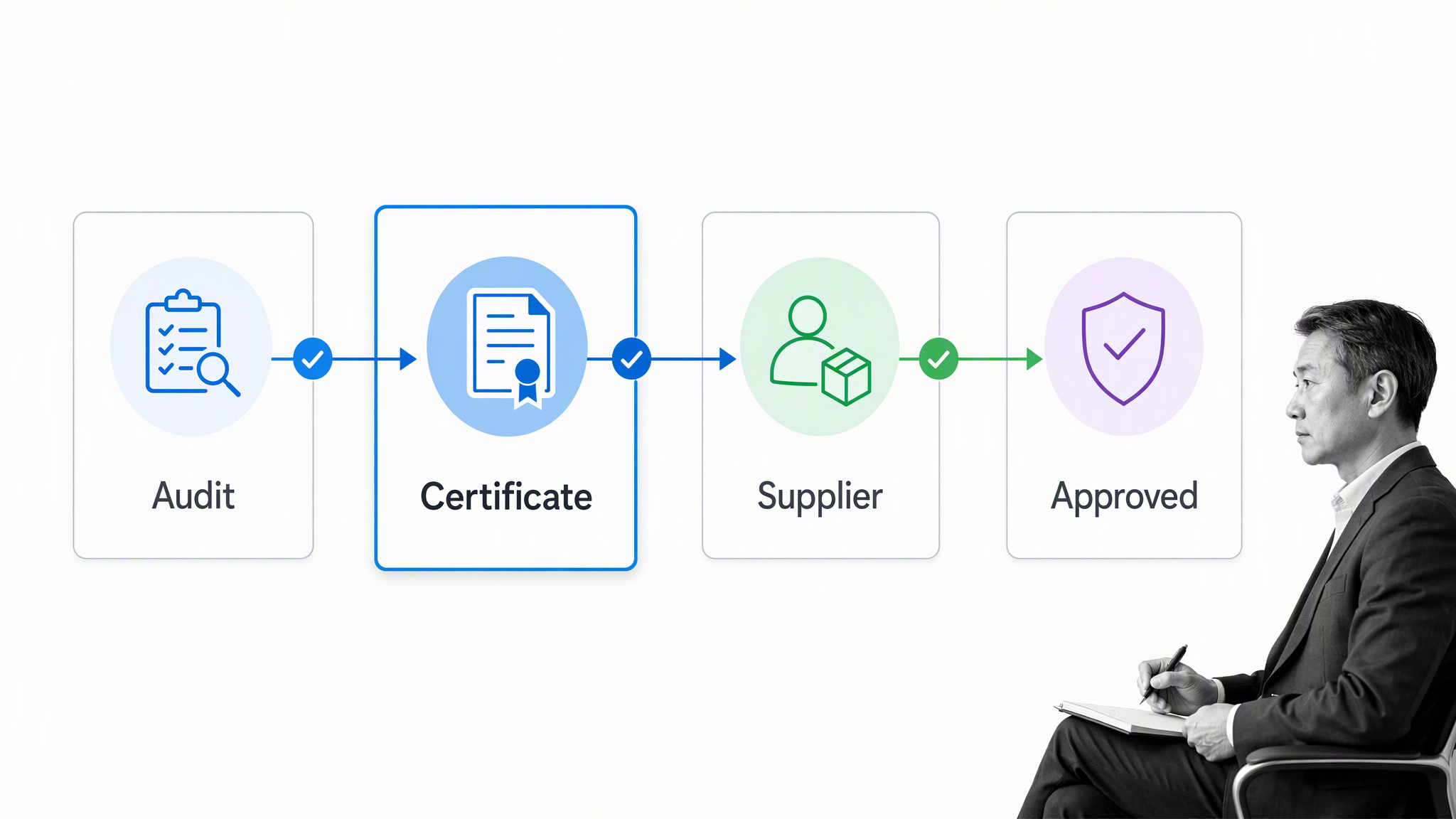
The Global Food Safety Initiative does not certify food companies itself. It benchmarks certification programs against its requirements and recognizes programs that meet the benchmark. Certification is performed by accredited certification bodies under the rules of a recognized Certification Programme Owner.
GFSI is a business-driven initiative focused on the development and benchmarking of food safety management systems. It oversees and recognizes auditing programs that meet its criteria. In practice, this means a food processor or manufacturer can point to a recognized certification when showing customers and potential customers that the facility operates a structured, comprehensive, and effective food safety program.
That model gives buyers a common way to evaluate food safety certification across supply chains. A GFSI-recognized certificate can reduce the need for every customer to invent a separate baseline audit, although customers may still apply their own supplier requirements, product specifications, or additional audits. Recognition supports comparability; it does not remove the buyer’s responsibility to manage supplier risk.
Foundation FSSC appears among GFSI’s recognized Certification Programme Owners. During a version transition, however, the recognition status of the specific scheme version matters. GFSI also publishes programs undergoing benchmarking. That is why teams should record the scheme version, audit date, certificate scope, certification body, site details, and validity status rather than treating “FSSC certified” as a timeless label.
For suppliers, the commercial value is straightforward: a valid certificate can make qualification easier where customers accept the program. For customers, it provides independently audited information about the supplier’s management system. For the certified organization, it creates a recurring discipline of surveillance, recertification, corrective action, and improvement.
Increased reputation and new trade opportunities. The food industry is demanding, and buyers need credible evidence that suppliers are committed to safe food. A GFSI-recognized FSSC 22000 certificate can support local, national, and international reputation, open conversations with new partners, and provide a recognized baseline when entering new markets.
Access to international markets and a strengthened supply chain. Certification can help an organization meet supplier-approval expectations across borders and improve confidence among existing supply-chain partners. The certificate does not guarantee a commercial relationship, but it gives both sides a structured and independently audited foundation for discussing food safety performance.
Those benefits reinforce one another. A stronger reputation can create a competitive advantage when a retailer is considering a product or when a manufacturer is selecting a new partner. New trade opportunities can increase the value of disciplined supplier management. Existing partners also gain a clearer basis for communication, audit follow-up, and continual improvement from farm to fork.
Verification should go beyond seeing a certificate image. Check that the legal entity and site match the supplier, the certified activities cover the purchased product, the scheme version and dates are current, the certification body is appropriately licensed, and any suspension or withdrawal status is understood. A certificate with the wrong scope does not provide assurance for an activity it excludes.
Certification still depends on the quality of implementation. An elegant manual cannot compensate for incomplete sanitation records, weak allergen changeovers, overdue corrective actions, untested recall procedures, or training that cannot be demonstrated. The useful question is not “Do we have the document?” but “Can we show that the control worked, and what happened when it did not?”
The additional positives of FSSC 22000 certification
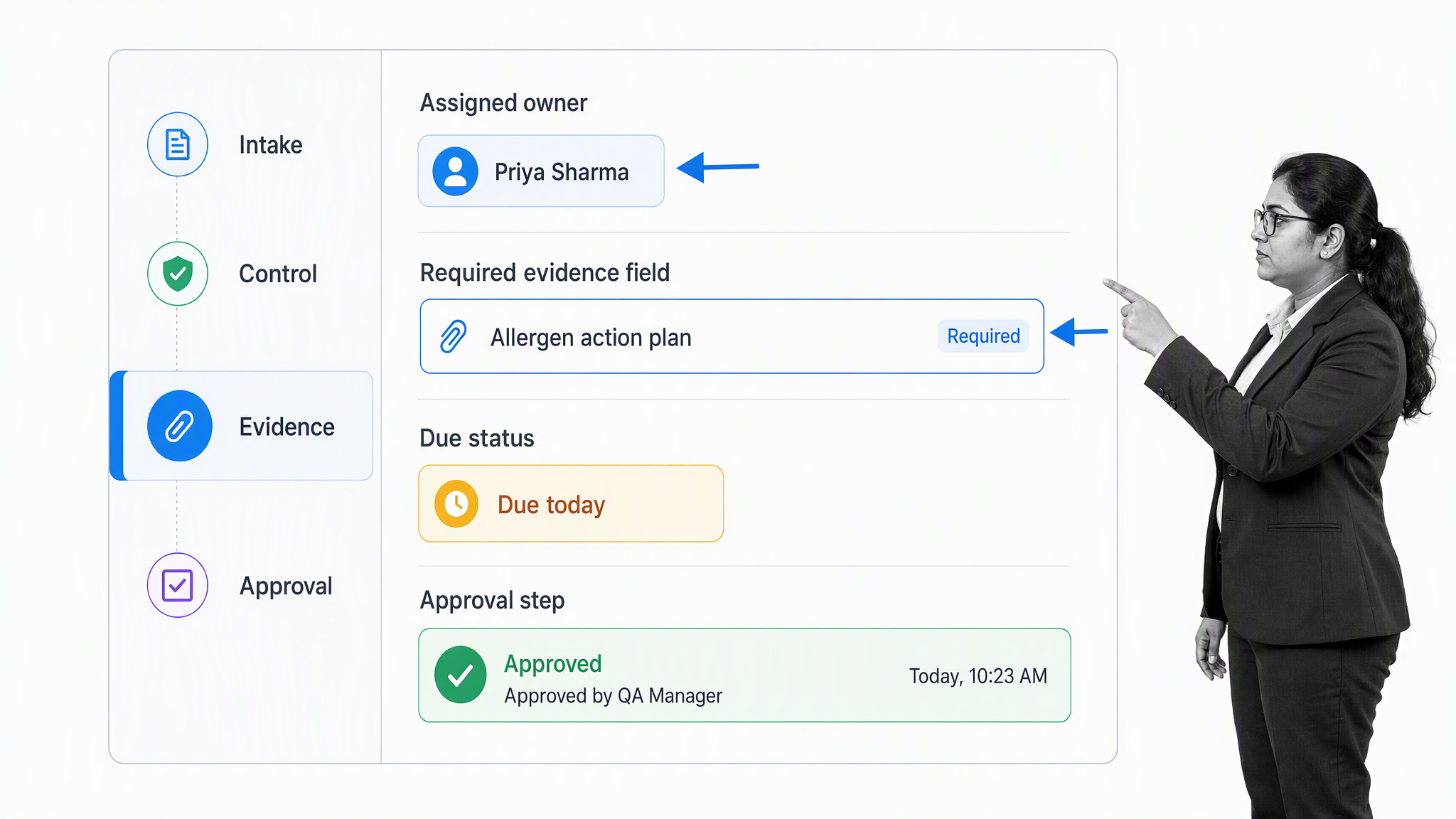
The main benefit of FSSC 22000 is a more coherent operating system for food safety. The scheme pulls policy, hazard control, prerequisite programs, responsibilities, monitoring, verification, internal audit, management review, and improvement into one auditable structure. That makes it easier to see where a risk has no owner, where a control has no evidence, or where corrective action has stalled.
Stronger accountability. Defined roles and assigned activities reduce ambiguity. Teams know who performs a control, who reviews the result, and who has authority to respond when a limit is exceeded.
Better traceability and evidence. Controlled records make it easier to reconstruct what happened, demonstrate conformance, and support investigations. Effective traceability is especially important for withdrawals, recalls, supplier issues, and customer complaints.
Proper process documentation. When building, implementing, and sustaining a robust food safety management system, it is critical to document food safety processes clearly. Good documentation helps employees follow the intended method, reduces avoidable mistakes, and helps new employees and partners learn their responsibilities more quickly.
More disciplined improvement. Internal audits, performance evaluation, nonconformity management, corrective action, and management review create feedback loops. Trends can be addressed before they become repeated findings or incidents.
Saved costs and improved processes. Preventing contamination, rework, waste, downtime, and repeated audit findings is usually less expensive than responding after failure. By documenting and optimizing the associated processes, teams can find poorly designed handoffs and controls that consume time, money, and unnecessary labor.
These are additional positives that are not directly related to the certification being GFSI recognized. A doubled-down food safety management system supports proper process documentation. Proper documentation helps ensure that employees follow the process and that new employees can learn it quickly. Saved costs can follow when improved processes and procedures remove extra work and prevent mistakes. In that sense, better documentation, optimized execution, and continual improvement reinforce one another across the board.
Supply-chain confidence. Independent certification can provide customers with a credible baseline for supplier approval. It can also help an organization participate in markets where a GFSI-recognized program is requested.
Integration with other management systems. ISO 22000 follows the harmonized management-system structure used by other ISO standards. Organizations with established quality, environmental, or occupational health and safety systems can align governance, document control, audit planning, corrective action, and management review while keeping technical food-safety controls specific.
Although the value of an organized system has been mentioned already, it is worth emphasizing again. Both ISO 22000 and FSSC 22000 help organizations in the food sector strengthen their food safety management systems and bring governance up to an internationally understood standard. That reassures customers and consumers only when the documented system is reflected in daily behavior and verified results.
When building out, implementing, and sustaining a robust food safety management system, it is critical to document the food safety management processes that employees and partners must follow. Documentation should make the correct method clear, explain the records that prove completion, and help new employees learn the process quickly. Controlled documents also need approval, revision, availability, and protection from unintended use.
Improved processes and procedures follow when teams use audit findings, incidents, complaints, monitoring results, and employee feedback to optimize the system. That work can stop or change poorly optimized activities that cause extra cost, delay, and unnecessary labor. It can also reveal controls that look effective on paper but are difficult to execute under production conditions.
More useful management review. FSSC 22000 gives leadership a structured reason to examine audit results, verification outcomes, food-safety incidents, objectives, resource needs, changes, and opportunities for improvement. A strong review ends with decisions and assigned actions. A weak review only repeats metrics. The difference is whether the meeting changes priorities, resources, or controls.
Certification is not a substitute for legal compliance, customer requirements, scientific expertise, or leadership. The World Health Organization’s food safety overview underscores the public-health consequences of unsafe food. The management system must remain grounded in applicable law, validated controls, competent people, and the organization’s actual hazards.
Manage FSSC 22000 with Process Street
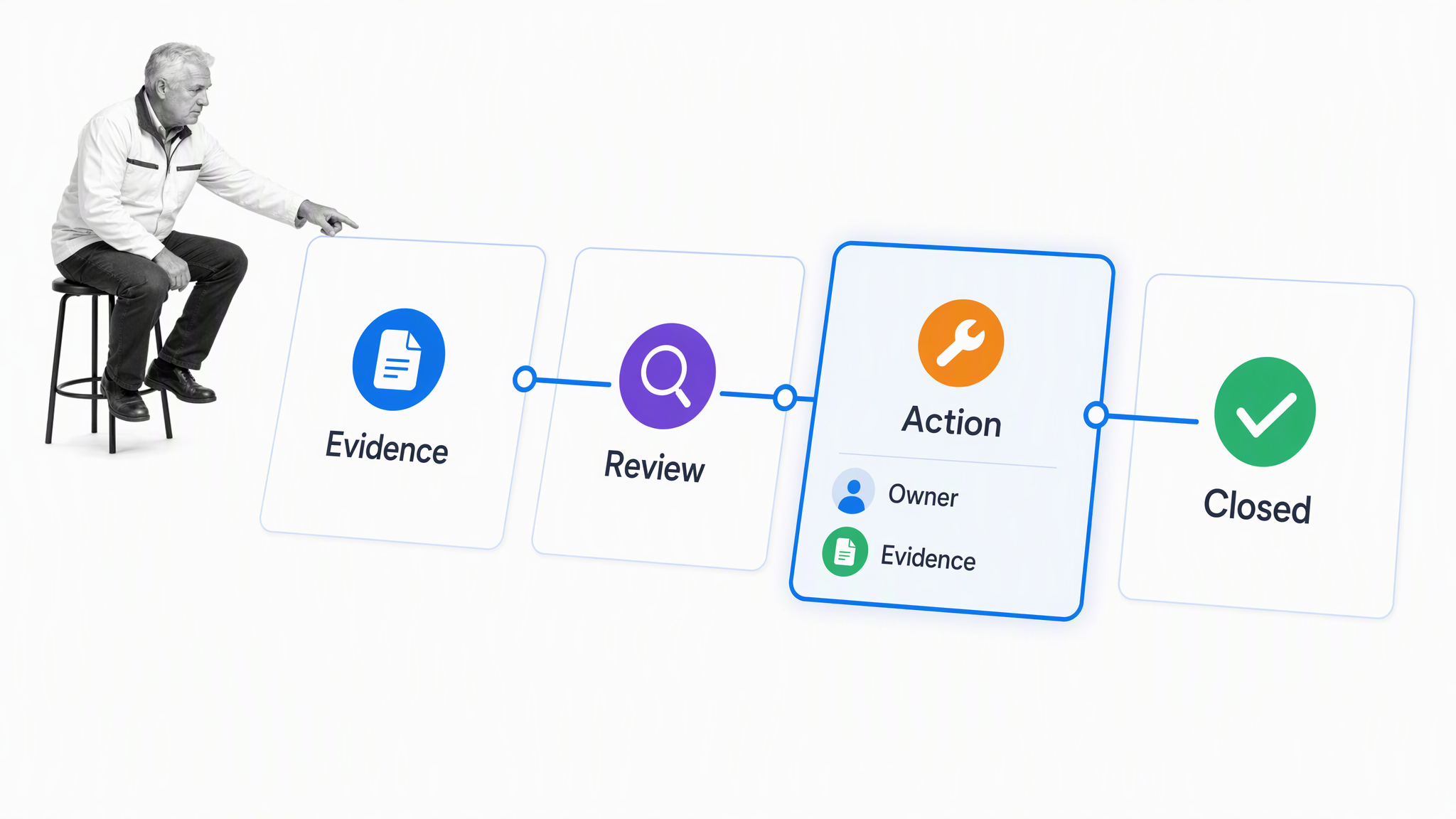
FSSC 22000 creates recurring work: approve controlled procedures, complete hygiene and prerequisite-program checks, review suppliers, investigate deviations, manage corrective actions, prepare internal audits, collect evidence, and report performance. Static documents can describe that work, but they do not ensure it happens on time or show where it is blocked.
Process Street quality management software provides one Compliance Operations Platform for that operating layer. Docs supports controlled process knowledge and procedures. Ops turns those requirements into assigned, trackable workflows with approvals, due dates, forms, and evidence. Built-in AI helps teams work with process information and reduce repetitive effort while people retain control of decisions and approvals.
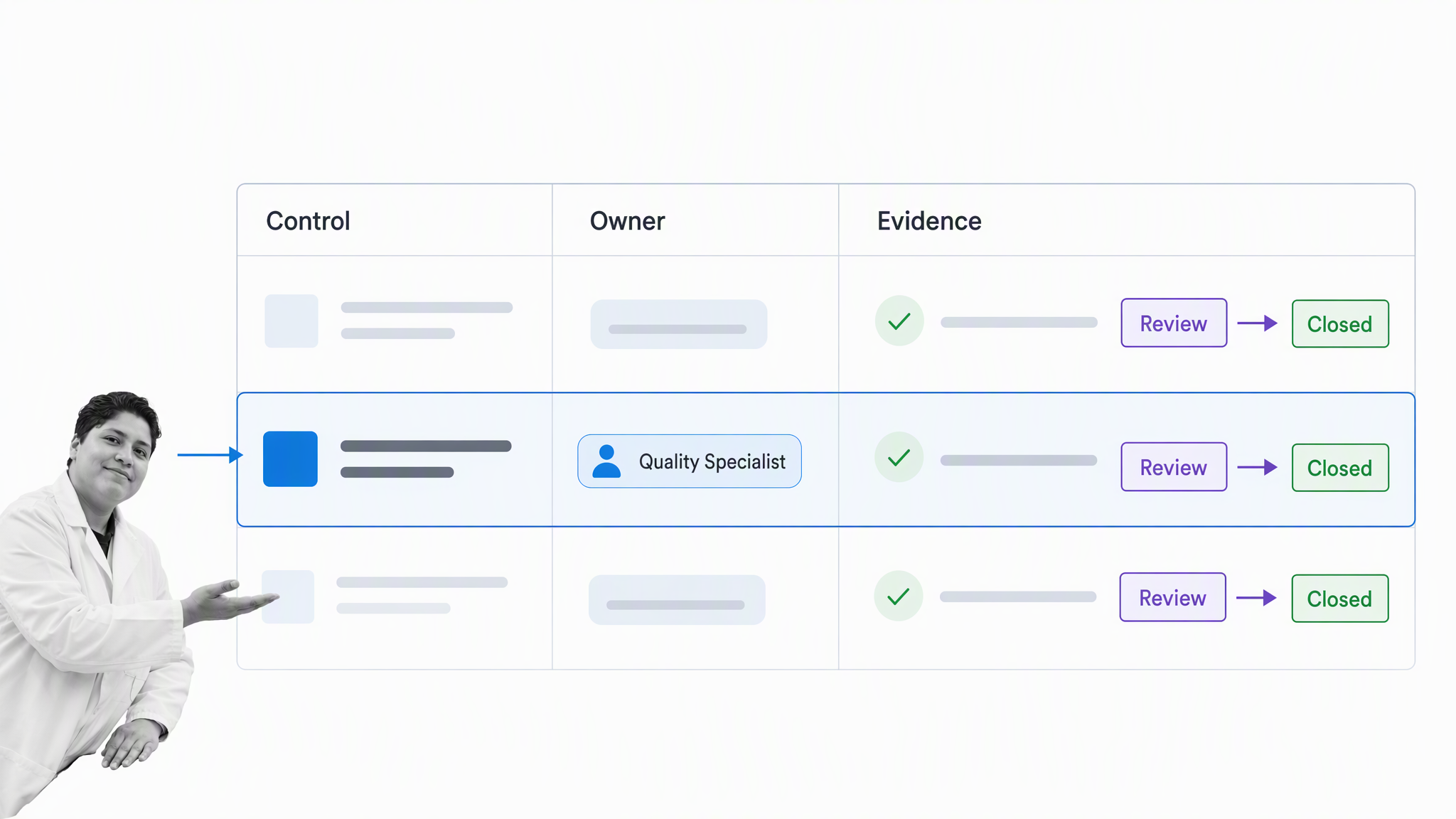
For example, an allergen-control workflow can require the assigned owner to attach changeover evidence before the review step becomes available. A deviation workflow can capture the affected product, containment, risk decision, root cause, corrective action, and effectiveness check. The record then shows who completed each step and when, instead of scattering evidence across email, spreadsheets, and shared drives.
Conditional logic can route work based on site, product, hazard, supplier status, or finding severity. Approvals can place a quality or food-safety decision at the right point in the process. Automations can notify stakeholders and connect workflow data to other systems. Reports can help leaders find overdue work, repeated exceptions, and bottlenecks before the next audit.
Useful workflow controls include required tasks, dynamic due dates, conditional logic, task permissions, task assignments, role assignments, webhooks, embedded resources, and approvals. Required tasks protect the order of execution. Permissions limit sensitive information to the appropriate people. Assignments and due dates make ownership explicit, while approvals document who accepted or rejected a result.
What makes the operational layer particularly useful is its workflow automation features. These integrated features help automate and improve essential processes while preserving human accountability. The objective is not automation for its own sake. It is to remove manual handoffs, surface exceptions, and keep the evidence trail attached to the work that produced it.
For instance, a required task can stop a user from progressing until the control at hand is complete. Task permissions allow only designated people to view sensitive data or information. Role assignments can route the same workflow to the correct food-safety manager at each site, and dynamic due dates can calculate deadlines from an audit, incident, or production event.
Built-in AI can assist with tasks such as finding relevant process knowledge, drafting a starting point, or summarizing operational information, but food-safety decisions still require competent human review. Validation, legal interpretation, hazard analysis, critical limits, disposition decisions, and certification evidence should follow the organization’s approved governance and authorization rules.
Start with the structure you already have. The ISO 9000 template below can help organize a management-system hierarchy. Adapt it to the FSSC 22000 Scheme, your certification scope, applicable PRP specification, legal obligations, customer requirements, and established document-control rules.
More resources for food safety systems, processes, and certification
Solid systems and processes help an organization translate a standard into repeatable operations. These Process Street resources provide additional detail on documentation, automation, supply chains, quality management, and ISO certification:
Where would an organization be without solid systems and processes? Not in a good place. Whether you are building out systems and processes correlating to FSSC 22000 or another framework or standard, the reading list below can help connect certification requirements to day-to-day execution.
- What is an SOP? Essential Steps to Writing Standard Operating Procedures
- Free SOP Templates to Make Recording Processes Quick and Painless
- How Processes Protect Your Business From Crashing and Burning
- Business Process Documentation: Benefits and Why You Should Use It
- Benefits of Business Process Management and Why You’ll Love It
- The Complete Guide to Business Process Management
- Ways To Save Time and Money with Workflow Automation
- Process Automation Ideas for Recurring Work
- Logistics Management Processes to Perfect Your Supply Chain
- Tips from IKEA’s Supply Chain
- How to Build a Better Purchase Order Workflow with Process Street
- Tips to Improve Your Company’s Shipping Processes
- What is ISO 9000? The Beginner’s Guide to Quality Management System Standards
- What is ISO 9001? The Absolute Beginner’s Guide
- What is ISO 9001 Certification? How to Get Certified
- What is Quality Management? The Definitive QMS Guide
- Agile ISO: How to Combine Compliance with Rapid Process Improvement
A sensible implementation sequence is to map the requirements, identify each control and record, assign ownership, define review and escalation paths, migrate recurring work into executable workflows, and test the system with internal audits. Keep the official Scheme documents as the source of requirements and use the operational system to make execution and evidence consistent.
At this point, you have learned what FSSC 22000 is, how it differs from ISO 22000, what GFSI-recognized certification means, and the positives FSSC 22000 certification can bring. The next step is to compare the official requirements with your current food safety management system, document the gaps, and agree a certification plan with qualified food-safety specialists and a licensed certification body.
Organizations that want to achieve FSSC 22000 certification and become FSSC 22000 certified should treat that plan as an operational change program, not merely an audit date.
FSSC 22000 certification is earned through the management system your organization runs every day. When procedures, workflow ownership, evidence, and corrective action stay connected, audit readiness becomes an outcome of normal operations rather than a last-minute project.