All posts in Management

How to Build a Strong Company Culture for Your Remote Team

How to Build a Strong Company Culture for Your Remote Team

This is a guest post by David Miller, a technical writer & edu-tech enthusiast currently pursuing research in project management software. You can find him on Twitter, or writing for the ProProfs Project.

If I ask you to select a few colleagues in your company and take a survey of how well they understand their company’s culture, how do you think they’d score?

Not so sure?

Now, think about remote teams.

Teams you don’t even talk on a regular basis – how sure are you that they know your company’s values or culture?

Let’s take an example.

According to a PMI study, 83% of respondents spend at least an hour or two working remotely every day. Among which the percentage of remote employees stand at:

  • 47% – Business Owners
  • 47% – Managers
  • 50% – Executives
  • 36% – Team Members

Now, as you can see that most upper-management employees are usually working remotely with the company, and if they themselves don’t possess a firm grasp on company culture – how will they pass it on to their team members?

Usually, remote team members are simply assigned tasks with a due date and it is all professional.

But, what most companies don’t realize is that it is really crucial for everyone who is part of a company to understand their values and culture.

Continue Reading

The Ultimate Risk Management Guide: Everything You Need to Know

Image showing the introduction to an article titled, "The Ultimate Risk Management Guide: Everything You Need to Know"

Organizations face a wide array of uncertainties that can disrupt operations, threaten profitability, and damage reputation. Whether it’s market volatility, technological disruptions, or regulatory changes, the ability to anticipate, assess, and mitigate risks has become a crucial part of successful management. This is where risk management comes into play.

Risk management is the structured process of identifying potential threats, evaluating their likelihood and impact, and developing strategies to minimize or eliminate their adverse effects.

By integrating risk management into their decision-making processes, organizations can not only safeguard their assets but also seize opportunities that arise from taking calculated risks.

In this article, we explore the fundamentals of risk management, its various types, and why proactive risk mitigation is essential for businesses to thrive in uncertain times.

Continue Reading

What Is ISO 31000? Getting Started with Risk Management

what is iso 31000? Getting started with risk management

We analyze and manage risks every day.

From crossing the street, correctly preparing food, fastening seat belts, to coordinating a journey via public transit. Each of these is an example of a risk management process happening in our heads; sometimes the result of “common sense”, sometimes these decisions are made unconsciously.

When it comes to business management, a more rigorous, formalized approach is needed.

One such strategy for managing risk is to utilize standards for risk management, like ISO 31000. This approach is useful in pretty much any situation, for organizations of all shapes and sizes, to manage risk in their everyday operations.

Managing risk effectively is essential to ensure businesses succeed and thrive in an environment of constant uncertainty. This post covers everything you need to know about ISO 31000; here’s a quick rundown of the article structure:

Continue Reading

Gap Analysis: How to Bridge the Gap Between Performance and Potential

Gap Analysis How to Bridge the Gap Between Performance and Potential

If you want to grow your business, you need to know how to allocate your resources to make it happen. How do you figure out the steps you need to take, or the processes you need to implement to make it happen?

You conduct a gap analysis.

Simply put, the gap analysis is a tool designed to help you understand where you are, and what you need to do in order to get to where you want to be.

In this article, I’ll be breaking down the basics and running through a process for getting started with performing your first gap analysis.

Here’s what this Process Street article has in store:

Let’s get started.

Continue Reading

ISO 13485: Basics and How to Get Started (QMS for Medical Devices)

iso 13485 checklist

In today’s business world, owners are constantly grappling with concerns and surmounting obstacles, the least of which is actually staying afloat financially in what can be an unforgiving economy.

However, the struggle to turn a profit pales in comparison to some of the harsher consequences of failing to comply with certain regulatory requirements.

Take HRIS broker Zenefits for example. Failure to comply with several licencing regulations issued by the California Department of Insurance landed them a $7million fine.

That’s just the tip of the iceberg; more severe penalties extend to include government bodies compelling you to dissolve your company, and ultimately the endangerment of the lives and well-being of individuals your organization is servicing.

“On a global scale, we are all being asked to do more with less—and for less. At some point soon, the current internal systems will not be able to hold back the deluge, and companies will be faced with a stark decision—consistently improve or perish” – Erik Myhrberg and Joseph Raciti, Practical Field Guide for ISO 13485

Often, these kinds of requirements take the form of the ISO 13485 standard for medical device manufacturers.

In this article, I’ll break down the ISO 13485 standard, from a basic introduction to suggestions and resources for implementing it in your business or organization.

Continue Reading

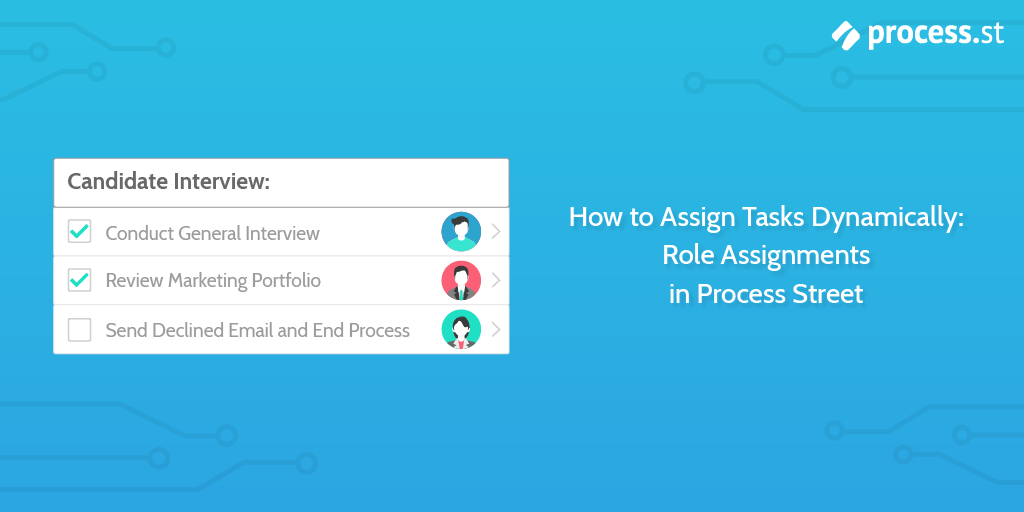
How to Assign Tasks Dynamically: Role Assignments in Process Street

Role Assignments

Assigning team members to their tasks is a duty which is as vital as it is tedious.

Everyone pretty much knows what they should be doing, so there’s no need to directly assign them to everything when you could be spending time on more important tasks, right?

Wrong.

Human error (of which memory plays a huge part) affects 1/100 routine tasks where care is needed. This means that the people responsible either makes a mistake or forgets what they need to do (hence why documented processes are so important).

That’s why we here at Process Street have a role assignment feature in our checklists.

Role assignments let you dictate who each task in your process checklists needs to be assigned to without fail every time. All you need to do is set up the role which will have the task assigned, then Process Street does the rest.

Ready to assign your tasks without fail, fuss or tedious fiddling? Then let’s dive right in.

Continue Reading

What is Customer Support? How to Improve Your Support Team (17 Free Processes)

Customer Support

A buggy Netflix account. A defective iPhone. Faulty B2B software.

There’s nothing more frustrating than when products and services encounter issues, or when they simply don’t work at all.

Consumers expect the products and services they buy to perform properly. After all, they’ve handed over their hard-earned money to the vendor in exchange for goods.

Who do consumers turn to for assistance? Customer support.

However, a customer-facing employee can only carry out excellent service if they’re onboarded correctly, fully trained, taught how to interact with customers, and given regular feedback on their performance.

If consumers aren’t impressed with their experience, they can churn immediately and leave negative reviews in their wake. Should the churn rate increase and harmful reviews accumulate, it could be the death knell of an entire business.

At Process Street, we know about – and strongly believe in – effective customer support. In fact, we operate a policy where each new employee must undergo a period of customer support experience, which amounts to a few weeks in total.

That’s why we created these 17 free templates for other teams.

The process templates featured in this free template pack will help strengthen any customer-facing team’s ability to perform successfully. From new employee training checklists to performance reviews, churn reduction checklists to a guide on responding to negative reviews, we’ve got your workflows covered.

Continue Reading

Key Takeaways from 5 Excellent Company Culture Examples

company-culture-examples

It is by no means easy for any organization to establish a strong identity.

It takes excellent leadership from the get-go to clearly define values, goals, and objectives that stakeholders can stand by and employees feel motivated to forward with consistent high-quality performance.

This is proving increasingly challenging for businesses as there is no clear solution, no clear method to getting it right.

But it’s time serious measures were taken to do something about it.

According to research by Deloitte, culture and engagement is the most important issue companies face around the world, with 87% of organizations citing culture and engagement as one of their top challenges, and 50% call the problem “very important.”

The importance of company culture has become increasingly important over the last couple of decades, as younger generations demand a work environment that feels nurturing, encourages collaboration, and offers challenges that keep them engaged and present opportunities to make a notable impact in some way.

Continue Reading

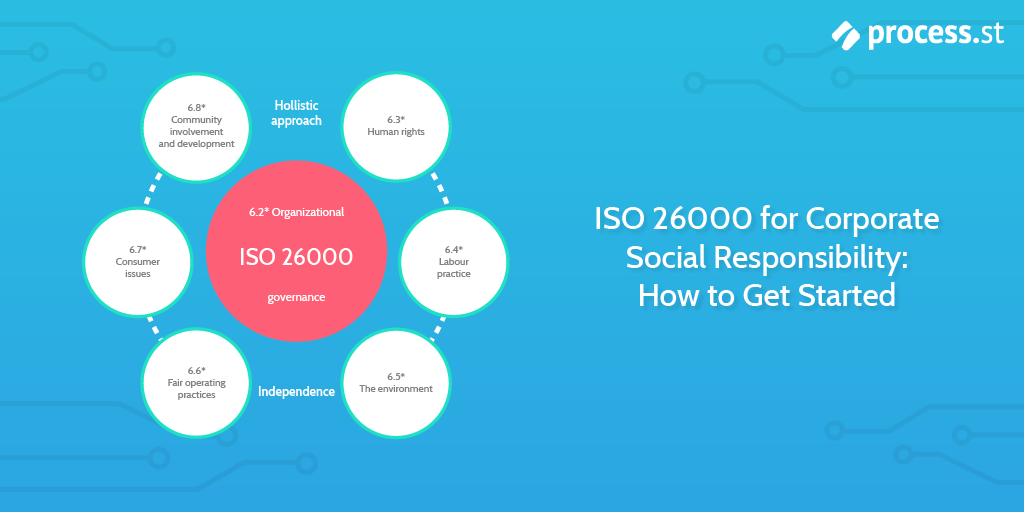
ISO 26000 for Corporate Social Responsibility: How to Get Started

corporate social responsibility

Organizations, including businesses, do not exist in a vacuum. Every organization is embedded in a wider web of societal, political, and environmental systems, that spans from smaller local networks to expansive and complex global systems.

As IAG puts it:

“Sustainability is neither a program nor an initiative, it’s considered simply good management.”

This statement recognizes the link between an organization and the social, environmental and economic wellbeing of the communities in which they operate.

An organization’s relationship to the society and wider environment in which they exist and operate is a key factor in their ability to succeed and thrive. It can also be an insight into their general performance.

ISO 26000 is a set of guiding principles for businesses and organizations to use to steer them in a more socially responsible direction.

In order to better contribute to the health and welfare of their supporting societies and environments, businesses must enforce principles of ethical and transparent behaviour.

Continue Reading

What is Quality Management? The Definitive QMS Guide (Free ISO 9001 Template)

Deepwater Horizon – arguably one of the most catastrophic industrial disasters of human history, and the estimated largest marine oil spill in the history of the petroleum industry.

It also happens to be one of the most abysmal failures of quality management by any company, period.

On an otherwise unsuspecting evening of April, 2010, approximately 50 miles off the coast of Louisiana in the Gulf of Mexico, the first in a chain of quality management related failures became glaringly apparent as the emergency response protocols were enforced after an oil leak in the drilling well was discovered.

The oversights were as follows:

  • Lack of proper quality assessment resulted in weak, potentially contaminated cement or “drilling mud” used in the initial failsafe failing to properly block the leak.
  • Fluid pressure tests were not properly carried out and clear warnings were ignored.
  • Rising oil and gas levels were not properly monitored.
  • The final failsafe on the ocean floor, designed to close the leaking pipe shut, failed to close due to the conditions of the drill pipe.

The aftermath of this chain of negligence left 11 people dead, caused over 130 million gallons of oil to leak into the Atlantic Ocean, and cost over $62 billion in damages.

Not one point of failure, but four. Clearly not an anomaly, this disaster was the result of a series of systematic failures that uncover a dark truth about the reality of cost-cutting and disregard for quality control.

Continue Reading

Take control of your workflows today