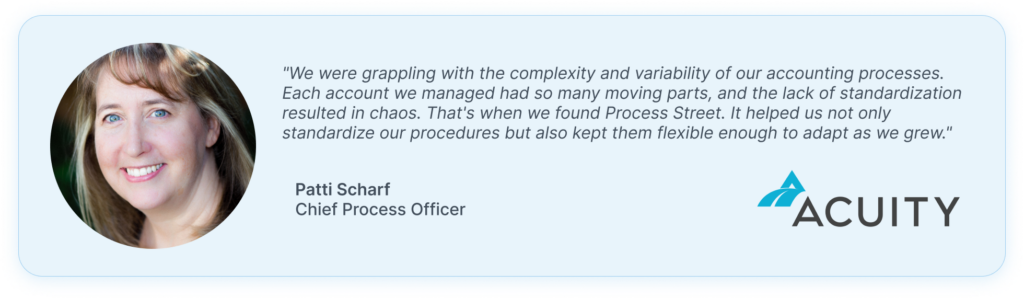
Patti Scharf, Acuity’s Chief Process Officer, first started using Process Street with her company Catching Clouds, a smaller team of 30 people who later merged with Acuity.
A key selling point was Process Street’s integration with Zapier.
Raw Capital Partners faced multifaceted challenges in their pursuit of operational excellence.
At Raw Capital Partners, the demands of mortgage documentation and due diligence are critical challenges due to regulatory compliance requirements.
From ensuring compliance in mortgage handling to streamlining employee onboarding, Raw Capital needed a solution that could effectively address these needs.
They wanted a solution that could guarantee accuracy and consistency in all operations.
This is where Process Street stepped in, offering tailored solutions to improve compliance and optimized their approach to operations.
In this Spotlight Series blog, we are delighted to introduce Tony Vila, our Senior Product Designer.
Tony has been working with us for nearly two years and is our go-to expert for shaping user experiences that marry functionality with aesthetics.
With a background in horticultural product design and a passion for UX/UI, Tony brings a unique perspective to our team.
His journey from aspiring music teacher to seasoned UX/UI designer has been marked by pivotal moments in London’s startup scene, where he honed his skills and embraced the dynamic challenges of B2B product design.
Join us as we delve into Tony’s journey, insights, and the impactful projects that define his tenure at Process Street:
Zonos is a software company headquartered in St. George, Utah, whose software allows businesses to automate the complexities of international e-commerce. This includes automating the calculation, collection, and remittance of duties and taxes.
The software company makes it easy for international shoppers to make purchases on websites with language and currency localization and the ability to prepay duties and taxes. Zonos also automates cross-border compliance and HS code generation.
Although the company strived to improve their customers’ international shopping experience, they faced challenges when getting these clients up and running with their software. Especially those with complex software integrations that varied in requirements.
The previous system Zonos used for their customer onboarding was clunky and lacked the flexibility they needed, making the experience cumbersome and inefficient. This prompted Zonos to seek a more dynamic and user-friendly solution. That solution turned out to be Process Street.
Welcome to the Employee Onboarding Podcast, where we explore the best practices and innovative ideas from the world’s top HR professionals and thought leaders. The topic for this podcast: What really makes a successful onboarding process.
Today, we’ll be joined by Maxine Dorkin, a dynamic professional in the youth employment sector and currently a PhD candidate at the University of the Witwatersrand in South Africa.
Maxine’s impressive journey includes managing work readiness programs that have impacted over 5,000 unemployed youth, extensive experience in the nonprofit sector, and a pivot into the technology space where she now excels in designing and facilitating onboarding programs.
Join us as we uncover Maxine’s insights on how to align personal values with organizational missions, the importance of community in the workplace, and strategies to enhance employee engagement and retention.
This conversation provides practical takeaways for any HR professional looking to elevate their onboarding process.
Colliers is a global commercial real estate company that helps its clients select corporate real estate, manage lease renewals, and handle portfolio strategies.
It’s a massive operation that requires an intense amount of organization and transparency to deliver the best services for its clients. One of the ways it accomplishes this is by using Process Street.
But how did Colliers come to use Process Street? And how has it helped transform its operations? We will answer those questions and more in this case study.
We’ll cover:
The challenge
The solution
The results
If you want to learn more about how Process Street has helped Colliers, check out our video about it below:
Welcome to the Employee Onboarding Podcast, where we dive into cutting-edge onboarding strategies and gain insights from HR leaders.
Today, we’re thrilled to be joined by Keisha Toussaint who is a seasoned HR professional crafting exceptional onboarding experiences.
With eight years of HR expertise and a master’s degree in human resource management, Keisha leads initiatives in learning and development, employee engagement, and relations at Betches.
She prioritizes honesty and transparency in onboarding and highlights the crucial role of managers in tailoring experiences to individual needs and preferences.
Here’s everything we’re going to cover in this episode:
In our 20th episode of the Employee Onboarding Podcast, we are honored to host Dr. Christina Moran, joining host Erin in an insightful conversation on employee onboarding and creating exceptional onboarding experiences.
Dr. Christina Moran is a licensed psychologist and an esteemed member of the leadership team at a renowned design architecture firm.
Together, they explore innovative ideas and best practices gleaned from Christina’s extensive expertise in people leadership, organizational effectiveness, and psychological research.
Join us as we unravel the essential elements that contribute to successful onboarding and learn valuable insights into prioritizing the human touch amidst evolving technological advancements.
Ever envisioned a world where your onboarding process is powered by artificial intelligence or where complex tasks are seamlessly managed by sophisticated algorithms?
Join us for the latest episode of Process Street’s Employee Onboarding Podcast, where Erin engages in a conversation with Tarek Kamil, the founder of Cerkl, delving into the future of employee onboarding, the transformative potential of technology, and the ethical considerations surrounding AI.
Nick Sonnenberg is an entrepreneur, columnist, guest lecturer at Columbia University, and the Wall Street Journal’s bestselling author of Come Up for Air: How Teams Can Leverage Systems and Tools to Stop Drowning in Work.
Nick is also the founder and CEO of Leverage, a leading operational efficiency consultancy that helps companies implement the CPR business efficiency framework.
It’s the culmination of Nick’s unique perspective on the value of time, efficiency, and automation, which stems partly from the eight years he spent working as a high-efficiency trader on Wall Street.
In this episode of The Employee Onboarding Podcast from Process Street, Nick discusses:
How operational efficiency saved Leverage from bankruptcy
Optional cookies and similar technologies support analytics, advertising and visitor identification, and embedded content. Change or withdraw consent in Cookie settings. Cookie policy.