All posts by Ben Mulholland

How to Create a Killer Pitch Deck (With 3 Proven Examples)

pitch deck

When your average pitch is worth $5,800 per second you can’t afford to get things wrong.

You have an average of 3 minutes and 44 seconds to convince potential investors that your business potential is worth their money.

Oh, and that you know what on Earth you’re doing.

That’s a lot of pressure for any business owner. So, we here at Process Street have taken our own experience pitching to 2,500+ investors, venture capitalists, and business owners to give you the ideal formula for creating a winning pitch deck.

We’ll be covering:

Let’s get started!

Continue Reading

Leadership Theories: How to Be the Perfect Leader for Your Team

Leadership Theories

… 71% [of organizations] said their leaders are not ready to lead their organizations into the future. Only 25% of organizations said they had a ready and willing successor identified for one out of 10 critical leader positions.” – Brandon Hall Group, State of Leadership Development 2015: Time to Act is Now

Great leadership is like electricity.

Without study, it’s a one-shot, lightning-in-a-bottle event. However, with a solid theory to explain how it works and how to harness it, you can use it to power your team like a well-oiled machine.

That’s why it pays to know your leadership theories, and why this post from the Process Street team will teach them to you.

Using these theories of leadership you can analyze your leadership style and find out what kind of leader you are and how to more effectively manage your team.

We’ll be covering:

However, before we get stuck in, let’s have a quick recap on why these theories matter…

Continue Reading

Systems vs Goals: How I Lost 70lbs and Learned Piano

systems vs goals

To put it bluntly, goals are for losers… goal-oriented people exist in a state of nearly continuous failure that they hope will be temporary.” – Scott Adams, Scott Adams’ Secret of Success: Failure

Matching up systems vs goals might seem odd but the truth is that you should be using one and not the other.

Let’s be honest – we’ve all set goals that we’ve never met.

From broken New Year’s resolutions to a failed career as the next big rockstar, goals have a nasty habit of not being met.

Scott Adams, the author of Dilbert thinks much the same in his book How to Fail at Almost Everything and Still Win Big: Kind of the Story of My Life.

He identifies that everything wrong with goals can be solved by instead applying a regular system to complete your tasks.

I scoffed at first but then realized that I’d done precisely that to lose 70 lbs in six months and learn the piano.

That’s why today I’ll cover:

  • What are goals?
  • What are systems?
  • Systems vs goals
    • Systems replace motivation with routine
    • Goals are hard to follow up on
    • Systems are consistently rewarding
    • Goals carry a more negative mindset
    • Systems are more realistic and flexible
  • Turning goals into systems
  • How to build systems

Let’s get started!

Continue Reading

Process Street Alternative: When the Best Is Too Much

Process Street Alternative

Sometimes the full range of process management features can be overwhelming.

We here at Process Street know that we can’t please everyone. However, if you’re going to use a Process Street alternative, we’d rather tell you about them from our own accounts than throw a bunch of marketing at you.

That’s why we’re covering some common Process Street alternatives in today’s post.

To skip to a particular section, use the links below:

Continue Reading

Customer Research: 5 Ways to Read Your Target Customers’ Minds

Ben Mulholland September 19, 2019

customer research

The following is a guest post by Priscilla Tan, a freelance content marketer for SaaS and Tech companies that care about making small businesses successful. Certified by SmartBlogger, her works have been spotlighted on places like Forbes, Inc Magazine, and CNBC Make It.

Did this happen to you?

You spent brutal months building your product solely based on your gut.

In a bid to keep your head in the game, you assured yourself, repeatedly, that success is just around the corner.

And yet, when you released your product to the public… it tanked. Sure, you had a few sign-ups, but no one stuck around.

As you slumped your shoulders in defeat, you questioned yourself, what went wrong?

You tweeted for help, hoping to find comfort. And you did. In fact, your tweet even went a little viral.

Founders, developers, and marketers in the SaaS space flocked in to share similar experiences. You read every single one of them, nodding your head along to their demoralizing tales.

Then… horror struck.

It hit you: you built your product based on false assumptions. And so did they.

Just as you were about to close Twitter, you stumbled on this tweet and it straight up punched you in the gut:

customer research tweet
(Source)

And there it is, the guilty culprit of unsuccessful products: the lack of customer research.

Continue Reading

Why You Need a Risk Management Process (+ Free Template)

risk management process

Can you afford to lose $185 million?

That’s what Wells Fargo had to pay in fines after failing to apply a working risk management process.

Their lack of attention to the risk and pressure that they exposed their employees to led to sales practices that were bad enough to cause 5,300 employees to be fired and the penalty fines mentioned above.

Risk is inherent in everything we do – from conventional ideas of the risks in gambling to the chance of collisions while traveling. In business, risks can come from any direction and can severely impact your output.

Whether you wake up late and get less work done because of it or someone doesn’t get their work done on time and holds up the rest of the team, you need to be able to predict, prepare for, respond to, and monitor the things that can go wrong.

That’s why our post today will examine everything you need to know to build a risk management process to make your work watertight. We’ll even throw in a free, fully-built risk management process for you to use!

If you want to skip to a particular section then feel free to use the links below:

Let’s get stuck in.

Continue Reading

How to Pitch Your Company and Land Investors

how to pitch

Your average pitch gets examined by investors for about 3 minutes 44 seconds and (if successful) is worth around $1.3 million.

That’s more than $5800 per second.

With figures like that, you need to know how to pitch to land investors, customers, employees, prizes or whatever it is you’re aiming for.

That’s where we here at Process Street come in.

We pitched to over 2500 top SaaS professionals and investors at SaaStr Europa 2019, walking away with the grand prize from the pitch competition, the contact details of several venture capitalists, and collaboration opportunities for months to come.

However, I’m getting ahead of myself. In this post I’ll show you;

Let’s get stuck in.

Continue Reading

Task Permissions: How to Create Secure, Flexible Processes

Task Permissions
Yahoo! lost $350 million to their sale price after the reveal that a security breach had caused 3 billion accounts to be compromised. They learned the hard way that if you have sensitive data you’ll also need measures to protect it.

You need an easy way to secure your processes without providing extra hoops for your team to jump through and get confused over.

That’s why we here at Process Street let you set task permissions in your checklists.

This feature lets you hide tasks from viewers with variable permission levels within your checklists. You’re left with a checklist that shows different tasks to different people based on what you think they should see.

The best thing? It solves your security and clarity issues while providing a singular location for your data to be stored, making it easy to review.

Enough dilly-dallying, let’s get to it!
Continue Reading

What Are Bug Bounties? The Top 20 Bounty Lists and Why They’re Useful for Companies

bug bounties

Hacking is constantly misunderstood in pop culture.

From an 11-year-old crashing Wall Street and flying through 3D landscapes in Hackers to “hacking” an entire city in Watch Dogs, it’s easy to see why it’s seen as an extreme and dangerous hobby to have.

In reality, there are plenty of “white-hat” (well-intentioned) hackers who help companies to identify security weaknesses in their programs through bug bounties.

So, to de-mystify the air around bug bounty programs and white-hat hacking, this post will show you:

  • What bug bounties are
  • How you can start earning money through them
  • What to consider when setting up your own bug bounty program
  • 20 examples of top bug bounty programs you can take inspiration from or take part in yourself

Let’s get started.

Continue Reading

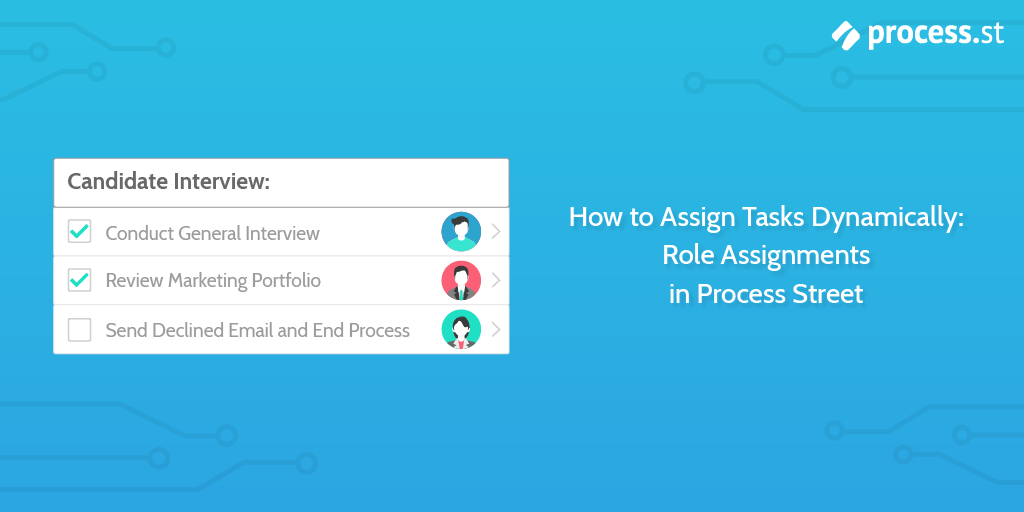
How to Assign Tasks Dynamically: Role Assignments in Process Street

Role Assignments

Assigning team members to their tasks is a duty which is as vital as it is tedious.

Everyone pretty much knows what they should be doing, so there’s no need to directly assign them to everything when you could be spending time on more important tasks, right?

Wrong.

Human error (of which memory plays a huge part) affects 1/100 routine tasks where care is needed. This means that the people responsible either makes a mistake or forgets what they need to do (hence why documented processes are so important).

That’s why we here at Process Street have a role assignment feature in our checklists.

Role assignments let you dictate who each task in your process checklists needs to be assigned to without fail every time. All you need to do is set up the role which will have the task assigned, then Process Street does the rest.

Ready to assign your tasks without fail, fuss or tedious fiddling? Then let’s dive right in.

Continue Reading

Take control of your workflows today