All posts in Marketing

Why & How We Focus on Co-Marketing in Our Content Marketing Team

Why and How We Focus on Co-Marketing in Our Content Marketing Team-01Content marketing is definitely in the top 3 spammiest areas of marketing.

Not a day goes by where someone isn’t trying to get me to link to their dodgy looking website or sending me nonsense.

In some cases you just have to respect the hustle. I know the article I was pitched yesterday wasn’t written by “John Smith” because the use of English in the title didn’t make sense. If you’re a non-native English speaker though, you often need to take those risks. I’d do the same.

But content marketing isn’t all spam and nonsense.

Lots of places do great content that’s high quality and produces loads of value for their audience. Outreach, relationship building, and collaborations aren’t always tacky either – they can be great ways to co-create content; media content being a really useful avenue for this.

We’ve created the best process management content on the web for a good while, and people come to us as a trusted source on other areas like onboarding, HR, operations, ISO, and customer success. That stuff, we’re good at.

The second part, though, is something we’ve been working on doing better.

In this Process Street article, I’ll explain how and why we moved to a co-marketing focus to support our SEO and business goals, including:

  • Why not just backlink build and guest post?
  • How is our relationship management system set up?
  • We’re seeing results and our flow is much smoother

Let’s jump right in!
Continue Reading

How We Use Automations for Marketing Operations Reporting

How We Use Automations for Marketing Operations Reporting

As your marketing team’s content manager, you want to be able to know your content engine is working for you at maximum efficiency, and have a clear overview of the important work being done.

This is perhaps easier said than done, when there can be countless systems and processes to keep track of, from marketing operations, onsite content, offsite comarketing relations, email correspondences, to SEO reporting – it can all become overwhelming.

But it doesn’t have to be!

Wouldn’t it be great if you could benefit from detailed reporting without having to bend over backwards restructuring your meetings and how you collect data?

Well, that’s more or less how we’ve set up reporting in our marketing team at Process Street. In this post I’ll briefly summarize how our marketing team saves time and effort with a nifty workflow that utilizes Automations and native integrations, and allows us to:

  • Coordinate dozens of comarketing relationships while maintaining clear record of communications;
  • Track the number of guest posts we’ve accepted and published;
  • Highlight top priority action items;
  • Quickly & easily analyze referring domains of target pages;
  • Automatically push everything into Google Sheets;
  • Automatically generate graphs and charts;
  • Automatically post a Slack message with key marketing reporting metrics;

Specifically, this post will cover:

Continue Reading

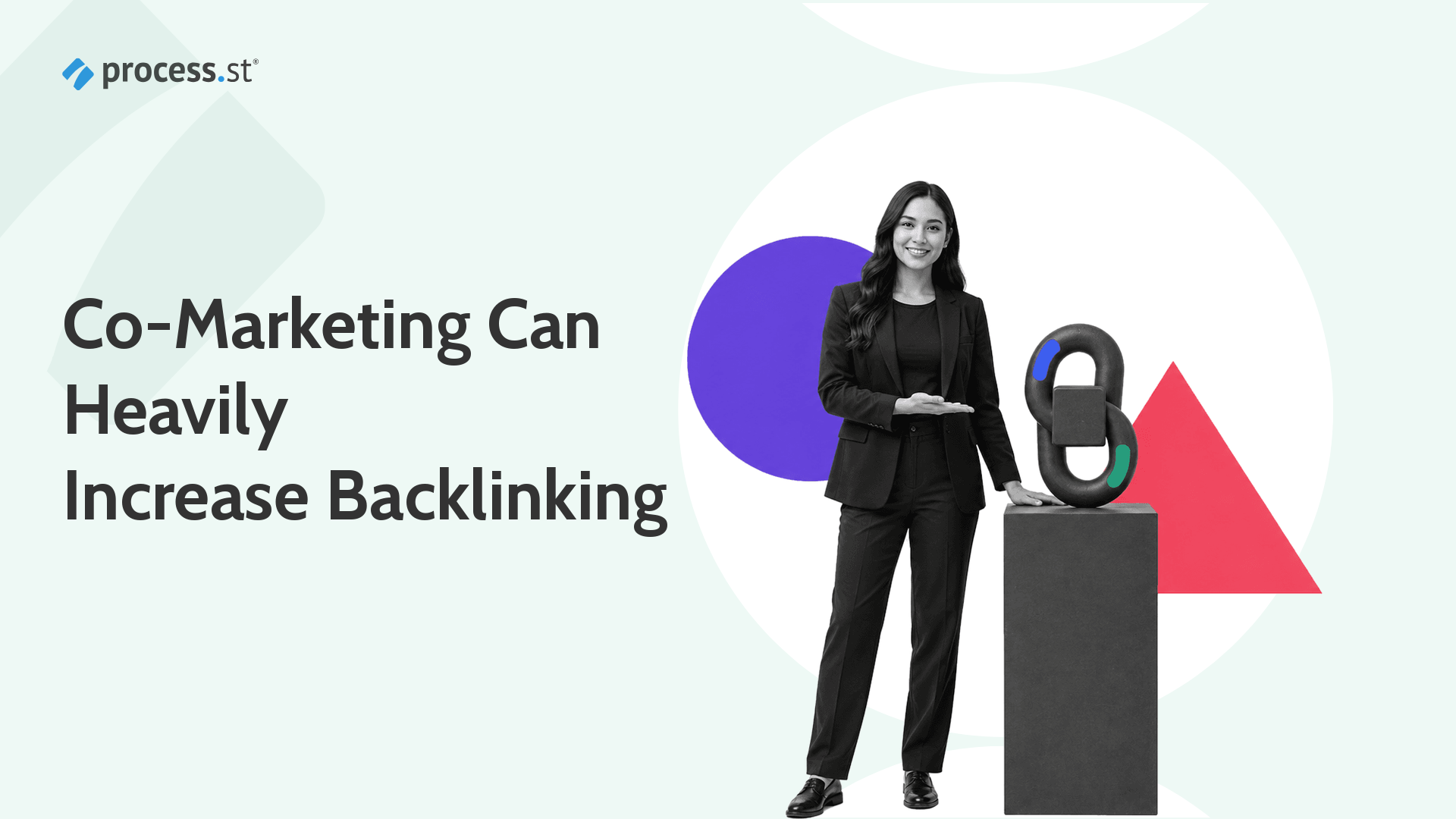
How Co-Marketing Can Heavily Increase Your Backlinking Game

Partnership marketer presenting interlocked partner links around a shared asset

Guest post written by David Campbell, a digital marketing specialist at Ramp Ventures. He helps manage the content marketing team at Right Inbox. When he’s not working, he enjoys traveling and trying to learn Spanish.

Co-marketing is a strategy in which complementary brands combine expertise, audiences, and distribution to create something more useful than either could produce alone. For content teams, that can mean joint research, webinars, expert contributions, or other assets that earn relevant editorial backlinks because people genuinely want to cite them.

Continue Reading

How to Scale Content Marketing: Building a System for Growth

how to scale content marketing

Brad Smith is the CEO at Wordable and the founder of Codeless (a content production agency). His content has been highlighted by The New York Times, Business Insider, The Next Web, and thousands more.

So, you’re ready to scale your marketing efforts, eh?

You’re not the only one: 70% of marketers are taking content marketing seriously — and sooner or later, they start scaling up, increasing competition in the process.

With all the marketing noise out there, it can be difficult to position yourself as an industry leader. But don’t worry, we’re here to help.

In this Process Street post, we’ll cover:

Let’s jump right in!
Continue Reading
Building a Content Marketing Strategy: Tips to Get Your Team Excited

Content strategist using a physical funnel model to plan a content marketing strategy

Guest post by Ovi Negrean, CEO and co-founder of SocialBee. He and his team help startups, small businesses, freelancers, and entrepreneurs reach their marketing goals through customer-informed articles and practical social media content. You can also find Ovi on X.

Every marketing team has a list of ideas it wants to try. A useful content marketing strategy turns that list into shared goals, clear ownership, a realistic publishing rhythm, and enough room to learn from the results. That structure is what gets a team excited: people can see why the work matters, where their contribution fits, and what happens next.

Continue Reading

Marketing Agency vs. Marketing Consultant: Which is Better for Project Managers?

marketing agency vs marketing consultant

Jaron Soh is Co-founder and COO at Traktion, the platform that makes hiring for growth simpler, agile, and more profitable for businesses.

According to a recent survey by The Digital Project Manager, the two biggest project management challenges of 2020 can be neatly summarised as people problems and project problems.

If that sounds a little vague, let’s get specific. 27% of those surveyed experienced challenges with their project stakeholders (i.e. people), while 24% encountered challenges with budgets and deadlines (you guessed it, project).

Thinking about this within the context of a marketing project, it’s easy to get distracted by those project-related concerns, wondering: “How do I deliver this on time and on budget?”

Well, here’s the thing… In my experience, you’re asking yourself the wrong question.

When it comes to marketing, don’t focus solely on the “how”; make sure you look at the “who”, too.

There’s a people problem to overcome. Ask who you should use to help deliver your marketing project on time and on budget; a solo marketing consultant, or a full-blown marketing agency? To answer that, you need to understand how they differ from one another, and the scenarios in which to use them.

In this Process Street post, we help you do just that. Here we explore:

Ready? Let’s dive in.
Continue Reading

How to Build a Successful Go-to-Market Strategy

go-to-market strategy

A go-to-market (GTM) strategy is the way in which a company brings a product or service to market.

No matter how good your idea is, you need a go-to-market strategy.

Why?

Because statistically speaking, your business is more likely to fail than succeed.

In fact, if you’re a startup, your chance of failure is a dreary 90%. That’s not to say that your idea isn’t a brilliant one, or that you haven’t got what it takes to bring it to market.

Startups fail for different reasons. Perhaps the market is already awash with companies offering the same solution as yours, or the market isn’t mature enough to welcome your product. Or, maybe the cost of developing and launching your product is so steep that it’s unprofitable.

If successful, a go-to-market strategy will be your salvation and prevent you from failure. The question is, how do you develop a winning strategy? Which factors should you consider?

I asked our VP of Marketing Bryan Sise these very questions. Through the course of his career at companies like Twilio, SendGrid, Twitter, Dynamic Signal, and now Process Street, Bryan has noticed what contributes to GTM success.

In this post I’ll share with you what he has to say. I’ll cover what a go-to-market strategy is, types of go-to-market strategies, the key steps to building a successful go-to-market strategy, and what GTM strategies we use here at Process Street.

Let’s get strategizing.
Continue Reading

Make Magic & Embody Cross-Departmental Collaboration

Cross-Departmental CollaborationThis is a guest post written by Kashyap Trivedi. Kashyap is a Project Manager, working with an awesome team at Launch Space. He helps SaaS companies conquer the SERPs with Expert Outreach. When he is not working, you’ll find him playing Table Tennis or Meditating.

The Sales, Marketing, and Support teams form the three significant points of a business’ interactions with customers. Because of this, they must work together to create a seamless transition for the customers that are moving from one stage of the buying process to another.

When all three teams work together in sync, they can easily help each other to reach organizational goals quickly. This article will show you how these three teams can work together and how your business can benefit from it. To jump to a specific section of the post click the appropriate link below.

Let’s start with Sales.
Continue Reading

Beyond Enlightenment – How to Make an Impact With Data Storytelling

Beyond Enlightenment – How to Make an Impact With Data Storytelling

This is a guest post by Brian Skewes, a technologist into deconstruction. Over two decades of self-employment, he has accumulated a wealth of inadvertent real-world lessons related to building, running, and preserving a small company.

There’s a phrase that’s become popular in web analytics, digital marketing, and business consultancy in the last few years: data is everything.

There’s a lot to recommend it. It’s short, snappy, and captures the importance of data to the way in which we do business today. Whether you are building organic links or in the process of drafting an employee development plan, the path to success runs right through a big ‘ol pile of numbers.

Unfortunately, there’s more to numbers than just numbers.

This is due to the nature of data itself. The problem with relying on numbers and nothing else is that no matter how impressive it is, it also remains inscrutable, incomprehensible, or simply boring for the majority of people. Unless your audience is composed entirely of the type of person who can instantly visualize columns of figures, you are going to need to provide some context for the ever-so-impressive stats.

This is where the concept of storytelling comes in.

In this Process Street article, we’ll look at how you can go beyond data acquisition, compilation, and presentation. We’ll show you how to make your data come alive through the magic of storytelling.

Once upon a time…
Continue Reading

Reach the Right People & Get the Right Result With a Customer Profile

customer profile

We’ve never met, but I know who you are.

You spend 90% of your day either in meetings or answering emails, so you’re incredibly short on time.

You’re a big believer in “moving fast and breaking things” but over-regulation, cyber threats, obsoletion, and the availability of key skills keeps you awake at night.

You check in with Twitter and Reddit daily to stay in-the-loop, and you’re a keen consumer of content that’s quick and easy to digest, from reputable sources, and provides clear answers to your questions. You hate waffle!

Am I close?!

Whether I’m right or wrong (and before this gets any creepier), I know all this because I’ve created your customer profile, or buyer persona if you prefer.

Organizations that use customer profiles to create and deliver content enjoy 73% higher conversions than those that don’t. So, I used market research and data to build up a semi-fictional representation of you.

I identified your common behavior patterns, discovered what your key motivations were, and established your biggest pain points so I could write a tailored post that clearly answers your questions, provides value, and delivers useful insights.

I won’t lie; this took a lot of time!

But was it worth it?

Take 10 minutes to read this Process Street post and get insights from the likes of Hiten Shah, Lincoln Murphy, and Tomasz Tunguz, learn how to create a customer profile in five simple steps, and find out:

Let’s “cut fast, cut deep”, and cut the crap.
Continue Reading

Take control of your workflows today

Choose which optional cookies to allow. You can change or withdraw consent here at any time.