All posts in SaaS

What is Churn Rate? How to Calculate Customer Churn (Definition + Meaning)

churn rateWhen it comes to running a business, particularly a SaaS company, understanding churn is vital.

There’s a lot to cover, so let’s cut straight to the chase.

In this Process Street article, we’ll look at:

  • What is churn?
  • How to calculate churn rate
  • Churn examples: From Facebook to Twitter to HubSpot
  • Why do customers churn?
  • McKinsey’s 4 best practices to increase retention rates 15%
  • 3 practical steps to reduce churn in your business
  • The Harvard churn management algorithm
  • Churn management resources to help you reduce churn
  • Use Process Street to help you tackle churn in your business

Continue Reading

The 45 Best Sales Books to Learn How to Dominate Your Industry

best sales booksSales is one of the core aspects of how a business functions.

Without sales, your brilliant product will just sit there, neglected and unused.

But no one is born as a brilliant salesperson, just as no one is born with an innate knowledge of how to run an effective outbound strategy.

We learn these things on the way. A lot of the time, we learn from the sales jobs we’ve had. But we shouldn’t limit ourselves to that. Why not learn from the best salespeople, the highest performing companies, and the extreme examples?

In this Process Street article, we’re bringing expertise galore to your bookshelf or Kindle. We’ll go through our 7 key recommended reads, and follow that with 38 more sales books to satisfy your niche, industry, or needs.

Continue Reading

What Starting A Dropshipping Business Taught Me About Running a SaaS Company

Starting a dropshipping business

Process Street started in an unexpected place: the beaches of Thailand.

I was 24, had just quit my 6-figure sales job, and was ready to leave the rat race and travel the world.

Just months before taking off, I read Tim Ferriss’ The 4-Hour Workweek and discovered dropshipping — moving a product directly between a manufacturer and customers without keeping it in your own storage. It wouldn’t require making or storing any product, it wouldn’t require a giant team or a huge investment, and best of all, it wouldn’t require an office.

Continue Reading

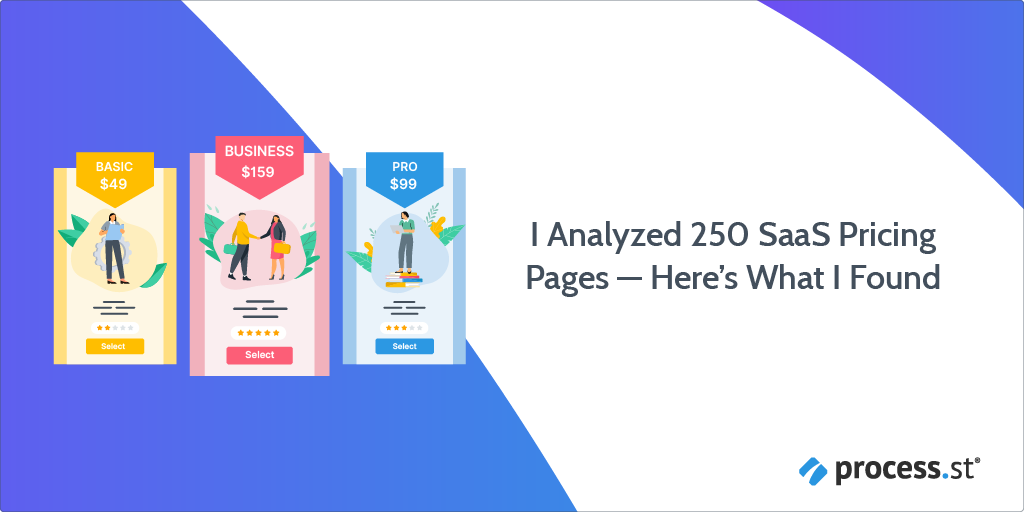
I Analyzed 250 SaaS Pricing Pages — Here’s What I Found

We recently had a major overhaul of our pricing and landing page and wanted to get a good idea of what a high-converting pricing page looked like. We turned to the experts.

There are a lot of best practices for SaaS pricing pages out there, with giants like HubSpot, ConversionXL and SixteenVentures being the authorities.

I thought the best way would be to look at the pricing pages of the SaaS 250 — a list compiled by Montclare of the most successful SaaS products in the world.

To see this data in the form of an infographic, you can skip straight down to the bottom on this page.

Before we start — why did 80% of companies not have pricing pages?

Before jumping right in, it’s interesting to note that of these 250 companies, only 48 had pricing available. The rest had pricing available on request by contacting the sales people.

Jason Lemkin, CEO and Co-Founder of EchoSign, says that most companies have a very good reason for this. Writing on Quora, he outlined 5 key reasons you might be better off not showing pricing on your website.

  1. Deals will get more complex as you grow. Some day you’ll do a deal so large and complicated it wouldn’t have been able to be expressed in $/user/month. Products with integrations and add-ons will be priced so confusingly, it’s simpler to just get them on the phone to sales.
  2. Discounting will become difficult. With a preset rigid pricing structure, you’ll put off enterprises. Jason says “Your champion will require a discount. Then, it will get sent to procurement. Procurement’s bonus will be tied to the next discount they win. If you have rigid pricing, you’ll blow the deal.”
  3. A $700k deal is sold differently to a $100k deal. When it means the difference between an everyday deal and a huge account, you’re going to treat the customers differently. Pushing both down the same track is risky because you want to make sure that the big customers are on the phone to sales straight away.
  4. Enterprise customers just want to buy. Jason says that price doesn’t matter for enterprises. More than 80% of the time, they just want to get set up with a solution as efficiently as possible. Price comes after features.
  5. Looking as if you’re ‘all about price’ is a bad look. Pricing can make your product look cheap, and not enterprise-oriented. Jason says, “If your competitor says “Call Me” and appears more or equally enterprise-grade and trustworthy — your transparent pricing may say “cheap”. “

So, 202 of the SaaS 250 have good reasons for not being transparent with their pricing. Let’s look at what I found when analyzing the SaaS pricing pages of the remaining 48.

Continue Reading

Why Upselling is the Job of Your Whole Company, Not Just Your Sales Team

upsellingThroughout a customer lifecycle, it is important to take opportunities when they present themselves.

One aspect which many SaaS companies will be familiar with is the ongoing attempt to upgrade customers to the next level of billing.

The core method of achieving this is to add features and improve your product.

This provides provides greater value for the client and gives them more reasons to consider purchasing your services – resulting in an upsell which works for both parties.

I imagine most of you reading have bought something from Amazon at some point in time. Yet when Amazon offer a more premium delivery service with access to films and television shows many of you will have gone from occasionally using Amazon for purchases to being fully fledged Prime users!

Amazon offered greater value and you thought it was worth paying for. You were upsold.

But importantly, both you and Amazon came out of the deal as winners!

In this article, we’ll look at how different companies have utilized upselling to drive their business forward, and try to learn a little something from each.

Then we’ll take a more in depth look at how Process Street upsells its customers, and the importance of seeing this as a company wide effort rather than small aspect of sales.

At the end of the article, we’ll give you a free Process Street process template you can use in your business for upselling customers. This process is geared to be run by a member of the sales team to try to upsell a valuable client, and close the deal.

Checkout the snapshot below!
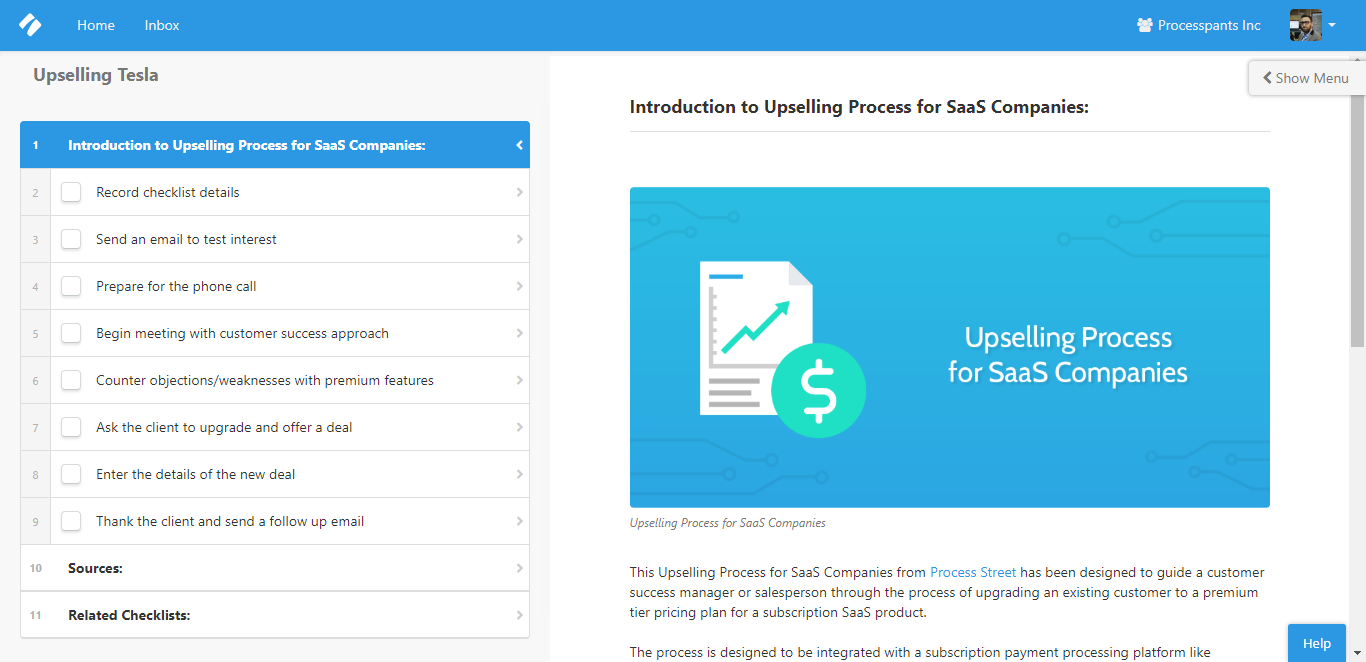
upselling process street checklist

Continue Reading

What is a Business Process Consultant? (And How To Find a Good One)

business process consultant

What do you do if you don’t have the time or know-how to document and improve your processes?

You hire a business process consultant of course!

While we’ve talked endlessly in the past about why processes are important and how to manage your own, hiring a business process consultant lets you reap all the benefits without having to spend an age assessing your organization and talking to every last employee involved.

So, if you want to organize your processes and bring efficiency to your business but don’t have time to do it yourself, read on!

process consultant hired
(Source)

Continue Reading

Scaling Your Business? Be Sure You Determine Customer Value

The following is a guest post from Sam Suthar, the CMO of Acquire.


Scaling your business is almost impossible until you know your customer’s value. Whether you’re going to scale a brick-and-mortar business or an online business, it doesn’t matter; it’s vitally important to understand what each customer is worth to your business.

Statistics by Unicom Group show that 50% of customers naturally churn every 5 years. Sadly, this number can increase if you fail to understand what the customer who signed up last night is worth.

Can you reduce your churn and increase customer retention rate?

Yes, it’s doable. Although very tricky. In the rest of this article, I will show you how to scale your business by first knowing the value of each customer.

Continue Reading

Study: How 4 Highly Profitable SaaS Companies Market to Enterprises

Are you ready to market your SaaS product to enterprises? Do you know what makes or breaks a million dollar deal?

There’s a huge segment of SaaS companies that target only SMBs, and an increasingly well-funded bunch that go after the enterprise market from the outset. Some, like Dropbox, Asana, and HubSpot, have gradually scaled their products to meet the needs of enterprise customers. By looking at their enterprise-specific landing pages, we can isolate the key factors these companies have chosen to persuade enterprises, and find out what works.

Continue Reading

How We Built and Launched a Successful Microsite on Product Hunt

On August 25th, we launched a library of 1000+ real sales and emails from the top 280 SaaS companies.

The library was hosted on a microsite, Inside SaaS Sales, which allows users to browse the full sales cadences, organized in the order the message or voicemail was sent.

The launch landed us almost 800 votes on Product Hunt, 10,000+ site visits, a mention in Hiten Shah‘s SaaS Weekly, and publicity from the SaaS and VC community.

Continue Reading

How to Be GDPR Compliant: A Guide for SaaS and Beyond

Adam Henshall September 29, 2017

gdpr compliance header

A spectre is haunting Europe – the spectre of GDPR.

It seems to be the one thing everyone in the data security industry is talking about, Equifax aside…

Articles are being written, consultancy firms are popping up, and businesses are quietly panicking.

Yet, like so many grand legislative changes, many people are unsure what GDPR is, how it could affect their business, or whether they should even be worried about it at all.

In this article, we’ll be looking to clear up some of those misconceptions while presenting actionable steps for how companies can go about adjusting to the coming changes. We’ve scoured the available resources to find the answers to our concerns about GDPR and now we’re sharing it with you.

(Still employ a consultant though. As you’ll see, there’s too much at stake not to!)

We’ll explore not just the impact on European companies but also companies outside the European market who process or control data which could come under the scrutiny of these EU measures.  SaaS companies like Process Street will find themselves needing to adapt their services for their large European clients, and if you work within the SaaS field you might have to do so too.

Before we go further, let me give you a Too Long; Didn’t Read:

The best short summary of the ethos of GDPR I’ve read comes from Wired:

For companies that have more than 250 employees, there’s a need to have documentation of why people’s information is being collected and processed, descriptions of the information that’s held, how long it’s being kept for and descriptions of technical security measures in place

The GDPR broadly sets out:

  • You need to have a system in place to manage data and security.
  • You need to have that system fully documented.
  • You need to operate with the parameters of the GDPR, e.g.
    • Consent boxes cannot be auto-filled as “yes”.
    • Companies must respond to access requests from users within 1 month.
    • Requests for personal information must be processed free of charge.

At the end of this article, you’ll find a free Process Street checklist which uses ICO recommendations and Article 29 Working Party advice to guide you through assessing your company’s GDPR readiness!

Continue Reading

Take control of your workflows today