All posts in Processes

There’s a New Way CS Leaders Should Measure Value Generated

There's a New Way CS Leaders Should Measure Value Generated-01

According to Deloitte Insights, advances in technology are changing the business landscape and they are calling this a digital disruption. This is altering customer expectations and demands, presenting critical challenges for customer success teams globally.

To successfully ride this wave of change, Deloitte – and us here at Process Street – believe businesses should rethink how they are measuring value delivered to the customer. The aim is to ensure these measurements are customer-centric to refine CS activities and enhance the customer’s experience.

Think of it as a customer success evolution in response to digital disruption.

This CS transformation has the potential to bolster positive referrals by 83%, lower costs by 20%, and increase customer lifetime value by x1.6.

What have you got to lose?

In this article, you’ll learn how to apply a customer-centric means of measuring customer value generated for your organization. I’ve split the process down into three steps based on the Customer-Centric Digital Transformation report by Deloitte.

With that said, let’s jump straight to it!
Continue Reading

How to Manage a Successful CS Transformation to Be More Customer-Centric

How to Manage a Successful CS Transformation to Be More Customer-Centric-04A recent Deloitte study found a mere 30% of respondents stated customer success was a strategic priority by the board of directors. Only 26% reported official business communications to regularly mention customer success.
At Process Street, we find this concerning. Technological advancements and the rise of Industry 4.0 are altering the business landscape. Businesses are facing new pressures, with changing customer demands and expectations as the biggest catalyst altering how business is done. To respond, organizations need to focus on customer success (CS).

Businesses need to lead a successful customer success transformation, one that means they’re more customer-centric. In this Process Street article, I explain how organizations should do this in three simple steps.

With that said, let’s jump straight to it!
Continue Reading

Customer Success Onboarding: Learn How to Improve Profitability and Reduce Customer Churn

Customer Success Onboarding Learn How to Improve Profitability and Reduce Customer Churn_1

90% of customers feel that the companies they buy from could do better when it comes to how they experience onboarding.

Customer success is about helping your customers understand and leverage the value of your product; you’re basically helping them achieve their goals. In a sense it’s one step beyond traditional customer support, taking a proactive approach to understanding and addressing customer needs.

A key component of customer success is making sure your customers are effectively onboarded.

Onboarding provides a unique opportunity for the CS team to nurture and address the key needs of a new customer, and an effective onboarding program can mean the difference between a long-term customer and a rapid churn.

For customer success teams to succeed with onboarding, CS managers should drive clear best practices and use well-structured processes to make onboarding as effortless as possible for everyone involved.

In this Process Street article, we’ll dive into:

Continue Reading

Master Project Management with the Critical Path Method

Master Project Management with the Critical Path Method

Project management requires a wide spectrum of skills, organizational abilities, and attention to detail to make sure everything moves forward according to plan. A good project manager is able to keep all the plates spinning in sync while making it appear effortless at the same time.

However, the more plates you have spinning at once, the harder this is to accomplish. Critical path method (CPM) is one of the tools project managers can use to create a comprehensive plan and organize complex projects with many moving parts.

In this Process Street post, I’ll take you through the CPM process step-by-step, and then show you how our templates and checklists can take some of the stress out of your project management.

Read on, or feel free to skip ahead:

Let’s jump in!
Continue Reading

How to Launch on Product Hunt: What We Learned from 30+ Launches

how to launch a product on product hunt

Way back in 2014, we first tried our hand at launching on Product Hunt with an early version of Process Street. It got featured, but that was a different time; when Product Hunt’s staff manually selected each product feature (these days Product Hunt claims that an automated algorithm decides).

It was hunted (Product Hunt lingo for “promoted”) by Audrey Melnik of Funnel Ventures, didn’t even have a maker (another Product Hunt termin for the creators of a product), yet still found its way to the front page of Product Hunt.

Six years, a couple of relaunches, and a $12 million Series A on from that humble effort, Process Street has changed a fair bit. We’ve shipped over 30 products on Product Hunt; from podcasts, new Process Street feature launches, to whole product launches, to eBooks.

Some of them were great successes, with multiple top 4 spots and a whole bunch of front-page features. Others weren’t so great; some garnered next to no traction and were essentially dead-on-arrival.

The point of this article is to impart some of the lessons we’ve learned, from common myths and misconceptions, to what worked well for us (and what didn’t work so well).

Here’s a breakdown of what I’ll be covering:

Let’s start with the basics, which often get taken for granted when it comes to deciding whether or not to launch on Product Hunt.
Continue Reading

How to Make Your Call Center 5 Star: Quality Assurance 101

How To Make Your Call Center 5 Star: Quality Assurance 101
Call center quality assurance is like going to the dentist: everyone agrees it should be done regularly, no one likes doing it, and it’s probably been put off much longer than it should.

No one’s blaming you – agents hate it, supervisors hate it, even quality assurance auditors hate it. It’s tedious, time-consuming, and repetitive. Add to that the high call center attrition rate and low job satisfaction, and you may be wondering: why even bother?

Well, I’ll tell you. In this post, I’ll cover:

Plus I’ll provide you with 11 free checklists to take the drudgery out of QA audits!

If you came for the templates, grab them here:

If you want to use these checklists, just sign in with your Process Street account and start customizing your templates. If you don’t have an account yet, sign-up here to get started with your free trial!

Otherwise, let’s get to it.
Continue Reading

How to Radically Improve Your Sales With a Sales Process Template

sales process template

Etymologically-speaking, the word “template” has an interesting history. Our modern usage of it is linked to the Proto-Indo-European word “tempos”, which means “to stretch”. Specifically, though, it refers to time and the stretching of it.

As time-bound human beings, making use of templates allows us to have more time each day. By completing recurring processes and actions far faster overall whether they’re marketing processes or sales processes, we’re able to, in a way, cheat time itself.

For sales teams, templates are a necessity for both cheating time and doing great work, repeatedly.

Seeing as 20% of sales staff turnover happens within the first 45 days, there needs to be a thorough, documented template for how to onboard staff properly. Similarly, for the sales process itself, there needs to be a sales process template (or better yet, templates).

With such playbooks at hand, it could help your team become high performers by a whopping 33%!

That’s why, in this Process Street post, I’ll discuss what a sales process template is, provide you with a stellar sales process template, and tell you how you can use more or even build your own templates from scratch.

Just read through the following sections:

Or, if you can’t wait and want to start using the aforementioned stellar sales process template, here’s our MEDDIC Sales Process Checklist Template:

Click here to get the MEDDIC Sales Process Checklist Template!

Carry on reading to find out how to cheat time further. ⏳

Continue Reading

How to Implement a Powerful Procurement Process Like a Pro (Free Templates!)

procurement process

If there’s one thing the COVID-19 pandemic has taught the world of business (apart from that remote work is the future), it’s this: We aren’t prepared for disruption.

Supply chains, in particular, suffered a massive shockwave, with supermarkets, shops, and services being unable to operate the way they did before the virus struck. In fact, more than 3,000 suppliers in China were driven to force majeure declarations in the first few months alone.

As the world moves toward a new normal, you’ll be thinking about disruption and risk a lot more than you had done previously.

For businesses using suppliers, it’s necessary – now more so than ever – to establish a stellar procurement process to ensure goods and/or services can always be secured, no matter if micro (small, every day) and macro (large, extraordinary) disruptions happen.

That’s why, in this post, I’ll be discussing what the procurement process is, the benefits a documented and solid process brings, what the flow of a robust procurement process looks like, and how Process Street can help.

Read through the below sections to get up-to-date:

Or, if you just wanted to get your hands on a procurement process that you can default to in every day and extraordinary situations alike, grab it here:


Click here to get the Procurement Process Checklist Template!

Ready to become a pro at the procurement process?
Continue Reading

How to Solve Your Problems With Lean Six Sigma (Free DMAIC Checklist)

lean six sigma

Elisabeth Swan is the co-author of “The Problem-Solver’s Toolkit” and co-host of “The Just-in-Time Cafe Podcast.” She’s been a process improvement consultant, speaker, and innovator for over 30 years. She’s the Chief Learning Experience Officer for GoLeanSixSigma.com, a former cast member of ImprovBoston, and – if asked – may still be able to ride a unicycle.

Surgeon Atul Gawande made headlines when he told the world that a simple checklist could drastically reduce unnecessary deaths in The Checklist Manifesto.

Yet, checklists conjure images of forklift drivers on loading docks with clipboards counting boxes. How could they transform healthcare?

“He has… produced a 90-second checklist which reduced deaths and complications by more than one-third in eight hospitals around the world – at virtually no cost and for almost any operation.” – James Clarke, reviewing The Checklist Manifesto, Ulster Med J. 2011 Jan; 80(1): 54.

Aviation was transformed decades earlier when management and engineers at Boeing Corporation created the pre-flight checklist after the 1935 crash of the prototype Boeing B-17 at Wright Field in Dayton, Ohio. Checklists have become so essential to the airline industry that most crashes can be traced to the misuse or failure to complete a checklist.

A New York Times reviewer noted, “no matter how expert you may be, well-designed checklists can improve outcomes”. Since the purpose of process improvement is improving outcomes, Lean Six Sigma and checklists are natural companions.

To prove that, this Process Street blog post will show the relationship between checklists and lean six sigma, and provide you with a free DMAIC Improvement Project Tollgate Checklist that you can use right now.

Use the links below to jump to that section of the post:

Or, if you just want the checklist, check it out below!

Let’s get started.

Continue Reading

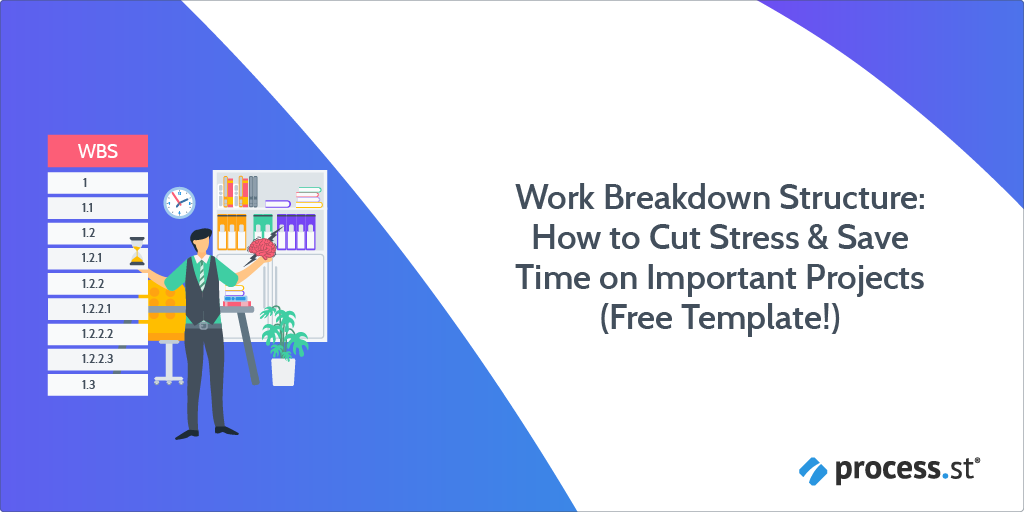
Work Breakdown Structure: How to Cut Stress & Save Time on Important Projects (Free Template!)

work breakdown structure

The excitement around a new project is intoxicating.

After all, it’s an opportunity for your team to collaborate and put their well-honed skills to use.

But with important projects, excitement can easily turn into dread. Especially considering that 70% of organizations have failed one or more of their projects in the last 12 months, with a lack of clear goals being the main issue.

So how can everyone involved know what’s expected of them? What deliverables they must bring to the table? How their actions figure into the bigger picture? And how can you, the project manager, break the project down into manageable segments?

While The Beatles professed that “love is all you need”, what’s going to be more useful in this scenario is a work breakdown structure.

That’s why, in this Process Street post, you’ll learn what the work breakdown structure is, why it’s so useful, different examples of it, and tips on how to create a work breakdown structure yourself. To boot, you’ll even get your hands on our easy-to-use Work Breakdown Structure Template!

Read through the following sections to get clued-up:

Or, if you’re eager to get the template already, here it is:

Click here to get the Work Breakdown Structure Template!

Let’s break it down.

Continue Reading

Take control of your workflows today

Choose which optional cookies to allow. You can change or withdraw consent here at any time.