All posts in Processes

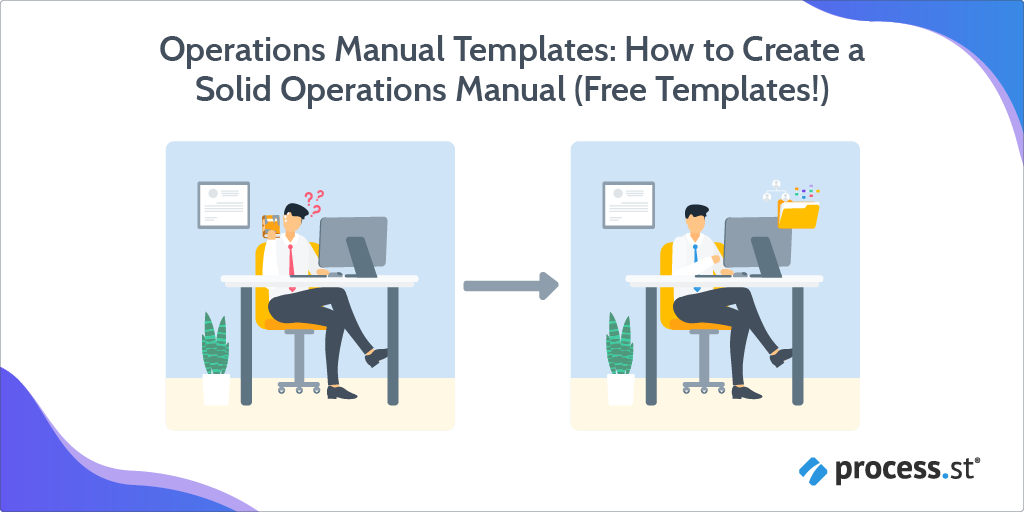
Operations Manual Templates: How to Create a Solid Operations Manual (Free Templates!)

Operations Manual Templates

In a past life, I interned at a fashion company. And at the tender age of 19, it was my first introduction to the working world.

But my time there was largely spent in a state of bewilderment, wondering what tasks I should be focusing on, what the right processes for those tasks were, and what a successful end-result for those tasks would look like. (This company was part of the 22% that have no onboarding program.)

And because the team was always out of the office – attending photoshoots, meeting brands and retailers, going for their 17th coffee of the day at over-priced (and mediocre) cafés in London’s East End – it meant I was often alone in the office, wondering what the hell to do.

Unsurprisingly, the company went bust in 2019.

If they’d have had an operations manual or some operations manual templates, however, I would’ve been able to complete a ton of work while they were focusing on other parts of the business. That’s because an operations manual contains information about the company, the company’s hierarchy, roles and responsibilities, business policies, and key facts regarding processes and procedures.

Don’t let your business fall into the same trap as the now-defunct fashion company.

Create, implement, and audit an operations manual.

In this post, I’ll further define what an operations manual is and the benefits of having an operations manual. To boot, I’ll provide you with a host of nifty operations manual templates, and tell you how Process Street can aid you with your manual!

Read the following sections to get clued up:

Or, if you just wanted the templates, grab them here:

In fact, here’s a sneak preview of the templates that you’ll be getting for free!

Let’s get started, shall we?

Continue Reading

How to Write a Procedure: 13 Steps to Eclipse Your Competition

how to write a procedure - header

Knowing how to write a procedure is a key skill for anyone looking to build a successful business. Procedures are vital to consistent success for many of the same reasons that processes are important – they let you reliably repeat your successes, isolate and correct your mistakes, and create a business model that lets you scale your operations.

If you don’t know how to write a procedure then you’re dead in the water. Get it right, and the resulting efficiency boosts can put you on track to eclipse your competitors.

This Process Street post will cover the following topics to help you write effective procedures:

Read on to learn the 13 steps to writing your business’ procedures effectively, in a way that they will actually be followed instead of getting read once and then forgotten.

Continue Reading

How to Perform a Fire Extinguisher Inspection (Free Template!)

Fire Extinguisher Inspection

Lunch was over.

I was walking back to our senior common room with my friends. When we reached Foundation House, we found all of the students and teachers standing outside while the fire brigade trailed in.

There was no smoke or visible flames but I saw three friends that we’d left in the common room off to one side of the car park looking sheepish.

Turns out that they’d managed to make a pseudo-napalm launcher out of a tube of Pringles, a rubber band, spray deodorant, a lighter, and a supply of biro casings.

My friends were smart but, as you might’ve guessed, had no common sense.

Whether you have students setting off fire alarms with molten flaming plastic or have a much larger accident, it’s important to know that your safety measures are up to standard.

$25 billion in damages were caused by fire in 2018 in the US alone, which should tell you how vital it is to catch fires and deal with them early before they need additional help to contain.

That’s why fire extinguisher inspections are so important.

In this post I’ll cover:

You’ll also get access to Process Street’s free Fire Extinguisher Inspection Checklist in the very next section of this article!

Let’s get started.
Continue Reading

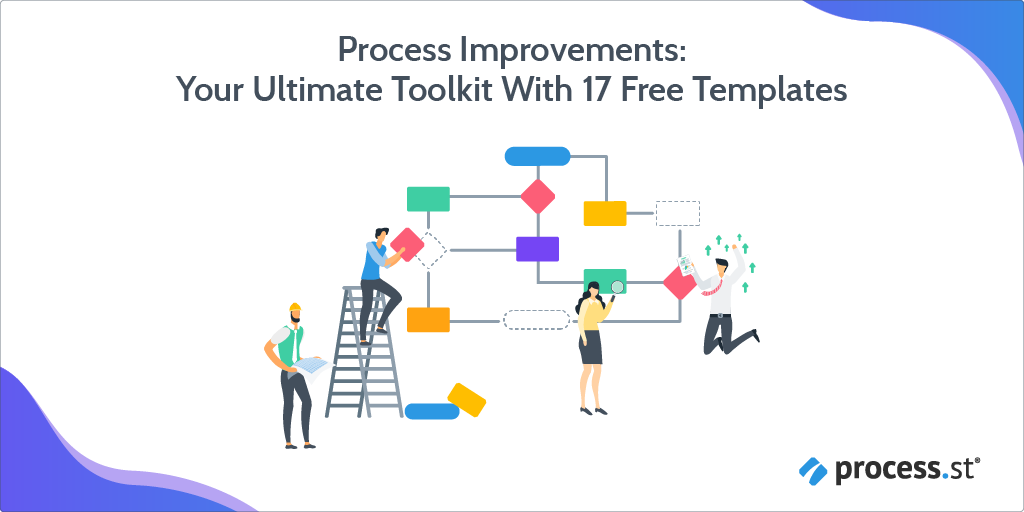
Process Improvements: Your Ultimate Toolkit With 17 Free Templates

Process improvements

The biggest room in the world is the room for improvement” – Helmut Schmidt

Only 4% of businesses measure and manage their processes. Process improvements are impossible with stats like that.

Why, when doing so provides an avenue for continuous improvement, advancement, and business success?

At Process Street, documenting our processes means we can continuously assess what is working and what is not.

For instance, when I first began as a Content Writer, I found navigating HTML code difficult. Luckily for me, at Process Street we document all of our business processes, creating full transparency over what works and what doesn’t. In this sense, a stronger HTML focus was needed during training. The required changes were made, and our training resulted in major process improvements.

In this article, you will find out how you can do the same. You will learn how to:

  • Identify opportunities for process improvements.
  • Implement the changes required.
  • Measure the success of the changes made.

Think of this article as your ultimate toolkit, to make continuous process improvements in your business. We provide you with 17 free templates, to support you in improving your processes. Click on the links below to jump to the relevant template.

Or, if you just can’t wait, check out the first of our templates below to see what we’ll be giving you!

We begin this article by explaining exactly what we mean by the term process improvement, and identifying the three steps you should follow to effectively improve processes in your business. The templates provided above have been carefully designed to assist you with each step.

Click on the relevant subheader below to jump to the appropriate section, alternatively scroll down to read all we have to say.

Let’s get started!
Continue Reading

How to Apply 7 Change Management Principles to Your Remote Workforce

change-management

This is a guest article by Dan Fries – entrepreneur, investor, and writer. Dan shows bootstrapped entrepreneurs and business owners how to prepare for an exit by making better long-term financial decisions.

The only constant thing in business is change.

Whether you are seeking to grow your business or looking to adapt your model to evolving market conditions, implementing strong change management techniques is key to keeping your business agile and sustainable.

Effective change management techniques have many different elements, some of which Process Street has covered before. For instance, checklists for teams can help you to keep a careful track of the development of your team, and these ten templates that optimize creative workflow management can provide your team with the flexibility and creativity they need to stay ahead.

One of the biggest obstacles to applying change management techniques in the contemporary workforce is the rising number of freelance, remote workers.

In this Process Street post, we’ll cover the following seven key principles for managing change within a modern, remote workforce:

Let’s get stuck in.

Continue Reading

Quality Control: How to Get It Right With 19 Free Templates

Quality control

As I stood, staring at my big toe which had somehow poked its way through a layer of polyester, it occurred to me that:

    1. These 2-month-old running shoes definitely needed to be disposed of.
    2. I will not be buying from this poor quality brand again.

In this scenario, I had fallen victim to poor quality control measures.

Purchasing a pair of running shoes not robust enough to meet my needs meant I, as a consumer, was not satisfied and did not repeat my custom with the given brand.

This reaction is to be expected.

A study by Psomas et al, detailed on Emerald Insights, concluded that effective quality control measures, in the form of Quality Management Systems (QMS systems), directly improve employee benefits, business performance, and customer satisfaction.

Quality is never an accident; it is always the result of high intention, sincere effort, intelligent direction, and skillful execution; it represents the wise choice of many alternatives” – William A Foster, Forbes Quotes

In this Process Street article, we take a look at what quality control is, and how you can implement effective quality control processes in your business today.

You will be presented with 19 free templates, ready and waiting to be used right away. These templates will help you build and audit your QMS systems, to meet the needs of key stakeholders in your business.

  1. ISO 9001:2015 Internal Audit Checklist for Quality Management Systems
  2. Financial Audit Checklist
  3. Environmental Accounting Internal Audit
  4. Environmental Management Self Audit Checklist
  5. Management Systems Audit Checklist
  6. ISO 9001 and ISO 14001 Integrated Management System (IMS) Checklist
  7. PPC Audit Checklist
  8. Google Analytics Audit
  9. Technical SEO Audit
  10. UX Audit
  11. ISO 27001 Information Security Management System (ISO27K ISMS) Audit Checklist
  12. SQL Server Audit Checklist
  13. Firewall Audit Checklist
  14. Network Security Audit Checklist
  15. ISO 45001 Occupational Health and Safety (OHS) Audit Checklist
  16. Diversity Management Monthly Audit
  17. Hotel Sustainability Audit
  18. Laboratory Safety Procedure Audit
  19. Retail Store Audit Checklist

Sound good?

Click on the relevant subheader below to jump to that section, alternatively, scroll down to read all I have to say.

Let’s begin!
Continue Reading

Intake Process: Onboarding Clients Efficiently & Effectively as a Law Firm

Intake Process

Lawyers are busy people.

They’re at the frontline of all legal matters, providing advice on tricky issues, resolving disputes, and representing clients in court if needs be. All. Year. Round.

Ergo: There’s a lot on any given lawyer’s plate.

With the huge amount of recurring tasks that need to be completed, on top of looming deadlines and constant work-related pressures, it’s easy for quality to slip. Especially when it comes to one of the most important processes of all – the intake process.

It’s why 61% of law firms forget to ask for the client’s name during their initial conversation, why 35% of calls from clients go unanswered, and why it takes 3 or more days for 42% of law firms to respond to prospective clients.

For a law firm to keep its prestigious reputation – and to continue working with great clients – the intake process needs to effective, efficient, and done properly.

That’s why this blog post exists.

In this post, I’ll discuss what an intake process is, its benefits, why it’s important, and how Process Street can help law firms streamline the entire process.

Read through the sections below to get clued up:

Let’s begin; the court is in session! ⚖️
Continue Reading

How to Perform a Root Cause Analysis (Free Template)

root cause analysis

If you’re chronically ill, pain medication will help but not solve the issue. Just like if you’re experiencing abnormally high customer churn, the last thing you want is to spend all your time firefighting.

You need to find the cause.

That’s exactly why root cause analysis is a vital process. It helps you to understand the causal focus and underlying issues behind your biggest business problems.

For example, Eastman Chemical‘s customer complaint numbers were cut in half after conducting a logic tree root cause analysis to pinpoint their deeper issues. Clipper Windpower saved $1 million in lost revenue by identifying the underlying causes of their turbine malfunction.

In this Process Street article, we have a root cause analysis template for you to follow. Our aim is to give you a comprehensive overview of the root cause analysis process, from a simple introduction and break down of the key principles to when and why you’d want to perform a root cause analysis.

We’ll be covering:

Let’s take a quick look at the root cause analysis template.
Continue Reading

WFH Transition: How Your Team Can Pivot & Work From Home Like Pros (Free Templates)

WFH transition

Unequipped. Unprepared. Uncertain.

34% of people believe their organization isn’t properly prepared for employees to be working from home.

Speaking of which, has your organization recently – and rather hastily – transitioned from office working to working from home?

If the answer is “Yes“, no sweat. Process Street has you covered.

This post will guide you through the basics of working from home (WFH), the positives of it, the potential problems you could run into, on top of offering you our (free!) checklist templates that’ll ensure a safe and smooth WFH transition.

Read through the following sections to get completely clued up:

Or, if all you want is the checklists, get them here:

Let’s dive into all things WFH, ASAP. ‍
Continue Reading

Ultimate SOP Guide: Standard Operating Procedures Made Easy (Free Templates!)

sop templates

SOPs (often pronounced S-O-P) are basically just another way to think about processes. Specifically, with a focus on formally defining the best way of doing something.

In business terms, that means saving time and money by building a clear, concise set of instructions for all of your internal processes. Policies (or standards) are important too; SOPs are kind of like a hybrid of policy and procedure.

Traditionally, SOPs were useful in principle, but often suffered from being difficult to maintain and crucially, hard to enforce. What good is an SOP if it lives its life sat on a dusty stack of paper forms? Your SOPs should be actionable, and that’s where BPM software like Process Street comes in.

If you understand how to build, maintain, and optimize SOPs with software, you can supercharge your standard operating procedures.

In this article, we want to give you everything you will ever need to know about SOPs, including:

Each section will be as concise as possible, with links out to further reading wherever appropriate. Let’s start with the basics.
Continue Reading

Take control of your workflows today