
All posts in Startups

What I Learned Evolving My Startup’s Team Structure (Featuring Lego)

The following is a guest post from Brett Farmiloe. Brett is the CEO of digital marketing company, Markitors, and advisor to career resource, Organizational Leadership Degrees. He is a regular contributor to Huffington Post and Forbes, and also enjoys tending his backyard vegetable patch.

startup team structure

Workplace structure.

What popped into your mind after reading those words? A large office building with hundreds of employees and multiple layers of management? Something gargantuan and sluggish?

That is certainly how I pictured the classic workplace structure, especially before starting my own company. Now I truly understand that all businesses, no matter how small, have a set structure of who reports to who – and for good reason. While it may sound unnecessarily methodical and plodding, it adds an element of organization to your organization.

Something I learned through years of trial and error was that organizational structures are a fluid beast – they need to evolve and grow as your company does.

Below are some of my tips for ensuring the success and longevity of your business, with lessons from Lego, Zappos, and my own company.

Continue Reading

How We Use Free Screencasting Apps To Crush Communication At Our Startup

free screencasting apps Screencasts are true powerhouses in team communication; they allow us here at Process Street to convey everything in a concise manner with both visual and audial cues, whilst giving the viewer a resource that they can run through as many times as they want.

Unfortunately, many teams put off using screencasts because you have to:

  • Spend time recording it
  • Wait for the file to export
  • Wait for the video to convert
  • Wait for the video to upload
  • Remember you recorded a video that has now finished uploading
  • Manually send it to the right team member

Whilst conversations are more likely to be forgotten or lost, their ease makes them the go-to method for communication (or, at best, a Skype call). This is a huge mistake.

Using just a couple of free screencasting apps you can record your video, spend three seconds saving it and then have it automatically sent to to the right person. Rather than waiting for your time zones to match up or the other person to reply, you can record, save, then get on with the rest of your day.
Continue Reading


Why Team Alignment Should Be Your Startup’s Holy Grail

The following is a guest post by Darren Chait, Co-Founder at Hugo. Hugo is the meeting note platform that keeps your team connected with what your customers are thinking and saying. It enables fast-moving teams to make meeting insights shareable and actionable in their existing tools.

As a startup guy, my world is full of buzzwords. We’re disrupting a space, have pivoted, got our minimum valuable product (MVP) out to our total addressable market (TAM) and even had a ‘.ai’ domain name. Undoubtedly, one of my ‘favorites’ is ‘team alignment’.

While team alignment is not a new concept and certainly not unique to fast-growing technology businesses, I’m fascinated with my peers’ obsession with this utopian concept. It’s understandable. Why wouldn’t you want your team moving forward in unison with precise coordination and execution? Why wouldn’t you listen when experts warn that misalignment kills startups?

In this guest post, I’ll share our story and perspective on team alignment and some easy-to-implement solutions to achieve this ideal state with your team.

Continue Reading

What is ASO? The App Optimization Strategy to Boost Your Downloads

what is aso app optimization new headerThe app market is booming and revenue is soaring.

According to TechCrunch, citing a report from AppAnnie:

Global app downloads topped 175 billion and consumer spending exceeded $86 billion in 2017, thanks to growth in emerging markets including China, India, Brazil and Russia…

One of the benefits of targeting this huge and growing market is that the Appstore and PlayStore are largely closed ecosystems. You can promote your apps directly to potential users in the one marketplace they are using to access apps.

The AppAnnie report also notes that app usage is up, with the average user spending 3 hours a day within apps on their phone. This means your app, once downloaded, is competing with the other apps on a user’s phone rather than countless other websites across the web.

So how do we get these downloads?

According to another report co-authored by AppAnnie and Adjust, titled The Complete Guide to Mobile App Marketing: App Store Optimisation, two thirds of all app downloads are organic. This means the app has been found in the store as a result of a user’s search, rather than being directed there by adverts on Facebook, Google, or elsewhere.

To harness these downloads and drive consistent traffic to your app, you need to have a strategy for app store optimization: ASO.

In this Process Street article, we’ll look at:

  • What is ASO?
  • How to build a process for keyword optimization
  • What are the best platforms to help you drive downloads?

Continue Reading

The 9 Best Organizational Tools to Bring Order to Chaos

Organizational Tools

Documented processes don’t just save you time, money, and give a consistent method for your team to follow. They make everything you do more reliable and efficient, even increasing project success rate by 70%.

Unfortunately, getting started is the hardest part. Whether you don’t feel like you have time to set up your management system or just don’t know what to use for your needs, it’s difficult to get over the initial learning curve.

That’s why I’m going to outline the 9 organizational tools you can use to get started right now.

From their pros and cons and best use guidelines to general tips on what to do with your organizational tools, this post will cover:

  • Process Street
  • Office 365 (Microsoft Word and Excel)
  • Trello
  • Airtable
  • Google Suite (Google Docs, Google Sheets, and Google Drive)
  • Zapier
  • …and 4 process management techniques to get you started

It’s time to learn what organizational tools you need to manage your processes, and how to use them.

Continue Reading

How to Start a Lean Process for Continuous Company Learning

The following is a guest post from Pascal van Opzeeland. Pascal is CMO of Userlike, software for website and messaging support. He and his team share tips about customer service and communication on the Userlike Blog.

In school, everyone looks forward to the day they can stop learning and start doing. But once inside hamster wheel of working life, many long back to the times in which they had the time to invest in their personal development.

At Userlike, we see this lack of time for personal learning as a serious challenge. The world is developing faster than ever, and the pace is only accelerating. To stay competitive, we need employees to keep up; to keep learning and stay up-to-date with their craft. Other benefits from  having a culture that stimulates continuous learning include:

  • Increased productivity
  • Attract and retain talent
  • The ability to grow leaders in-house and reward loyalty

The best employees have an innate desire to grow, but it’s hard to free up time when your daily tasks and duties mess up your schedule. Learning is one of those high importance – low urgency tasks that easily gets pushed aside.

Continue Reading

How to Analyze an Article: Don’t get Fooled by Terrible Advice


how to analyze and article don't get fooled by terrible advice headerThere’s a lot of advice on the internet. Some of it is good, some of it is terrible, and some sits in the gray area between.


Within the fields of tech and startups, a lot of what people do day to day is influenced by what they’ve learned online; I doubt many people reading this article learned in school how to effectively market a product over Instagram!

Sorting the good from the bad is a challenge we all face, and one we have to become better at as individuals and as a society.

Improving our ability to analyze information doesn’t just mean identifying fake news, though we will look briefly at it. It also means being able to take a second look at informative journalism and the reporting of research; the kind of information which you might use to inform big business decisions. We’ll look at:

  • The importance of recognizing the gray area in complex issues and reviewing the source text.
  • How media reporting of studies can often obscure the real points
  • Why certain models of investigation can have inherent flaws, and why you should be wary of that.

At the end I’ll follow up with the 10 step process you can use to improve your analysis. This process is pulled from the recommendations of Carl Sagan, Richard Feynman, and Michael Shermer, and repurposed for your professional needs.

But first, let me tell you a little story…

Continue Reading

How We Built and Launched a Successful Microsite on Product Hunt

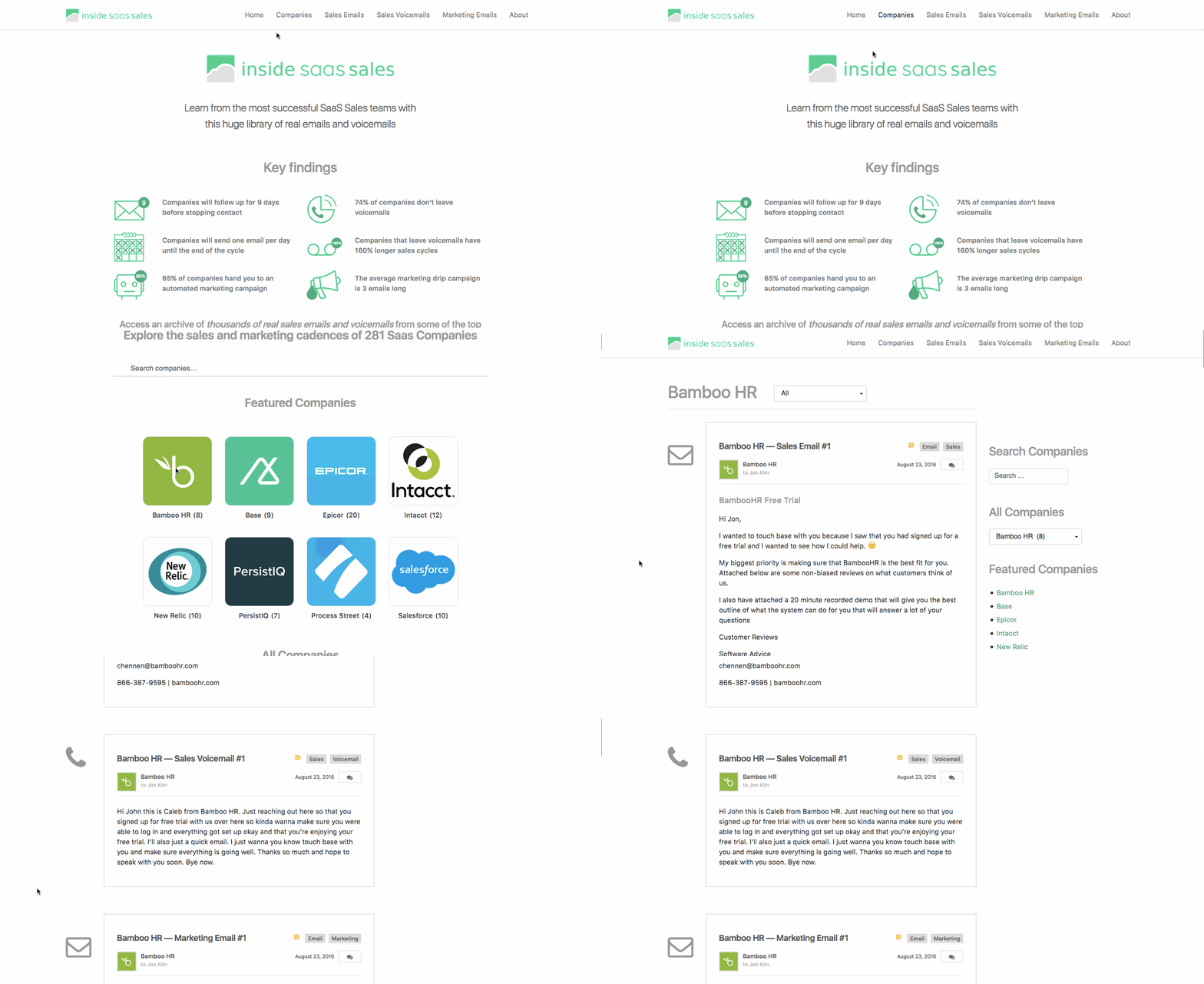
On August 25th, we launched a library of 1000+ real sales and emails from the top 280 SaaS companies.

The library was hosted on a microsite, Inside SaaS Sales, which allows users to browse the full sales cadences, organized in the order the message or voicemail was sent.

The launch landed us almost 800 votes on Product Hunt, 10,000+ site visits, a mention in Hiten Shah‘s SaaS Weekly, and publicity from the SaaS and VC community.

Continue Reading

How to Build an MVP App Without Writing Code

mvp app how to build an mvp app without writing codeWhen you have a great idea for a startup or a service the first thing you desire to do is create it, talk about it, and see what people think.


In creating a minimum viable product, entrepreneurs choose between experiments that can validate or invalidate their assumptions about a business model. – N. Taylor Thompson

These experiments could be anything from interviews with potential customers, trying to build a client base on the promise of a future product, or building a basic version of your idea and testing it in the market.

That last one is what we’re going to focus on. How can you create software to make a product a reality?

For some people, this means sitting down and writing code. Line after line slowly pieces together the idea and shapes details until a version which works exists.

This is how we make software. It’s how we’ve always made software.

However, you wouldn’t think you needed years of coding experience to create a blog. You could just start a Medium account or a Tumblr, or whichever platform is trendy right now.

Because you’re not the only person who wanted to build a blog, other people with greater technical skill developed tools to help you build blogs without needing to code.

This makes it easier and faster for everyone. But it’s not just blogs which you can build without coding.

In this article, we’ll look at a number of different tools you can use to build a whole range of products by pointing and clicking and dragging and dropping.

If you want to make your product a reality, rapidly building a first working iteration is a very useful option to get started!

Continue Reading

The Art of SaaS Review: What SaaS Is and How to Do It Right

Art of SaaS review - header

The Art of SaaS shows that even industry veterans are sick of unnecessary jargon and bloated descriptions.

Rather than spending thousands of words (or multiple books) trying to explain every variation of the SaaS model, it draws from the experiences of Dr. Ahmed Bouzid and Dave Rennyson in order to cover all of the basics of a quality SaaS business in less than 60 pages.

art of saas review - book cover

Being so short, an Art of SaaS review might seem redundant at first. Why not just read the book in about an hour and learn what the authors believe to be:

  • What SaaS is
  • The bargain between vendor and user
  • The importance of uptime (and how to maintain it)
  • The three priorities all teams should share
  • The three practices which achieve those priorities
  • The structure of every team, and how they should be managed

Well, in this post I’m going to cover both the core takeaways of The Art of SaaS and the context surrounding the book itself by drawing from other figures in the field.

I’ll show you why this odd little volume is worth reading and what pitfalls to avoid when taking it at face value.

Let’s get started.

Continue Reading

Take control of your workflows today